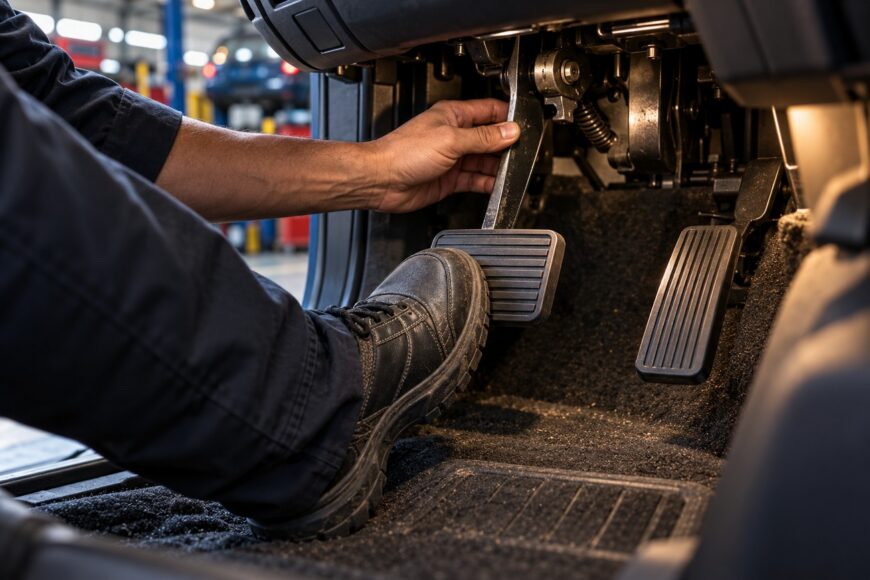
A brake pedal that suddenly feels soft, travels farther than usual, or becomes firm only after you pump it deserves prompt attention. The change may indicate air in the hydraulic system, falling fluid pressure, an external leak, an internal master-cylinder leak, hose flex, or fluid affected by heat. If the pedal becomes softer after repeated hard braking, overheating and brake fade also belong in the diagnosis.
A car can still stop while carrying a serious brake-system fault. The vacuum booster is often blamed for every unusual pedal, yet a classic sinking or spongy pedal more commonly points to a hydraulic problem; a booster fault more often produces a hard pedal and increased effort. The safest approach is to identify the mechanism first, then repair it, rather than assuming that bleeding, new pads, or a quick pedal pump will solve everything.
- What a Spongy Brake Pedal Feels Like—and Why It Matters
- The Most Likely Causes of a Soft or Sinking Pedal
- How to Diagnose the Problem Before Replacing Parts
- Spongy Pedal Symptoms: What Each Pattern Usually Suggests
- How to Fix a Spongy Brake Pedal Safely
- Brake Pressure, ABS, and the Vacuum Booster: Avoiding Misdiagnosis
- Common Mistakes, Hidden Faults, and Post-Repair Checks
- When to Stop Driving and What Repair Cost Depends On
- Frequently asked questions
- How much does it cost to fix a spongy brake pedal?
- Why is my brake pedal spongy even though there are no leaks?
- How do I get rid of a spongy brake pedal?
What a Spongy Brake Pedal Feels Like—and Why It Matters
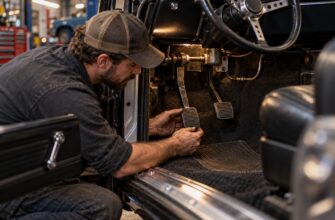
A spongy pedal feels elastic or “full of air” under your foot. It may move farther than it used to before the brakes begin to bite, and it may continue moving as you apply steady pressure. Some drivers describe this as a “mushy” or soft pedal, while others notice that braking begins only near the end of the pedal travel.
A long-travel pedal is related, but the terms do not describe exactly the same sensation. Excessive pad clearance, air, a leak, hose expansion, or internal seal bypass can increase the distance between the released pedal and effective braking. If pumping the pedal makes it temporarily firmer, the system may be moving excess hydraulic volume, compressing trapped air, or compensating briefly for an internal pressure-loss problem.
A sinking pedal behaves differently from a pedal that is merely low. If you hold firm pressure and the pedal gradually moves toward the floor, internal master-cylinder leakage or another hydraulic pressure loss becomes more concerning. A pedal that pulses or vibrates with wheel rotation usually suggests a different fault, such as a disc, hub, ABS, or related wheel-speed problem, even though several faults can exist together.
Stop driving and arrange professional assistance if the stopping distance has increased, the pedal reaches the floor, the pedal travel is worsening rapidly, the fluid level is falling, or a brake-system warning lamp remains on. Visible fluid, severe vibration, or squealing accompanied by changed braking also requires attention. A vehicle that still stops is not automatically safe to drive because braking performance can deteriorate further without much warning.
The Most Likely Causes of a Soft or Sinking Pedal
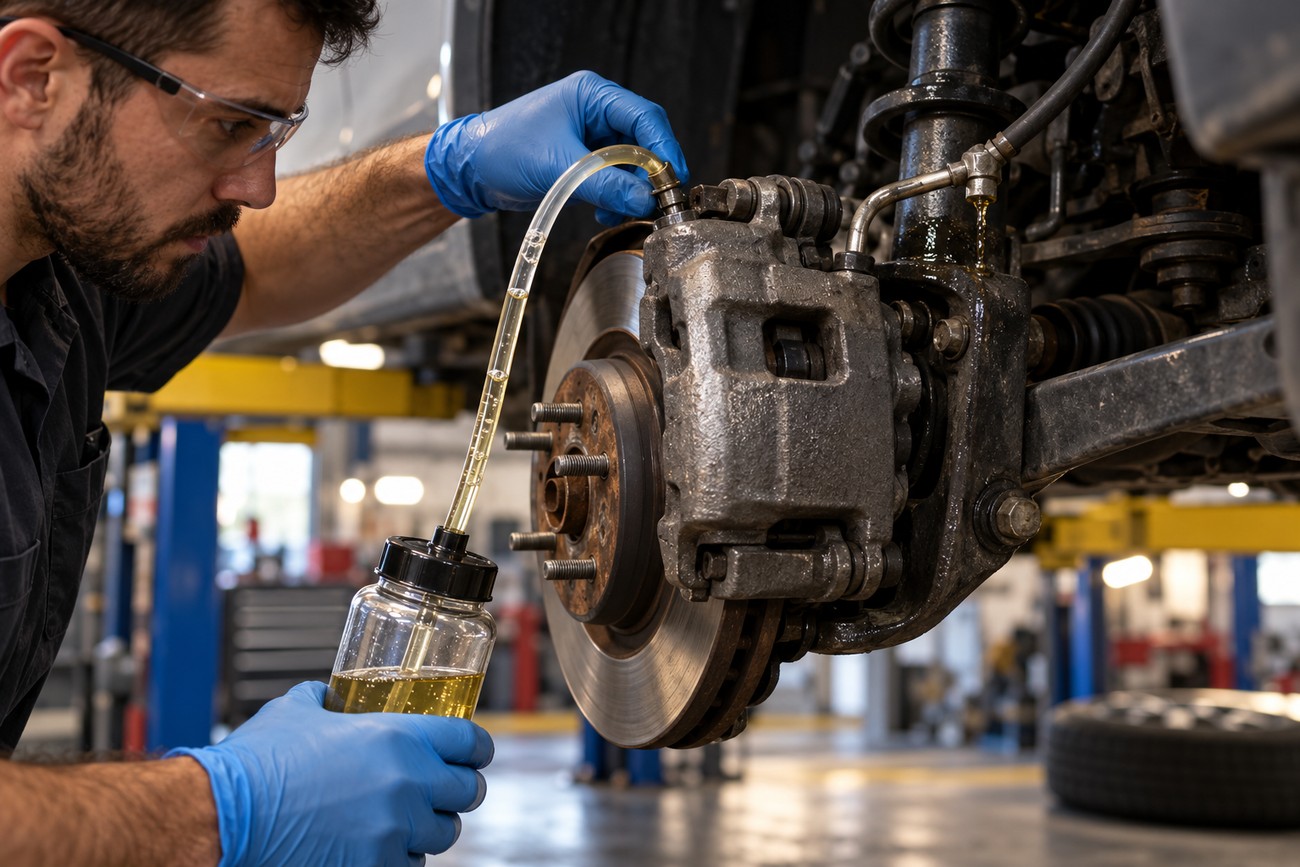
Air in the hydraulic system is one of the most familiar causes. Unlike brake fluid, air compresses, so part of your pedal movement is spent compressing bubbles instead of transferring force to the calipers or wheel cylinders. Air can enter after a line, caliper, hose, master cylinder, or ABS component has been opened, and it can remain trapped if the required bleeding procedure is not followed.
External fluid loss is another direct route to a soft pedal. Inspect the reservoir, hard lines, flexible hoses, fittings, calipers, wheel cylinders, and the area around the master cylinder. A small leak may lower the fluid level gradually and introduce air before it creates an obvious puddle, while a larger leak can cause rapidly increasing pedal travel. The correct repair is to find and repair the source, then replace or restore the fluid and bleed the complete system.
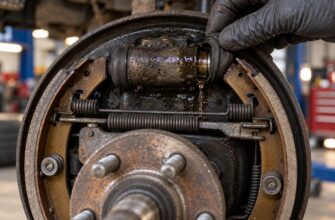
A master cylinder can also lose pressure internally. Worn seals may allow fluid to bypass inside the cylinder rather than pushing the pistons as intended. This fault can make the pedal sink during sustained pressure even when the engine bay, wheels, and ground look dry. A caliper or wheel-cylinder seal can create a similar hidden hydraulic problem, so a dry system does not prove that the master cylinder is the only possible cause.
Flexible hoses deserve a careful inspection. Age, internal deterioration, and microcracks can allow a hose to expand under pressure or flex more than designed. The hose may not be visibly split, yet that movement absorbs pedal travel and reduces firmness. A braided or reinforced hose may improve response when ordinary hose flex is confirmed, but it cannot cure trapped air, fluid loss, a worn master cylinder, or an ABS fault.
Brake-pad wear alone does not necessarily create a classic spongy pedal. It more often contributes to longer travel or a wear indication, depending on the vehicle’s design. If softness appears after repeated intense braking, consider overheated or boiling fluid, which can soften the pedal, and brake fade, which can reduce braking performance, as well as air. ABS hydraulic components can add another layer, especially after work on the modulator or when a warning fault is present.
How to Diagnose the Problem Before Replacing Parts
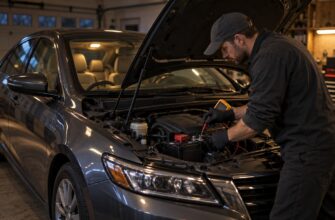
Begin with the reservoir. Check the fluid level against the marked range and look for a dark, contaminated, or otherwise degraded appearance, while following the vehicle manufacturer’s fluid specification. A low level may reflect worn pads, a leak, or both, so topping up without identifying the reason for the change is not a complete diagnosis.
Next, inspect the hydraulic path. Look for wetness or staining around lines, unions, hoses, calipers, wheel cylinders, the master cylinder, and ABS hydraulic connections. Examine flexible hoses for swelling, cracking, rubbing, or movement while the brake is applied under controlled workshop conditions. Do not rely only on the parts that are easiest to see; brake pads and discs can appear normal while a hidden hydraulic fault changes the pedal.
A sustained-pressure pedal test is useful before condemning the booster: a pedal that keeps sinking directs attention toward hydraulic pressure loss. A system that looks dry can still have an internal master-cylinder leak because the fluid may bypass the seal inside the cylinder.
With the vehicle secured and the correct procedure for the model in mind, technicians compare pedal behavior with the engine off and running. A booster test commonly helps separate assistance from hydraulic feel, while repeated pumping shows whether the pedal temporarily firms up. These observations narrow the diagnosis; they do not identify one failed part by themselves.
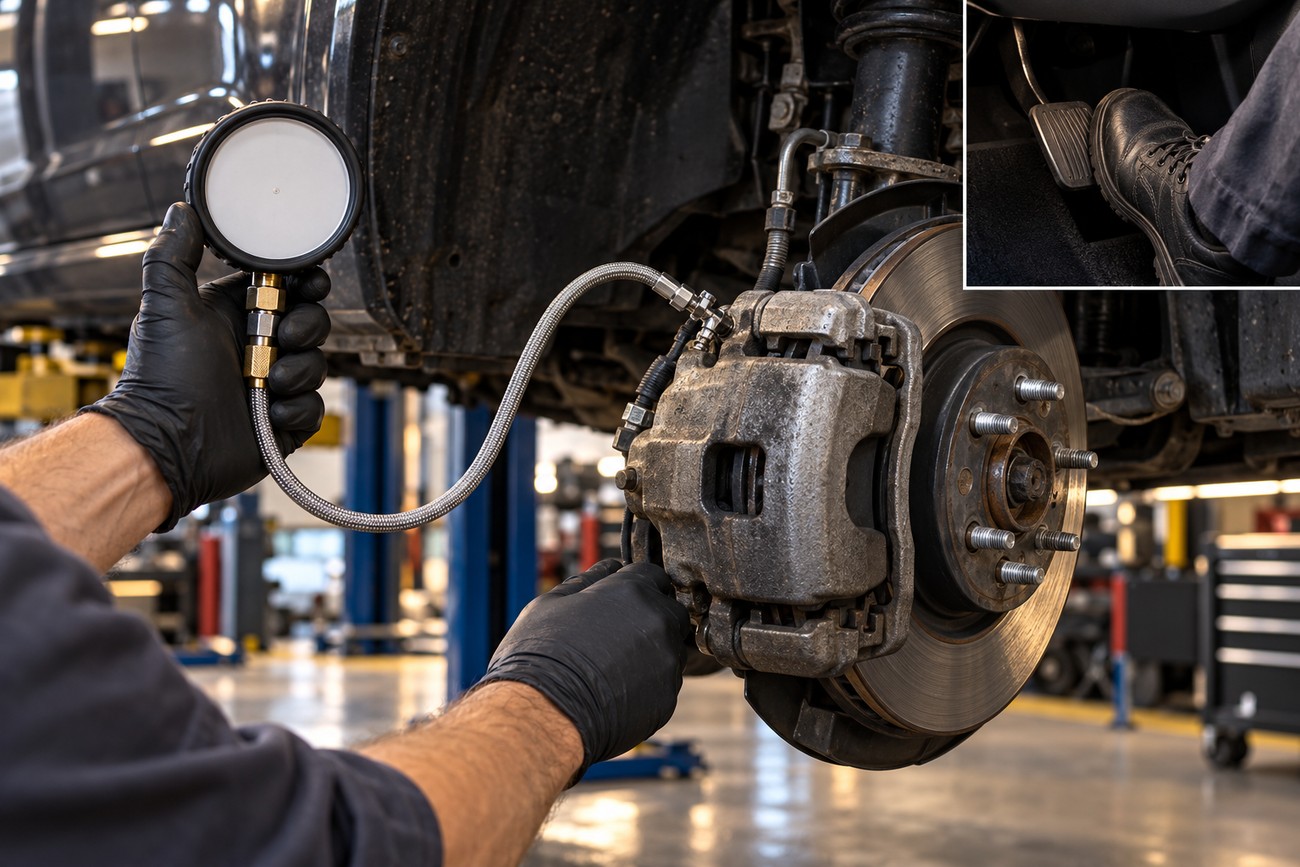
Professional pressure testing can distinguish trapped air, a restriction, hose flex, caliper faults, and master-cylinder problems. In a properly functioning hydraulic system, pressure at different points is nearly the same, so a soft pedal is generally not caused by one wheel having inherently weak pressure. A pressure reading must be interpreted against the vehicle’s design and test procedure rather than treated as a universal pass/fail number.
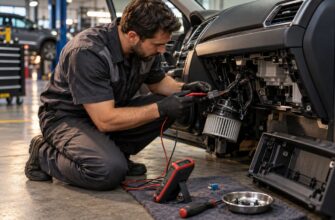
If the ABS warning lamp is on, inspect the complete ABS circuit, including sensors, wiring, hydraulic components, and tone or reluctor rings. Corrosion or damage to a ring can produce a wheel-speed signal fault, while a wiring or sensor problem may coexist with a separate hydraulic issue. Replacing a sensor without checking the surrounding circuit can leave the original problem unresolved.
Spongy Pedal Symptoms: What Each Pattern Usually Suggests
These patterns help prioritize inspection, but none proves a failed part on its own.
| Pedal pattern | What it may suggest | Useful next check |
|---|---|---|
| Pedal becomes firmer after pumping | Air, excess hydraulic travel, hose flex, or a seal-related pressure problem | Check fluid level, leaks, hose condition, and perform a complete hydraulic diagnosis |
| Pedal slowly sinks under steady pressure | Internal master-cylinder leakage or another hydraulic pressure loss | Hold-pressure testing and inspection of the master cylinder and hydraulic circuit |
| Softness appears after repeated hard braking | Overheated or boiling fluid and brake fade; air may also be present | Assess fluid condition, heat damage, and the complete braking system |
| Pedal is hard rather than soft | Possible loss of vacuum or other power assistance | Test the booster, vacuum supply, check valve, and related controls |
| Pedal pulses or the vehicle vibrates | Possible disc, hub, ABS, or related wheel-speed problem | Inspect rotating components and scan or test the ABS system |
| Brake or ABS warning lamp is on | A control, sensor, hydraulic, fluid-level, or parking-brake-related fault | Read fault information and inspect the complete affected system |
Symptom patterns narrow the diagnosis, but they do not replace inspection. Several faults can produce similar pedal movement, and one vehicle can have both a hydraulic problem and an ABS or mechanical problem.
How to Fix a Spongy Brake Pedal Safely
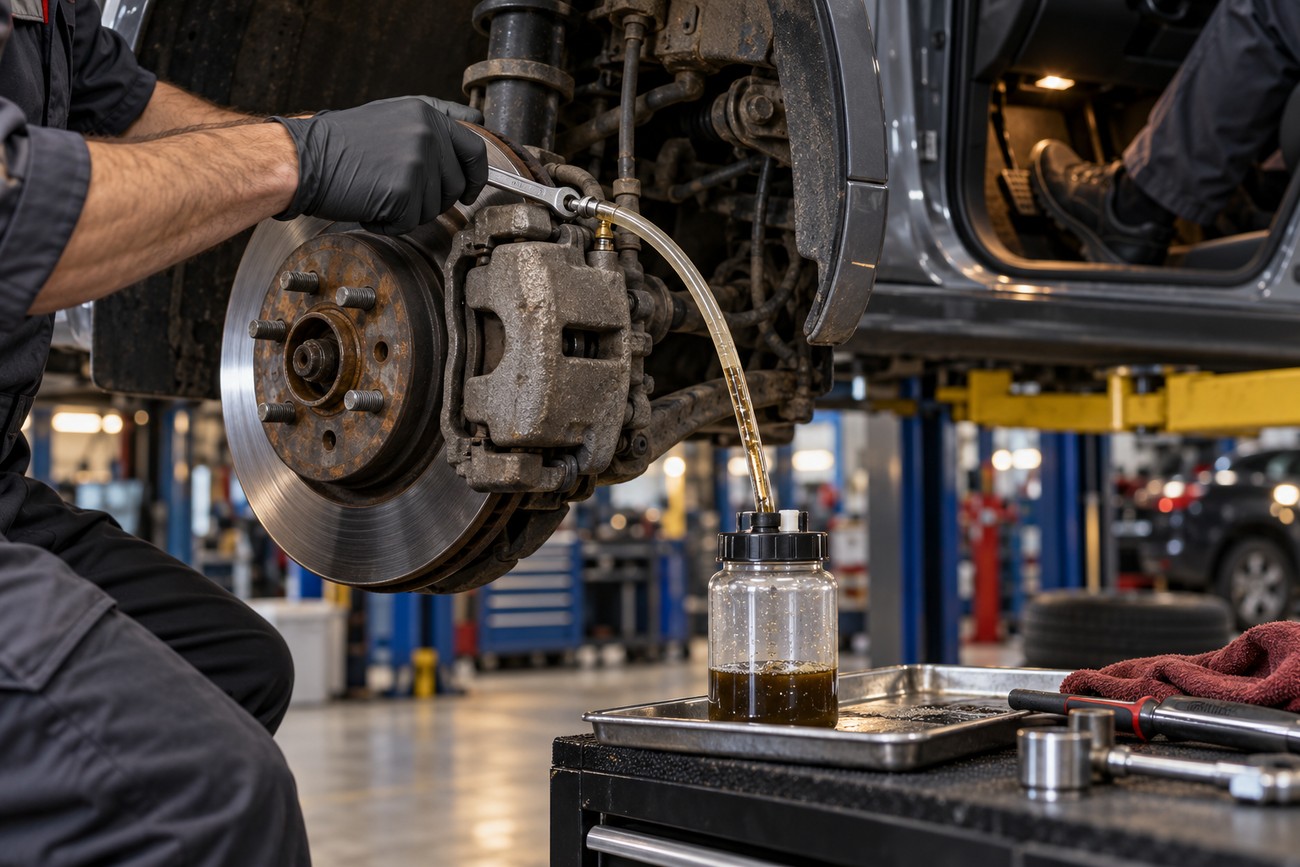
If trapped air is confirmed and the hydraulic system is sound, bleeding removes the compressible air and restores the intended fluid column. The procedure must follow the vehicle’s service instructions, including the correct sequence and any requirements for cycling an ABS modulator. A partial bleed at one visible component may leave air elsewhere in the system.
A leak must be repaired at its source before bleeding. Depending on the finding, this may involve a line, fitting, flexible hose, caliper, wheel cylinder, master cylinder, or ABS hydraulic component. After the repair, the system needs the specified brake fluid, proper fluid replacement where required, and a complete bleed followed by a check for renewed loss.
A defective hose or caliper should be replaced when testing confirms that it is causing pressure loss or excessive movement. New pads or discs cannot compensate for air, a leaking seal, or a failing hose. Similarly, braided hoses may alter response when hose expansion is the actual cause, but they are not a general cure for a soft pedal.
Confirmed internal leakage in the master cylinder normally requires replacement or an approved repair according to the vehicle’s service information. If air or a fault is present in an ABS modulator, ordinary wheel bleeding may be insufficient; the manufacturer’s scan-tool or hydraulic service procedure may be needed. The repair is complete only when pedal firmness is restored, fluid loss has stopped, and brake or ABS warnings have been addressed.
A quick pump before every stop is not a repair. Do not mix incompatible fluids, use an unspecified fluid, or treat a warning lamp as cosmetic. Brake work affects a safety-critical hydraulic system, so use clean equipment, protect painted surfaces from fluid, support the vehicle correctly, and follow the exact procedure for the vehicle rather than a generic sequence.
Brake Pressure, ABS, and the Vacuum Booster: Avoiding Misdiagnosis
The pedal provides mechanical input, the master cylinder converts that input into hydraulic pressure, and the calipers or wheel cylinders convert pressure into clamping or shoe force. ABS then modulates pressure at individual wheels when the control system detects a locking tendency. A problem in one layer can change pedal feel, but the symptom must be matched to the mechanism.
In ordinary passenger-car hydraulic systems, pressure commonly rises rapidly to about 80–120 bar during pedal application. Some references cite peak pressures around 180 bar for modern systems and up to about 200 bar for sports or reinforced systems. These figures are context-dependent and are not universal home-test targets or normal service specifications for every vehicle.
Pressure at different points in a healthy hydraulic system is nearly the same. That is why a soft pedal is generally associated with compressible air, fluid loss, pressure loss, seal bypass, or component movement rather than one wheel simply producing “weak pressure.” Professional gauges and the vehicle’s test procedure are needed to compare circuits safely and interpret results.
A vacuum-booster fault more often produces a hard pedal or increased effort. It can make braking feel abnormal, but it does not usually explain a classic sinking or spongy pedal by itself. Testing the vacuum supply, check valve, booster, and pedal linkage is appropriate when the pedal is hard; a soft pedal still requires a hydraulic inspection.
An ABS sensor, wiring fault, or corroded tone or reluctor ring can trigger a warning and alter braking behavior. That does not automatically mean total loss of the base brakes, but it does require inspection of the wider ABS circuit and a careful assessment of how the vehicle now stops. Pneumatic or air-hydraulic systems use different diagnostic criteria: a reference of no more than 0.05 MPa pressure loss over 30 minutes with the brake released and over 15 minutes after full application must not be transferred to ordinary hydraulic passenger-car diagnosis.
Common Mistakes, Hidden Faults, and Post-Repair Checks
The most common repair mistake is treating the visible part as the failed part. New pads may be fitted because they are worn, while air remains in the system; a disc may be replaced even though the pedal problem comes from a master-cylinder seal. A repair can be appropriate and still fail to cure the symptom if the original hydraulic cause was never tested.
Bleeding can also appear unsuccessful when the sequence, equipment, or fluid-handling method is wrong. Air may remain in a high point, a caliper, or an ABS hydraulic unit. If the system was opened, use the prescribed procedure rather than assuming that fluid coming from one bleeder proves that the entire circuit is free of air.
Temporary improvement after pumping is another trap. Pumping can move pistons closer to their working positions or compress air for a short time, creating a firmer pedal without restoring reliable pressure control. A system can look dry while an internal master-cylinder or caliper seal fault continues to cause pressure loss.
Post-repair verification should cover the whole system. Check that the pedal remains stable under sustained pressure, does not sink, and has the expected travel. Confirm that the fluid level is stable, there is no fresh wetness, warning lamps are cleared for a valid reason, and the parking brake and other control devices work correctly.
Only after those checks should braking performance be confirmed in a controlled, safe location, with traffic and speed kept appropriate to the conditions. A complete inspection may include warning-system operation, parking-brake function, and control-device faults, not only whether the car stops. The pneumatic pressure-loss reference of no more than 0.05 MPa over 30 minutes with the brake released and over 15 minutes after full application belongs to pneumatic or air-hydraulic systems, not to a universal hydraulic-car test.
When to Stop Driving and What Repair Cost Depends On
Park the vehicle and arrange professional assistance if the pedal reaches the floor, the pedal travel is worsening rapidly, the fluid level has fallen significantly, or the stopping distance has increased. A persistent brake or ABS warning lamp combined with changed braking, visible leakage, or severe pulsation is also a strong reason to avoid driving it to a repair facility. Towing or another suitable transport method may be safer than testing the vehicle on public roads.
There is no honest universal price for a spongy pedal because the repair can range from diagnosis and bleeding to replacement of a hose, caliper, wheel cylinder, master cylinder, or ABS component. Labor and fluid requirements differ, and ABS service may require additional testing or a model-specific procedure. A low-cost estimate based only on bleeding is incomplete if the system has a leak or internal pressure loss.
A useful estimate should identify the diagnostic work, the failed component, fluid replacement, bleeding, and final verification separately. Ask which finding supports the proposed repair and whether the warning lamps and pedal behavior will be rechecked afterward. This makes it easier to distinguish a confirmed repair from a parts-swapping approach.
Frequently asked questions
How much does it cost to fix a spongy brake pedal?
No single price is reliable because the cause determines both parts and labor. Bleeding may be the main service when air entered during an otherwise sound repair, while a leaking hose, caliper, wheel cylinder, master cylinder, or ABS unit requires different parts and procedures.
Request an estimate that separates diagnosis, failed parts, brake-fluid work, bleeding, and final testing. That breakdown helps reveal whether the shop has identified a cause or is proposing a general replacement based only on the pedal symptom.
Why is my brake pedal spongy even though there are no leaks?
No visible leak does not exclude internal master-cylinder bypass, a caliper or wheel-cylinder seal problem, air trapped in an ABS modulator, or flexible hoses that expand under pressure. Fluid can also lose performance after contamination, overheating, or prolonged service, especially if softness appears after repeated hard braking.
A sustained-pressure test, hose inspection, fluid assessment, and model-specific ABS procedure can separate these causes. The reservoir and ground may remain dry while hydraulic pressure is still being lost internally.
How do I get rid of a spongy brake pedal?
First identify whether the pedal is soft because of air, a leak, hose movement, internal seal bypass, heat-related fluid problems, or an ABS hydraulic fault. Repair the confirmed cause, use the specified fluid, and complete the required bleeding procedure rather than pumping the pedal as a workaround.
Afterward, verify stable pedal travel, no sinking under sustained pressure, no fluid loss, and no unresolved brake or ABS warning. If the pedal reaches the floor or stopping performance has changed, do not drive the vehicle for further testing.