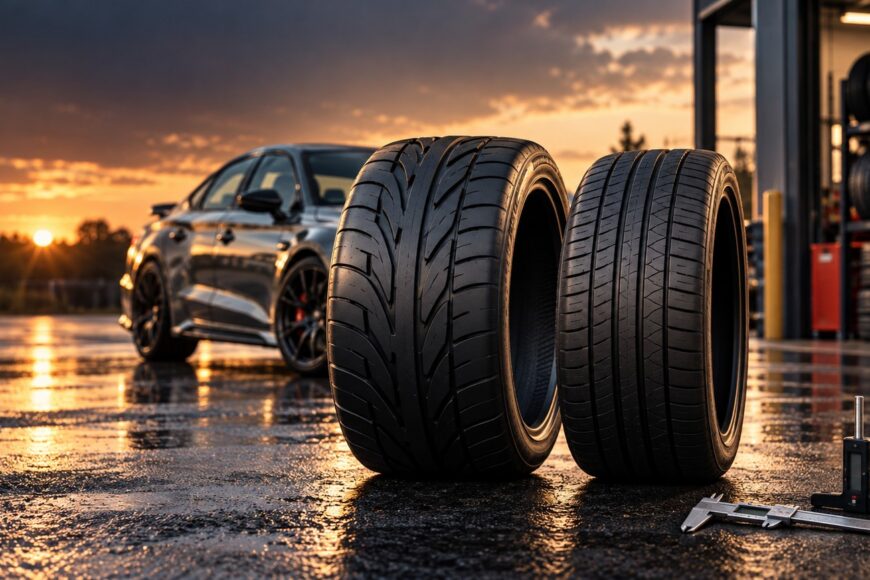
Hankook Ventus and Kumho Ecsta are families, not single tires. A brand-level verdict can therefore mislead you on grip, comfort, tread life, noise, and warranty value. A Ventus evo, S1 evo3, Ecsta PS71, V730, Sport, or 4XII may suit a different job even when the names appear in the same budget-performance comparison.
The real choice is usually between sharper steering and stronger everyday compromises in wear, ride comfort, wet confidence, or warm-up behavior. Model, tire size, load index, speed rating, vehicle setup, climate, and driving style can overturn the apparent winner. The useful comparison starts with the complete tire specification, then checks whether the result fits your car and roads.
- Ventus and Ecsta Are Families, Not Direct Rivals
- Model-by-Model Comparison: What the Names Actually Tell You
- Dry Grip, Wet Safety, Cold Response, and Ride Comfort
- Treadwear, UTQG, and Warranty Reality
- The Fitment and Ownership Traps That Change the Verdict
- Which One Should You Buy for Your Driving?
- Frequently asked questions
- What is better than Hankook tires for a daily driver?
- How should I compare two tires when their UTQG ratings are far apart?
- Which tire is better, Kumho Ecsta PS31 or Hankook Ventus Prime 4?
- What’s better than Hankook Tires?
Ventus and Ecsta Are Families, Not Direct Rivals
Hankook Ventus and Kumho Ecsta are tire families rather than single models. Relevant examples include Ventus evo or S1 evo3 versus Ecsta PS71, V730, Sport, or 4XII. These products can differ in tread pattern, rubber compound, intended use, construction, and available sizes.
A valid comparison therefore needs the exact model and specification. Check the complete size, load index, speed rating, XL construction, seasonality, and any vehicle approval before comparing test results or owner comments. A wide, extra-load summer tire may feel and perform very differently from a narrower standard-load version carrying the same family name.
UTQG ratings also vary within a family. Official Hankook Ventus evo treadwear figures can range from 220 to 340; traction is A–AA, and temperature is A in the cited range. Those figures describe specific size and specification combinations, so one Ventus evo listing cannot represent every Ventus tire.
The same caution applies to Ecsta. Kumho Ecsta 4XII is cited with treadwear 420, traction AA, and temperature A in certain sizes, not every Ecsta tire. Treating that rating as a family-wide promise is as misleading as transferring the behavior of a track-focused model to a daily road tire.
Model-by-Model Comparison: What the Names Actually Tell You
The table is a screening tool for identifying the right comparison. It does not establish a universal ranking, because the final result depends on the exact size, vehicle, road conditions, and evidence available for that specification.
| Model or family example | Intended role to verify | Likely performance priority | Reported or possible trade-off | Specifications to check |
|---|---|---|---|---|
| Hankook Ventus evo | Road-oriented performance tire; exact application varies by version and size | Steering response, dry grip, and balanced wet performance | Some owners report faster wear; other owners rate Hankook highly for grip | Exact size, UTQG, XL construction, load index, speed rating, and warranty eligibility |
| Hankook Ventus S1 evo3 | Performance-focused road use | Grip, response, and high-speed stability within the approved fitment | Owner feedback is divided, so test conditions and wear state matter | Size, load and speed ratings, vehicle approval, production date, and pressure requirements |
| Kumho Ecsta PS71 | Performance-oriented road use | Dry and wet response after the tire reaches its operating range | Some users describe it as ordinary in city driving and cold before warm-up | Exact size, compound specification, XL status, load index, speed rating, and seasonal suitability |
| Kumho Ecsta V730 | More specialized performance use; confirm road legality and intended application | Response and grip priorities appropriate to the specific use | Comfort, wear, and cold behavior may not match a daily touring-oriented tire | Approved use, size, load capacity, speed rating, and operating conditions |
| Kumho Ecsta Sport | Sport-oriented road use | Steering feel, grip, and usable road manners | Some owners report it as quieter or gripper than a comparable Hankook, but this is not a universal result | Exact model designation, size, construction, vehicle setup, and independent test evidence |
| Kumho Ecsta 4XII | Road performance with a stated mileage-warranty position in qualifying applications | Longer-wear potential alongside wet and dry road performance | Higher treadwear does not automatically mean stronger sports grip or identical behavior across sizes | UTQG for the exact size, warranty conditions, exclusions, load index, and speed rating |
Professional tests and owner reports can point in different directions because they measure different things. A controlled test may compare braking or handling at a particular temperature and tread depth, while an owner may care more about noise, commuting behavior, cold response, or wear after many months. Both perspectives can be useful when their size and vehicle conditions are comparable.
Size differences are especially important. Width, diameter, XL construction, and load can change steering effort, ride quality, hydroplaning behavior, and braking results. A test using one specification should not be treated as direct evidence for a different size fitted to a heavier or lighter vehicle.
Family names can also hide a change in priorities. A driver seeking precise steering may prefer a performance-focused model, while a daily commuter may value predictable rain behavior, lower noise, and acceptable wear. Compare the model’s purpose before comparing its badge.
Dry Grip, Wet Safety, Cold Response, and Ride Comfort

Dry grip is usually the easiest quality to notice. A performance tire may give quicker turn-in and a clearer steering response, particularly with a firm sidewall. That response can make a car feel more controlled on smooth roads, although it does not guarantee shorter braking distances in every temperature or surface condition.
Wet behavior needs a broader check than a single braking result. Hydroplaning resistance, wet braking, lane-change stability, and consistency as the tread wears all matter. Some Kumho Ecsta HS52 owners report weak hydroplaning resistance and inconsistent wet behavior; those are user reports, not a universal finding for every Ecsta model or size.
Cold response can change the character of a performance tire during ordinary trips. Some PS71 users describe the tire as mediocre in city driving and cold until it warms up. That complaint matters to drivers whose journeys are short, whose climate is cool, or who expect immediate response before the tire reaches a more favorable operating range.
A stiff sidewall can improve steering accuracy while making broken pavement feel harsher, especially on a light vehicle or a wheel with limited sidewall height.
Ride comfort and noise are often where owner impressions diverge most sharply. Some drivers report Kumho Ecsta Sport as quieter or gripper than a comparable Hankook, while other owners favor Hankook grip. These impressions can change with wheel width, suspension tuning, tire pressure, cabin insulation, and the road surface used most often.
Hankook feedback is similarly mixed. Some Ventus owners report faster wear, while others value the grip and response. If a tire appears to lose performance quickly, inspect pressure, alignment, rotation history, and inside-edge wear before assigning the entire result to the compound.
Treadwear, UTQG, and Warranty Reality
UTQG treadwear is a comparative rating, not a direct prediction or guarantee of mileage. Official Hankook Ventus evo treadwear figures can range from 220 to 340, with traction A–AA and temperature A depending on size. A figure from one listing should not be used as a universal specification for the family.
Kumho Ecsta 4XII is cited at treadwear 420, traction AA, and temperature A in certain sizes. The higher treadwear number may suggest a different durability target, but it does not mean the tire will last a fixed number of miles or deliver twice the service life of a tire with a lower number.
Actual wear depends on vehicle mass, alignment, camber, pressure, road surface, driving style, rotation, and climate. A tire driven on smooth highways with correct maintenance can produce a different result from the same tire used on rough urban roads or a vehicle with uneven geometry.
Hankook’s Ventus evo 30,000-mile mileage warranty applies only to qualifying sizes and conditions. Kumho states basic coverage up to 72 months, and a 40,000-mile warranty is stated for Ecsta 4XII, subject to exclusions and proportional compensation. These programs are conditional coverage, not a promise that every owner will receive a free replacement at the stated mileage.
Proportional compensation generally means the benefit is reduced according to the remaining usable tread or other program terms. Registration, proof of purchase, maintenance records, even wear, and the qualifying size may matter. Read the current warranty document for the exact tire rather than relying on a retailer headline.
The Fitment and Ownership Traps That Change the Verdict
Confirm the complete fitment before comparing prices. The cited Hankook 225/40ZR18 XL example has load index 92 and speed rating Y. The cited Kumho 275/40ZR20 XL example has load index 106 and speed rating W. These are not interchangeable evidence: they differ in width, diameter, load capacity, and speed rating.
Check the production date, XL designation, load index, speed rating, and approved fitment for your vehicle. A lower price may reflect an older production date, a different construction, or a specification that does not match the vehicle maker’s requirements. The cheapest listing is useful only after the tire’s identity is verified.
Cold pressures, alignment readings, tire age, and inside-edge wear should be checked before a tire is blamed for poor grip, noise, or short life.
Pressure and geometry can create symptoms that look like a tire defect. Incorrect pressure changes contact behavior and comfort, while toe or camber problems can remove tread unevenly. Rotation is also important where the vehicle and tire design permit it; without it, axle-specific wear can distort the comparison.
Kumho road-hazard coverage for eligible tires applies during the first 12 months and until the first 2/32 inch of tread wear. It is not lifetime protection. Sidewall cuts, incorrect inflation, and operating damage are commonly excluded, so the wording and eligibility requirements matter more than the existence of the benefit alone.
Ownership cost includes mounting, balancing, seasonal storage, and possible replacement after uneven wear. Those costs can outweigh a small purchase-price difference. A tire that fits the vehicle correctly and wears evenly may be the better financial choice even when its initial price is higher.
Which One Should You Buy for Your Driving?

Choose the exact Hankook or Kumho model according to the priority that matters most in your driving. Maximum steering feel points toward a performance-focused comparison; daily comfort favors attention to sidewall stiffness, noise, and ride quality; frequent rain makes hydroplaning resistance and wet consistency central; long ownership makes verified wear behavior and warranty conditions more important.
Sport-oriented evaluation should include cold grip, warm-up, hydroplaning resistance, and performance as the tire wears, not only dry braking. A higher UTQG treadwear figure can involve trade-offs in warm-up, feedback, or sports grip. The useful choice is the tire whose compromises match your roads and driving habits.
Vehicle setup can change the result substantially. Mass, suspension settings, alignment, camber, and wheel width affect how the same tire feels. A stiff tire that feels precise on one car may feel unsettled or harsh on another, while a tire that seems quiet on smooth pavement may reveal more noise on coarse asphalt.
There is no reliable brand-wide winner between Hankook Ventus and Kumho Ecsta. Verify the exact size, approved load and speed ratings, production date, warranty eligibility, and independent evidence for that specification before buying. Then compare the complete installed cost rather than the tire price alone.
Frequently asked questions
The answers below focus on exact model pairings and shopping decisions that a family-level brand verdict cannot resolve.
What is better than Hankook tires for a daily driver?
No single alternative is automatically better for every daily driver. Start with the priority: wet confidence, quiet ride, longer wear, or sharper steering. A touring-oriented tire may suit a commuter better than a performance-focused Ventus, while a driver who values response may accept more noise or a firmer ride.
Compare the exact size, load and speed ratings, wet-test evidence, owner reports from similar vehicles, warranty conditions, and expected maintenance. The right alternative is the one that matches your climate and use, not simply a different brand name.
How should I compare two tires when their UTQG ratings are far apart?
Do not treat different manufacturers’ treadwear numbers as a direct mileage ratio. UTQG treadwear is comparative and does not guarantee a fixed mileage total. Check whether the ratings apply to the same size, load, construction, and intended use.
Then look for independent tests, wear observations from comparable vehicles, warranty terms, and evidence about wet performance, cold response, noise, and behavior near the end of tread life. Pressure, alignment, rotation, and driving conditions can influence real wear as much as the printed rating.
Which tire is better, Kumho Ecsta PS31 or Hankook Ventus Prime 4?
There is no reliable universal answer from the model names alone. Compare the exact sizes and ratings, then decide whether your priority is daily comfort, wet confidence, steering response, or expected wear. The vehicle’s suspension, wheel width, and alignment can change the result enough to outweigh a general model reputation.
For a purchase decision, use evidence from the same size and a similar vehicle whenever possible. Confirm production date, load capacity, speed rating, and warranty terms before treating a test or owner review as applicable to your car.
What’s better than Hankook Tires?
The better choice depends on the specific Hankook model and the job required. A different tire may offer stronger wet behavior, quieter commuting, longer expected wear, or more comfortable ride quality, while a performance tire may provide the steering response you prefer.
Compare complete specifications and installed ownership cost rather than switching brands by default. There is no brand-wide replacement that is superior across every Ventus and Ecsta pairing, vehicle, climate, and driving style.