A floor jack can look suitable on a shelf and still fail at the car: its nose will not slide beneath the lift point, or its saddle reaches full height before the wheel clears the floor. Either problem becomes harder to solve once the vehicle is parked in a tight garage and the job has begun.
Start with the clearance at the vehicle’s approved lift point, the height needed to unload the wheel, and the load you intend to raise. Then consider how much room the jack needs to roll and pump. Whatever model you choose, the jack lifts the vehicle; appropriately rated stands support it during work underneath.
- The five floor jacks worth considering
- Five garage floor jacks: fit and trade-offs at a glance
- Check clearance and lifting height before you buy
- Choose capacity for the load you will actually lift
- The garage trade-offs specs do not show
- Lift safely—and know when to stop using a jack
- Frequently asked questions
- How much should I budget for a home-garage floor jack?
- What is the best floor jack for a home garage?
- How much are floor jacks for houses?
- How much does it cost to jack up a house to level it?
The five floor jacks worth considering
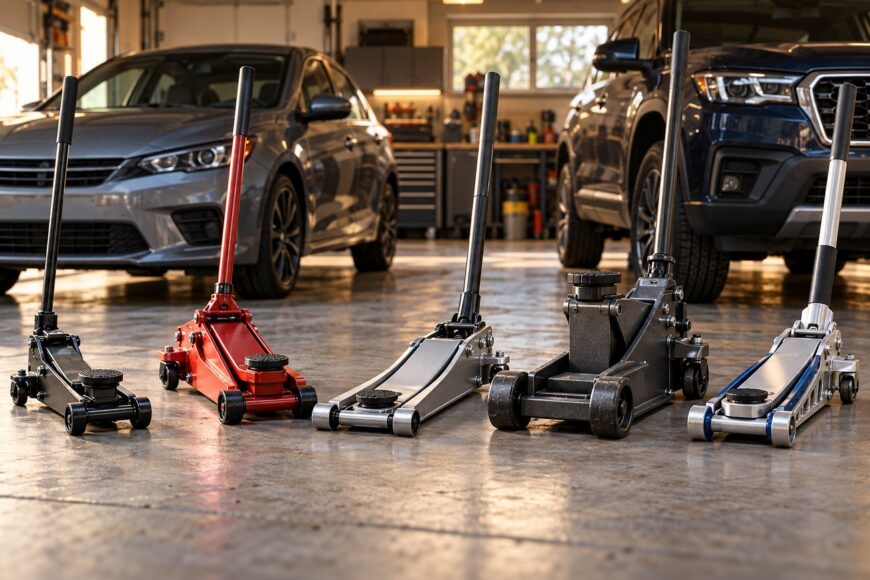
These five models cover different home-garage constraints, from a lighter-car budget to access beneath a low vehicle. Their names and usual market positions are useful starting points, but variants and specifications can change. Confirm the current capacity, saddle-height range, construction, and availability in manufacturer documentation before buying.
A compact car may be a sensible match for a 2-ton jack if the load at its lift point and the required height fall within the jack’s rating and range. Heavier SUVs and pickups commonly lead shoppers toward 3-ton or 3.5-ton models, though neither rating guarantees a match. Access matters just as much: low-profile jacks commonly start around 70–90 mm, yet the nose and chassis must also pass beneath the car.
Choose by the obstacle you need to solve rather than treating the entries as an overall ranking. A longer chassis may reach a recessed lift point while taking more space to maneuver; a lighter jack may be easier to move while costing more. Each pick has a practical reason to consider it and a limitation to check before ordering.
- Pro-Lift F-767 — a budget-oriented candidate for lighter cars and occasional wheel changes. Check its current rating and maximum saddle height against your vehicle; its compact appeal is little help if the wheel cannot be lifted clear.
- Pittsburgh 3-Ton Low-Profile — a value-focused option where you need a higher capacity class and lower entry than a typical standard jack. Check the exact version’s nose clearance and reach; a low saddle alone may not reach a lift point set far under the car.
- Daytona 3-Ton Low-Profile Long-Reach — worth considering when a low car’s approved lift point sits well inward. Its longer chassis is the trade-off: measure the space available beside the car to position it and operate the handle.
- Arcan ALJ3T — an aluminum option for a garage where moving and storing a jack matters. Confirm the current model’s construction and dimensions; lower weight does not establish lift-point fit, and aluminum designs generally cost more than comparable steel ones.
- Blackhawk B6350 — a candidate for heavier SUVs and pickups where a higher-capacity class is appropriate. Its size and weight may be awkward in a crowded garage, and you still need to check its maximum height against the vehicle’s suspension travel.
Five garage floor jacks: fit and trade-offs at a glance
Model names indicate the intended comparison, not verified specifications. Capacity and saddle heights are left unlisted where current manufacturer documentation has not been established; check those figures for the exact version sold to you.
| Model | Intended vehicle or constraint | Rated capacity | Minimum saddle height | Maximum saddle height | Handling or construction | Principal drawback |
|---|---|---|---|---|---|---|
| Pro-Lift F-767 | Lighter cars, budget-conscious occasional use | Verify current rating | Verify current specification | Verify current specification | Compact-style garage option; confirm current construction | May lack the lift range your car needs |
| Pittsburgh 3-Ton Low-Profile | Lower entry height at a value-focused price point | Verify current rating | Verify current specification | Verify current specification | Check the exact version’s size and weight | Low entry height does not ensure adequate reach |
| Daytona 3-Ton Low-Profile Long-Reach | Low cars with lift points farther inward | Verify current rating | Verify current specification | Verify current specification | Long-reach layout; check chassis dimensions | Needs room to position and operate |
| Arcan ALJ3T | Easier movement around the garage | Verify current rating | Verify current specification | Verify current specification | Aluminum design; confirm the current variant | Generally costs more than a comparable steel choice |
| Blackhawk B6350 | Heavier SUVs and pickups, subject to vehicle fit | Verify current rating | Verify current specification | Verify current specification | Check stored size and moving weight | Can be cumbersome in limited space |
Check clearance and lifting height before you buy
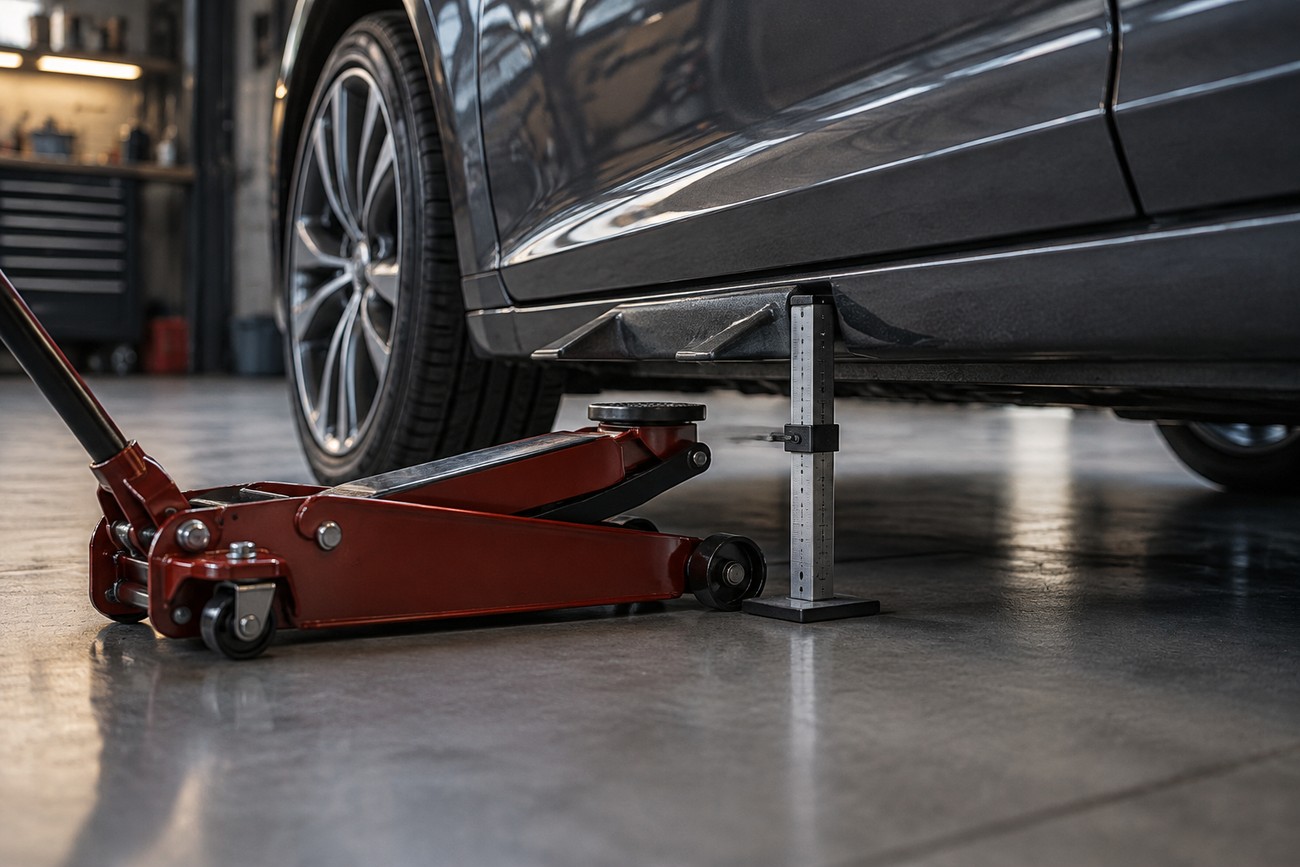
Measure from the floor to the vehicle’s approved lift point while it is parked on level ground. Compare that measurement with the jack’s minimum saddle height, allowing for any suitable lift-point adapter. A low-profile label does not guarantee access beneath every low car.
Follow the path the jack must take, too. The nose, frame, and saddle all move under the vehicle before the saddle reaches its target. Low-profile jacks commonly start around 70–90 mm, while standard models more often start around 120–150 mm; neither range describes every model’s nose geometry.
At the other end of travel, check whether the maximum saddle height will unload the suspension enough to remove the wheel. Many garage floor jacks reach approximately 350–500 mm, and some long-travel or high-lift designs go higher. A stated maximum can still be insufficient for a particular vehicle, tire, or lift point.
A low splitter can block access even when the saddle would fit farther underneath. Suitable approach ramps may create the clearance needed to roll the jack into position, provided their use follows the vehicle and equipment instructions. Check that plan before assuming a different low-profile jack will solve the problem.
Choose capacity for the load you will actually lift
Size the jack for the load at the intended axle or corner. Vehicle weight alone does not establish the load at a particular lift point, especially when one end carries more weight. Use the vehicle’s approved lifting locations and seek a practical capacity margin of about 25–50% where feasible.
A 2-ton jack may suit a compact car if the lift-point load and required height fit its rating and range. For heavier SUVs and pickups, 3-ton and 3.5-ton jacks are common starting points, not universal guarantees. If the vehicle’s loading or approved lifting procedure is unclear, consult its manual rather than guessing from its size.
Rated capacity also says little about how comfortable a jack is to use. Handle length, pump travel, saddle shape, and room around the vehicle affect the job even when the rating is adequate. The stands you plan to use must independently suit the intended load.
The garage trade-offs specs do not show
A longer handle can make pumping easier, but it needs an open arc beside the vehicle. Casters must roll into place on the garage floor; rough concrete or a cramped parking space can make a large jack harder to position than its product photo suggests. Measure the working space with the car parked as it normally is.
Saddle contact deserves similar attention. An approved lift point may need a suitable rubber or slotted adapter to protect its shape and help the saddle seat correctly. Use an adapter intended for that contact point, and account for its added height when checking clearance and lift range.
Aluminum jacks can weigh roughly 30–50% less than comparable steel designs and generally cost more; construction alone does not determine suitability. Fast-lift mechanisms can reduce pumping before the saddle meets the vehicle, but added cost or weight may bring little benefit for occasional work. Prioritize fit, controlled lowering, and a layout you can move safely.
Lift safely—and know when to stop using a jack
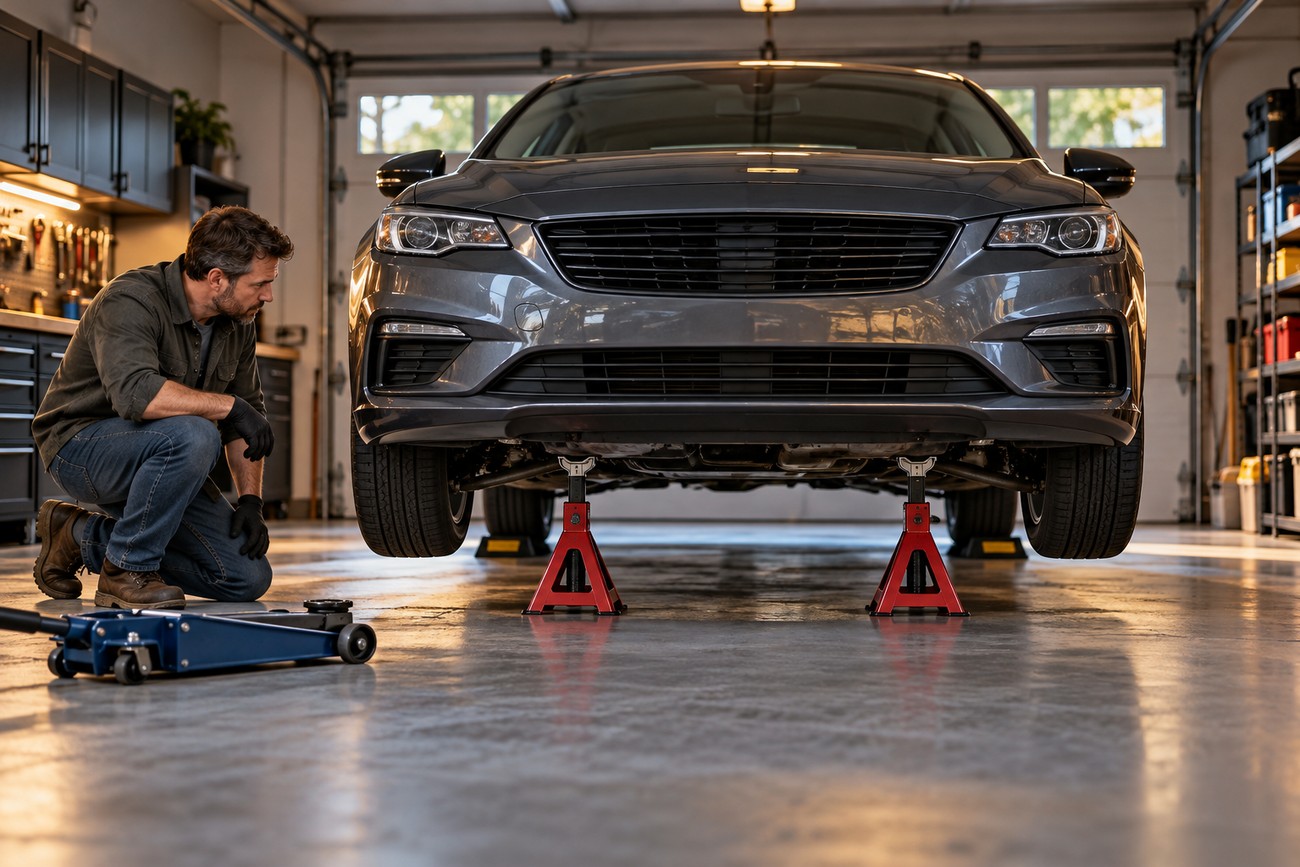
Park on firm, level ground, follow the vehicle manual’s lifting instructions, and chock the wheels that remain on the floor. Position the saddle at an approved lift point, then raise the vehicle only as needed. Keep clear of the underside while placing appropriately rated stands at the specified support points.
Lower the vehicle carefully onto the stands and check that it is stable before working underneath. A floor jack is for lifting, not supporting a vehicle while someone works beneath it. Both jack and stand capacities must suit the intended load; a capable jack does not compensate for undersized stands.
Soft ground, uneven surfaces, and damaged lift-point contact can make an otherwise suitable setup unsafe. Do not improvise a support surface or lift from a point the vehicle maker has not approved. If the jack or vehicle shifts unexpectedly, lower it when safe to do so and reassess the setup.
A jack that slowly sinks under load needs inspection and must not be treated as safe support. Follow its manual for troubleshooting and service, and remove a suspect jack from use until the fault is resolved. Hydraulic pressure is never a substitute for stands.
Frequently asked questions
For a home garage, the best purchase is the jack-and-stand setup that fits your vehicle and the space where you work. Costs and equipment types change substantially if the job involves lifting a house rather than a car.
How much should I budget for a home-garage floor jack?
Budget for a compatible jack and appropriately rated stands together, rather than spending the full amount on the jack. For occasional use, compare verified lift range, controlled lowering, and warranty terms before paying extra for lighter construction or fast lifting. Frequent use may make easier handling worth more to you.
What is the best floor jack for a home garage?
The best choice is the model whose verified capacity and saddle-height range suit your vehicle’s approved lift point and whose chassis fits your parking space. Among these picks, the Daytona is the long-reach candidate, the Arcan addresses handling weight, and the Blackhawk targets heavier vehicles. Choose only after checking the exact current specifications and your vehicle manual.
How much are floor jacks for houses?
Jacks used in house lifting are specialized structural equipment, so an automotive floor-jack price is not a useful guide. Equipment cost depends on the lifting method, loads, and supports required. Have a qualified structural professional assess the building before pricing or selecting equipment; a garage floor jack is not intended to lift a house.
How much does it cost to jack up a house to level it?
There is no reliable single cost without an assessment of the foundation and the cause and extent of movement. Access, temporary support, repairs, and local labor can all change the scope. Seek a structural assessment and itemized quotes rather than estimating the project from jack rental or purchase costs alone.