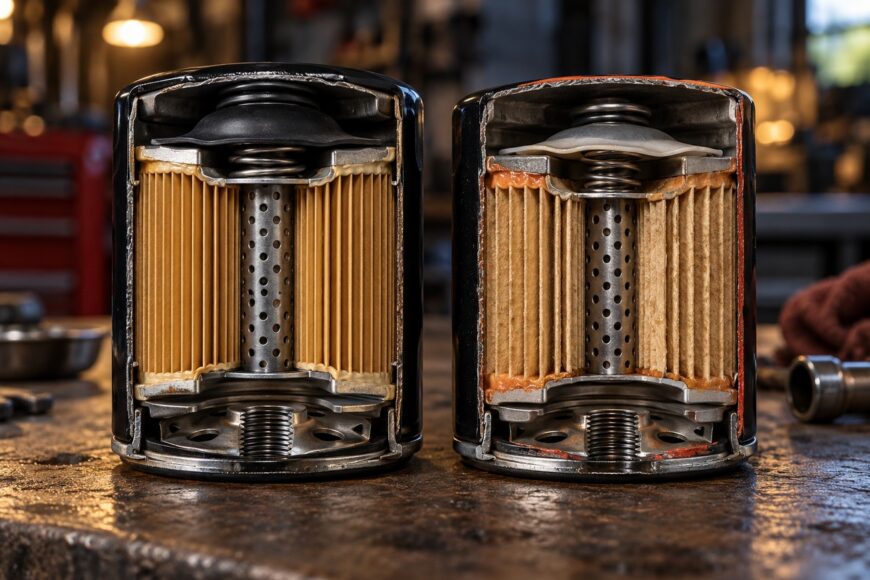
Cutting open a WIX or FRAM oil filter is visually persuasive: the pleats, center tube, end caps, spring, and valves are immediately visible. It can expose construction differences that a catalog photograph hides, including media type, adhesive coverage, and support details.
The limits are just as important. WIX and FRAM use multiple product lines, and the same brand can use different media, valves, bypass settings, and construction across part numbers. A teardown is meaningful only when the filters match in catalog application, engine requirements, market, purchase period, and test conditions. The useful comparison therefore starts with specifications, not with a simple brand winner.
- What a Cut-Open Comparison Can—and Cannot—Prove
- Published Specs: WIX 57356, WIX 51372, and FRAM FE10060
- Why 99% Efficiency and Micron Ratings Are Easy to Misread
- Bypass Valves, Anti-Drainback Valves, and Application Fit
- What to Look for Inside a WIX or FRAM Filter
- Common Mistakes That Make Filter Comparisons Unfair
- How to Cut Open an Oil Filter Without Ruining the Evidence
- Frequently asked questions
- What is the best tool for cutting open an oil filter without contaminating the media?
- Why can FRAM oil filters be difficult to find at times?
- What is the best way to cut open an oil filter?
- Why is everyone out of FRAM oil filters?
What a Cut-Open Comparison Can—and Cannot—Prove
A clean teardown can identify the filter media, approximate pleat construction, center-tube design, end caps, adhesive, spring, bypass mechanism, and anti-drainback valve. These details help explain how a particular filter was built and whether the assembly appears complete and mechanically sound.
Visible area and pleat count do not establish filtration efficiency, permeability, pressure drop, service life, or collapse resistance. A tightly packed element may contain more folds while offering less effective flow area, and a larger element may still depend on its adhesive, support tube, and media strength to remain stable.
Visual inspection also cannot reliably determine the actual bypass opening pressure. A valve may look substantial yet open outside the requirement for the intended engine. Controlled testing is needed to measure pressure behavior, particle removal, and durability.
Part number, market, production date, and revision matter. One teardown cannot support a universal conclusion about WIX, FRAM, a country of manufacture, or an entire production batch. It describes the filter that was opened.
Published Specs: WIX 57356, WIX 51372, and FRAM FE10060
These are part-number examples, not confirmed direct application equivalents. The figures should be read within each manufacturer’s published specification and not converted into a brand-wide ranking.
| Specification | WIX 57356 | WIX 51372 | FRAM FE10060 |
|---|---|---|---|
| Media | Enhanced-cellulose media | Not provided | Synthetic media |
| Nominal rating | 21 µm | 21 µm | Not provided |
| Beta ratio | Beta 2/20 = 6/20 | Beta 2/20 = 12/25 | Not provided |
| Flow | 34.1 L/min | 41.6 L/min | Not provided |
| Bypass opening pressure | 0.551 bar | 1.516 bar | 22 psi |
| Burst pressure | Not provided | Not provided | 400 psi |
| Anti-drainback valve | Not provided | Not provided | Silicone anti-drainback valve |
The two WIX examples show why the logo is an inadequate basis for comparison. Both list a nominal rating of 21 µm, yet their beta ratios, flow figures, and bypass opening pressures differ substantially. The FRAM data describes a different part number with synthetic media, a stated burst pressure, and a silicone anti-drainback valve.
These figures cannot establish that one brand is superior. The filters may serve different engines and have different design targets, so application fit must be confirmed before the construction or specifications are judged.
Why 99% Efficiency and Micron Ratings Are Easy to Misread

A nominal micron rating is not an absolute cutoff. A filter listed at 21 µm does not remove every particle larger than 21 µm, because the result depends on the test method, particle distribution, flow conditions, and the way the rating is defined.
Beta ratio provides more context than a single micron number because it relates the number of particles upstream to the number downstream at a stated particle size. The two WIX examples both list a nominal 21 µm rating, but WIX 57356 lists Beta 2/20 = 6/20, while WIX 51372 lists Beta 2/20 = 12/25. Those values do not describe identical filtration performance.
FRAM Ultra Synthetic claims 99%+ efficiency for particles greater than 20 µm under ISO 4548-12 manufacturer testing. That is a result tied to a specified particle size, test method, and test series. It is not an absolute cutoff and is not automatically comparable with a nominal rating or beta ratio from another filter.
FRAM Synthetic Endurance claims 99% efficiency and service life up to 25,000 miles under the manufacturer’s stated oil, vehicle, and maintenance conditions. The claim does not create an automatic replacement interval. The vehicle maintenance schedule, oil condition, operating environment, and engine requirements remain controlling factors.
Bypass Valves, Anti-Drainback Valves, and Application Fit
The bypass valve protects oil flow when restriction across the filter reaches the valve’s opening point. Whether that point is suitable depends on the engine and filter specification. A higher setting is not universally better, because delaying bypass too far can affect oil delivery under conditions the engine was designed to handle differently.
WIX 57356 lists a bypass opening pressure of 0.551 bar, while WIX 51372 lists 1.516 bar. FRAM FE10060 lists a 22 psi bypass. These values are not a direct performance ranking because the part numbers may serve different applications.
Two housings can look nearly identical while requiring different bypass settings. Catalog application and engine requirements should be verified before construction is judged.
A silicone anti-drainback valve helps retain oil after shutdown, which can reduce oil drain-back through the filter when the valve and mounting arrangement are suitable. It does not independently prove filtration efficiency or guarantee immediate oil pressure after every start.
Anti-drainback valve presence and material must be checked by exact part number and product line. A brand logo does not establish that every filter in the range uses silicone or even the same valve construction.
What to Look for Inside a WIX or FRAM Filter
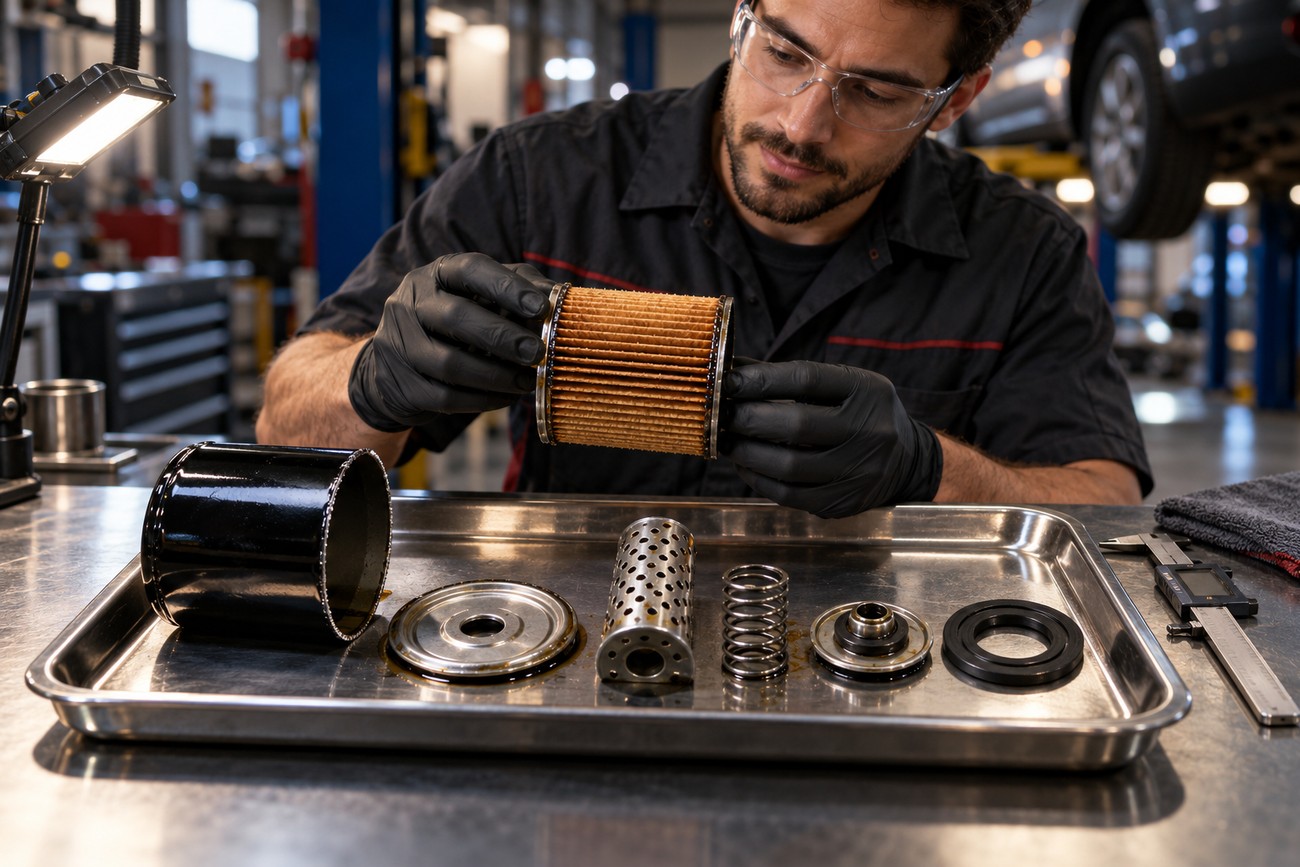
Begin with identification. Photograph the unopened filter, label, part number, country-of-manufacture marking if present, purchase date, and market. Record the application before cutting, because a visually similar filter from another catalog line may have different specifications.
Inside the housing, document pleat count, measured media area, media type, end-cap bonding, adhesive coverage, center-tube support, spring or leaf-spring arrangement, bypass mechanism, and anti-drainback material. Look for torn pleats, uneven spacing, detached end caps, adhesive gaps, distorted support tubes, and signs of collapse.
WIX product lines can include cellulose or enhanced-cellulose media. FRAM lines can include cellulose, blend, or full synthetic media. The media category helps describe construction, but it does not by itself establish efficiency, flow, or service life.
Where possible, weigh the filter media after separating it from the housing and measure its dimensions rather than estimating from photographs. Media area is only one factor; pleat geometry, adhesive, support, valves, pressure drop, and collapse resistance all influence how the filter performs.
Common Mistakes That Make Filter Comparisons Unfair
The largest error is comparing brands instead of applications. Match the engine, thread, gasket fit, catalog application, and required bypass pressure first. A filter that fits the mounting stud may still be unsuitable if its valve specification or internal design differs from the engine requirement.
A micron number is often treated as a hard particle cutoff, which it is not. Likewise, counting folds as a quality score ignores media permeability, effective area, adhesive strength, pressure drop, and resistance to collapse. More pleats alone do not prove a better filter.
FRAM Synthetic Endurance claims of up to 25,000 miles, where applicable to the stated product conditions, do not override the vehicle’s maintenance schedule or operating conditions. Extending an interval requires the correct oil, suitable use conditions, and compliance with the vehicle maker’s requirements.
Leaks after installation are not automatic evidence of failed filter media. An old gasket left on the mounting surface, a double gasket, incorrect lubrication, or overtightening can cause leakage. Check the mounting surface and installation procedure before blaming the filter element.
How to Cut Open an Oil Filter Without Ruining the Evidence
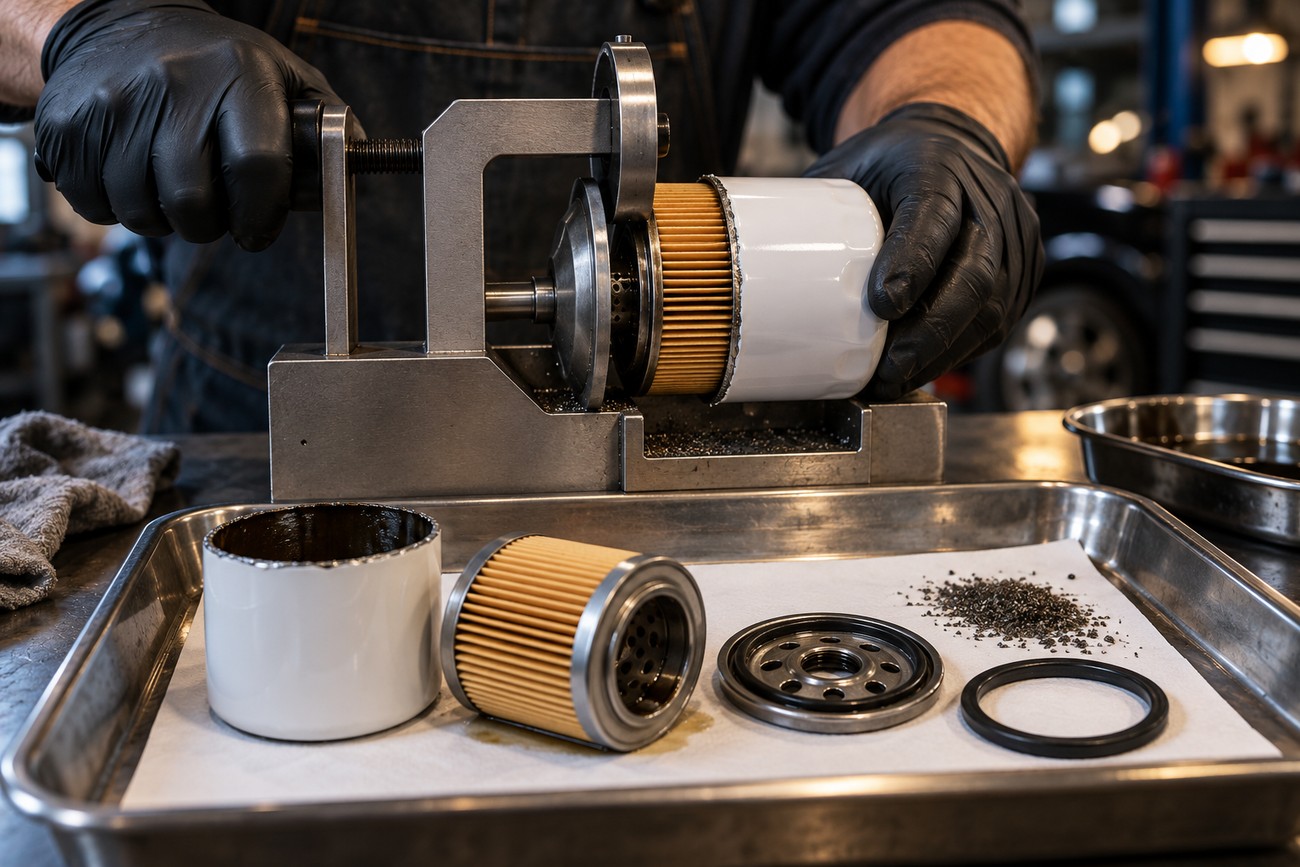
Identify and photograph the filter before opening it. Use a filter cutter or another controlled cutting method that separates the housing without grinding through the element. Keep the filter over a clean tray or sheet so loose debris can be distinguished from material already present inside the filter.
A grinder or abrasive tool can introduce metal particles into the media and housing. Those particles may then be mistaken for engine wear or filter contamination. Abrasive heat and fragments can also damage the pleats, making the inspection less representative.
After opening the housing, separate the media assembly from the shell before examining it. Photograph the bypass valve, anti-drainback valve, end caps, adhesive joints, center tube, and any visible distortion. Count the pleats and measure the element rather than relying on a visual impression.
For a repeatable comparison, use the same application class, market, and purchase period. Record the part numbers, measure media area, weigh the media where possible, and apply the same inspection method to every sample. This produces useful construction evidence without presenting a visual teardown as laboratory testing.
Frequently asked questions
What is the best tool for cutting open an oil filter without contaminating the media?
A dedicated oil-filter cutter is generally the cleanest choice because it removes the shell with limited metal debris and little heat. A fine-tooth manual cutting method can also work if the cut is controlled and the element is protected, but the opened filter should still be handled over a clean surface.
A grinder or abrasive wheel is a poor choice for evidence-quality inspection. It can scatter metal particles into the media, add heat, and create contamination that was not present in the filter. If abrasive cutting is unavoidable, the result should be treated as a limited visual inspection rather than clean contamination evidence.
Why can FRAM oil filters be difficult to find at times?
Temporary stock shortages, market differences, distribution changes, and changing supply for particular part numbers can make FRAM filters difficult to locate. Availability can vary by region and by exact catalog number, even when another FRAM line remains widely stocked.
Short-term availability does not establish filter quality. Check the exact part number, application, seller, manufacturing information, and return policy rather than substituting a different filter solely because its housing looks similar.
What is the best way to cut open an oil filter?
Record the part number and condition first, then use a filter cutter over a clean tray. Open the housing without contacting the media with abrasive debris, remove the element carefully, and photograph the valves, end caps, pleats, adhesive, and support tube before disturbing them.
For comparison work, measure the media and count the pleats using the same method for every sample. A clean, repeatable process is more valuable than a dramatic cut that damages the evidence.
Why is everyone out of FRAM oil filters?
“Out of stock” usually describes a temporary or local supply condition rather than a universal shortage. Retailers may have different inventory for different part numbers, and availability can change between markets and purchase periods.
Use the vehicle application and exact catalog number to guide a replacement search. Do not infer that a filter is better or worse because it is temporarily scarce, and do not substitute a visually similar part without checking thread, gasket fit, bypass requirement, and application.