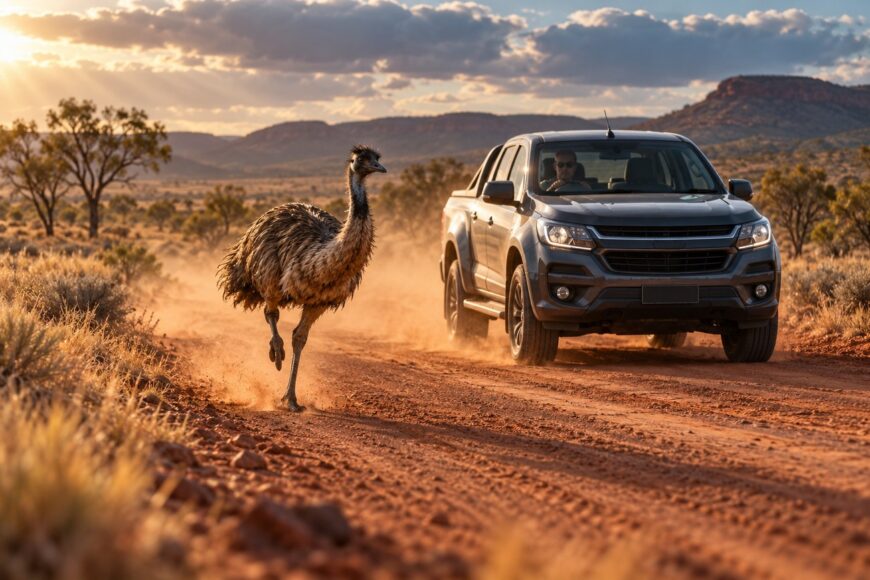
For a moment, emus running beside a Holden Colorado on an outback road can look like a race. The resemblance ends when one bird changes direction toward the ute. A large, flightless animal at the roadside is an unpredictable hazard, whether it runs alongside the vehicle, stops, or crosses in front of it.
A Colorado is built for the dirt roads and long distances common in remote Australia. Its 4×4 capability cannot guarantee protection from a wildlife strike, and rugged styling says little about what happens when a driver brakes suddenly or reaches a soft shoulder. The useful question is how much room and time the driver has to slow down safely.
- When “Emus Racing a Holden Colorado” Is Not Really a Race
- Where Emus Meet Vehicles in the Outback
- What a Holden Colorado Can—and Cannot—Take
- The Driver Mistakes That Turn a Sighting Into a Crash
- The Emu War Myth and the Modern Road-Safety Lesson
- Frequently asked questions
- How many bullets can an emu take?
- What eats an emu?
- Who won the Australia–emu war?
When “Emus Racing a Holden Colorado” Is Not Really a Race
“Emus racing a Holden Colorado” is a vivid description of birds moving near a vehicle, not an organized event. There is no documented official connection between the Holden Colorado and an emu race. The pickup, or ute, is commonly used as a working 4×4 on dirt roads, farms, and long outback trips.
A bird keeping pace beside a ute makes a striking image. From the driver’s seat, though, its next movement matters more than its apparent speed. An emu may continue along the road edge, change direction, or enter the vehicle’s path.
Calling the encounter a contest also obscures the consequences. Vehicle collisions are a recognized mortality threat for emus, while occupants may face a damaged vehicle or a dangerous evasive maneuver. Neither bird nor driver benefits from treating the moment as something to win.
Where Emus Meet Vehicles in the Outback
Emus are large, flightless Australian birds distributed across much of mainland Australia. They favor open, dry spaces, including savanna, scrub, open woodland, and desert margins. Dense forest and the deepest desert are generally less characteristic emu habitat.
That makes transition zones more relevant to a driver than the empty desert of a film scene. Scrub beside a road, open woodland near a farm track, and pasture edges can all limit the time available to spot a bird. A clear view down the road does not necessarily give you a clear view through roadside vegetation.
Dawn and dusk deserve particular care because reduced visibility can make an animal harder to pick out, and wildlife encounters may be more likely then. Dust, low light, and a bird close to the road edge can compress the interval between noticing movement and needing to brake.
Driver reports describe emus entering roads suddenly, changing direction, or appearing in groups. Those accounts are useful warnings, though they do not establish that every bird will behave the same way. The firmer point is that vehicle collisions are a recognized threat to emus, so an apparent gap ahead should not be treated as a guarantee of safe passage.
What a Holden Colorado Can—and Cannot—Take
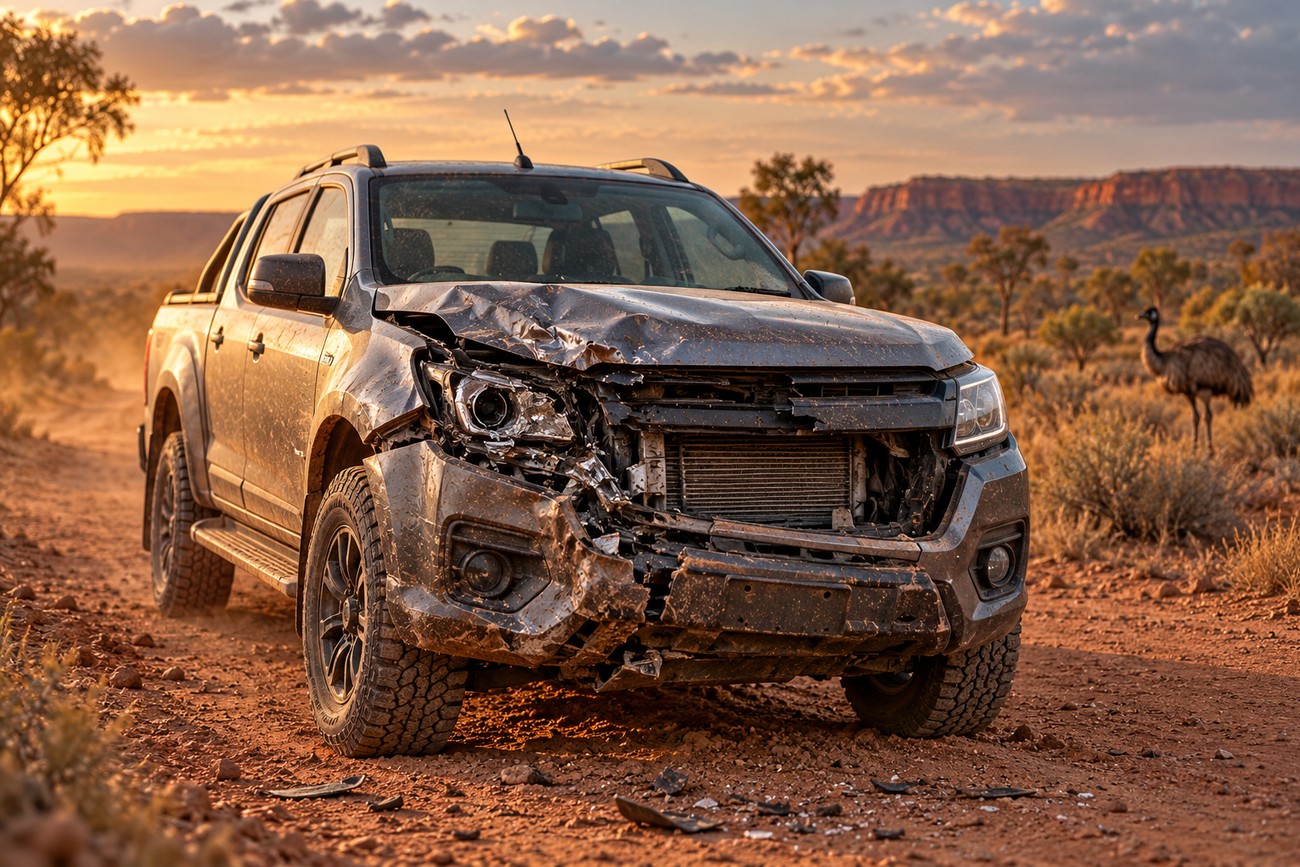
A Holden Colorado can be well suited to carrying people and equipment across rough, remote roads. Clearance and 4×4 traction help it travel on those roads; they do not make a collision with a large bird safe. Impact energy rises with vehicle mass and speed, regardless of how capable the ute feels on dirt.
Damage depends on speed, angle, and the point of impact. The bumper and grille may be visibly affected, while the radiator or other cooling components, lights, windscreen, and suspension may also be at risk. Driver reports of damage are warnings about possible outcomes, not a prediction that every impact will affect the same parts.
A bumper that still looks serviceable can conceal a problem that matters miles later. After an impact, check for cooling-system leaks and damage to lights, steering, and suspension before continuing into remote country.
A rugged-looking standard bumper is not automatically dedicated wildlife protection. Even where a vehicle has added frontal equipment, its presence should not be taken as permission to maintain speed near animals. Protection varies, and a strike can reach components behind the most visible part of the front end.
Remote travel makes a seemingly minor impact more consequential. If the ute is leaking coolant, a light has failed, or the steering feels different, driving on may turn one roadside incident into a breakdown far from help. Stop somewhere safe, assess the vehicle, and seek assistance if you cannot establish that it remains roadworthy.
The Driver Mistakes That Turn a Sighting Into a Crash
An empty straight road can invite a speed that leaves too little time to respond to movement at its edge. The problem grows at dawn and dusk, when visibility is reduced and wildlife encounters may be more likely. Ease off early where sightlines are limited rather than waiting until an emu is directly ahead.
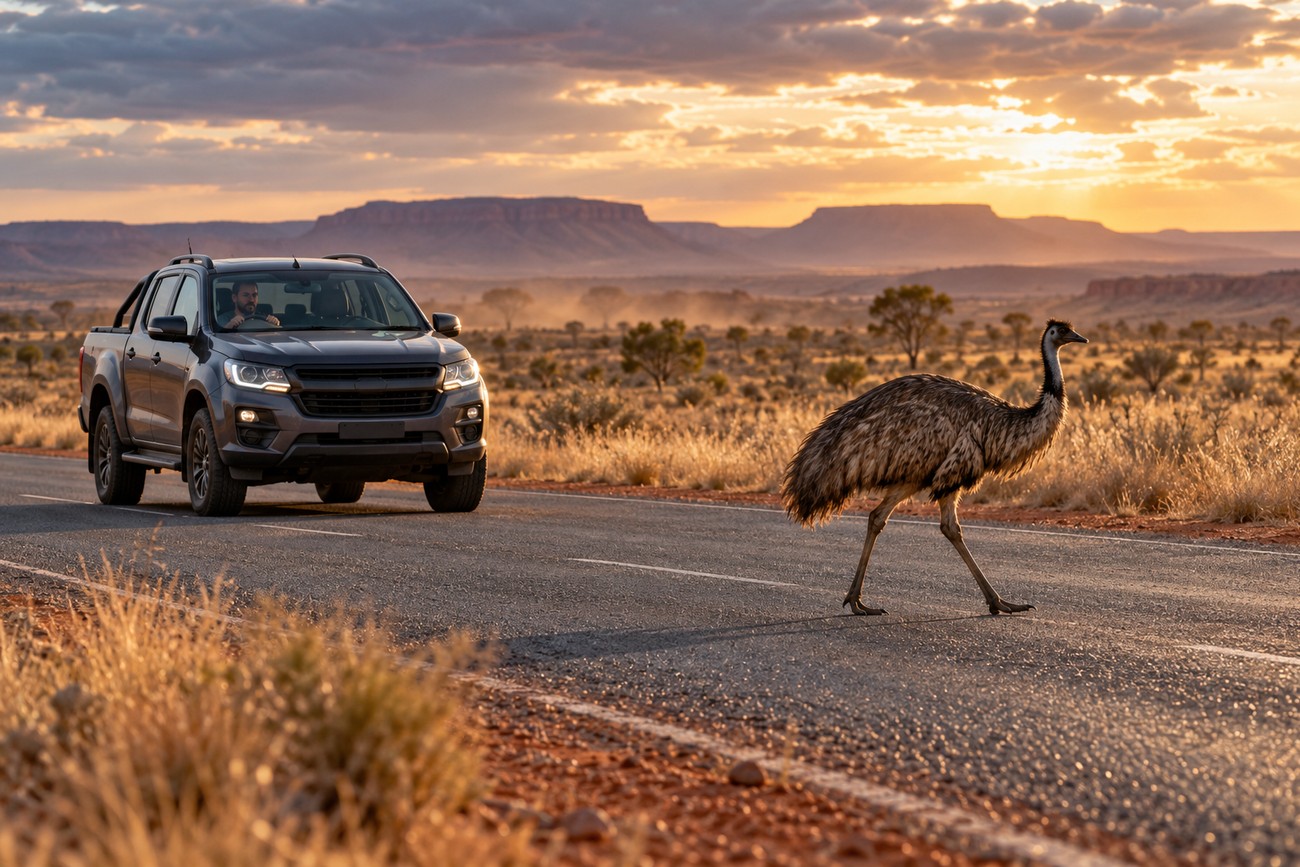
Assuming the bird will flee is another risky bet. An emu may hold its line, change direction, or cross again after its first movement. Watch the animal and the road around it while reducing speed in a controlled way.
Abrupt swerving can create a second hazard. A soft shoulder, rut, or loose road edge may offer less grip than the driving surface, especially during a sharp steering input. Brake firmly while maintaining control, and avoid a high-risk swerve when the available space and surface do not support it.
Keep looking after the first bird clears your path. Driver reports of birds moving in groups are a reason to check the roadside for others before accelerating. A bird that appears to have moved away may also change direction, so give the situation time to settle.
If a collision cannot safely be avoided, the priority remains control of the vehicle and the safety of its occupants and other road users. Once stopped in a safe place, assess the vehicle before continuing. An animal on or near the road can remain a hazard for approaching traffic.
The Emu War Myth and the Modern Road-Safety Lesson
The Emu War was a real episode in Australian history, often retold with the line that “the emus won.” Historical accounts describe hundreds or thousands of birds killed; the winner label is shorthand for the episode’s outcome and reputation, not the result of a sporting contest.
It has no documented connection to a Holden Colorado racing emus. A claim involving 1987 and a 1000-watt car belongs to a solar-racing story, not to this kind of wildlife encounter. Mixing the stories together gives drivers no useful guidance about a bird beside the road.
The practical historical lesson concerns reducing contact. Barriers and separation of routes are more relevant to managing conflict with wildlife than expecting a vehicle to overpower it. On an open road, the driver’s equivalent is modest: maintain a speed that leaves room to observe, slow, and stay on stable ground.
Frequently asked questions
These questions often accompany the better-known stories about emus. Their answers need some context: an animal’s vulnerability is not a useful spectacle, and a historical nickname does not describe what happens on a road.
How many bullets can an emu take?
There is no meaningful fixed number. An injury’s outcome depends on circumstances, and claims that an emu can reliably “take” a set number of bullets turn animal suffering into a misleading test. The historical Emu War is no basis for trying to measure an individual bird’s resistance.
What eats an emu?
The answer depends on the emu’s life stage. Adult emus are large animals and face different predation risks from eggs and chicks, which are more vulnerable to predators that could not tackle a grown bird. Vehicles are an additional human-caused threat, rather than a substitute for the emu’s place in a wider food web.
Who won the Australia–emu war?
“The emus won” is the popular shorthand for the Emu War’s widely mocked outcome. It reflects a political and military story about the limits of that campaign, not a literal score or evidence that emus competed with vehicles. On a modern road, there is no winner when an animal and a driver meet at speed.