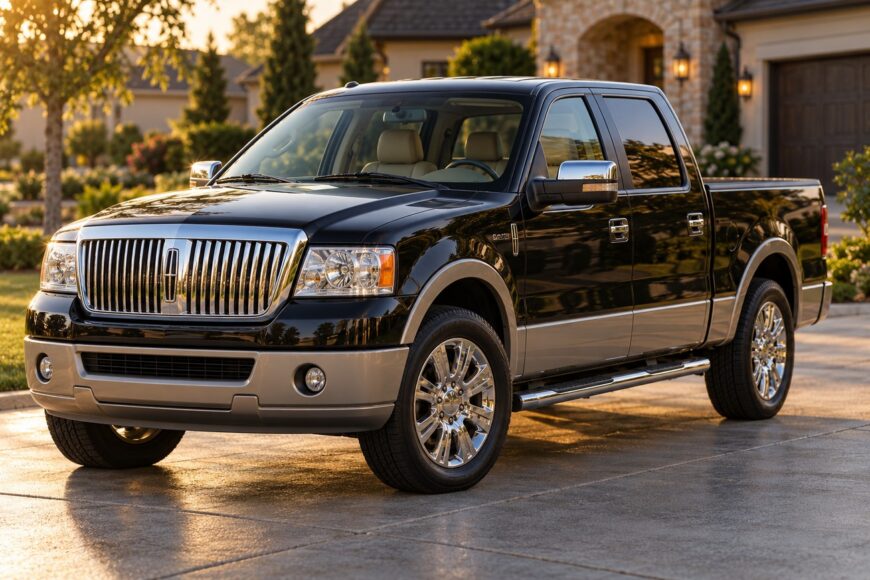
The Lincoln Mark LT offered the appearance of a luxury truck and the capability of a full-size pickup, yet buyers largely rejected the formula. Under the Lincoln-specific grille, trim, and cabin treatment sat a Ford F-150-based luxury pickup, with the same basic mechanical logic and many of the same compromises.
U. S. sales peaked at 12,753 units in 2006, then fell to 8,382 in 2007, 4,631 in 2008, and only 147 in 2009. Today, the bigger issue is specification uncertainty: power figures, equipment, and market origin vary. Rarity can make a Mark LT distinctive, but it can also make parts, resale, and history harder to manage.
- What the Lincoln Mark LT Really Was
- The V8, Four-Speed, and Specification Confusion
- Size, Payload, and Towing: The Numbers That Matter More Than the Badge
- The Sales Collapse That Defined the Mark LT
- Where the Luxury Ends and F-150 Ownership Begins
- Buying a Used Mark LT Without Buying Someone Else’s Problems
- Who Should Buy One Today—and Who Should Walk Away
- Frequently asked questions
- Which Ford F-150 years should I avoid buying if I am considering a Mark LT?
- How can I verify whether a Mark LT really has 300, 304, or 360 horsepower?
- Was the Lincoln Mark LT sold outside the United States after 2009?
What the Lincoln Mark LT Really Was
The Lincoln Mark LT was built from the Ford F-150 rather than from a separate Lincoln truck architecture. That shared foundation brought familiar full-size pickup hardware, proportions, and service logic. Lincoln concentrated its effort on presentation: exterior styling, cabin materials, equipment, and the impression of a more upscale truck.
U. S. and Canadian production ran from 2005 to 2009. Production for the Mexican market continued through 2014, which is one reason listings can appear to describe substantially different vehicles under the same Mark LT name. A Mexican-market truck may also have a different specification, history, and parts situation from an earlier North American example.
The F-150 connection is useful for maintenance, since many mechanical parts may be shared. It does not make every component interchangeable. Lincoln-specific body panels, lighting, interior pieces, trim, and equipment can be difficult to match through ordinary F-150 parts catalogs.
That distinction defines the ownership proposition. The Mark LT delivers Lincoln-style trim around F-150-based engineering, so its value depends heavily on whether the buyer wants distinctive presentation and full-size capability enough to accept older truck technology and specialty-part complications.
The V8, Four-Speed, and Specification Confusion
A key North American configuration used a 5.4-liter Triton V8 rated at 304 hp and paired with a four-speed automatic. This was a familiar older-truck drivetrain: substantial in size and expensive to feed when used as a daily vehicle. Its age also limits refinement compared with later full-size pickups.
Catalog listings show approximately 300–360 hp depending on market and year. Engine listings span approximately 4,951–5,408 cc, corresponding broadly to 5.0- and 5.4-liter V8 applications. These figures should be treated as market- and year-dependent specifications, not as interchangeable descriptions of every Mark LT.
The 360-hp figure appears in some listings and requires verification by VIN and market. An advertisement that repeats a catalog number is weak evidence, especially when the truck has been imported, modified, or registered under incomplete vehicle data.
Before comparing tax, insurance, performance, or replacement parts, confirm the VIN, model year, market of origin, engine identification, and registration data. A verified 300-, 304-, or 360-hp figure is useful; an unverified number in a sales listing is merely a starting point.
Size, Payload, and Towing: The Numbers That Matter More Than the Badge
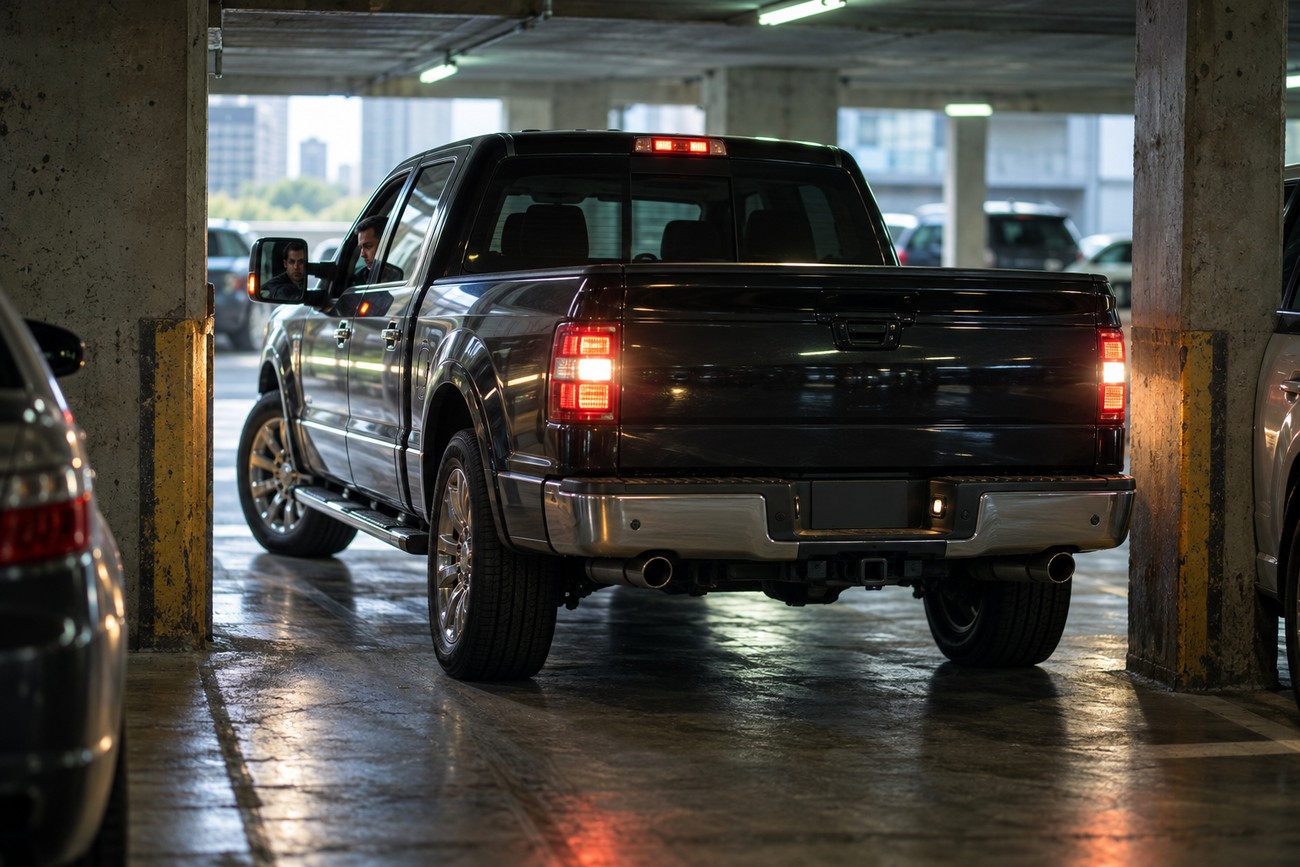
A typical Mark LT is approximately 5.685 m long, 2.004 m wide, and 1.93 m high. Those dimensions are manageable on open roads but demanding in older parking garages, narrow streets, and crowded urban lots. The width affects door clearance and mirror judgment, while the length makes tight turns and reverse parking slower than the photographs suggest.
The long-wheelbase version reaches approximately 5.989 m. That extra length can improve bed utility and highway stability, yet it makes city use more awkward and increases the space required for parking. Buyers who rarely carry long loads may gain little practical value from the longer body.
Catalog payload is approximately 734 kg, while maximum listed towing capacity reaches up to 4,037 kg. Those figures describe capability under specified conditions, not a promise that every old example remains ready for that work. Tires, brakes, suspension condition, cooling systems, hitch equipment, and maintenance history all matter.
On an aging full-size pickup, towing history can say more about wear than the odometer alone. A truck with moderate mileage may have spent years pulling heavy trailers, while a higher-mileage example used mainly for light transport may have experienced less stress. Inspect the hitch, frame areas, suspension, steering, transmission behavior, and service records together.
The Sales Collapse That Defined the Mark LT
U. S. sales peaked at 12,753 units in 2006. They fell to 8,382 in 2007, 4,631 in 2008, and only 147 in 2009. The pattern shows that the Mark LT’s market window was brief rather than steadily established.
| Year | U. S. sales |
|---|---|
| 2006 | 12,753 |
| 2007 | 8,382 |
| 2008 | 4,631 |
| 2009 | 147 |
The proposition was expensive to justify because buyers received an older V8-era truck with high fuel use and a four-speed automatic. The Lincoln trim added distinction, yet the underlying vehicle remained close to the mass-market F-150 in architecture and working behavior. That left the Mark LT exposed to comparisons with a more familiar truck that offered broader recognition and easier parts access.
Low sales do not prove poor mechanical quality. They do explain why the used market is thin, why specialist body and interior parts can be difficult to locate, and why resale may take longer. Rarity creates interest among the right buyers, but it does not automatically create collector value.
Where the Luxury Ends and F-150 Ownership Begins
The genuine advantage is presentation. A clean Mark LT can offer a more distinctive cabin and exterior appearance than an equivalent work-oriented F-150, while retaining the seating, cargo, and towing format of a full-size pickup. That combination still appeals to buyers who want a truck with less common styling.
The mechanical foundation remains F-150-based, and owners commonly complain about high fuel consumption from the older V8 setup. Age-related suspension and steering wear is also a significant inspection concern, especially on trucks that carried heavy loads or spent time towing. These issues affect ride quality, tracking, tire wear, and confidence under braking.
Parts compatibility stops at the shared mechanical foundation. F-150 interchange can simplify some repairs, while Lincoln-specific trim, lighting, cabin, and body components may still require patient searching and a larger budget.
Rare body and interior components can be slower and more expensive to source than common F-150 parts. A damaged grille, lamp, seat component, or trim piece may turn a straightforward repair into a search across specialist suppliers and used-parts networks. A buyer should price those items before purchase, especially if the truck already has cracked, missing, or modified trim.
Buying a Used Mark LT Without Buying Someone Else’s Problems
Start with identity, not appearance. Verify whether the truck is a U. S., Canadian, or Mexican-market specification, then use the VIN to confirm the model year, engine, body configuration, and available equipment. The advertised horsepower figure should be treated as unconfirmed until it agrees with the VIN, registration data, and physical engine identification.
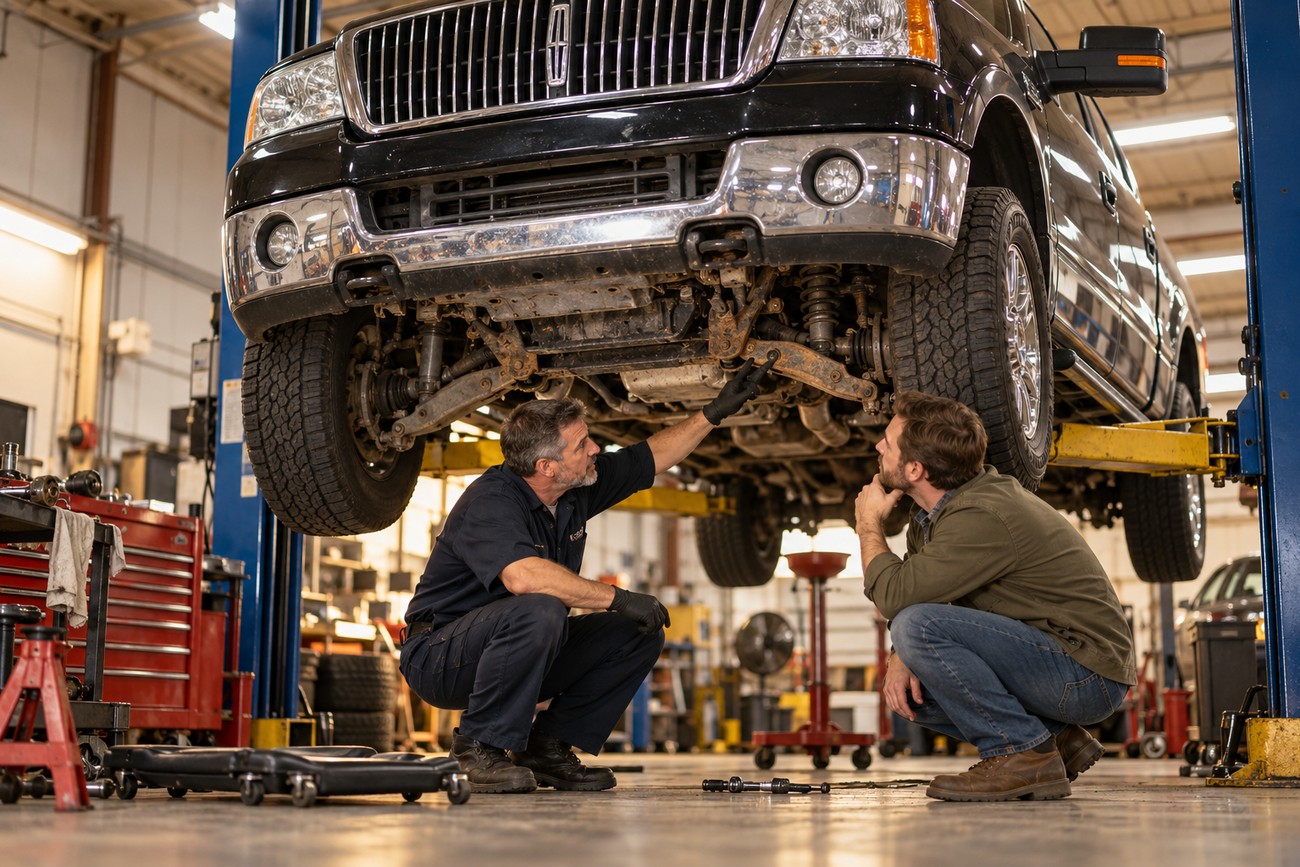
Next, establish the truck’s working history. Ask whether it towed regularly, carried heavy loads, or received suspension and drivetrain repairs. With a maximum listed towing capacity of up to 4,037 kg, the vehicle may have been used far harder than its mileage suggests. Look for evidence in the hitch, frame, suspension, steering, transmission service, and uneven tire wear.
Configuration, load history, and undocumented repairs deserve attention before cosmetic condition. A polished exterior can hide a heavily worked chassis, while a less attractive truck with verified identity and consistent maintenance may be the safer purchase.
Inspect the steering for excess play, wandering, uneven response, and worn components. Check the suspension for sagging, damaged parts, leaks, abnormal tire wear, and signs of previous heavy use. Test the automatic transmission when cold and warm, and review evidence of fluid service rather than relying on a seller’s general assurance.
Look closely for non-factory modifications, wiring changes, replacement body panels, unusual lighting, aftermarket suspension parts, and poorly documented repairs. Imported or rebuilt trucks can combine components from different specifications, making future diagnosis harder. A pre-purchase inspection with a VIN-confirmed parts strategy is more valuable than a visual assessment from photographs.
Among otherwise similar vehicles, a stock example with a clear history is generally preferable to a heavily modified one. The Mark LT already has a limited parts ecosystem; custom equipment and improvised repairs add another layer of uncertainty. Budget for age-related maintenance even when the truck appears clean and drives well.
Who Should Buy One Today—and Who Should Walk Away
The Mark LT suits a buyer who values unusual styling, full-size capability, and Lincoln trim enough to accept high fuel use and older mechanical technology. It can make sense as a distinctive personal truck when the configuration is verified, the history is coherent, and the owner has access to competent service and parts research.
It is a poor fit for cheap daily transportation, easy resale, or compact urban use. The approximately 5.7–6.0 m length and 2.0 m width complicate parking, while the older 5.4-liter V8 and four-speed automatic limit economy and modern refinement. Running costs are closer to those of an aging full-size truck than to those of a conventional luxury vehicle.
Rarity should also be valued accurately. The Mark LT is unusual and visually distinctive, but it is not a mass-market collectible. Its limited supply can attract attention, while its limited buyer pool can reduce liquidity and lengthen the resale process.
The best purchase is therefore a specific, documented truck rather than the rarest-looking listing. If the VIN, market origin, towing history, suspension condition, and parts availability all check out, the Mark LT can be an interesting ownership choice. If those details remain unclear, the Lincoln badge is insufficient compensation for the risk.
Frequently asked questions
Which Ford F-150 years should I avoid buying if I am considering a Mark LT?
There is no universal avoid list for a Mark LT based only on its F-150 connection. Risk depends more on the specific engine and transmission configuration, market origin, maintenance record, towing history, and current condition than on a simple model-year rule.
Evaluate each truck through its VIN, service documentation, cold-start behavior, transmission operation, steering, suspension, and evidence of heavy use. A well-maintained example with a coherent history can be a better purchase than a lower-mileage truck with undocumented repairs or extensive towing exposure.
How can I verify whether a Mark LT really has 300, 304, or 360 horsepower?
Use the VIN, model year, market of origin, registration data, and engine identification together. Compare the VIN-decoded specification with the vehicle’s documentation and physical engine details; do not rely on the seller’s listing or a generic online catalog.
The 300–360 hp range reflects differences by market and year, and the 360-hp figure requires VIN-specific verification. If the records disagree, treat the configuration as unresolved until a qualified parts or diagnostic source confirms it.
Was the Lincoln Mark LT sold outside the United States after 2009?
Yes. U. S. and Canadian production ran from 2005 to 2009, while Mexican-market production continued through 2014.
This distinction explains why a post-2009 Mark LT may exist without being a later U. S.-market truck. Check the VIN, registration history, equipment, and parts catalog before assuming that all examples share the same engine, trim, or electrical configuration.