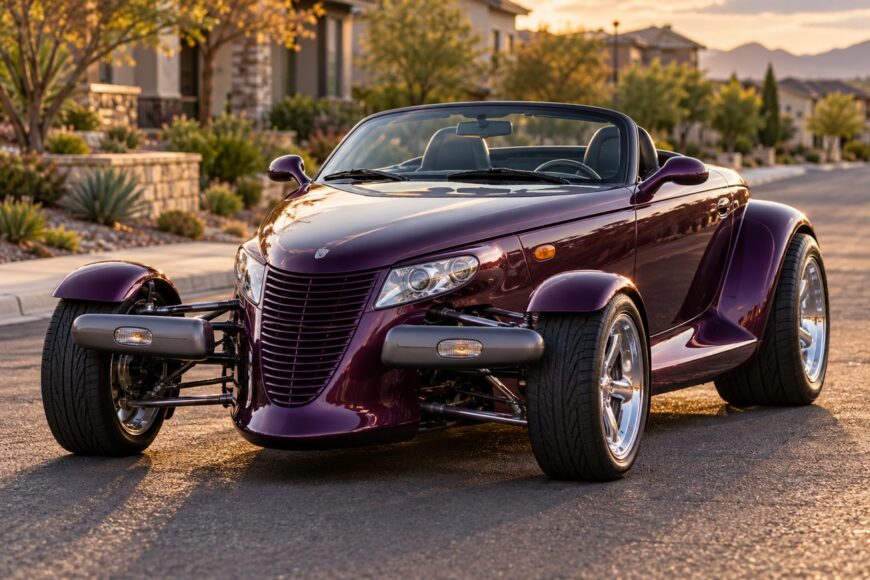
The Plymouth Prowler looks like an extreme prewar hot rod that escaped from a custom shop, yet it left the factory with a 3.5-liter V6 and an automatic transmission. Its exposed front wheels, long nose, and narrow cabin promise old-school mechanical drama; the actual car delivers a more polished, carefully engineered interpretation of that image.
That contradiction defines the buying decision. The Prowler has genuine engineering interest, aluminum construction, and a collector presence few contemporary cars can match, but it also brings limited practicality, expensive wide rear tires, firm ride quality, and less theatrical powertrain hardware than its styling suggests. It makes more sense as a weekend showpiece than as an everyday convertible, provided you buy the condition and originality rather than the silhouette alone.
- The Factory Hot Rod That Wasn’t a Traditional Hot Rod
- Design and Engineering: More Than Retro Styling
- V6, Automatic, and the Performance Reality
- The Costs of Living With a Prowler
- Buying One Today: What Condition Matters Most
- Production, Editions, and Collector Logic
- Frequently Asked Questions
- What is the rarest Plymouth Prowler?
- How much is a Plymouth Prowler worth today?
- Which year is considered the best year to buy a Plymouth Prowler?
- Was the Plymouth Prowler a fast car?
The Factory Hot Rod That Wasn’t a Traditional Hot Rod
The Prowler mattered because Chrysler put an unusually radical design into series production. The exposed front wheels and open-wheel stance came directly from the visual language of early hot rods, but the execution used modern manufacturing, modern safety expectations, and a body made from aluminum rather than the steel panels associated with a traditional home-built rod.
Production ran from 1997 through 2000 according to the supplied brief. This was never a conventional high-volume Chrysler model: Prowlers were assembled on a separate production line. That production method helps explain the car’s hand-finished feel and its unusual relationship with the parts network, while also making certain body and trim pieces less straightforward to replace.
Public expectations worked against the car from the beginning. A classic hot rod usually suggests a V8, a manual gearbox, rear-wheel-drive theatrics, and a direct connection between throttle and machine. The Prowler delivered the rear-drive attitude and dramatic proportions, but its V6 and four-speed automatic made it a modern interpretation of the genre rather than a mechanical continuation of it.
That distinction is important for collectors. The Prowler was designed to attract attention at a stoplight, on a concours lawn, or outside a good event venue, where its shape does most of the talking. It was never intended to provide the cargo space, weather protection, or relaxed ergonomics of an ordinary daily-use convertible.
Design and Engineering: More Than Retro Styling
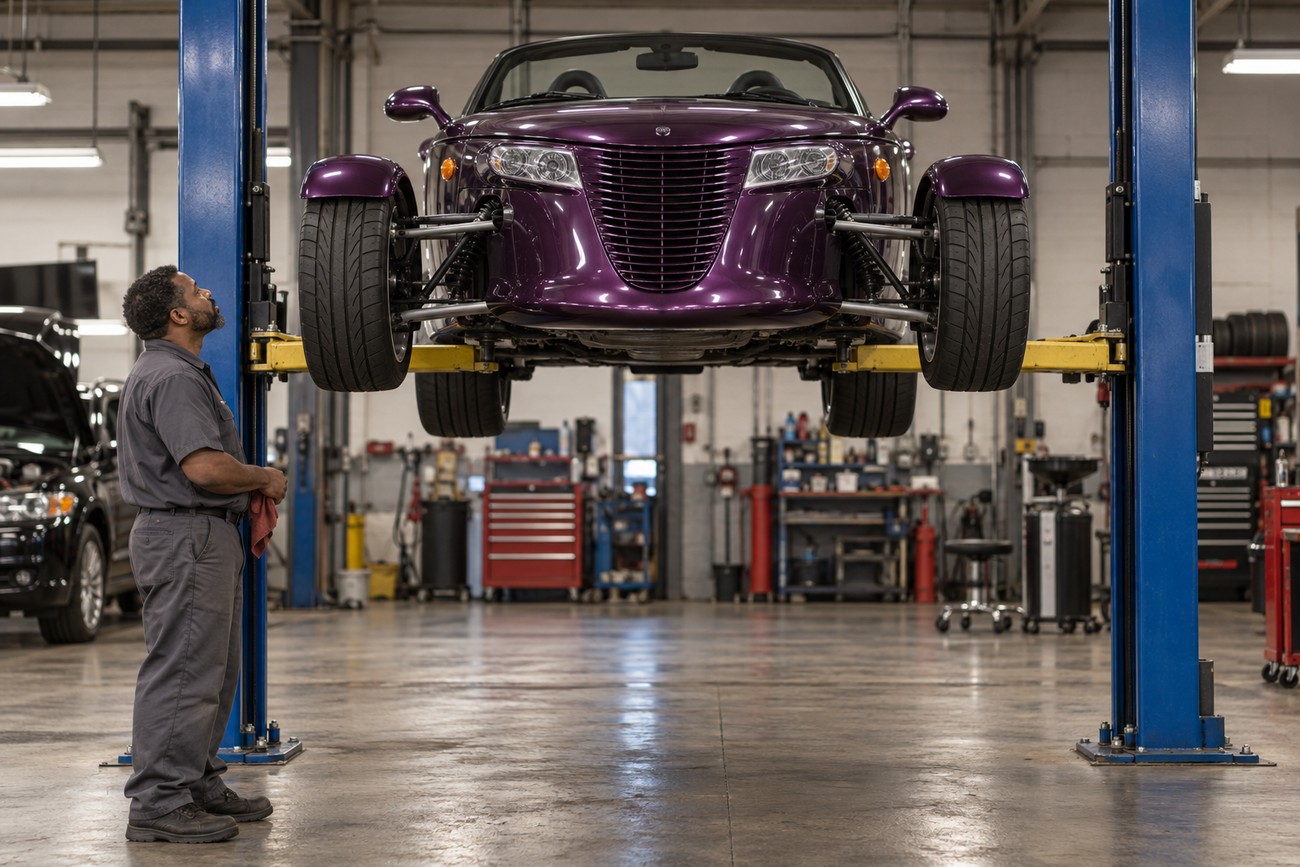
The Prowler’s architecture gives the styling real substance. Its engine sits at the front, while the transmission and differential form a rear transaxle. This arrangement distributes major mass along the car instead of placing the entire drivetrain at the nose, and it contributes to the long hood, compact passenger compartment, and unusually clean visual proportions.
The tire layout is equally deliberate. The car uses narrow front tires and very wide rear tires, creating the classic hot-rod stance while making the rear axle look planted. Those proportions are part of the Prowler’s identity, but they also have practical consequences: normal tire rotation is impossible, replacement choices are narrower, and the rear pair can become a substantial ownership expense.
Aluminum body construction reinforces the car’s modern engineering character. This is not a simple old-fashioned steel body fitted over a mass-market chassis. The specialized structure, unusual suspension presentation, and rear transaxle give the Prowler a distinct technical identity, though they also reduce the convenience of relying on generic donor parts when a body or interior component is damaged.
That combination creates an unusual collector-car trade-off. The Prowler is more thoughtfully engineered than its cartoon proportions might imply, yet its uniqueness can make ownership less forgiving. Original wheels, correct tire dimensions, exterior trim, and complete interior details preserve the intended visual balance; replacing them with ordinary alternatives may make the car easier to operate while making it less convincing as a collectible.
V6, Automatic, and the Performance Reality
Every factory Prowler used a 3.5-liter SOHC V6 rated at 214 hp and 221 lb-ft. The only transmission was a four-speed Autostick automatic; no factory manual transmission was offered. That specification is the central source of disappointment for buyers who approach the car expecting a V8-powered traditional hot rod.
Published acceleration was approximately 5.9–6.0 seconds from 0 to 60 mph, which gives the Prowler enough pace to feel lively in ordinary traffic and convincingly quick for its era. Top speed was officially limited to approximately 126 mph. The numbers are respectable, but they do not turn the car into a modern extreme-performance sports car.
On the road, the Prowler’s sensation depends as much on position and visibility as on outright acceleration. You sit low, see the front wheels working in the open air, and occupy a body that attracts attention at every stop. That visual drama can make moderate speeds feel more eventful, while the V6 produces less sound and low-speed authority than the car’s proportions lead many people to expect.
The Autostick allows some driver involvement, but it cannot reproduce the mechanical rhythm of a manual gearbox or the torque-heavy character of a large-displacement V8. A careful buyer should therefore judge the Prowler as a quick, style-led cruiser with credible straight-line performance. Calling it slow is inaccurate; calling it a full-blooded muscle car is equally misleading.
The Costs of Living With a Prowler
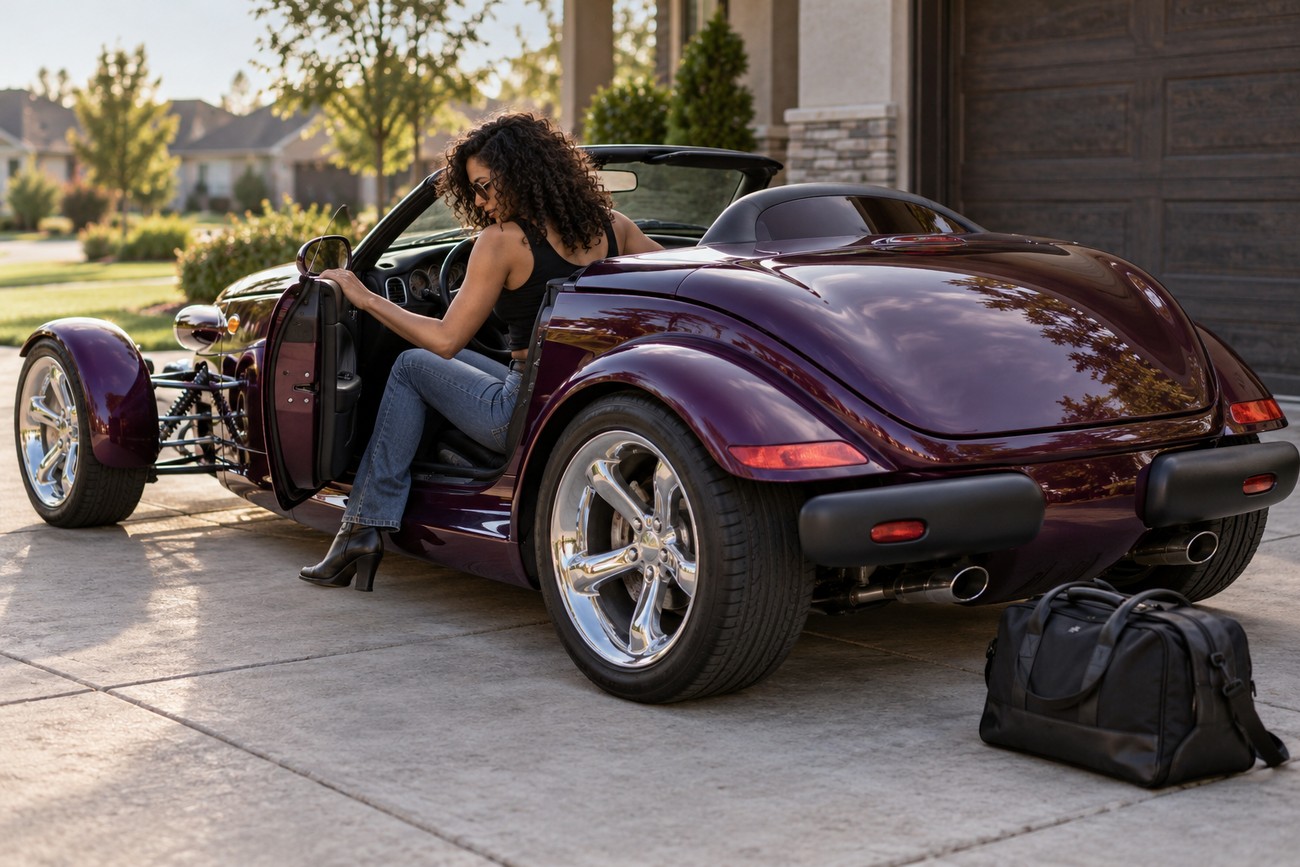
Daily use exposes compromises that are easy to overlook in photographs. The short-wheelbase, low-profile setup contributes to a firm ride, and highway noise can become tiring over a long drive. The low seating position also makes entry and exit less graceful than in a normal convertible, while the exposed front-wheel design and compact cabin limit the relaxed practicality many drivers expect from a modern road car.
Luggage capacity is limited, and the cabin is not especially accommodating for routine errands. Access, visibility, and storage matter more after the novelty fades: a car that is easy to admire for an hour may be awkward when carrying bags, parking in tight spaces, or spending a full day on the highway.
The staggered tire arrangement creates a recurring ownership issue. The front and rear tires cannot be rotated in the usual pattern, so wear must be monitored by axle rather than managed across the whole car. The very wide rear tires can wear quickly and may be expensive to replace, particularly when originality and the factory appearance remain priorities.
These traits point toward the right role for the car. A well-kept Prowler works best for weekend drives, events, and short scenic trips where its visual impact is an advantage. As a daily driver, it asks you to accept more noise, less storage, a firmer ride, and more specialized consumables than a conventional roadster or convertible.
Buying One Today: What Condition Matters Most
A pre-purchase inspection should begin with the tires, brakes, and suspension, even when the paint looks flawless. Check tire age, inner-edge wear, cracking, and uneven contact patterns, then inspect the braking hardware and suspension for deterioration from age or long periods of storage. Low mileage does not prove that these systems are healthy.
Body panels deserve close attention because Prowler-specific replacements can be difficult to source. Look for inconsistent gaps, repaired damage, corrosion around relevant mounting areas, and signs that an apparently minor incident required improvised parts. Interior trim, gauges, special panels, wheels, and small exterior details also matter because an incomplete car can take disproportionate effort to return to original condition.
Tire age and inner-edge wear deserve more trust than the odometer. Many collector cars spend long periods parked, allowing suspension and brake deterioration to progress even when the mileage barely changes.
Originality should be assessed alongside completeness rather than treated as a rigid rule. A professionally repaired or carefully maintained car may be a better purchase than a low-mileage example with missing trim, altered wheels, neglected tires, or an interior that has been stored poorly. The Prowler’s value rests in the complete system: body, stance, cabin, drivetrain, and the details that make the design coherent.
Before buying, confirm that the vehicle can be supported in your region. Some routine mechanical work may be manageable through a capable specialist, but niche body and interior pieces can require more searching. Budget for inspection, transport, tires, and corrective work without assuming that a collector car will be cheap simply because its mileage is low.
Production, Editions, and Collector Logic
The supplied brief states total production of 11,702 vehicles and confirms that no 1998 model year was produced. It lists 457 cars for 1997, 5,086 for 1999, and 3,180 for 2000. Those listed figures add up to 8,723, so they do not reconcile with the stated total of 11,702 and should not be treated as a complete, verified year-by-year census.
The first model year naturally attracts attention because early cars represent the beginning of the production story, and the brief lists 457 examples for 1997. That figure is useful as a rarity reference, but the inconsistency in the supplied production data means buyers should avoid presenting any single annual count as definitive without stronger documentation.
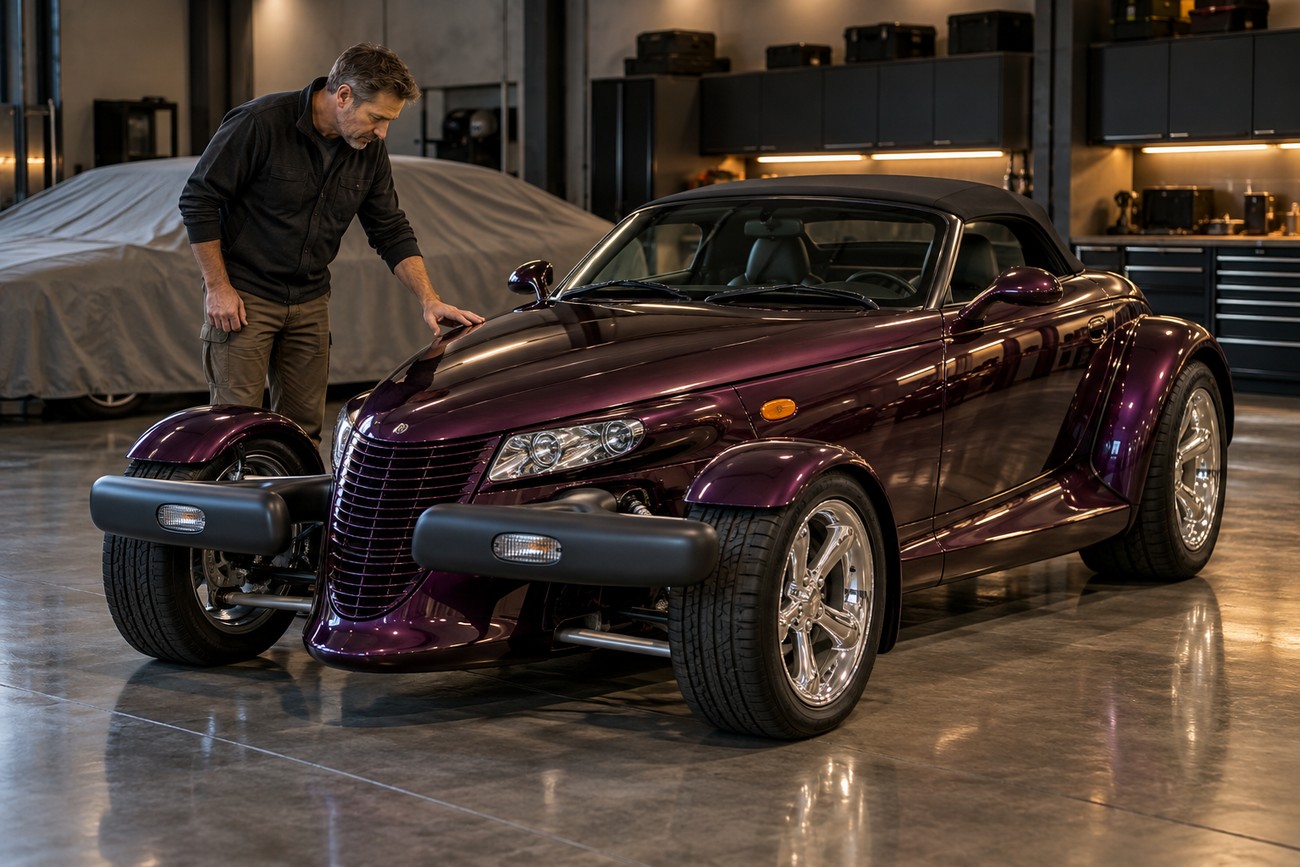
The Mulholland Edition was available in 1999–2000, with differences primarily in trim and appearance rather than the core mechanical specification. It can be the preferred choice for a buyer who wants its particular presentation, but the edition designation does not automatically make the car mechanically superior or eliminate the same tire, comfort, and parts concerns.
Rarity alone is a weak valuation argument for a Prowler. Condition, originality, completeness, specification, and niche-market demand usually matter more than a low production number on a neglected or modified example. A complete, well-preserved car with correct details can make a stronger collector purchase than a rarer car that requires difficult bodywork and missing trim.
Frequently Asked Questions
What is the rarest Plymouth Prowler?
The 1997 Prowler is the clearest rarity reference because it was the first model year and the supplied brief lists 457 cars. However, the provided yearly figures are incomplete or inconsistent: the listed 1997, 1999, and 2000 counts total 8,723, while the stated production total is 11,702. Treat the early model year as a likely rarity point, then verify the individual car’s documentation and originality.
How much is a Plymouth Prowler worth today?
A Prowler’s value depends on condition, originality, completeness, specification, and buyer demand rather than rarity alone. A car with correct wheels and trim, sound tires, healthy brakes and suspension, and an unaltered interior is easier to justify than a low-mileage example requiring scarce body parts or extensive recommissioning.
Which year is considered the best year to buy a Plymouth Prowler?
The best year is usually the best-preserved and most complete car you can document and inspect properly. The 1999–2000 Mulholland Edition may suit a buyer who prefers its trim and appearance, but it should be chosen as a styling preference rather than assumed to be a mechanical upgrade.
Was the Plymouth Prowler a fast car?
It was quick for its era and image, with approximately 5.9–6.0 seconds from 0 to 60 mph. Its 3.5-liter V6, four-speed automatic, and approximately 126-mph official limiter prevent it from qualifying as a modern extreme-performance car, but the acceleration is sufficient to make the Prowler feel lively on public roads.