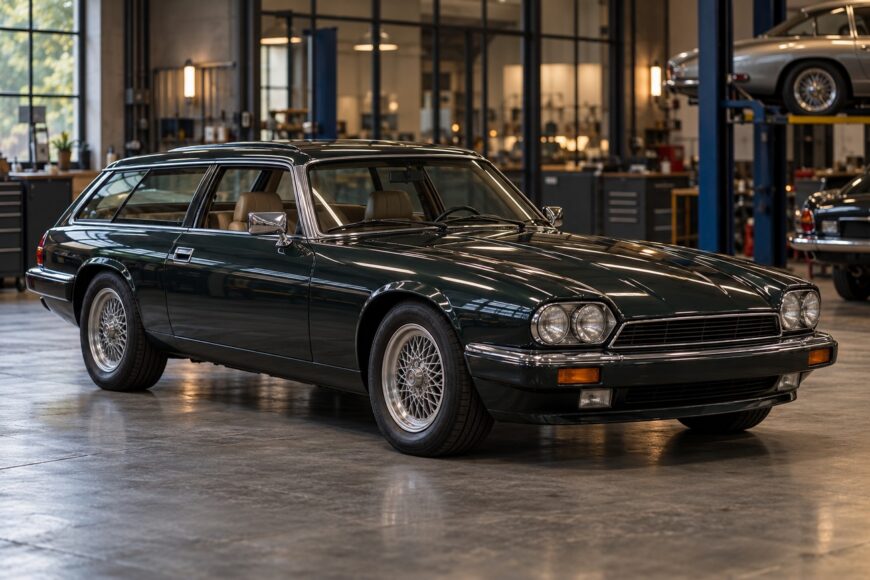
The Lynx Eventer is a hand-converted Jaguar XJS coupé, reshaped into a shooting brake by Lynx for individual customers. It was never a factory-built Jaguar series model, and that distinction matters: every surviving car represents a particular donor, specification, standard of workmanship, and repair history.
Its rarity and useful load area make the Eventer attractive, but neither automatically makes one a sound collector car. The conversion itself must be examined as carefully as the XJS mechanicals. Production figures are also disputed: 67 is the most commonly quoted total, while some sources count 63, depending on methodology and whether the prototype or borderline cars are included. The frequently repeated 380-hp claim creates a separate trap, since it belongs to a TWR-modified 6.1-litre V12 project rather than ordinary Eventers.
- What the Lynx Eventer Actually Was
- The Conversion Was Far More Than a New Tailgate
- Engines, Production Numbers and the 380-HP Myth
- What Ownership and Restoration Make Difficult
- How to Inspect and Authenticate an Eventer
- Eventer Versus XJS: Usefulness, Dynamics and Authenticity
- Frequently asked questions
- Which Eventer parts are usually interchangeable with facelift or pre-facelift XJS parts?
- How should a 380-hp Eventer be described in a sale advert?
What the Lynx Eventer Actually Was
Lynx developed the Eventer by using the Jaguar XJS coupé as its donor vehicle. The aim was to retain the long-distance character, V12 presence, and cabin refinement of the XJS while adding the rear access and carrying ability of a shooting brake. The result occupied an unusual place between a grand tourer and a specialist utility car.
The first prototype was presented in 1982. Conversions then continued as bespoke commissions rather than on a fixed production line with one universal specification. The last conversion left the Lynx workshop in 2002, although some accounts describe the overall production span differently because the starting date and cars counted are not always treated in the same way.
A customer could therefore specify an Eventer around a particular engine, transmission, interior, and donor car. V12 examples are well known, but six-cylinder cars and later combinations also existed. Differences between cars of a similar age are not automatically evidence of poor restoration or incorrect assembly; they may reflect the original commission. Documentation is needed to separate genuine specification variation from later alteration.
The conversion time was stated as approximately 14 weeks, although an individual specification could extend the schedule. That figure describes a workshop process, not a simple body-kit installation. It also offers little assurance about the quality of a surviving car decades later, because corrosion repairs, replacement glass, repainting, and interior work may have changed the vehicle substantially.
The Conversion Was Far More Than a New Tailgate
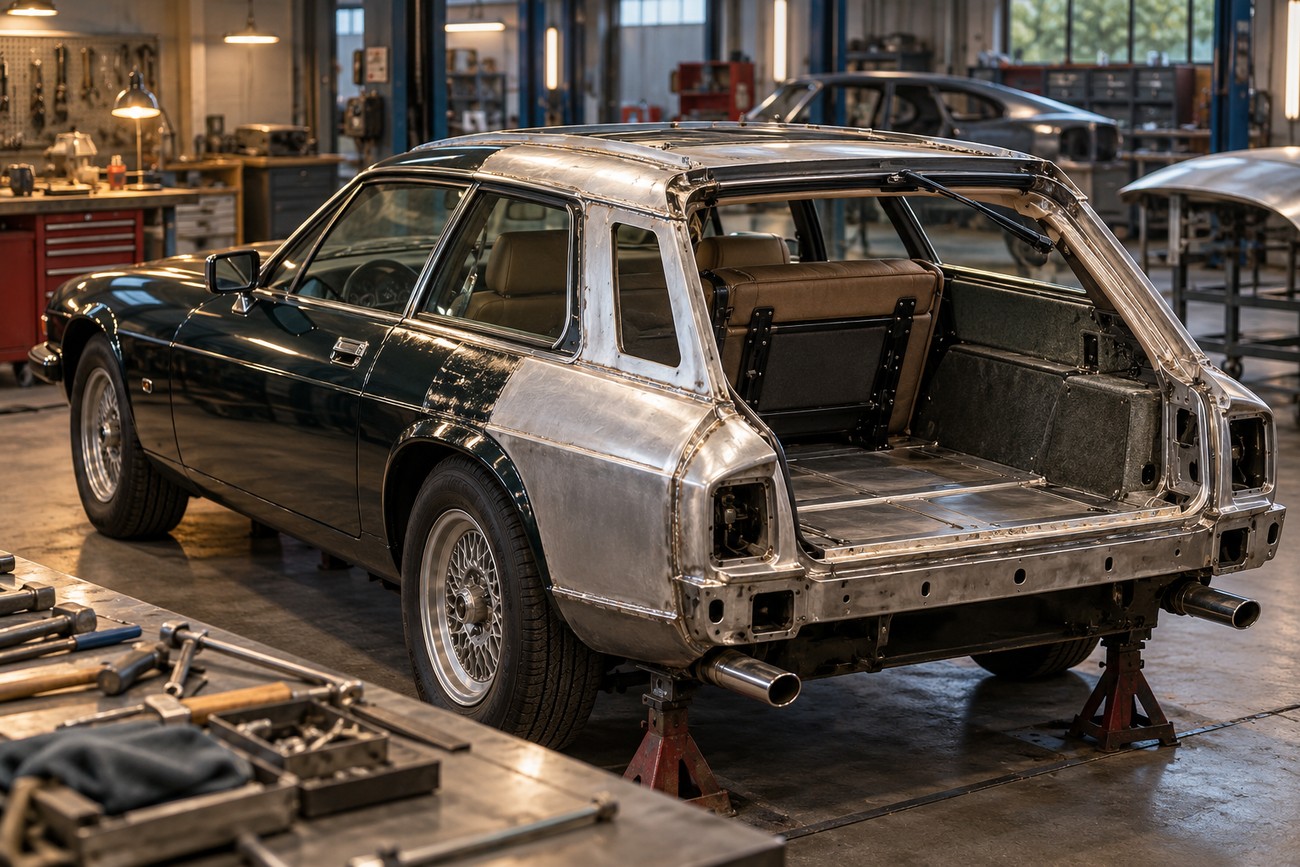
Lynx removed the original rear roof section and rear pillars from the XJS coupé. A new upper body structure, commonly associated with glass-reinforced plastic work, was installed along with the rear door, glazing, wiper, and washer system. The roof joints, door aperture, water channels, and transitions between original and new structure became critical areas of the build.
The engineering changes continued below the waistline. The fuel tank and rear floor were relocated or revised, folding rear seats were fitted, and the conversion was advertised as providing about 6 feet of flat load floor. In use, the wheel arches, threshold height, and trim reduce the amount of cargo that can be carried easily. The space is valuable for selected loads, but it does not turn the Eventer into a modern wagon.
Removing the factory rear structure changed both body stiffness and mass distribution. Lynx addressed this with revisions to the body structure and reinforcement to the rear suspension. The precise result depended on the individual car, its equipment, and subsequent repairs. A claim that an Eventer is lighter than an XJS says little about handling unless the complete suspension and structural work are understood.
That variation is central to restoration. A well-executed conversion can have clean roof lines, consistent panel gaps, effective drainage, and a properly supported rear floor. Another may have hidden repairs, stressed joints, water leaks, or improvised brackets. The Lynx name establishes provenance; it does not replace an inspection of the actual workmanship.
Engines, Production Numbers and the 380-HP Myth
The Eventer engine range included the XJS V12, the 3.6-litre straight-six, and the 4.0-litre engine. Some cars were separately commissioned with higher-performance specifications, including cars associated with XJR-S-related work. These should be described by their documented engine and conversion history rather than grouped together under one assumed specification.
The most commonly quoted total is 67 Eventers, divided into 52 pre-facelift cars and 15 post-1991 facelift cars. Some sources count 63 cars instead. The difference reflects methodology, including the treatment of the prototype and borderline examples, and there is no universally accepted public factory register that settles every case.
The 1991 facelift is relevant to more than the visible nose and trim. Donor-era panels, electrical systems, and parts compatibility can differ between pre-facelift and post-facelift cars. A parts search based only on the Eventer name can therefore lead to the wrong component, particularly where the surviving car has already received mixed-era repairs.
The 380-hp figure belongs to a separate TWR-modified 6.1-litre V12 project. It must not be applied to ordinary Eventers, including standard V12 cars that retain the original XJS engine specification. A sale description should identify the engine displacement, the documented TWR work, and the evidence supporting that specification before making a power claim.
This distinction affects value as well as accuracy. A rare body conversion does not prove a rare engine installation, and an impressive number in an old advertisement does not prove that the present car retains the same drivetrain. Engine stamps, invoices, period photographs, and a coherent ownership history carry more weight than an isolated performance statement.
What Ownership and Restoration Make Difficult
Eventer-specific body parts are scarce. Glass, seals, door components, roof sections, and drainage details may require specialist sourcing or individual manufacture. Even when a replacement can be made, reproducing the correct fit and appearance may demand more time than repairing a conventional XJS panel.
The relocated fuel tank and altered rear floor deserve particular attention during restoration. They introduce additional areas where moisture, dirt, and previous repairs can cause corrosion, while access for service may be less straightforward than on the donor coupé. A clean exterior finish can conceal poor work underneath, especially after a cosmetic restoration that concentrated on paint.
Water paths and the underside of the relocated tank and rear floor deserve inspection before judging paint quality, because cosmetic restoration can conceal the most expensive conversion-specific defects.
The donor XJS also brings its own age-related risks. Electrical faults, cooling-system problems, automatic-transmission wear, vacuum-system issues, and corrosion remain relevant regardless of the rarity of the rear body. A specialist needs to understand both the XJS systems and low-volume body construction; a routine service shop may be competent with one and unfamiliar with the other.
Practical use requires restraint. The high sill and threshold make loading awkward, the wheel arches consume usable width, and valuable or fragile trim may be difficult to replace. Owners often gain more from treating the cargo area as protected luggage space than from using the Eventer as a working estate car. Regular inspection of seals and drainage is also sensible because water ingress can damage both structure and interior.
How to Inspect and Authenticate an Eventer
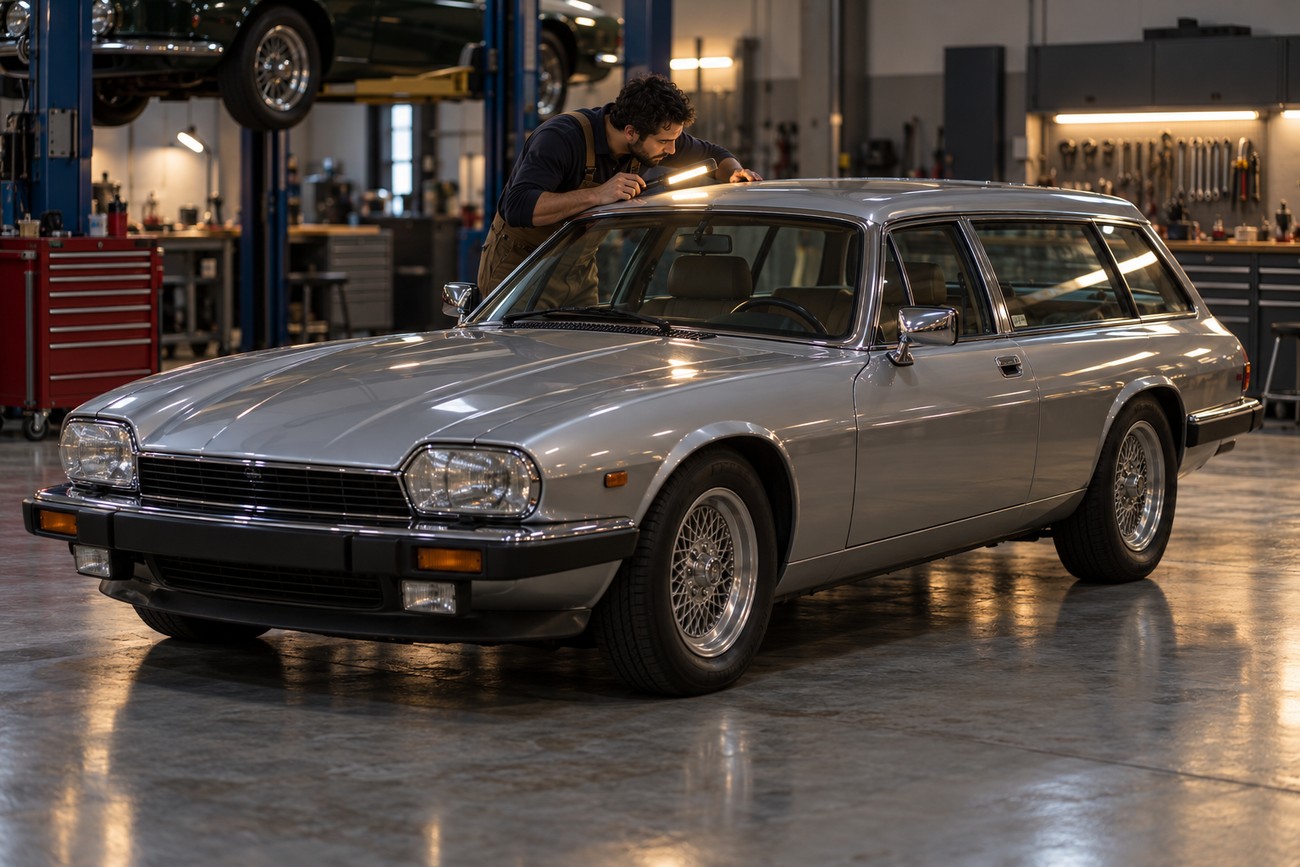
Begin with the conversion, not the rarity claim. Examine the roof seams, the join between original and replacement structure, the rear door alignment, the glazing, and the condition of seals. Uneven gaps, stress marks, cracked filler, or evidence of repeated adjustment can indicate movement or earlier structural work.
Follow the water paths. Check the gutters and drainage channels for blocked outlets, inspect the underside around the relocated tank, and look closely at the revised rear floor from above and below. The quality of welding, reinforcement, corrosion protection, and access panels matters more than a fresh paint finish. A lift inspection is especially useful where the seller’s photographs show only the upper body.
Ask for photographs taken during the conversion or later restoration, together with invoices and parts records. Those documents can reveal how the rear pillars were removed, how the new structure was supported, and whether the tank and floor were rebuilt correctly. They also help distinguish original Lynx work from later replacement parts or modern repairs that may affect historical authenticity.
A coherent history should connect the donor identity, engine, gearbox, body conversion, and later repairs; a rare badge alone cannot establish that the car being inspected is the car described in old records.
Finally, match the car’s specification to its history. Confirm the donor identity, engine type, transmission, facelift status, and any claimed XJR-S or TWR involvement. Statements that the car is one of 63, one of 67, or “the only one” should be treated as claims requiring evidence, not as authentication. The most useful file is a consistent chain of records rather than a dramatic production-number story.
Eventer Versus XJS: Usefulness, Dynamics and Authenticity
The following comparison shows where the Eventer differs from the standard XJS coupé in ways that affect ownership and inspection.
| Area | Standard XJS coupé | Lynx Eventer |
|---|---|---|
| Rear structure | Factory coupé roof, pillars, rear glass, and luggage compartment | Rear roof and pillars removed, with a new upper body structure and rear door |
| Load access | Conventional coupé trunk opening | Large rear door and an advertised flat load floor of about 6 feet |
| Fuel tank and floor | Original XJS arrangement | Tank and rear floor relocated or revised as part of the conversion |
| Rear suspension and body work | Factory XJS specification | Rear suspension reinforcement and changes addressing body stiffness and mass distribution |
| Parts supply | Wider XJS-related supply, subject to age and facelift differences | Rare body, glass, seal, and door components may require bespoke manufacture |
| Practical use | Limited luggage capacity through a coupé trunk | More useful long-item access, constrained by arches, threshold height, and fragile trim |
The Eventer’s advertised flat load floor was about 6 feet long, which is a meaningful improvement for long luggage or selected equipment. The high threshold and wheel arches still shape what can be loaded, while the trim may be too valuable or delicate for rough use. Its usefulness is therefore real but specialized.
Handling should be assessed on the individual car. Any reduction in mass does not automatically produce sharper dynamics, because the conversion altered weight distribution and the center of gravity. Rear suspension compensation addressed those changes, but settings, condition, tires, and later modifications determine how a particular Eventer drives.
Post-1991 cars can differ from earlier examples in donor panels, electronics, and parts compatibility, not only in appearance. For collectors, complete original conversion details and documented history usually provide better evidence of authenticity and value than an unsupported serial-number claim. An Eventer with an honest, well-recorded specification is more useful than one with a stronger story and uncertain bodywork.
Frequently asked questions
Eventer records are incomplete, and systematic owner reports about Eventer-specific body failures are limited compared with sales descriptions and collector reviews. The answers below therefore focus on evidence that can be checked on an individual car.
Which Eventer parts are usually interchangeable with facelift or pre-facelift XJS parts?
Many donor-era mechanical and cabin components may relate to the corresponding XJS, but compatibility must be checked against the car’s model year and facelift status. Panels, electronics, electrical hardware, trim, and related systems can differ between pre-1991 and post-1991 cars.
The rear body is a separate matter. The Eventer roof, rear door, glazing, seals, and drainage components are conversion-specific and should not be assumed interchangeable with ordinary XJS parts. Before ordering, compare the donor specification, photographs, measurements, and any existing part numbers.
How should a 380-hp Eventer be described in a sale advert?
It should be described as a documented TWR-modified 6.1-litre V12 Eventer, if the car has records proving that specification. The advert should identify the engine work and supporting invoices or provenance rather than imply that 380 hp was standard across the Eventer range.
For a regular V12 car, use the documented engine specification and avoid the 380-hp figure. This wording prevents a separate TWR project from being presented as a general characteristic of the Lynx conversion.