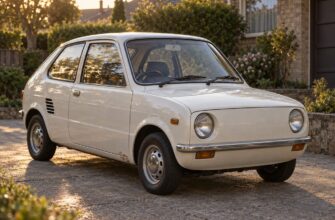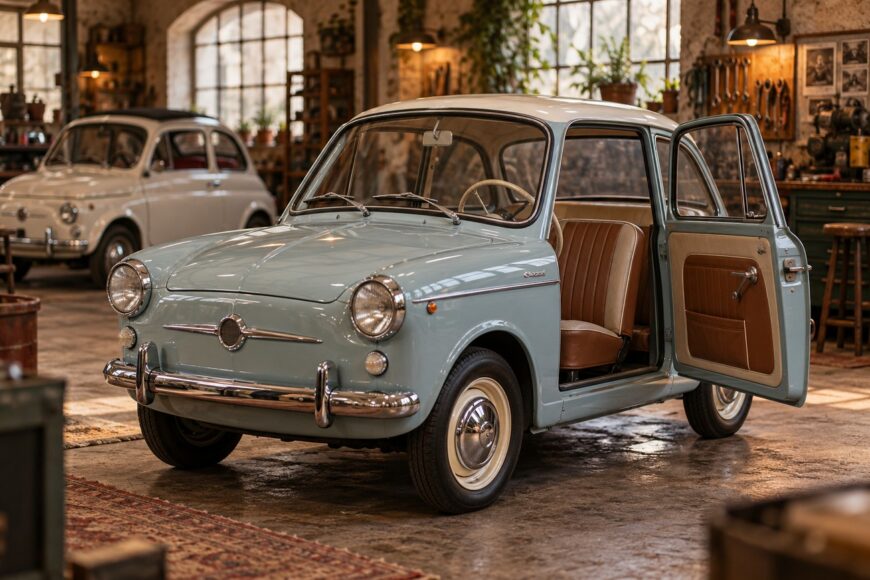
The Fiat 500 is familiar: a tiny rear-engine Italian car with simple mechanics and an enormous enthusiast following. The Autobianchi Bianchina uses much of that practical foundation, yet presents it in a more carefully styled and better-trimmed form. Its appeal lies in the gap between mass-market engineering and coachbuilt-style character.
Bianchina was a family of bodies rather than one fixed model. Buyers could choose among the Trasformabile, Cabriolet, Berlina, Panoramica, and Furgoncino, each with its own identity and parts concerns. That variety makes the cars more interesting, but it also means that identifying the exact series matters before ordering anything.
Ownership offers charming Italian style, accessible mechanical support, and an unusual presence at modest physical size. It also brings rarer trim, hidden corrosion, incomplete originality, and harder-to-find body parts. A running engine is a useful start; it is not evidence that the car is structurally sound or economically sensible to restore.
- What Is the Autobianchi Bianchina?
- Bianchina Body Styles at a Glance
- How Much Fiat 500 Is Really in a Bianchina?
- Buying One: The Rust and Restoration Reality
- Living With a Bianchina Today
- The Myths That Make Bianchina Projects Expensive
- Frequently asked questions
- What cars are similar to the Fiat 500?
- Why do Bianchina listings disagree about whether production ended in 1969 or 1970?
- Which Bianchina is the most practical for carrying luggage or equipment?
What Is the Autobianchi Bianchina?
The Autobianchi Bianchina was introduced in 1957 as an upscale companion to the Fiat 500. Its layout followed the Fiat architecture: rear-wheel drive, a rear-mounted, air-cooled two-cylinder engine, and compact running gear suited to inexpensive urban transport. The mechanical relationship is real, and it is one reason the car remains serviceable today.
Calling it merely a Fiat 500 with a different shell, however, misses the point. The bodywork, bright trim, interior fittings, panel details, and some mounting arrangements had their own specifications. The result was a small car with a more formal or stylish presentation, depending on the version, rather than a simple factory rebadge.
Production is generally dated to approximately 1957–1970, although some catalogues give 1969 for the end of the main Bianchina series. Derivatives may be counted separately, which explains part of the disagreement. Total production is commonly estimated at approximately 275,000 cars, enough to make the Bianchina established rather than unique, but far fewer than the Fiat 500.
Early cars used a 479 cc engine producing approximately 15 hp. Later cars adopted a 499 cc engine, with exact output varying by series and market. That progression matters when assessing originality: a later engine in an earlier-looking car may be a sensible replacement, but it should not automatically be described as factory-correct.
Bianchina Body Styles at a Glance
Each body style changes the car’s visual identity, practical use, and restoration workload. The Fiat 500 connection is strongest as a guide to mechanical architecture; it is less reliable as a guide to exterior panels and trim.
| Body style | Distinctive identity | Closest Fiat 500 relationship |
|---|---|---|
| Trasformabile | Two-door car with a fabric roof; debuted in 1957 and was styled by Luigi Rapi. | 500-derived mechanical layout with independent Bianchina body and trim. |
| Cabriolet | Open body with a more fully convertible character than the fabric-roof Trasformabile. | Shares the Fiat-based running gear, while its body fittings require version-specific checks. |
| Berlina | Closed saloon body aimed at discreet everyday use. | Closest in concept to the standard Fiat 500, but not a universal source of panels or interior parts. |
| Panoramica | Practical estate-like body with its own Bianchina details and trim. | Technically close to the Fiat 500 Giardiniera. |
| Furgoncino | Small commercial van body intended for carrying goods or equipment. | Also closely related to Giardiniera hardware, with distinct Bianchina bodywork. |
The version should be established before a parts search begins. A Panoramica is not automatically an ordinary wagon, and a Furgoncino cannot be treated as a standard 500 with the rear seats removed. Catalogues, photographs, chassis information, and surviving trim should agree before expensive restoration work starts.
How Much Fiat 500 Is Really in a Bianchina?
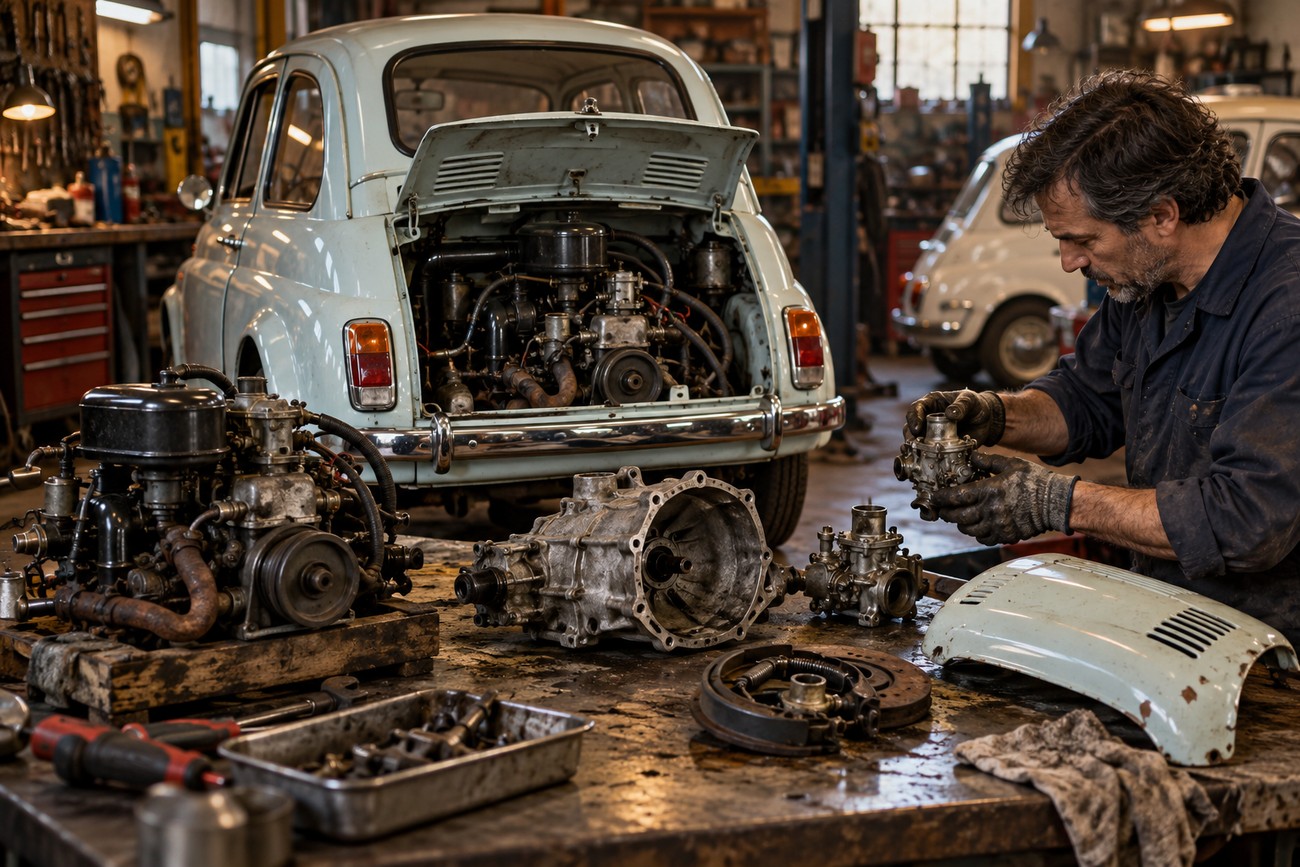
Fiat 500 compatibility is most useful for the mechanical core. Engine components, transmission parts, and many brake-related items provide a sensible starting point for research, especially when specialist Bianchina stock is unavailable. Even here, the exact year, engine specification, and supplier catalogue should be checked rather than assumed.
Body panels are a different matter. Door skins, wings, roof sections, front and rear trim, bumpers, window surrounds, and interior fittings may be specific to the Bianchina series. A Fiat 500 part can look close in a photograph and still have the wrong edge, mounting point, curvature, or relationship to adjacent panels.
The safest method is to identify the Bianchina body series and year first, then compare that information with the relevant Fiat 500 specification. This is particularly important for Panoramica and Furgoncino parts, where the Giardiniera is the nearest technical reference but not a complete visual or structural substitute.
Modified cars add another layer of uncertainty. A non-original engine, different carburetor, or 12-volt conversion may work perfectly while making ordinary parts advice unreliable. Before replacing a regulator, coil, lamp, or starter component, establish the actual voltage, polarity, wiring layout, and mounting dimensions on the car in front of you.
Buying One: The Rust and Restoration Reality
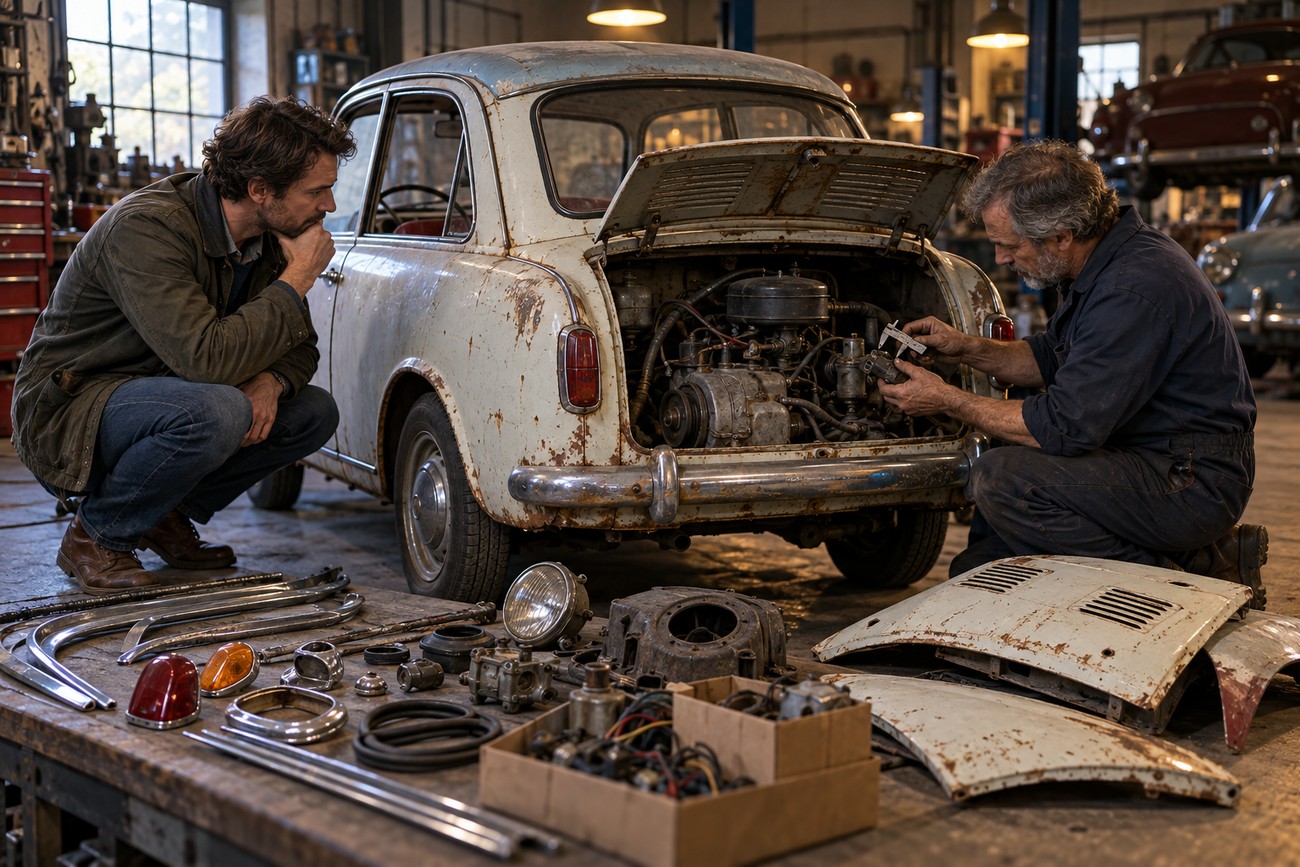
Shiny paint proves little on a Bianchina. Inspect the underside before discussing color quality, beginning with the sills, floor sections, wheel arches, structural seams, and suspension-mounting areas. Fresh underseal can hide repairs, while a clean engine bay can distract from corrosion that threatens the shell.
Look for uneven gaps, rippled metal, welds that stop abruptly, and changes in panel thickness. Magnet or paint-thickness checks can reveal filler, but they do not replace access from underneath. Fiat 500 replacement metal may have been used during an earlier repair, leaving incorrect gaps, fastening points, or proportions that become expensive to correct later.
Inspect structural seams and suspension mounts from underneath before negotiating over paint. Hidden corrosion and incorrect Fiat 500-based repairs usually determine the real restoration bill.
The mechanical inspection should continue even if the engine starts immediately. Test the brake hydraulics, wheel cylinders, steering, bearings, and tires, and look for seized components or fluid leaks. After long storage, a running motor can coexist with unsafe brakes and a fuel or electrical system that has not been properly recommissioned.
Restoration cost is often governed by the shell and its finishing details rather than by the engine. Correct body panels, chrome, interior parts, and period-appropriate paintwork can be substantially harder to source than Fiat-based mechanical components. A complete-looking car with the wrong trim may therefore be more costly than a rougher example with its original parts carefully stored.
Documents deserve the same attention as metal. Some cars are described or registered simply as Fiat 500s, which can complicate confirmation of the Bianchina version and its provenance. Match the body, chassis information, engine, identification markings, and paperwork before treating a rare specification as authentic.
Living With a Bianchina Today
A Bianchina feels lively at low speeds, but its modest power has clear limits. Hills, extra passengers, and modern traffic expose the small engine quickly, particularly when the car is expected to maintain contemporary road speeds. That is part of the period experience, provided the owner plans routes and driving conditions accordingly.
A car that starts after years of storage still needs recommissioning. Brakes, cylinders, the fuel system, and electrical connections commonly require attention before regular use. Old rubber parts, contaminated fuel passages, and corroded contacts can turn a promising start into a roadside failure.
The original wiring is thin, and poor grounds can cause unstable lighting, charging, and starting. Cleaning earth points and checking the charging circuit may solve faults more effectively than installing random modern components. Any 12-volt conversion should be documented clearly, because later owners need to know which lamps, instruments, and charging parts the car actually uses.
Originality also needs a precise definition. A restored Bianchina may contain a later engine, altered wiring, different seats, or replacement instruments and still be a pleasant, correctly running car. Decide whether you want a sympathetic refurbishment or a historically exact example, then inspect the evidence rather than relying on a seller’s broad description.
The Myths That Make Bianchina Projects Expensive
The first costly myth is that every Bianchina has a 499 cc engine and roughly 21 hp. Early cars used a 479 cc engine producing approximately 15 hp, while later output varied by series and market. Sources also cite 21 or 25 hp for some special versions; neither figure should be generalized to every car.
The second myth is complete Fiat 500 interchangeability. Shared mechanical architecture can make engine, transmission, and brake research productive, but body panels, interior trim, chrome, and electrical components still require exact checks. Buying a cheap 500 part before confirming the series can create more fitting work than it saves.
The production date is also less precise than many listings suggest. Some sources end the main Bianchina series in 1969, while others use 1970 for the broader production period. Giardiniera-derived and van versions may be classified separately, so the date should be tied to the specific body and catalogue being discussed.
Finally, confirm identity as a complete system. A listing may call the vehicle a Fiat 500, while the body, chassis, engine, and documents tell a more complicated story. That does not automatically make the car bad, but it changes its originality, registration, parts requirements, and likely value.
Frequently asked questions
What cars are similar to the Fiat 500?
The Autobianchi Bianchina is the closest style-focused relative, using Fiat 500-derived mechanical architecture while offering its own bodies and trim. The Fiat 500 Giardiniera is the most useful technical comparison for the Bianchina Panoramica and Furgoncino, particularly when researching the rear-engine estate and van arrangement.
Other small rear-engine Italian cars may share the same light, compact character, but they do not provide the same parts relationship. For a buyer, the Bianchina’s distinction is the combination of familiar Fiat running gear and less common coachbuilt-style bodywork.
Why do Bianchina listings disagree about whether production ended in 1969 or 1970?
The disagreement comes from classification. Some catalogues use 1969 for the end of the main Bianchina series, while broader histories extend the period to approximately 1970. Later Giardiniera-derived or van versions may be included in one account and separated in another.
For identification, the exact date is less useful than matching the body style, chassis information, engine, trim, and paperwork. A specific car should be judged against the production records for its series rather than against one universal end date.
Which Bianchina is the most practical for carrying luggage or equipment?
The Panoramica is the most useful passenger-oriented choice for luggage, while the Furgoncino is the natural option for equipment and commercial-style carrying. Both are technically close to the Fiat 500 Giardiniera, but their Bianchina body details and trim remain specific.
The Berlina, Trasformabile, and Cabriolet suit personal transport and open-air enjoyment more than bulky loads. Choosing the practical version does not remove restoration concerns: rear body panels, trim, and interior fittings can still be harder to source than shared mechanical parts.