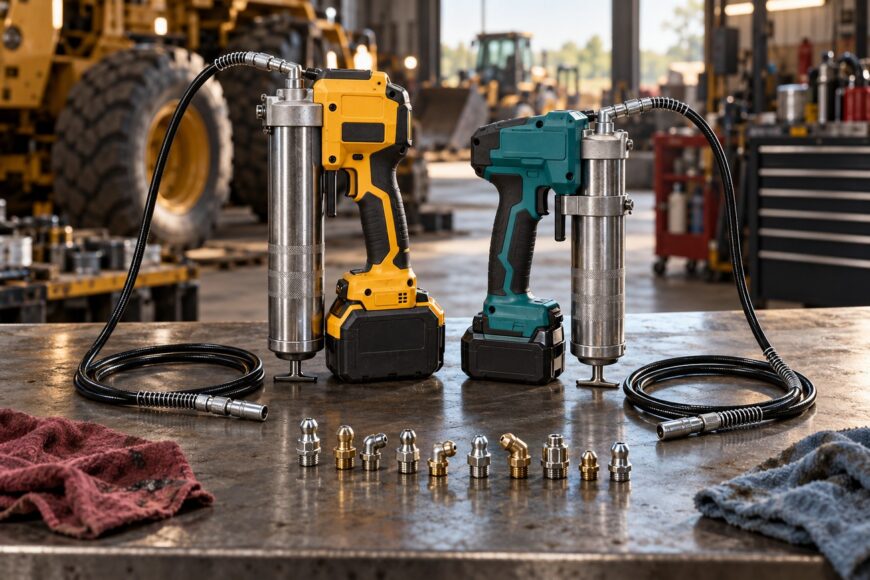
A shift with dozens of lubrication points calls for a different grease gun than an occasional service job. Fittings may sit behind guards, while cold grease can make a freshly loaded gun reluctant to deliver. A cordless tool saves repeated hand pumping, but its weight, hose access, and battery supply still shape how quickly you can finish the route.
DeWalt’s DCGG571/581 and Makita’s DGP180 both advertise high maximum pressure. Those figures deserve a unit conversion before they influence a purchase: they are effectively equal. The more useful comparison is the complete working setup—grease format, access to fittings, compatible batteries, and parts support. Published specifications provide a starting point, though they cannot tell you how either gun will behave at every fitting on your machine.
- DeWalt DCGG571/581 vs Makita DGP180: specs that matter
- Pressure is a tie, but flow is a different question
- Which gun keeps up with your lubrication route?
- Reach, weight, and control in awkward positions
- Cartridges, bulk grease, and cold-weather loading
- Battery platform and the real cost of entry
- When grease stops flowing: faults before brand blame
- The better buy for your setup
- Frequently asked questions
- How do I know whether a coupler will fit my machine’s grease fittings?
- What if one grease fitting refuses grease but the others work?
- How do I avoid overgreasing a bearing with a powered gun?
- How should I store a cordless grease gun between jobs?
DeWalt DCGG571/581 vs Makita DGP180: specs that matter
These published and listing-dependent figures are purchase checks, not a like-for-like field test. Confirm the exact model and market SKU before ordering.
| Item | DeWalt DCGG571/581 | Makita DGP180 |
|---|---|---|
| Maximum pressure | 690 bar (10,000 psi) | Listings cite 69 MPa, equivalent to 690 bar |
| Delivery or power | Published delivery: 147 g/min | Listings cite 480 W output; no comparable flow figure established here |
| Loading | Configurations described with a 400 g cartridge or 453 g bulk grease | Check local SKU and consumables |
| Hose | Listings describe roughly 1 m | Verify the supplied hose |
| Battery | Check exact XR/FlexVolt compatibility | Check exact LXT compatibility |
Pressure is a tie, but flow is a different question
DeWalt publishes a maximum of 690 bar (10,000 psi) for the DCGG571/581. Makita DGP180 listings cite a maximum operating pressure of 69 MPa. Since 69 MPa equals 690 bar, the figures express effectively the same pressure in different units. A larger-looking number on one product card is no basis for declaring a stronger gun.
Maximum pressure describes a limit the gun can develop under resistance. It does not describe how much grease reaches a bearing during normal use, or how long a technician spends at each point. A blocked fitting can resist either gun; the pressure rating is no reason to keep forcing grease into it. The fitting and the machine’s service instructions need attention first.
DeWalt publishes grease delivery of 147 g/min. That gives buyers a useful reference for the gun’s stated output, but it is not a prediction of route time. Makita listings cite 480 W output power, which measures something different. With no directly comparable Makita grease-delivery figure established here, neither a flow winner nor a time saving can be inferred from those numbers.
Access and grease condition further separate a specification from the job. A clear, reachable fitting may take little trigger time; a concealed fitting may take longer to find and couple securely. Cold, thick grease and restrictions can reduce actual delivery on either tool. Judge pressure as one capability among several, rather than a shortcut to selecting the faster gun.
Which gun keeps up with your lubrication route?

For a short, occasional job, the easiest gun to use may be the one that already has a charged, compatible battery on the bench. Setup, loading, and cleanup can take a substantial share of the visit. A published flow rate matters less if the route consists of a few fittings that are easy to reach.
Long routes around heavy equipment put different demands on the setup. DeWalt publishes 147 g/min delivery for the DCGG571/581 and describes a hose of roughly 1 m, which can help you reach points without moving the whole gun into a confined space. Even so, the number of fittings completed per charge is the useful question to test on your own equipment. No verified head-to-head fittings-per-charge figure is available here.
Grease supply also governs interruptions. DeWalt configurations are described with a 400 g cartridge or 453 g bulk grease; verify the locally sold version before planning stock. Count cartridge changes, coupling and uncoupling, and any priming needed after loading. Those pauses can outweigh a difference in theoretical delivery during a route with awkward or contaminated fittings.
A single battery can stop work while it charges, even when the gun and grease supply are otherwise ready. A second compatible battery helps keep a long route moving, provided it is charged and appropriate for the exact tool. Before buying, consider how you will carry the gun, spare grease, and battery through the route. Completion time depends on that routine as much as on the trigger.
Reach, weight, and control in awkward positions
A hose can reach a concealed fitting while the gun stays somewhere stable. DeWalt DCGG571/581 listings describe a hose of roughly 1 m, a useful length around large equipment where the barrel cannot fit beside the grease nipple. Reach alone does not guarantee a good connection: the hose must route without a sharp bend, and the coupler needs enough room to seat squarely.
Holding a cordless gun overhead is a separate problem from reaching the fitting. A full barrel and a larger battery put more weight in your hand, particularly when you work at arm’s length. Some DCGG571M1 listings give 3.63 kg with a battery, but that model-specific figure is not a like-for-like weight comparison with the Makita. Battery size and grease load also affect how either tool feels.
Where possible, set the gun on a clean, secure surface and guide the coupler with your free hand. On a lift or beside a machine, check that this position does not pull the hose across a moving part or leave the gun where it could fall. If you must support the entire tool while aligning the coupler, grip shape, trigger control, and balance become important.
An LED can help you locate a recessed point, but it cannot show whether the coupler seats properly from every angle. Similarly, a long hose is less useful if its route makes it hard to control the tip. A hands-on fit check with your usual battery and a representative access point is more revealing than a weight or hose-length figure alone.
Cartridges, bulk grease, and cold-weather loading
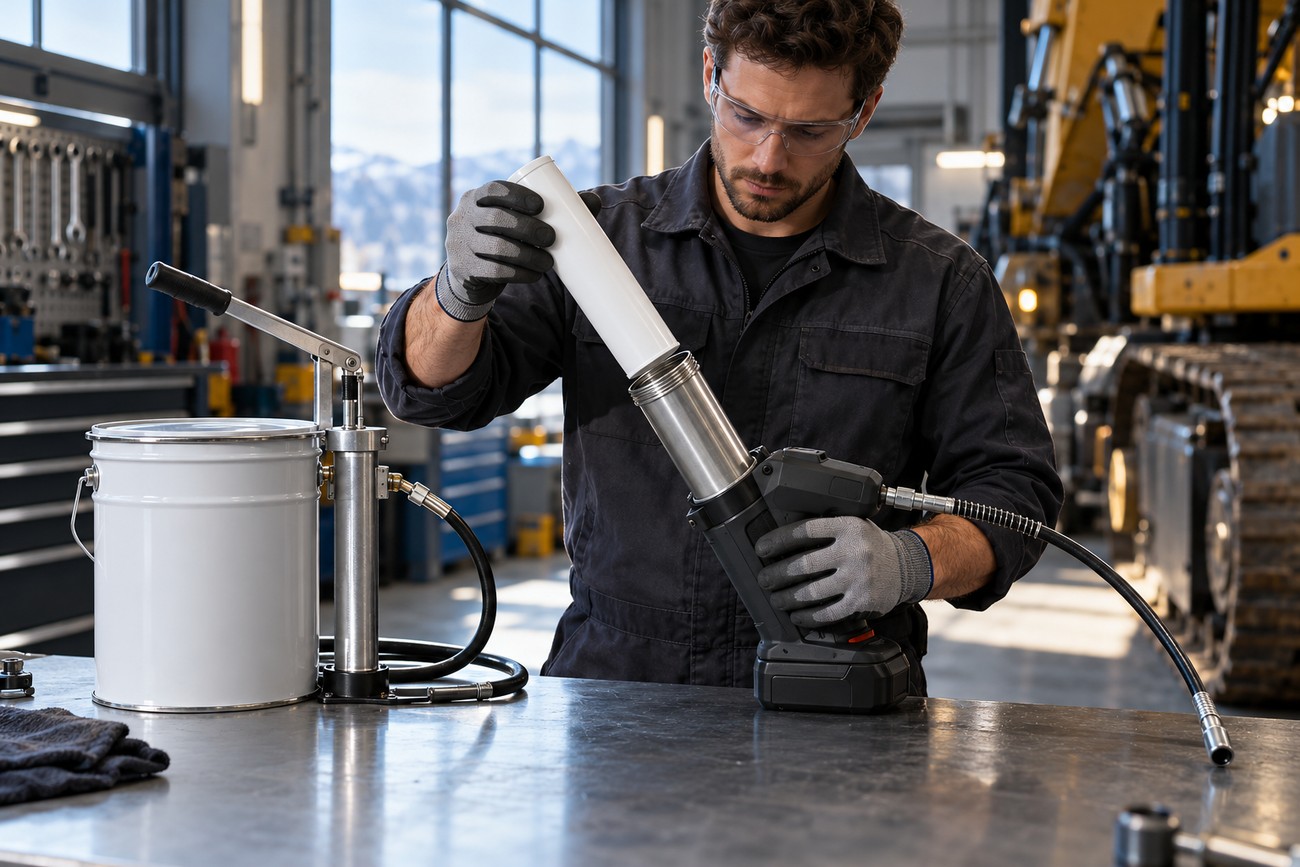
Cartridges can make grease changes cleaner and simplify stock control when a workshop uses a consistent product. Bulk loading may suit a site that already dispenses grease from a larger supply, though the filling process needs care to keep dirt out. DeWalt DCGG571/581 configurations are described with a 400 g cartridge or 453 g bulk grease. Check the local SKU and cartridge format before assuming that either loading method is supplied.
Do the same for the Makita DGP180. A familiar-looking barrel does not establish that the guns accept identical consumables in every market. Matching the cartridge, specified grease, and loading arrangement to what your storeroom carries prevents a routine service from becoming a search for a compatible refill.
After a cartridge change, trapped air can leave the motor running with little or no grease at the coupler. Allow time to prime the gun using its manual’s procedure before treating weak delivery as a pump fault. DeWalt descriptions call out an air-release valve, a practical feature when loading introduces air. Keep the open end and coupler clean throughout the change; contamination can cause problems beyond slow priming.
DeWalt specifies the DCGG571/581 for grease up to NLGI #2. That published limit is not a promise of unchanged flow when grease, hose, and tool are cold. Thick grease can increase resistance, so use a lubricant suitable for the machine and conditions, and follow the tool’s guidance. High maximum pressure cannot compensate for the wrong grease or guarantee steady delivery.
Battery platform and the real cost of entry
An existing tool fleet changes the buying calculation. If you already maintain suitable DeWalt batteries and chargers, a compatible DCGG571/581 package may be simpler to put into service. The same applies to a Makita LXT owner considering the DGP180. Check compatibility against the exact gun, battery series, and market; a shared brand name alone does not establish that a battery fits.
A first-time buyer needs to compare complete usable setups. A bare-tool listing may omit both battery and charger, leaving a lower displayed price than the cost of putting the gun to work. Price the exact package, a compatible charger, and a useful spare battery alongside the tool. Include the grease and coupler arrangement your machines require.
Makita LXT listings include battery capacities from 1.5 to 6 Ah, but capacity alone does not establish fittings per charge. Load, grease condition, and how long the motor runs at each fitting all matter. Rather than promise a runtime from the label, plan around the length of your route and whether you can charge or swap a battery during the shift.
Ownership costs continue after the initial purchase. Ask local suppliers about replacement hoses, seals, valves, and service support for the precise model sold in your region. A small difference on a specification sheet has limited value if a damaged hose leaves the gun idle while a part is sourced. Availability matters most to fleets that depend on scheduled lubrication.
When grease stops flowing: faults before brand blame
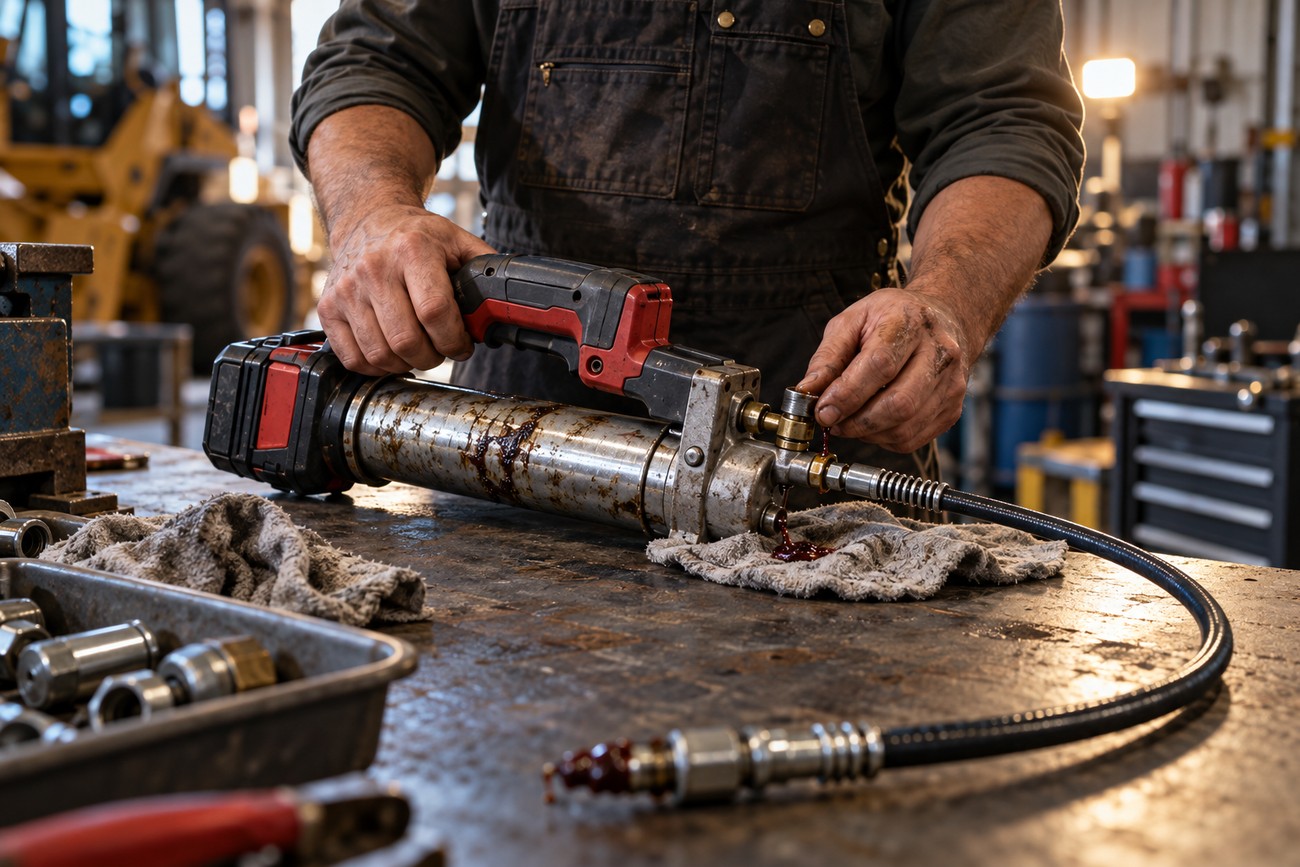
Start with the simple conditions that affect the whole gun. Check that the battery is charged and correctly seated, then consider whether the grease has become difficult to move in the cold. If delivery stopped after loading, trapped air is a likely possibility. Follow the model’s manual for priming; DeWalt descriptions specifically call out an air-release valve.
Next, look for a restriction in the accessible flow path, such as a damaged hose or a filter that needs attention under the manufacturer’s service procedure. Keep the distinction between a gun-wide problem and one fitting that refuses grease. If other points still take grease normally, investigate that fitting and the machine’s passage before replacing gun parts.
Neither headline pressure figure diagnoses a blockage: DeWalt publishes 690 bar (10,000 psi), while Makita listings cite 69 MPa, equivalent to 690 bar. Do not use those ratings as a reason to force a blocked point. Grease equipment can retain pressure, so consult the tool manual for safe pressure release before disconnecting or servicing components, and follow the machine’s lubrication procedure for the fitting itself.
The better buy for your setup
For a DeWalt owner, the DCGG571/581 deserves a close look if the exact gun accepts batteries already in the fleet. Its published 147 g/min delivery, roughly 1 m hose in listings, and described air-release valve are relevant to frequent work at hard-to-reach points. Confirm the local loading configuration and handle the gun with your usual battery before deciding that those features fit your route.
For a Makita LXT owner, the DGP180 may avoid a second battery and charger ecosystem, subject to exact compatibility. Its listed 69 MPa maximum operating pressure equals DeWalt’s published 690 bar (10,000 psi). The available figures do not establish a comparative Makita flow rate or a runtime winner, so avoid paying for either gun on an assumed speed advantage.
Without either platform, compare the cost and availability of complete working kits. Include the battery, charger, useful spare, locally stocked grease format, and replacement parts. Consider where the gun can rest during service and whether the supplied hose and coupler reach your actual fittings. Those details can affect a shift more directly than effectively equal pressure figures.
There is no universal quality winner established by these specifications. Before ordering, check the exact SKU, included battery and charger, battery-series compatibility, grease and cartridge format, and access to hoses, seals, valves, and service. That short check is more dependable than choosing by the largest-looking pressure number.
Frequently asked questions
These checks address fittings, lubrication limits, and care between jobs. Use the tool manual for model-specific procedures and the machine’s service instructions for its lubrication requirements. A gun that can develop pressure still needs the right connection and a clear stopping point.
How do I know whether a coupler will fit my machine’s grease fittings?
Identify the fitting style and the angle from which you can approach it, then check the coupler supplied with the gun against both. A coupler may match the fitting yet be too bulky to attach squarely behind a guard. Inspect a representative point before buying, including the clearance needed to connect and remove the tip without straining the hose.
If the machine uses more than one fitting style, confirm the required adapters and their compatibility with the hose connection. Keep adapters clean during changes so grit does not enter the fitting.
What if one grease fitting refuses grease but the others work?
If the same gun delivers normally at other points, investigate the individual fitting and its grease passage first. Check whether the coupler is seated correctly and whether the fitting is damaged or obstructed. Do not treat the gun’s maximum pressure as a reason to hold the trigger against a resistant point.
Consult the machine’s service procedure before removing a fitting or opening a passage. It may specify how to relieve pressure and where grease should appear. Persistent resistance can indicate a problem that needs maintenance beyond the grease gun.
How do I avoid overgreasing a bearing with a powered gun?
Follow the equipment manufacturer’s specified grease quantity and lubrication interval rather than judging by trigger time or gun pressure. Powered delivery can make it easy to add more grease than intended while waiting for a visible sign. If the procedure calls for a measured amount, use its stated method and stop at that amount.
Visible grease discharge is not a universal stopping rule. Some assemblies have a defined purge path; others can be harmed by excess grease. Check the bearing or machine instructions, particularly after a component has been serviced or its grease specification has changed.
How should I store a cordless grease gun between jobs?
Wipe the coupler and exposed grease from the tool, then protect the tip from dirt. Secure the hose so it is not kinked, crushed, or left pulling on its connection. Clean handling matters at the next job: contamination on the coupler can be carried straight to a fitting.
Store the tool and battery according to their manuals, including any instructions on temperature, battery removal, and long-term storage. Before returning the gun to service, inspect the hose and coupler for damage and confirm that the grease remains suitable for the machine.