A wider stance can improve a vehicle’s appearance and may have a place in a carefully developed track setup. The same spacer also changes wheel offset, steering geometry, fastener requirements, and the loads carried by bearings, ball joints, and steering links. Its thickness is therefore a fitment decision, not a styling measurement.
Poor planning commonly leads to vibration at highway speed, tire rubbing at full lock or during compression, heavier steering, and hardware or bearing life that falls short of expectations. The reliable approach is to calculate the final wheel position, verify clearances and centering, and validate the installation after driving rather than assume that a small spacer is automatically harmless.
- What Wheel Spacers Actually Change
- Choose Thickness by Fitment, Not Appearance
- Hub-Centric Fitment and Fastener Engagement
- Why Spacers Lead to Vibration, Rubbing, and Wear
- Track Width Tuning for Road and Track Use
- Installation, Validation, and the Mistakes to Avoid
- Frequently asked questions
- How much offset does a 2-inch spacer add?
- What is the 3% rule for tires, and does it apply to wheel spacers?
What Wheel Spacers Actually Change
A spacer moves the wheel outward from its original mounting face. Its thickness changes the wheel’s effective offset by the same amount: a 10 mm spacer makes the wheel sit 10 mm farther outward and changes the effective offset by 10 mm. Because both sides move outward, a 10 mm spacer on each side increases total track width by 20 mm.
That outward movement also increases the lever arm acting on the wheel bearings, ball joints, and steering links. The load generally rises nearly linearly with spacer thickness and offset change, although actual durability depends on the vehicle, wheel and tire mass, road conditions, and driving style. The OEM offset range is generally selected for the combined hub, bearing, arch, steering, suspension, and wheel package.
Front-axle spacers can alter scrub radius, steering feedback, sensitivity to road irregularities, and return-to-center behavior. A wider track may change how the vehicle feels in a corner, but it does not automatically create more tire grip or improve everyday handling. Geometry, tire characteristics, alignment, and road surface still control the result.
Choose Thickness by Fitment, Not Appearance
Start with the wheel’s original offset and subtract the spacer thickness to estimate the new effective offset. For example, a wheel with a positive offset of 45 mm and a 10 mm spacer behaves geometrically like a wheel with an effective offset of 35 mm. This calculation shows where the wheel moves; it does not prove that the resulting position is safe or compatible.
The final position must be checked against the fender, inner liner, suspension, brake assembly, and steering components. Check at full steering lock and through suspension compression, because a wheel that clears while stationary and unloaded may touch during a turn or over a bump. Tire width, sidewall shape, wheel design, ride height, and alignment can all change the result.
Claims that 3–5 mm spacers are automatically harmless are too broad. Even a small change can reduce thread engagement, affect centering, alter brake or body clearance, and change sensor behavior where relevant. A visual improvement may be worthwhile for a show-oriented build, while the same change offers no meaningful benefit in normal road handling.
Hub-Centric Fitment and Fastener Engagement
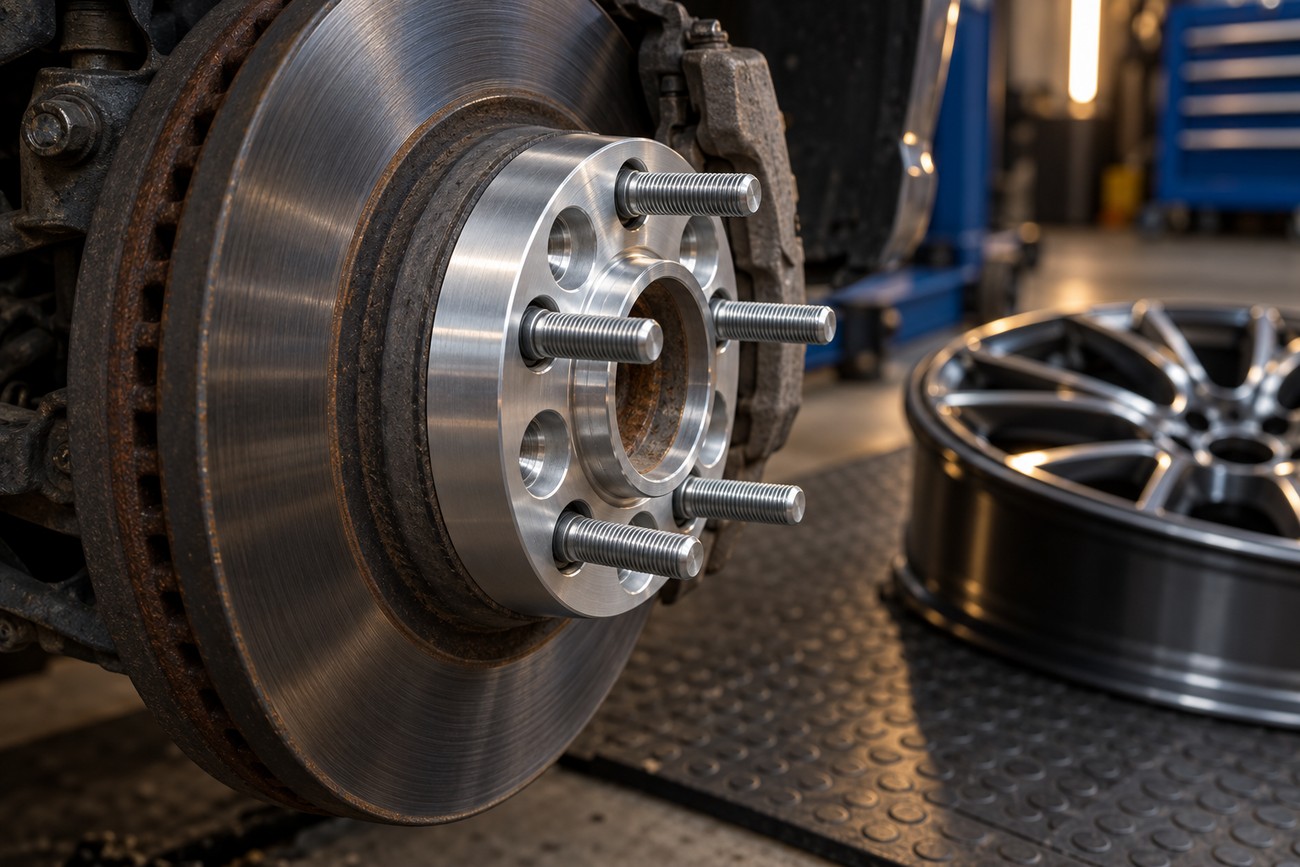
The spacer should be hub-centric and correctly match the vehicle hub and wheel center bore. The hub register centers the wheel assembly; the wheel fasteners clamp it in place. A universal non-hub-centric spacer can leave more room for radial runout and speed-related vibration, making diagnosis difficult because the tire, wheel, hub, and spacer may each appear acceptable when inspected separately.
Spacer thickness may require longer wheel bolts or studs. The original hardware must not be assumed suitable, especially if the spacer occupies part of the original thread length or uses a bolt-on design with its own fasteners. A practical baseline is thread engagement at least equal to the fastener diameter, while the vehicle, wheel, spacer, and fastener specifications control the final requirement.
Check the actual engagement rather than counting visible threads from outside the wheel. Confirm that the fastener seats correctly, that its head or seat matches the wheel, and that it does not bottom out before clamping the assembly. A seller’s generic statement about compatibility cannot replace the applicable OEM and fastener specifications.
Why Spacers Lead to Vibration, Rubbing, and Wear
Vibration after installation often results from accumulated tolerances between the hub, spacer, wheel, and tire. Mating-face dirt, corrosion, imperfect centering, spacer runout, wheel imbalance, or tire imbalance can combine into a problem that becomes noticeable at highway speed. Rebalancing and runout checks may be needed rather than immediate tire replacement.
Rubbing can occur at the fender, liner, brake, or steering components even when the vehicle appears clear in the workshop. The wider position reduces available body clearance, while steering lock, suspension compression, tire flex, and passengers or cargo change the wheel’s operating envelope. Listen for contact and inspect the affected surfaces after a controlled road check.
Drivers may also notice heavier steering, stronger kickback over potholes, or different return-to-center behavior. These effects are linked to the changed scrub radius and the longer lever arm on bearings, ball joints, and steering links. The front axle usually exposes geometry changes more clearly because it transmits those forces directly through the steering wheel.
A spacer adds unstrung mass and moves wheel mass outward, which can reduce suspension response and increase mechanical demands. On a heavy vehicle with large wheels, rough roads, or frequent impacts, the consequences may appear first as accelerated wear or bearing noise rather than as an obvious handling problem.
Track Width Tuning for Road and Track Use
Motorsport treats track width as one part of a complete setup. Engineers and drivers evaluate it together with camber, toe, tire characteristics, suspension behavior, and overall vehicle balance. A spacer used in that context is tested as part of a known package rather than selected as an isolated grip upgrade.
Front-axle changes usually produce the clearest change in steering feedback and sensitivity to road irregularities. Different spacer thicknesses front and rear can be used for fine balance tuning, but the outcome depends strongly on the platform, tire construction, alignment, and suspension settings. A result that suits one vehicle may make another less predictable.
On public roads, a wider track can increase sensitivity to grooves, potholes, and uneven surfaces. The altered tire path may also increase tramlining, impact harshness, or noise. A more purposeful stance can therefore coexist with a less comfortable and less confidence-inspiring drive, particularly where road surfaces are inconsistent.
Installation, Validation, and the Mistakes to Avoid
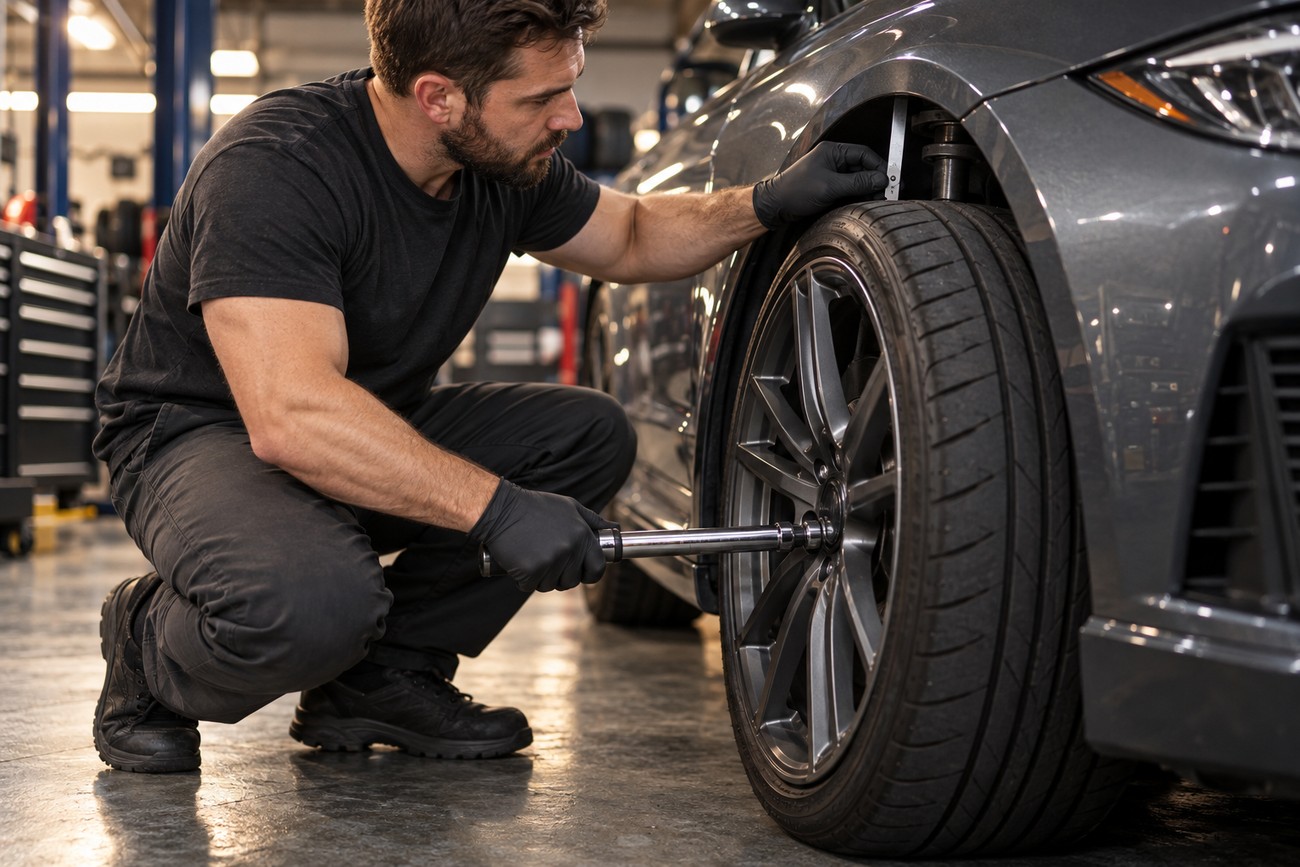
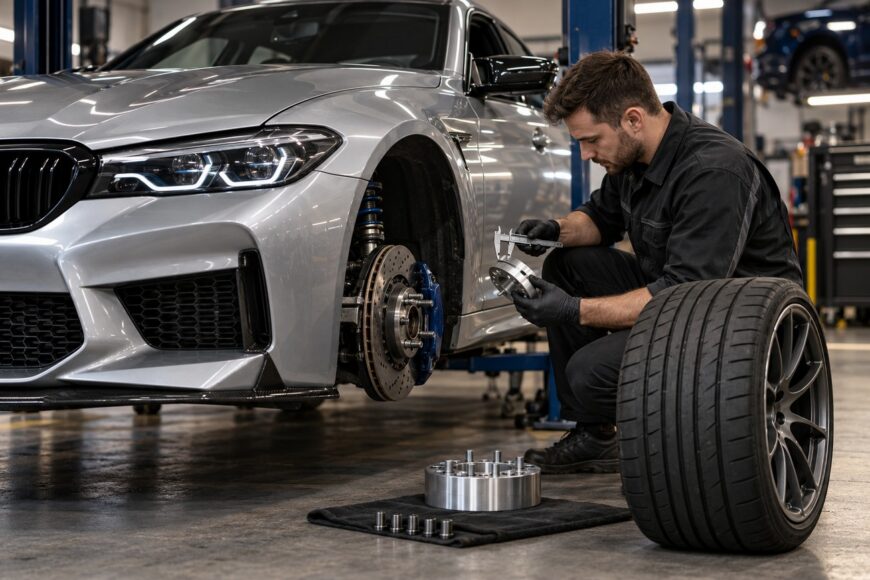
Before installation, confirm the vehicle hub diameter, wheel center bore, spacer design, wheel offset, and required fastener type. Calculate the final offset, then inspect clearance around the brake assembly, suspension, steering, fender, and liner. Include full steering lock and suspension compression in the check.
Clean the hub, spacer, and wheel mating faces until they seat fully and evenly. Dirt, corrosion, or trapped debris can create runout even when the spacer dimensions are correct. Fit the specified hardware, verify real thread engagement, and apply torque according to the applicable vehicle, wheel, and spacer specifications.
Post-installation vibration is best isolated in sequence: inspect mating-face cleanliness, measure hub and spacer runout, confirm wheel centering, and then check balance. Adding more torque or replacing tires first can hide the actual source.
Recheck for runout, vibration, and rubbing after installation, and perform later torque checks as required by the applicable specifications. Salt, brake dust, and dirt can accumulate around the enlarged wheel-to-hub interface, causing corrosion and making later removal difficult. Spacers may also interfere with snow chains or complicate wheel and brake service.
No visible rubbing proves that bearing loads, steering geometry, centering, or thread engagement are acceptable. Likewise, a small spacer is not automatically safe without measurement. Treat the absence of an immediate symptom as one observation in the validation process, not as approval of the installation.
Frequently asked questions
How much offset does a 2-inch spacer add?
A 2-inch spacer moves the wheel outward by 2 inches per side and changes the effective offset by 2 inches. Because both wheels on an axle move outward, total track width increases by 4 inches.
This is a geometric calculation, not fitment approval. The change must still be checked against the fender, suspension, brakes, steering components, fastener engagement, and hub design. Actual fitment feasibility depends on the vehicle and wheel package.
What is the 3% rule for tires, and does it apply to wheel spacers?
The 3% rule is a commonly cited guideline for keeping replacement tire diameter within roughly 3% of the original size. It is used to discuss tire diameter, speedometer behavior, gearing, and available clearance.
It does not determine spacer safety. Hub centering, fastener engagement, bearing load, scrub radius, brake clearance, and body clearance require separate checks. A tire can follow the 3% guideline while a spacer installation remains unsuitable.