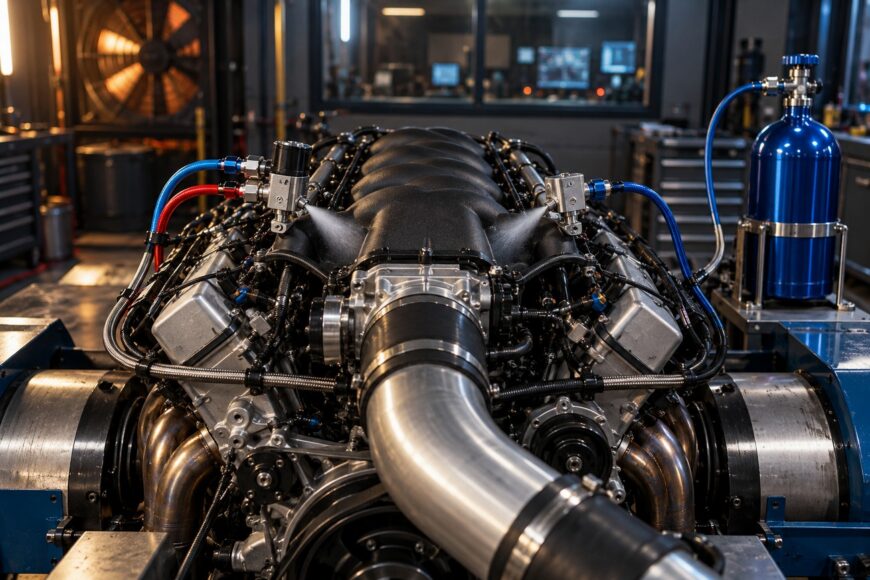
Choosing between a wet and dry nitrous kit is mainly a decision about where the additional fuel comes from and how much responsibility remains with the vehicle’s factory fuel system and ECU. A wet kit supplies N₂O and supplemental fuel through a shared injection path. A dry kit supplies N₂O while the existing fuel system, under ECU control, adds the fuel.
That distinction shapes the failure modes as much as the installation. A dry system may lean out at high rpm when injector or pump capacity is exhausted, while a wet system can create uneven cylinder fueling or an intake backfire if its atomization and nozzle placement are poor. Damaged plugs, unstable bottle performance, and inconsistent results usually point to fuel delivery, ignition timing, AFR control, pressure, or operating conditions rather than to the kit label alone.
Neither design is automatically safer. A reliable installation needs controlled activation, verified fuel pressure, shot-specific ignition retard, suitable spark plugs, and AFR or lambda data recorded during the actual nitrous event. For a street car, repeatable and diagnosable delivery is generally more valuable than the largest nominal shot a seller lists.
- Wet vs Dry Nitrous Kits: What Actually Changes
- Wet and Dry Kits Compared by Fuel, ECU, and Intake Demands
- Why Nitrous Makes Power—and Why Cooling Is Not a Free Safety Margin
- Tuning and Safety: Where Both Kit Types Succeed or Fail
- Common Nitrous Failures: Lean Spikes, Backfires, and Damaged Parts
- Bottle Pressure, Temperature, and Repeatability on the Street or Track
- How to Choose the Right Kit for Your Engine
- Frequently asked questions
- What is the difference between a wet and dry nitrous system on a modern fuel-injected engine?
- Why is nitrous oxide illegal in some cars or locations?
- How much horsepower does a 100-shot of nitrous actually add?
- What is the best nitrous system for a stock daily-driven car?
- How can you tell whether a nitrous problem is fuel delivery, bottle pressure, or ignition-related?
Wet vs Dry Nitrous Kits: What Actually Changes
A wet kit introduces nitrous oxide and additional fuel through the same injection path, usually upstream of the throttle body or at a selected point in the intake tract. The kit’s jets or metering system determine the intended relationship between the two fluids. This gives the system a degree of independence from the factory injectors during the nitrous event, although the engine still needs an adequate base fuel system and correct calibration.
A dry kit injects only N₂O. The vehicle’s existing fuel system and ECU must recognize the additional engine demand and supply the required fuel through the factory injectors. That arrangement can be clean and well integrated on a platform with sufficient injector headroom, pump output, predictable MAF or MAP behavior, and an ECU that can be calibrated for the activation window.
The difference also changes installation priorities. A wet system requires careful attention to fuel plumbing, jetting, atomization, line length, and nozzle location. A dry system may require less supplemental fuel hardware, but its success depends more heavily on injector capacity, fuel-pump output, sensor logic, and ECU intervention. A system that appears simpler under the hood can therefore demand more detailed electronic validation.
Intake architecture matters in both cases. Wet fuel and N₂O must remain properly atomized and distributed to the cylinders; a long or poorly designed intake can encourage unequal mixture delivery or liquid pooling. Dry systems avoid adding fuel in the intake tract, yet they can still create cylinder-to-cylinder differences through the factory fuel rail and injector arrangement. Safety depends on fuel delivery, ignition timing, AFR control, and hardware condition rather than kit type alone.
Wet and Dry Kits Compared by Fuel, ECU, and Intake Demands
The table shows general tendencies rather than guarantees. Engine architecture, fuel-system condition, ECU strategy, and installation quality can move a particular application away from the typical pattern.
| Area | Wet kit | Dry kit |
|---|---|---|
| Fuel delivery | Supplies N₂O and supplemental fuel through a shared injection path. | Supplies N₂O while the vehicle’s existing fuel system and ECU add the fuel. |
| Dependence on injectors and pump | Can better tolerate a moderate power increase when factory fuel reserve is limited because fuel is delivered with the N₂O event; the base system still must remain stable. | Depends heavily on injector capacity and pump output, especially at high rpm and high load. |
| ECU, MAF, and MAP sensitivity | Still requires suitable timing and engine management, but supplemental fuel is metered by the kit. | Strongly affected by MAF/MAP logic, closed-loop behavior, ECU protections, and calibration strategy. |
| Intake-distribution behavior | Can suffer from uneven cylinder fueling, intake pooling, or backfire if jetting, atomization, line length, or nozzle placement is poor. | Avoids adding fuel through the intake nozzle, but factory injector and manifold distribution still determine cylinder fueling. |
| Installation implications | Needs additional fuel plumbing, correct jets, sound connections, and careful nozzle placement. | May require less fuel hardware, but demands verified injector and pump reserve plus ECU calibration. |
| Typical platform fit | Attractive where moderate extra output is desired and the factory fuel system has limited reserve, provided intake distribution can be controlled. | Attractive where the ECU is well understood and injector and pump capacity are clearly sufficient. |
Wet systems can be forgiving of a limited factory fuel reserve because the kit adds fuel at the same time as N₂O. That does not make them independent of the vehicle’s fuel system. Fuel pressure still has to remain stable, the base tune must be sound, and the added fuel must reach the cylinders in a controlled way.
Dry systems are often marketed as simpler or safer for stock engines because they do not introduce supplemental fuel through the intake. The practical qualification is important: “usable on a stock engine” does not mean “usable without tuning.” If the factory injectors, pump, or ECU calibration reaches its limit during activation, the dry kit can run short of fuel at precisely the point when the engine needs more of it.
Neither side has a universal advantage in distribution. A wet kit can produce rich and lean cylinders when its spray pattern or location is wrong, while a dry kit can expose weaknesses in the factory rail, injector matching, or ECU strategy. The better choice is the one that gives the tuner a known fuel path and measurable control on the specific engine.
Why Nitrous Makes Power—and Why Cooling Is Not a Free Safety Margin
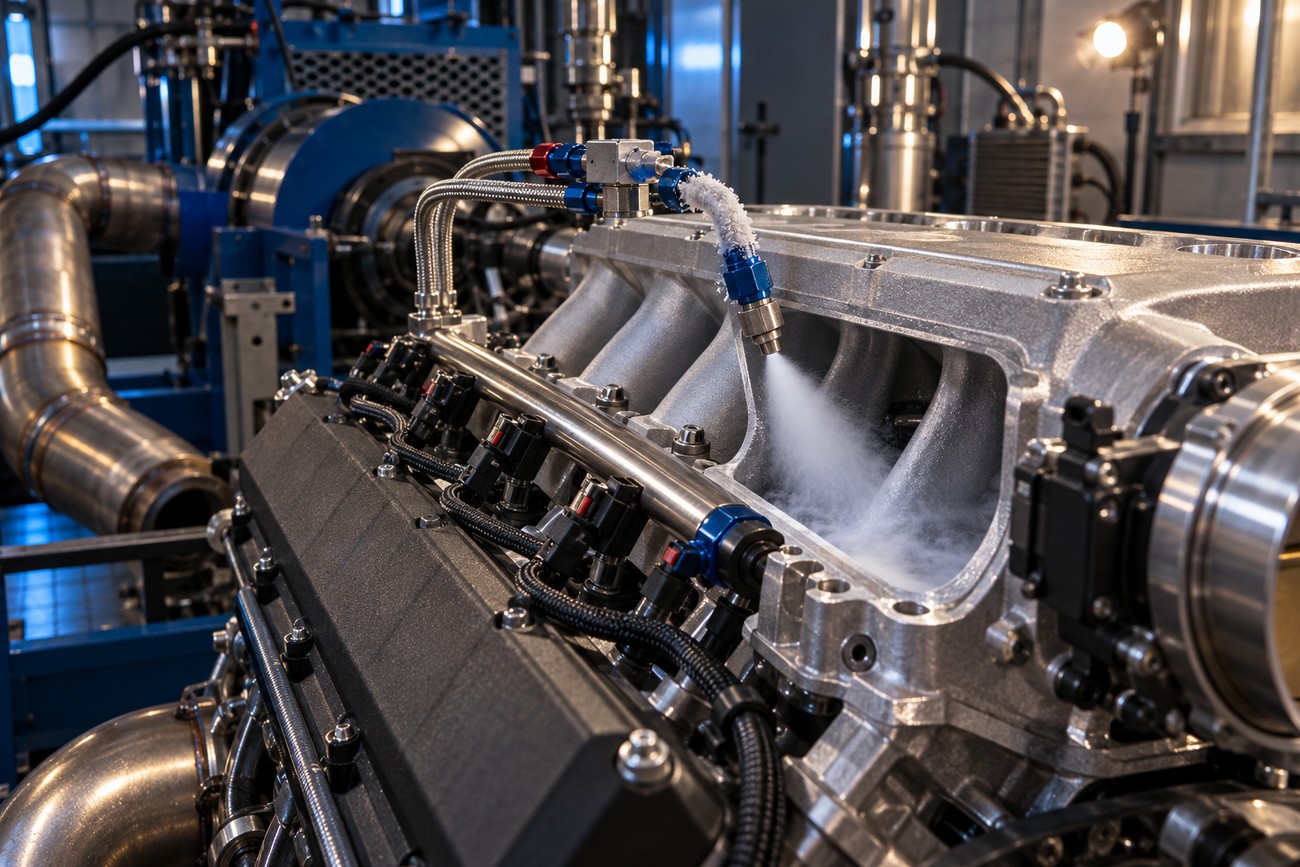
Nitrous oxide contributes power because, when heated in the engine, it supplies additional oxygen to the combustion process. More oxygen permits more fuel to be burned, so the mixture must be enriched with additional fuel during the nitrous event. Adding N₂O without providing that fuel increases the chance of a lean mixture and sharply raises detonation risk.
The gas also expands as it changes state and moves through the intake system. That expansion can reduce intake-charge temperature, which may improve the engine’s detonation margin and help the charge occupy less volume. The cooling effect depends on atomization, injection location, and engine load, so it varies with the installation rather than appearing as a fixed benefit with every activation.
Good cooling cannot compensate for a fuel shortage. A cooler intake charge may make the engine feel more responsive while the combustion mixture is still too lean, and that combination can encourage an aggressive shot before the fuel and ignition systems have been validated. Fuel quality remains important because a weak fuel supply or low detonation margin can erase the benefit of lower charge temperature.
Distribution is part of this calculation. If one cylinder receives a different mixture from the others, an average AFR reading can conceal the cylinder with the least safety margin. Nitrous therefore needs correct fueling, shot-specific timing control, and suitable engine hardware even when intake temperatures appear favorable.
Tuning and Safety: Where Both Kit Types Succeed or Fail
Activation should be limited to conditions the engine can actually tolerate. A WOT switch prevents the system from operating during partial-throttle transitions, while an RPM or similar control can keep the shot away from a low-speed condition where cylinder pressure and load may become difficult to manage. The exact control strategy depends on the engine and ECU, but accidental activation is a poor substitute for calibration.
Fuel pressure must be verified under load and during the nitrous event, not only with the engine idling in the workshop. The tuner also needs to confirm injector duty-cycle headroom, pump output, and the behavior of the pressure regulator. AFR or lambda logging under activation is essential because a static pressure check can miss a momentary drop when the system demands fuel.
Ignition timing needs shot-specific retard rather than a generic assumption that the factory map will provide enough margin. The required change depends on compression, fuel, combustion-chamber design, boost if present, engine load, and the intended N₂O level. Spark plugs are part of the same system: suitable colder plugs and an appropriate, often reduced, plug gap can help control misfire and heat stress, but they do not repair a lean mixture or excessive timing.
Fuel quality strongly affects detonation margin for both kit types. A tune that behaves acceptably with consistent, suitable fuel can become unsafe when fuel quality, ambient temperature, or bottle pressure changes. The initial test should use a smaller shot than the seller’s maximum claim, with logs and inspection guiding any later increase rather than a nominal rating dictating the result.
The phrase “works on a stock engine” describes a possible application, not a completed setup. A stock engine may still have limited injector reserve, an inaccessible ECU, unsuitable spark plugs, or an intake that distributes a wet charge poorly. Before repeated use, verify fuel pressure, AFR or lambda, timing control, plug condition, activation logic, and the condition of the engine itself.
Common Nitrous Failures: Lean Spikes, Backfires, and Damaged Parts
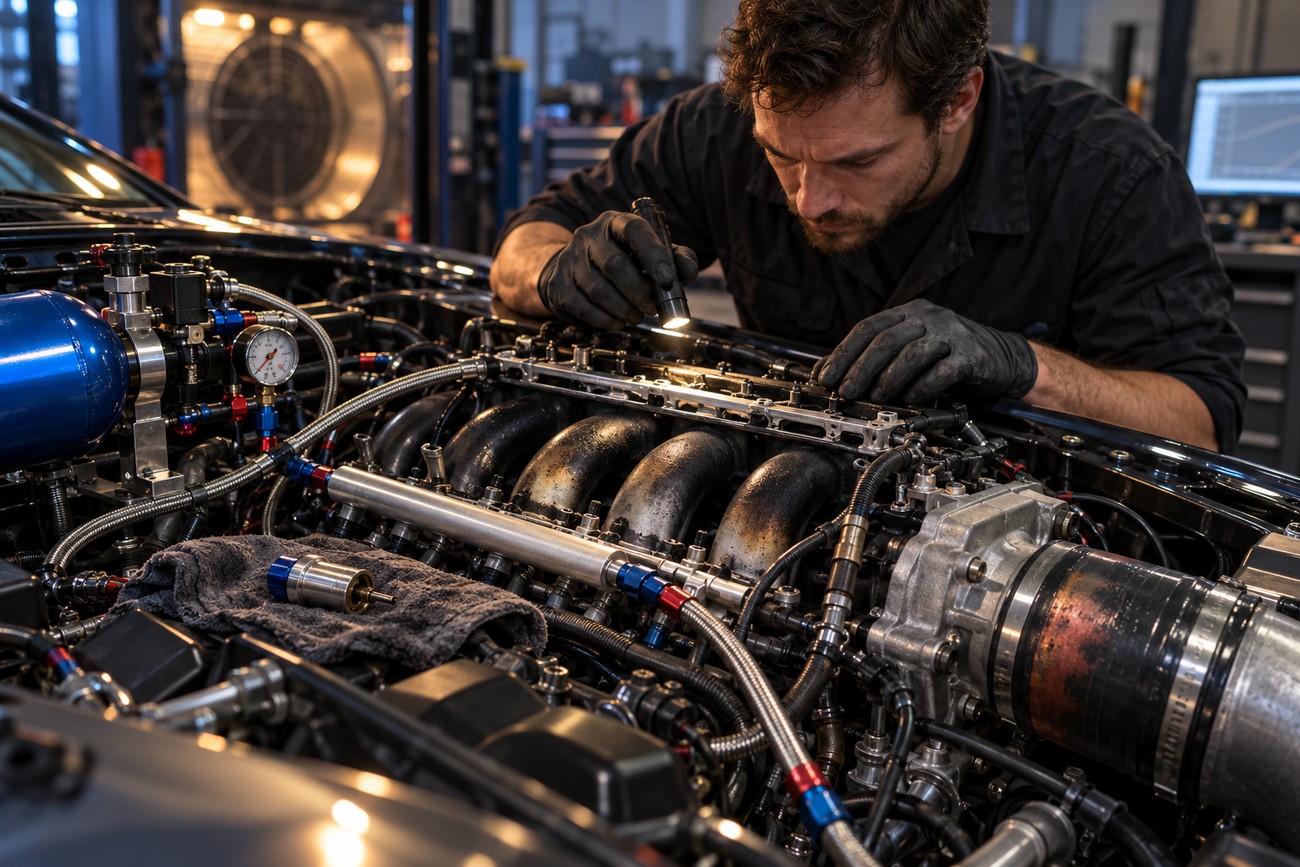
A car that pulls well at first and then falls flat near the top of the rev range may be running into fuel-system capacity. On a dry kit, the pump or injectors may no longer supply the required fuel, or the ECU may apply a correction or protection strategy that changes the mixture and power. A pressure trace and injector data under activation are more useful than assuming the bottle is empty or the engine has simply reached its limit.
A wet kit can create a different pattern of trouble. Poor atomization, incorrect jetting, long or unequal lines, and an unsuitable nozzle location can cause liquid fuel to collect in the intake or distribute unevenly between cylinders. That can produce rich and lean cylinders at the same time, along with hesitation or an intake backfire. Changing jets without checking the spray pattern and plumbing can hide the cause rather than solve it.
Detonation, cracked spark plugs, damaged pistons, and failed gaskets can follow an aggressive shot used without adequate fuel or ignition retard. Stock plug heat range and stock gap assumptions may increase misfire or heat stress, but plug damage alone does not identify the original failure. The diagnostic sequence should include timing, fuel pressure, mixture data, bottle pressure, and the condition of the intake and engine.
Both systems can become inconsistent when operating conditions change. Bottle pressure, ambient temperature, fuel quality, engine load, and delivery stability affect the real output of a nominal shot. If the same activation produces different results on separate runs, record those variables before changing calibration; otherwise, the tuner may compensate for pressure variation with an unsafe fuel or timing change.
Bottle Pressure, Temperature, and Repeatability on the Street or Track
Bottle pressure materially affects delivery. As pressure changes with bottle temperature and use, the same nominal jetting can produce a different mass flow and a different impression from the driver’s seat. A bottle that performs strongly on one pass may feel softer later, even though the switch, jets, and engine calibration have not changed.
Ambient temperature and fuel quality add further variation. Engine load, intake conditions, and the stability of the fuel supply influence how much of the available oxygen the engine can use safely. This is why a result observed on a cool test night may not transfer directly to a hot street session or a series of track passes.
Frequent runs can consume a bottle faster than new users expect. The practical consequence is more than refill cost: falling pressure can alter the result while the driver continues to judge the tune by acceleration alone. A pressure record, activation time, engine data, and plug inspection provide a clearer picture than seat-of-the-pants impressions.
Street vehicles generally benefit more from stable, repeatable delivery and clear diagnostics than from the largest possible shot. Track use exposes pressure and heat variation through repeated runs, so consistent bottle handling and comparable conditions become part of the calibration. A system that is slightly less aggressive but predictable is easier to protect and easier to troubleshoot.
How to Choose the Right Kit for Your Engine
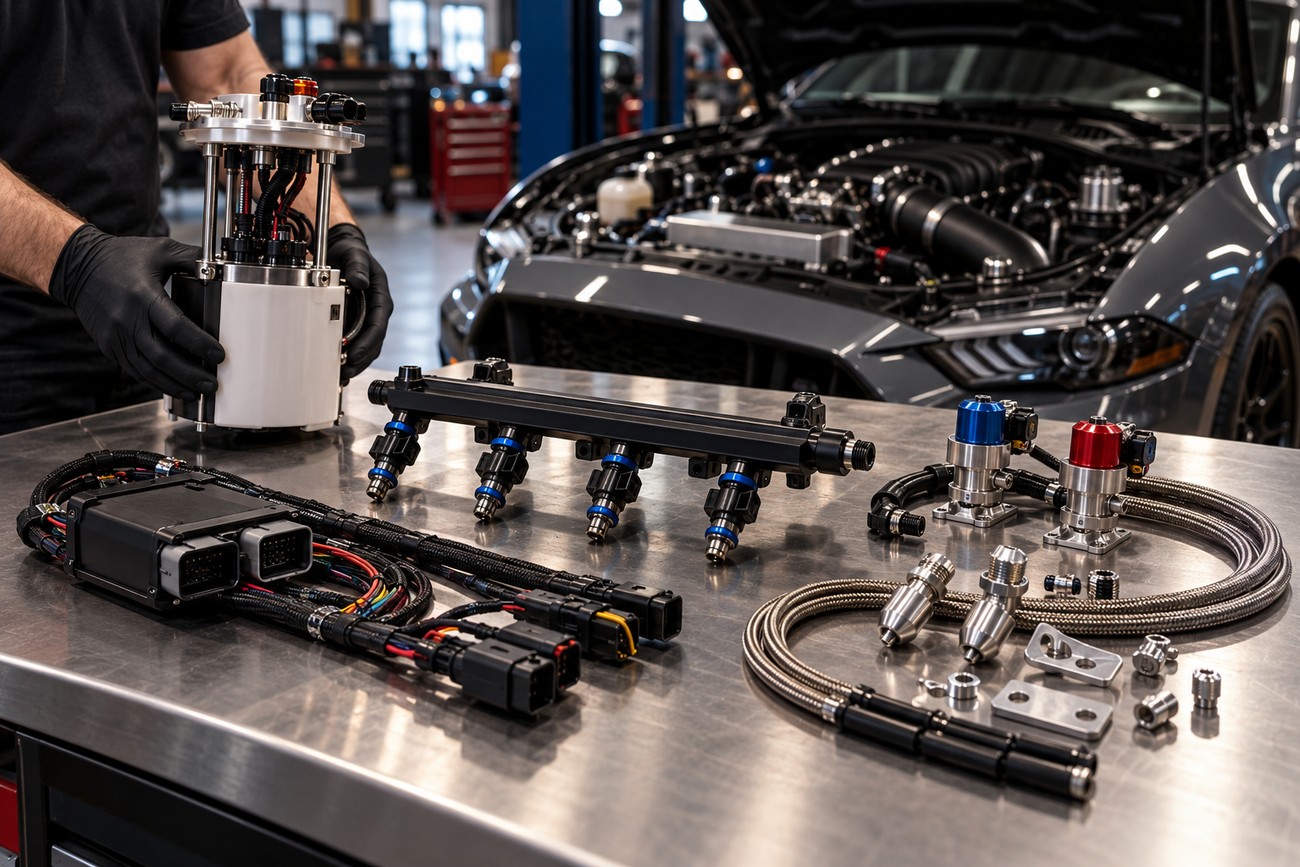
Start with the engine’s actual fuel-system reserve. Check injector capacity, pump output, fuel pressure under load, and the ECU’s ability to control enrichment and ignition timing. A wet kit may suit a platform with limited factory reserve because it adds fuel with the N₂O event, while a dry kit may suit an engine with sufficient capacity and a well-understood calibration.
Next, assess the intake architecture and sensor strategy. A wet system needs a nozzle location and spray pattern that distribute fuel and N₂O consistently across the cylinders. A dry system needs predictable MAF or MAP behavior, enough injector headroom, and an ECU that will not remove the intended enrichment or timing control during activation.
Use the intended application to set the priority. A street car needs serviceable plumbing, repeatable bottle pressure, clear diagnostics, and a calibration that can be checked after ordinary driving. A race car may justify more complex control and monitoring, but it still depends on fuel quality, stable delivery, and a shot appropriate for the engine’s mechanical condition.
Before installation, confirm the following points:
- Fuel pressure remains stable under load and during activation.
- Injector and pump capacity have been checked rather than assumed.
- The ECU can control the required enrichment and shot-specific ignition retard.
- A WOT switch and suitable activation limits are installed.
- Colder spark plugs and an appropriate plug gap are selected for the application.
- AFR or lambda can be logged during the actual nitrous event.
- Wet-kit jetting, atomization, line routing, and nozzle placement are verified.
- Bottle pressure and operating conditions can be monitored consistently.
- Road-use, emissions, bottle-mounting, and event rules have been checked for the intended location.
Wet is not always dangerous, and dry is not always safer. Both wet and dry kits can be used on street and race vehicles; suitability depends on engine architecture, fuel system, ECU, and intended use. Installation quality, tuning, monitoring, and operating conditions determine risk far more reliably than the name on the box.
Frequently asked questions
The most useful answer depends on the complete platform: engine design, fuel system, ECU strategy, intake layout, operating conditions, and intended use. The following points address common decisions without treating a nominal kit type or rating as a guarantee.
What is the difference between a wet and dry nitrous system on a modern fuel-injected engine?
A wet system supplies N₂O and supplemental fuel through a shared injection path, while a dry system supplies N₂O and relies on the vehicle’s injectors and ECU to add the fuel. On a modern engine, the practical difference extends into closed-loop corrections, injector headroom, MAF or MAP calculations, and ECU intervention.
Closed-loop operation may correct a mild change during ordinary driving, but it is not a substitute for a calibration that controls the actual activation window. If injector capacity is nearly exhausted, the ECU may be unable to add the required fuel or may invoke a protection strategy. A dry system therefore needs a well-understood control strategy, while a wet system needs verified distribution and spray quality.
Why is nitrous oxide illegal in some cars or locations?
Nitrous legality depends on jurisdiction and use. Road-use and emissions rules may restrict equipment that is active or installed on a street-driven vehicle, while bottle-mounting requirements can address restraint, venting, and occupant safety.
Racing organizations may apply separate rules covering bottle placement, shutoff access, safety equipment, and inspection. A system permitted at an event may still be unsuitable for public-road use, so local regulations and the rules of the specific event must be checked before installation or activation.
How much horsepower does a 100-shot of nitrous actually add?
A “100-shot” is a nominal kit rating intended to indicate approximately the added power target under specified conditions. It is not a guaranteed measured result on every engine. Actual output changes with bottle pressure, temperature, fuel quality, calibration, engine load, and engine condition.
The rating also does not describe safety by itself. A correctly supplied and calibrated system may produce a repeatable result, while an installation with unstable pressure or insufficient fuel may produce less power and greater mechanical risk. Testing should rely on controlled data rather than the label alone.
What is the best nitrous system for a stock daily-driven car?
There is no universally best system for a stock daily-driven car. Screen the choice by serviceability, fuel-system reserve, ECU accessibility, diagnostic capability, legal use, and the ability to maintain repeatable bottle pressure.
A wet kit may be attractive when the factory system has limited reserve and the intake can distribute the spray consistently. A dry kit may fit a platform with ample injector and pump capacity plus a controllable ECU calibration. In either case, a smaller, well-monitored installation is generally easier to live with than a larger system that cannot be diagnosed after a fault.
How can you tell whether a nitrous problem is fuel delivery, bottle pressure, or ignition-related?
Start by comparing the symptom with activation timing and recorded bottle pressure. If the engine leans out as rpm rises, check fuel-pressure behavior, injector demand, pump output, and AFR or lambda during the event. If power changes between otherwise similar runs while fuel data remains stable, compare bottle pressure, temperature, activation duration, and fuel quality.
Ignition-related problems may appear as misfire, plug damage, or detonation signs, but plug inspection should be combined with timing verification and mixture data rather than used alone. The useful order is to preserve the logs, confirm pressure and activation behavior, inspect plugs and hardware, then change one calibration or hardware variable at a time.