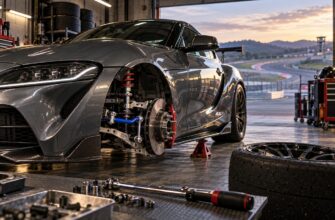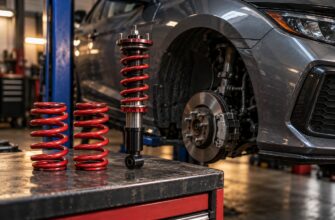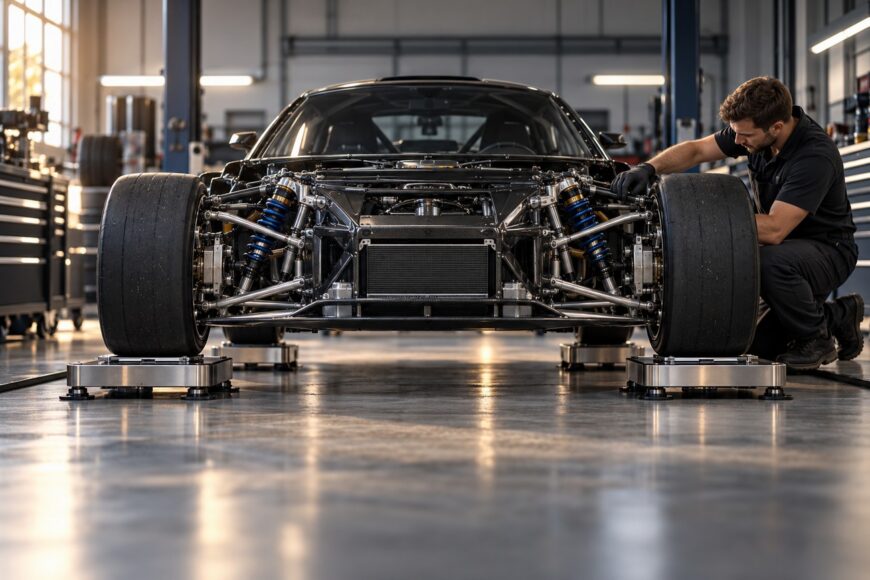
A car that turns willingly in one direction and pushes wide in the other may have more than a tire or alignment problem. Unequal static wheel loads can make the suspension reach its working range differently from corner to corner, especially on a track car with adjustable coilovers. The result is a car that feels inconsistent even when the ride height appears correct.
Corner balancing adjusts static load distribution across the four wheels by changing spring-platform height. It is a measured setup procedure, not a magic cure for poor handling. A nominal 50% cross-weight can mean little if the car was weighed without its driver, on inaccurate or poorly leveled scales, or without checking alignment after the height changes.
- What Corner Balancing Actually Changes
- Prepare the Car and the Scales Before Measuring
- Read Corner Weights and Set the Cross-Weight Target
- Adjust the Spring Platforms Without Chasing Bad Readings
- Why a Perfect 50% Reading May Still Handle Unevenly
- Common Corner-Balancing Mistakes and When It Is Worth Doing
- Frequently asked questions
- How do you properly corner balance a car?
- How much does a corner balance cost?
- What is the 30-60-90 rule for cars, and does it set corner weights?
What Corner Balancing Actually Changes
Corner balancing uses scales under all four tires to measure how much of the car’s static weight each wheel carries. The technician then changes spring-platform height to redistribute those loads. The aim is usually to make the car respond more consistently when the steering is turned left or right.
This procedure does not replace camber, caster, or toe alignment. Camber describes wheel tilt, caster affects steering-axis behavior and self-centering, and toe describes the direction the tires point relative to one another. Those settings control tire contact and steering response, while corner balancing controls the static load carried by each wheel.
A car can look level at the fenders and still have unequal diagonal loads. Arch-to-ground measurements are affected by bodywork, tire dimensions, and chassis geometry, so they cannot confirm balance. The useful comparison is made from measured wheel weights, with the car in the condition in which it will be driven.
Changing one spring platform also affects more than the scale reading. It can alter ride height, suspension travel, damper position, and alignment angles. The adjustment therefore needs a controlled process, followed by a final check of the car’s geometry and available clearance.
Prepare the Car and the Scales Before Measuring

The car must be weighed in its real operating configuration. That normally includes the driver, intended fuel level, fluids, aerodynamic parts, and equipment carried during use. A track car weighed without its driver can produce a result that changes as soon as the driver gets in.
Tire pressures should be consistent, and each tire must sit centrally on its platform. The scales should be zeroed without the car on them, then checked for stable readings after the car is loaded. A scale that is not repeatable can give false confidence, even if the displayed cross-weight looks precise.
All four platforms need to be level relative to one another. One practical guide allows no more than 1/8 inch difference between platforms, while some marketing material gives no measurable tolerance. The important point is that the scales must form a reliable reference plane; a sloped floor can turn a setup measurement into a correction for the floor itself.
Anti-roll bars should be disconnected or relieved of preload during measurement. A bar under tension can transfer load between the corners and make the readings depend on the exact position of the suspension. The steering should also be held consistently, because a changed steering position can affect the front wheel loads.
Before adjusting a spring platform, verify that the reading belongs to the car rather than the equipment. Centered tires, level platforms, stable zeros, and repeatable scale behavior matter more than a neat-looking final percentage.
It is sensible to inspect the suspension before weighing: look for worn or binding components, damaged mounts, seized adjusters, and obvious chassis damage. Corner balancing cannot compensate for a bent chassis, a sticking damper, or a faulty tire. Those problems should be resolved before any load target is selected.
Read Corner Weights and Set the Cross-Weight Target
The four individual readings show the static load at the left front, right front, left rear, and right rear wheels. The key diagonal comparison is RF + LR versus LF + RR. These two diagonal pairs represent the loads that influence how the car behaves in opposite directions.
Cross-weight is the percentage represented by one diagonal pair relative to the car’s total measured weight. A common symmetric baseline is approximately 50%, meaning the two diagonal sums are close. This is a useful starting point for a broadly even response, rather than a guarantee that the car will be neutral everywhere.
The selected target may need to reflect the track, tire behavior, aerodynamic balance, and driver preference. A circuit with more loaded corners in one direction can reward a setup that is deliberately different from a general-purpose baseline. The target must still be based on measured wheel loads, not visual equality at the arches.
There is no universal best cross-weight number for every car. A near-50% result with poor camber, inconsistent tire pressures, or an unsuitable toe setting can handle worse than a slightly different measured target with the rest of the setup working correctly.
Adjust the Spring Platforms Without Chasing Bad Readings
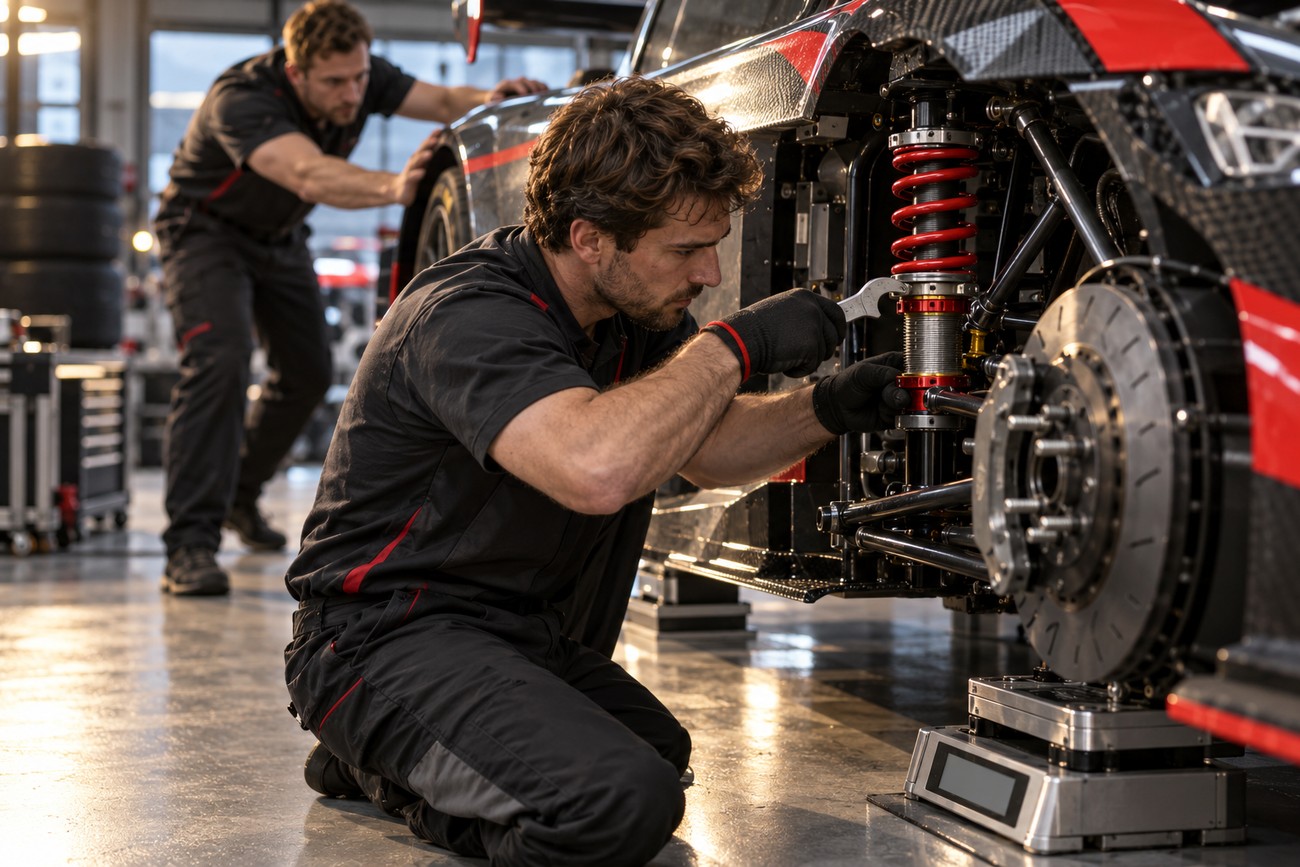
A sound adjustment cycle is simple in principle: change the spring platforms, settle the suspension, reweigh the car, and record the result. Adjustments should be small and deliberate, because changing several corners without recording the effect makes it difficult to understand which change produced the result.
Lowering one corner usually increases the load on that corner, while raising it usually reduces the load. The exact response depends on the suspension’s kinematics, spring arrangement, chassis stiffness, and the other corners. The load also moves through the diagonals, so the technician must watch all four readings rather than treating each corner as independent.
After every adjustment, roll the car forward and backward and/or load the corners several times. The suspension must settle before a new reading is accepted. Otherwise, bushing wind-up, friction, or a damper that is slow to move can leave the car in a temporary position that gives a misleading weight distribution.
Compare the first reading with the repeated reading after the suspension settles. If the number keeps changing, the cause may be bushing wind-up, a binding damper, or residual anti-roll-bar preload rather than a useful spring-platform adjustment.
Once the target is reached, reconnect the anti-roll bars with the suspension loaded and without preload. Then check ride height, damper travel, clearance, camber, caster, and toe. Because spring-platform changes can affect these settings, a final four-wheel alignment check is part of a complete service, not an optional finishing step.
Why a Perfect 50% Reading May Still Handle Unevenly
Cross-weight describes static load distribution, while handling is the result of the complete vehicle system. Tire condition and pressure, camber, caster, toe, steering position, and driver technique can all preserve a left-right difference after the scales show a near-50% result.
Aerodynamic balance adds another variable at speed. A car can be statically well balanced but develop an imbalance as downforce increases. Road crown and changing track conditions also alter the loads the driver feels, so the same setup may behave differently on a flat circuit and on an uneven public road.
Mechanical condition matters just as much. Worn bushings, seized dampers, binding suspension joints, a bent chassis, or uneven spring behavior can make the car turn differently even when the diagonal sums are close. Corner balancing is a setup tool, not a repair for a faulty suspension.
The benefit is usually more noticeable on a track car with adjustable coilovers than on a standard road car with fixed ride height and compliant rubber mounts. On a daily driver, the available adjustment may be limited, and the improvement may be subtle compared with correcting tire pressures, worn parts, or a poor alignment.
Common Corner-Balancing Mistakes and When It Is Worth Doing
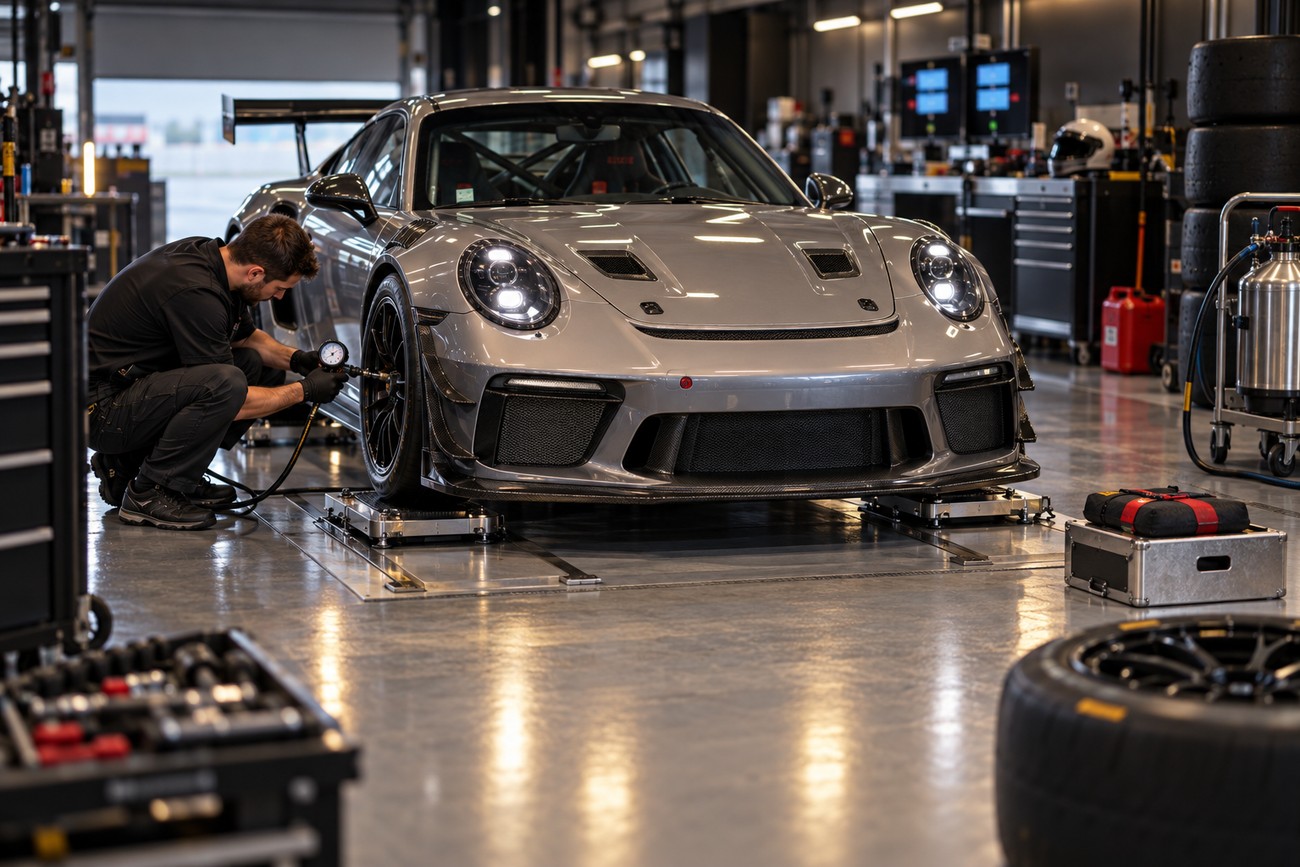
The most common failure is treating a 50% claim as proof of quality. If the driver, fuel, operating equipment, or aerodynamic parts were omitted, the car was balanced in a different condition from the one that matters. A shop should be able to explain the weighing configuration and provide repeatable before-and-after readings.
Other errors include measuring on a sloped floor, leaving anti-roll-bar preload in place, using inconsistent tire pressures, and skipping suspension settling. Measuring only the distance from the ground to the wheel arch is also insufficient. Control-point ride height and actual corner weights provide more useful information than a visually symmetrical body.
A final alignment check is essential. Changing spring-platform height can alter camber, caster, and toe, and a missed toe change can make the car pull or wear its tires unevenly. The technician should also confirm that the adjustment has not reduced bump travel, damper travel, or practical ground clearance.
Corner balancing can make one side of the car look slightly different from the other, particularly when the chassis or suspension is not perfectly symmetrical. It may also reduce clearance or place an adjustable damper in a less favorable part of its operating range. Those trade-offs should be accepted only when the measured handling benefit is relevant to the car’s use.
The service is most worthwhile when the car has adjustable coilovers, a known suspension condition, and a driver who can evaluate changes on the intended track. For an ordinary road car, the money may be better spent first on repairs, tires, and a proper alignment. Ask the shop for the operating configuration, individual wheel readings, target cross-weight, adjustment notes, and final alignment results rather than a bare promise of “50%.”
Frequently asked questions
Corner balancing is a measurement-led service, and its value depends on how carefully the car and equipment are prepared. These answers cover the practical details that are often missing from a simple cross-weight claim.
How do you properly corner balance a car?
First inspect the tires, suspension, mounts, adjusters, and chassis for faults. Set consistent tire pressures, establish the intended fuel level, add the driver and equipment, level and zero the scales, center the tires, and disconnect or relieve anti-roll-bar preload. Record the initial four wheel loads, adjust the spring platforms in controlled steps, settle the suspension after each change, and repeat the measurements.
After reaching the selected cross-weight target, reconnect the anti-roll bars under load without preload. Request the before-and-after corner readings, the operating configuration, the ride-height measurements, the target used, and the final alignment results. The paperwork should also show any limits or repairs that prevented a more complete adjustment.
How much does a corner balance cost?
There is no universal price because the labor depends on the suspension’s adjustability and the condition of the car. Adjustable coilovers may allow direct platform changes, while seized adjusters, worn components, damaged mounts, or chassis problems can add repair time before weighing begins.
Repeated settling and measurements also affect labor, especially when the initial setup is far from the desired target. Confirm whether a four-wheel alignment is included, whether the driver and equipment will be added, and whether the service includes documented before-and-after readings. A low quote that covers only one measurement may not represent a complete setup.
What is the 30-60-90 rule for cars, and does it set corner weights?
The 30-60-90 rule is not the corner-weight method described here and does not set the loads carried by the four wheels. It should not replace measured corner weights or the selected cross-weight target.
Corner balancing requires the actual RF + LR and LF + RR readings, taken with the car in its intended operating configuration. Those measured loads, together with the tires, alignment, suspension condition, and intended track use, determine whether a setup is appropriate.