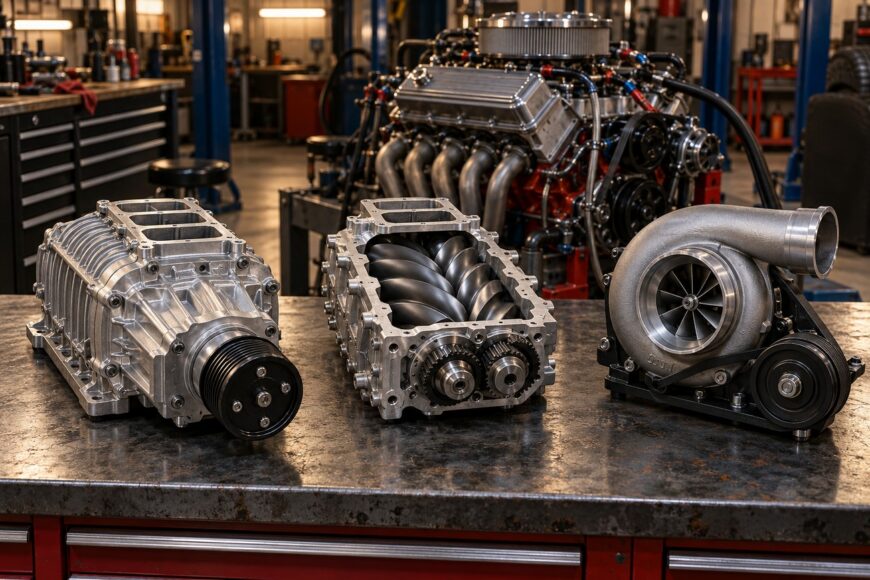
Choosing a supercharger kit is a decision about power delivery and system reliability, not simply the largest number in an advertisement. Roots and twin-screw units produce strong low-rpm torque that feels immediate in traffic, while a centrifugal unit builds boost progressively and saves much of its drama for the upper rev range.
That difference creates the central ownership trade-off. A positive-displacement kit can make a heavy car effortless in a high gear, yet it usually adds more intake and underwood heat and places a sharper load on the drivetrain. A centrifugal system may run cooler and deliver stronger top-end acceleration, but it can feel close to stock below the point where boost rises.
Real wheel power depends on the complete installation: pulley ratio, belt drive, fuel supply, calibration, cooling, transmission capacity, and tire grip. Treat the advertised engine output as a starting point for investigation, rather than a guaranteed result at the wheels.
- How Roots, Twin-Screw, and Centrifugal Superchargers Deliver Power
- Roots, Twin-Screw, and Centrifugal Kits Compared
- Advertised Horsepower vs. Real Wheel Power, Heat, and Efficiency
- Boost, Fuel, Cooling, and Calibration: The Reliability Boundary
- The Hidden Cost of a Supercharger Kit
- Choosing the Right Kit for Street, Drag, or Track Use
- Frequently asked questions
- How fast do twin-screw superchargers spin?
- What oil should be used in a supercharger?
- How much boost is safe for a stock engine?
How Roots, Twin-Screw, and Centrifugal Superchargers Deliver Power
Roots and twin-screw superchargers are positive-displacement designs. They move a substantial volume of air per revolution, so boost arrives early and remains almost flat across the usable rpm range. Roots systems produce near-linear torque growth from low rpm, while twin-screw designs generally compress the charge more efficiently within the housing.
A centrifugal supercharger works more like a belt-driven compressor. Its boost rises with impeller speed, which is linked to engine speed, so maximum boost appears closer to the redline and low-rpm pressure is noticeably lower. The engine may feel fairly ordinary in normal city driving, then accelerate much harder as revs build.
On the street, the positive-displacement curve means fewer downshifts and an easy response when you open the throttle in a high gear. That same torque can overwhelm ordinary tires and increase transmission stress. A centrifugal setup rewards keeping the engine in its upper rev range and can feel more progressive and manageable during normal driving.
Drag racing exposes the distinction clearly. Roots and twin-screw systems favor launch and 60-foot performance because torque is available immediately. Centrifugal systems often favor the latter part of a pass, where rising boost and engine speed allow them to build stronger top-end acceleration. Neither curve is universally superior; the correct choice follows the car’s use and gearing.
Roots, Twin-Screw, and Centrifugal Kits Compared
The figures below describe typical measured compressor efficiency, not a guaranteed percentage of wheel-power gain. Hardware design, pulley speed, intercooling, calibration, and engine airflow determine the result on a particular car.
| Design | Boost response | Typical strengths | Heat behavior | Packaging and noise | Efficiency | Best use | Principal drawback |
|---|---|---|---|---|---|---|---|
| Roots | Immediate; almost flat curve | Strong low-rpm torque and launch response | Higher intake heat during sustained wide-open throttle | Usually needs top-of-engine space; distinctive whine | Approximately 55–65% | Street torque and short drag launches | Parasitic loss, heat, and traction demand |
| Twin-screw | Immediate; almost flat curve | Broad torque, strong high-gear cruising, better efficiency than Roots | Still prone to substantial heat under sustained load | More vertical clearance; rotor noise can be prominent | Approximately 65–75% | Fast road cars and responsive drag builds | Height, service access, cost, and drivetrain load |
| Centrifugal | Progressive; strongest near redline | Top-end power, lower heat tendency, flexible integration | Generally cooler than positive-displacement systems | Needs room at the front or side; belt and impeller noise | Approximately 70–80% | Track, roll racing, and staged builds | Soft low-rpm response and dependence on revs |
Advertised Horsepower vs. Real Wheel Power, Heat, and Efficiency
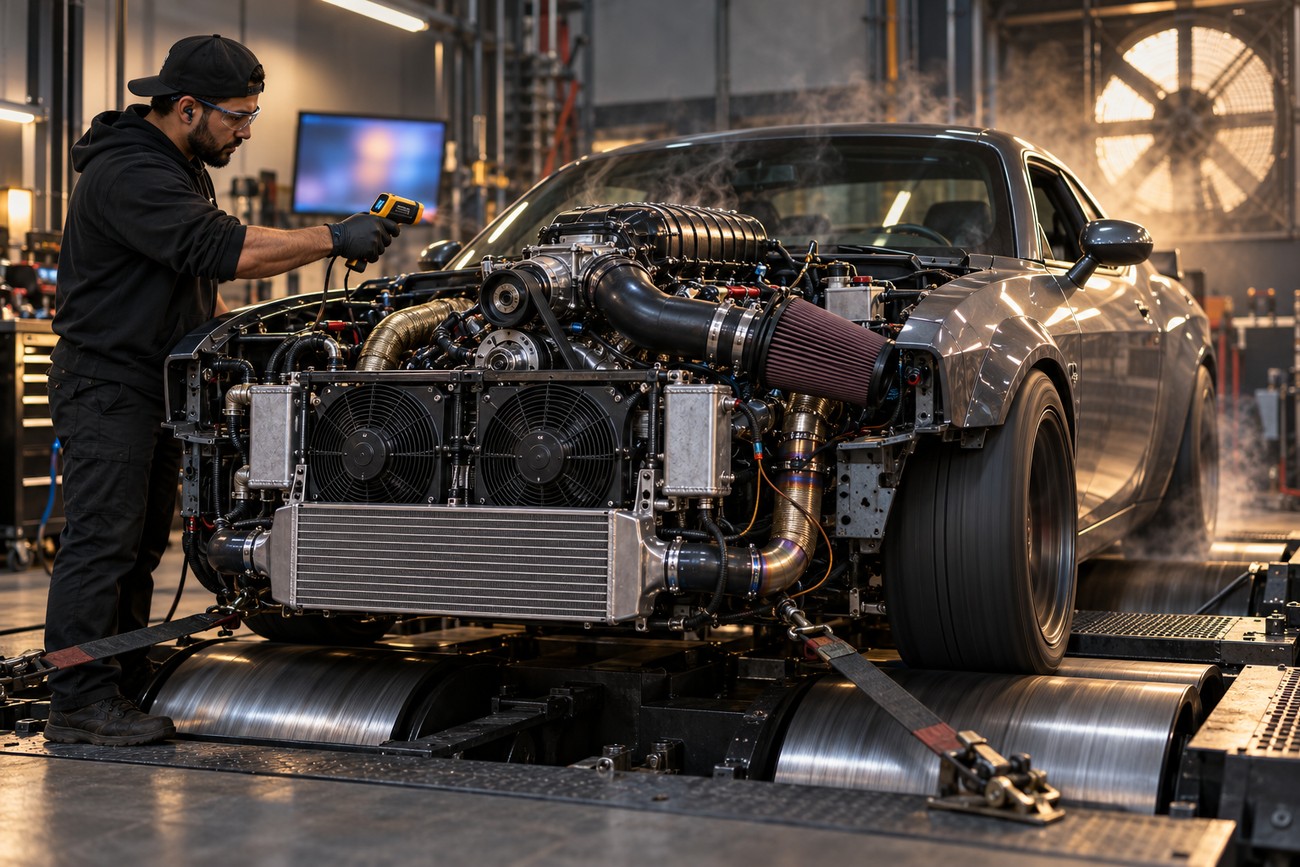
A claimed 150–200 hp increase may become approximately 80–120 hp at the wheels. Mechanical drivetrain loss, compressor drive power, intake heat, calibration, fuel limitations, and tire slip all reduce what reaches the pavement. A V8 supercharger can consume approximately 15–60 mechanical horsepower, so engine and wheel figures should never be treated as interchangeable.
Efficiency also changes the ownership experience. Typical measured ranges are approximately 55–65% for Roots, 65–75% for twin-screw, and 70–80% for centrifugal systems. These are compressor-level comparisons, not a universal conversion formula for wheel horsepower, but the general pattern explains why two kits at the same boost can produce different charge temperatures and require different cooling strategies.
Heat becomes especially important during a long pull, track session, or repeated street acceleration. Roots and twin-screw intake temperatures are commonly reported at approximately 40–60 °C above ambient during prolonged wide-open throttle. Rising charge temperature reduces density, increases detonation risk, and can force the calibration to remove ignition timing, leaving the car slower after it has warmed up.
Traction can hide some of the advertised gain even when the dyno result is sound. Stock street tires may convert a meaningful portion of added power into wheelspin, particularly with an instant-torque system. A dyno sheet therefore needs context: fuel used, correction method, intake temperature, calibration, tire condition, and whether the comparison was made on the same equipment.
Boost, Fuel, Cooling, and Calibration: The Reliability Boundary
Typical street kits use approximately 5–7 psi for daily driving and 8–12 psi for aggressive street use. Boost of 14+ psi generally requires major fuel-system and engine-internal upgrades. The conservative practical limit often cited for stock internals and stock fuel-system assumptions is approximately 5–7 psi, although the actual boundary depends on compression ratio, engine condition, fuel quality, charge temperature, and the calibration.
Fuel delivery must be sized for the intended power, rather than the kit’s base pulley alone. Common gasoline under-boost calibration targets are approximately AFR 11.5–12.0, but the correct target remains a calibration decision for the engine and fuel system. Manufacturers commonly recommend at least 91–93 AKI, approximately 95–98 RON, for boost levels of 7 psi and above; using lower-octane fuel than the tune expects can produce detonation and piston damage.
A vehicle-specific tune is essential because the engine, injectors, pulley, intercooler, intake, exhaust, and fuel all influence the result. A universal off-the-shelf flash cannot account for every combination. It may be a useful starting calibration, but load data, knock behavior, air-fuel ratio, and fuel pressure should be checked on the actual car.
Cooling is part of the power system. The radiator, charge cooler, intercooler circuit, oil cooling, and airflow through the engine bay must cope with the extra heat. Ignoring these areas can cause overheating, power loss, and detonation even when the initial dyno session looks successful.
Manufacturers may claim acceptable stock-engine durability at moderate boost, while engine builders and tuners warn that pistons, rings, and rod bearings can wear faster even at 6–8 psi. Neither position removes the need for inspection and conservative calibration. Added cylinder pressure and heat alter the service burden, so “safe on a stock engine” should be read as a conditional claim, not a lifetime guarantee.
The Hidden Cost of a Supercharger Kit
A kit described as complete may still require a larger fuel system, stronger clutch, or automatic-transmission upgrades. The extra torque can expose a worn clutch immediately, while a stock automatic transmission may suffer from heat and repeated shock loads. Budgeting only for the compressor and installation leaves the most expensive failure points outside the plan.
The belt drive deserves the same attention as the compressor. Slip, rapid belt wear, poor tensioner behavior, misalignment, and an inadequate rib count can cause inconsistent boost and throw belts. Higher boost also increases load on the crankshaft and accessory drive, including the harmonic damper pulley, which is easy to overlook during a bolt-on installation.
Inspect alignment first, then observe tensioner behavior, confirm belt width and rib count, and check pulley condition before blaming the supercharger brand for slip or inconsistent boost.
Service access affects long-term ownership. Supercharger oil may require a specific fluid and procedure, and additional heat and oil-system demands can contribute to leaks or reduced lubrication-system reliability. Underhood heat also accelerates stress on wiring, hoses, and plastic components, especially around a positive-displacement unit.
Emissions status is another ownership cost. Some major US-market kits carry CARB EO approval when used with the approved hardware and calibration, but higher boost or custom tuning can fall outside that approval and affect inspection eligibility. A modified car can also attract a smaller resale audience and a lower resale price, even when the work was technically sound.
Choosing the Right Kit for Street, Drag, or Track Use
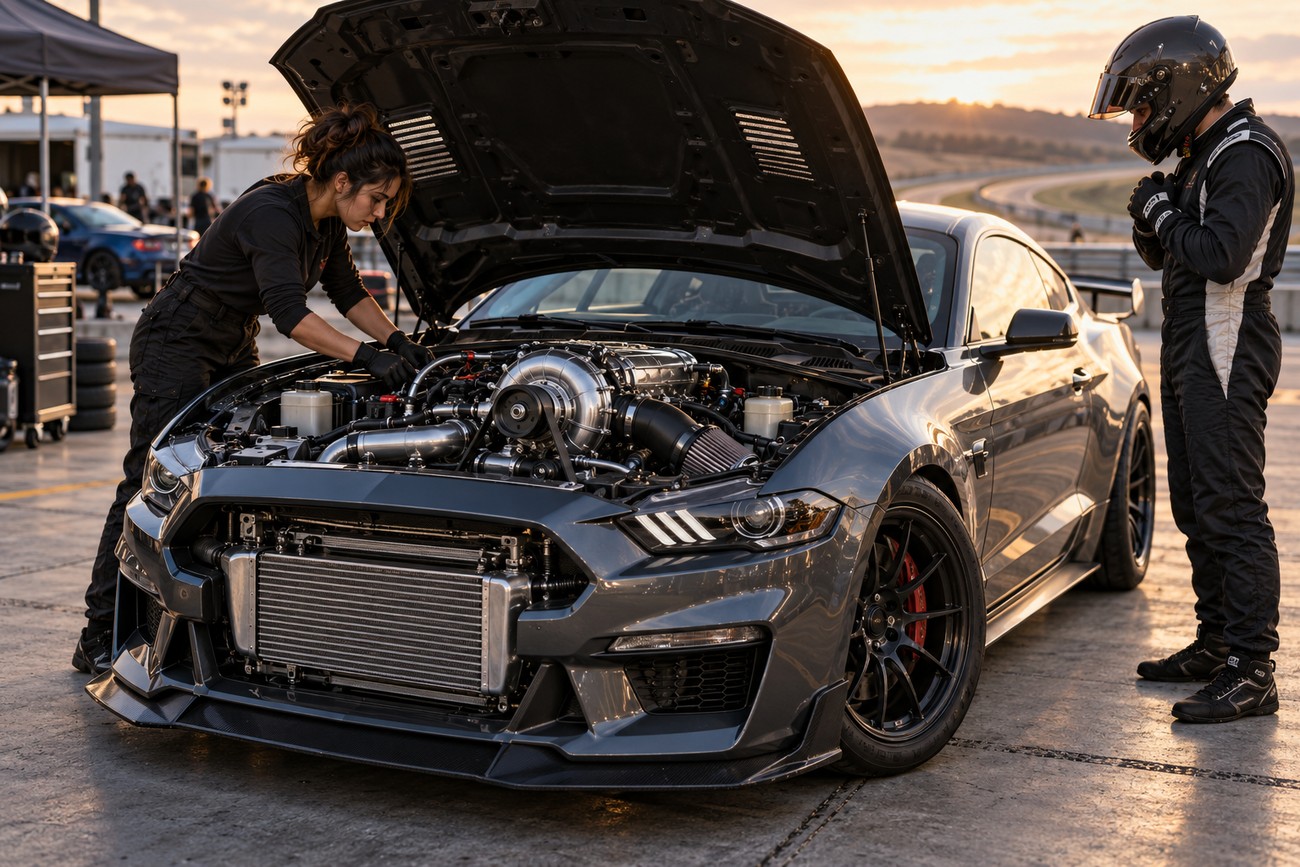
Roots or twin-screw is usually the logical choice when immediate torque, easy high-gear cruising, and launch response matter most. These systems make the car feel stronger in ordinary traffic and reduce the need for downshifts. Accept the associated heat, traction demand, noise, and drivetrain load before choosing them for a daily driver.
A centrifugal unit suits a car that spends more time at high rpm, on a road course, or in roll and top-end acceleration. Its progressive curve can be easier on traction and tends to create less intake heat than a positive-displacement system. It is also often easier to integrate with an existing turbocharger or a multi-component staged build, although low-rpm response may feel nearly stock.
At approximately 8–10 psi, belt width, rib count, alignment, and tensioner quality can matter more than brand choice. Check engine-bay clearance before ordering: a twin-screw typically needs more vertical clearance and may create hood problems, while a centrifugal system commonly needs space at the front or side of the engine. Service access should be part of that physical inspection.
- Confirm the fuel system and the fuel grade required by the calibration.
- Plan radiator, charge cooling, and oil-cooling capacity before installation.
- Match the torque increase to the clutch or automatic transmission.
- Verify pulley, belt, tensioner, damper, and alignment compatibility.
- Use tires wide and grippy enough to turn added power into acceleration.
- Check emissions certification, local inspection rules, and future resale implications.
A boxed kit is not safe at any boost: fuel, calibration, cooling, engine internals, and drivetrain capacity set the real boundary. The centrifugal design also has lag in the practical sense that boost rises with engine speed; it is not a turbocharger without lag. Choose the power curve you can use, then build the supporting systems around it.
Frequently asked questions
These service details are easy to miss because they rarely appear in headline horsepower claims. They can determine whether the kit remains consistent and serviceable after installation.
How fast do twin-screw superchargers spin?
There is no single universal rotor-speed figure. Speed depends on the drive ratio, pulley size, engine speed, rotor geometry, and the manufacturer’s maximum operating limit.
Changing the pulley changes more than peak boost: it also changes rotor speed, discharge heat, and the compressor’s position within its intended operating range. Use the manufacturer’s limit for the specific unit rather than applying an rpm number from another twin-screw design.
What oil should be used in a supercharger?
Use the supercharger oil and service procedure specified for that unit. Supercharger oil is not automatically interchangeable with engine oil, and both fluid level and refill method can vary between designs.
Follow the stated inspection interval and check for leaks around the case and oil lines. A compliant emissions-certified kit also remains subject to its stated hardware, calibration, fuel, and installation conditions.
How much boost is safe for a stock engine?
For many street applications, approximately 5–7 psi is treated as a conservative range for a stock engine and fuel system. The actual limit depends on compression ratio, engine condition, fuel quality, charge temperature, and calibration.
Higher boost can require upgrades to the fuel system, cooling, and engine internals. Even moderate boost can increase wear on pistons, rings, bearings, and drivetrain components, so safe operation is a conditional judgment rather than a guarantee.