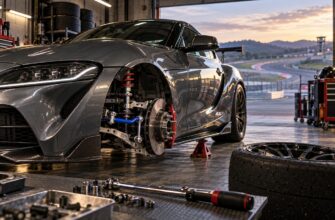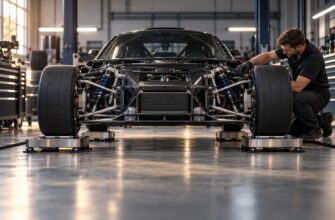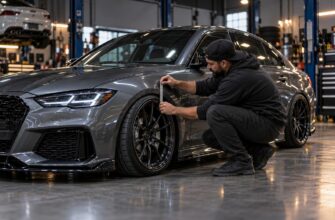
An aggressive body kit can make a car look lower and wider yet make it less aerodynamically efficient. Extra width can increase frontal area, and a large wing can change how aerodynamic forces are shared between the axles. A kit that looks purposeful may therefore add drag or make the car feel less settled at speed.
Choose around the driving you actually do. Look for measured results that match your car and the complete set of parts, then check whether the kit can be fitted securely without compromising clearance or everyday use. Aerodynamic claims matter only if the finished installation preserves the geometry that was tested.
- What an Aerodynamic Body Kit Should Actually Improve
- Match the Kit to How You Actually Drive
- How to Judge Real Aero Data Before Buying
- Choose Components as a Balanced Aero System
- Avoid the Hidden Costs of a More Aggressive Kit
- Fit, Materials, Validation, and Road Legality
- Frequently asked questions
- What car shape is most aerodynamic?
- How can I improve my car’s aerodynamics without installing a full body kit?
- How much ground clearance should an aerodynamic splitter have?
What an Aerodynamic Body Kit Should Actually Improve
Aerodynamic improvement has several meanings. Reducing drag can help efficiency during sustained higher-speed driving, while downforce can improve tire loading where speed is high enough for it to matter. Managing airflow around the wheels, mirrors, underbody, and rear of the car can also affect noise, spray, and stability. A kit should state which outcome it is intended to improve.
At a given speed, aerodynamic drag rises in proportion to frontal area and the drag coefficient, Cd. A wider bumper or fender may increase the area facing the air, even if its surface looks smoother. Lowering Cd alone does not guarantee lower total drag if frontal area grows. That distinction is important when comparing a stock body with a wide-body conversion.
Downforce and drag also pull a design in different directions: adding downforce almost always adds drag. More load at one axle is useful only if the overall balance suits the car. Wind-tunnel testing or computational fluid dynamics (CFD) can assess drag coefficient and downforce; a photograph cannot show either. Treat styling descriptions as design intent until the seller provides evidence of the result.
Match the Kit to How You Actually Drive
For a city-driven car, ground clearance, approach angles, noise, and durability usually deserve more weight than maximum downforce. A front lip that catches on a driveway or speed bump may restrict where you can drive, regardless of its claimed aerodynamic benefit. At low urban speeds, aerodynamic effects are generally modest, while added mass, width, and protruding edges can make the car less practical.
For regular highway use, focus on a clean fit and controlled airflow rather than a race-car silhouette. Poorly aligned joints can whistle, and changes to the rear wake may leave the window or camera dirtier in wet weather. If efficiency is the aim, ask for drag results for the full car at a comparable ride height, rather than a claim based on the shape of one component.
At road speeds up to roughly 120–140 km/h, the stability benefit of an aggressive racing kit is usually limited; that range is a practical guide, not a universal threshold. Results depend on the vehicle, its setup, and conditions. A pronounced downforce benefit is chiefly a track concern, where higher sustained speeds and repeated corners make the trade-off easier to evaluate.
On track, judge the kit by balanced behavior and repeatable evidence. Comparable runs, corner speeds, driver observations, and tire-temperature patterns can reveal changes that a marketing Cd figure does not describe. Control for tires, alignment, weather, and ride height before attributing a lap-time change to bodywork.
How to Judge Real Aero Data Before Buying

Start by asking what was tested: the complete car, a matched set of components, or an isolated part. Wind-tunnel results or CFD should identify the vehicle configuration, ride height, wheel and tire setup, and the speed or conditions used. Ask for changes in drag and in aerodynamic loading at both axles. A single headline result may conceal a shift in balance that matters more to the driver.
Next, check whether the evidence applies to the kit being sold. A rendering, a photograph, or the word “aerodynamic” establishes no performance result. Track telemetry can support a claim about handling, especially when runs are comparable, but it does not replace a wind tunnel or CFD for assessing Cd and downforce. If only part of a kit has been tested, avoid assuming the complete package behaves the same way.
Be particularly cautious of a wide-body kit advertised as lower-drag because it makes the car look low. Extending the body outward usually increases frontal area and, all else equal, drag. Airflow improvements elsewhere could offset that increase, but the claim needs measurements or a credible CFD comparison. Without them, buy the wider stance for its intended fitment or appearance, rather than an unverified efficiency gain.
Choose Components as a Balanced Aero System
A splitter, side skirts, diffuser, rear wing, wheel arches, and underbody influence connected regions of airflow. The splitter changes conditions beneath the nose; the underbody and side edges affect the flow reaching the rear; and the diffuser depends on what arrives there. Installing one part in isolation can produce a small, inconsistent, or unwanted result.
A large rear wing, for example, can add rear-axle load while leaving the front unchanged. The car may then resist turning into a corner or require a different setup to recover balance. Wing size alone reveals little about that effect, because mounting position, angle, and the rest of the bodywork also matter.
Compare corner-entry and high-speed steering behavior across repeatable runs, alongside front and rear tire-temperature patterns. Those observations can flag an axle-balance shift that the appearance of a wing cannot.
Ground clearance and underbody shape set further limits. A splitter close to the road may behave differently as the suspension moves, while a diffuser attached behind a largely uneven stock underbody may receive disturbed flow. Lowering either part without considering suspension travel and road obstacles can sacrifice usable clearance before producing a reliable gain.
Mixing components from unrelated kits adds another uncertainty: their edges, ride-height assumptions, and intended airflow paths may not align. If you must build in stages, assess each change before adding the next. The tuning target is a predictable balance between downforce and drag, rather than the largest possible downforce figure.
Avoid the Hidden Costs of a More Aggressive Kit
Extra edges, gaps, and steps can create wind noise or a whistle that was absent from the stock car. A flexible panel may also vibrate at speed, particularly if its mounts do not support the loads it encounters. These symptoms are useful warnings: inspect the fit and fastening rather than assuming they are an unavoidable feature of performance bodywork.
Airflow changes can affect visibility as well as handling. A spoiler or rear diffuser may redirect road spray and grime toward the rear window, bumper, or reversing camera. The outcome depends on the vehicle and conditions, but it deserves attention if you drive in rain or rely on a clear rearward view.
Low lips and deep rear pieces reduce ground clearance and approach or departure angles, making ramps and road obstacles harder to negotiate. Poorly secured protruding parts also present a risk if they flex or detach. Wide-body kits usually add frontal area, which can erase a claimed drag reduction, and often add mass. No kit necessarily brings all these drawbacks, but each is worth checking before purchase.
Fit, Materials, Validation, and Road Legality
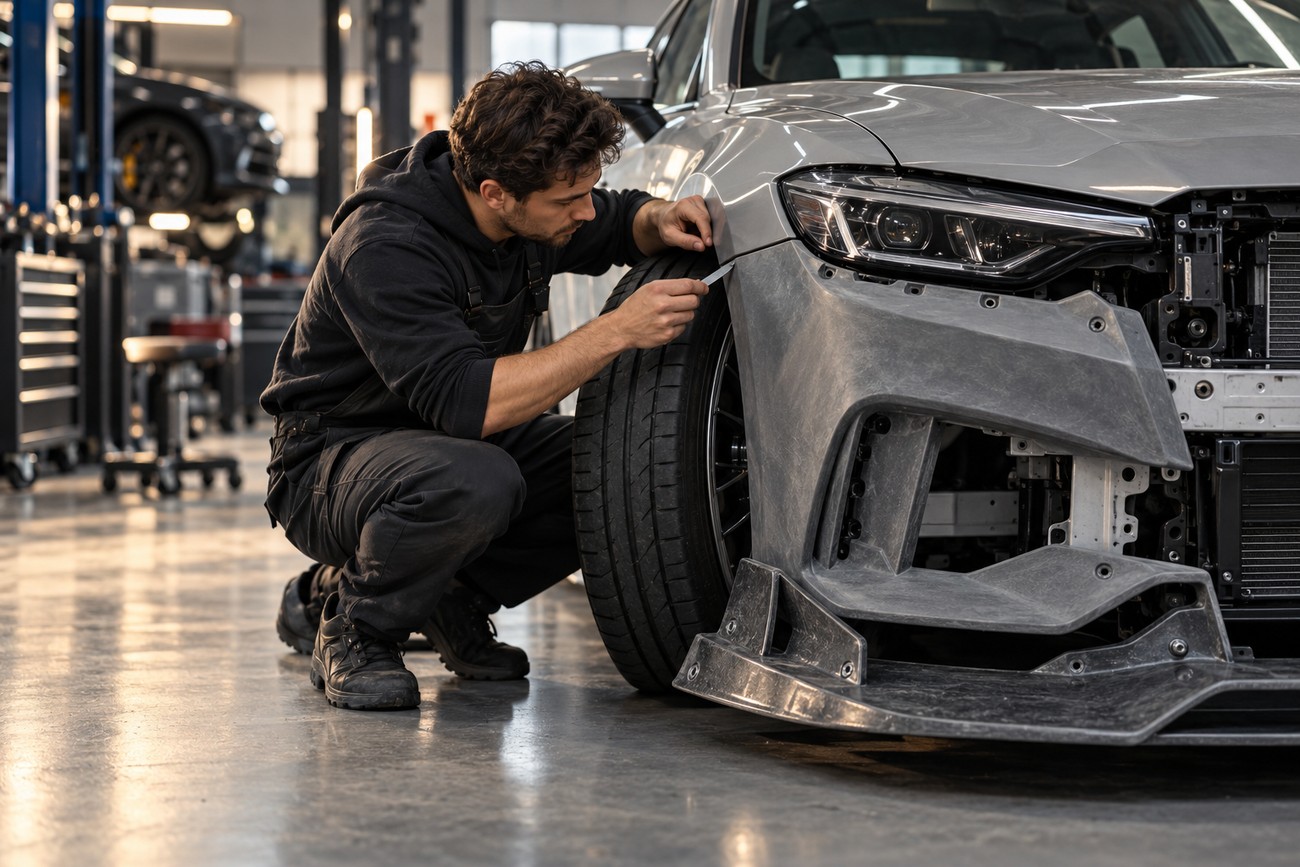
Confirm compatibility with the exact vehicle and any existing modifications before ordering. Trial-fit every panel before paint or permanent attachment, then check alignment, gaps, steps between surfaces, and wheel clearance through steering and suspension movement. A smooth profile in a product image will not survive a crooked installation.
Material choice matters mainly through the shape the finished part holds. Carbon and good-quality fiber-reinforced plastic (FRP) can provide useful stiffness and consistent geometry. Flexible polyurethane and inexpensive fiberglass moldings may need more fitting to avoid wavering surfaces or uneven gaps. Judge the actual part and its mounting design; a material label cannot compensate for poor manufacture.
Secure the components as specified for their intended use, then check that the installed ride height leaves room for suspension travel and ordinary obstacles. Inspect fasteners and panel movement before higher-speed driving. After installation, assess steering, braking, noise, and vibration progressively in suitable, lawful conditions; stop and recheck the car if its behavior changes unexpectedly.
Finally, check local rules before committing to protruding parts or structural changes. Certification, inspection, and insurance requirements vary by location and modification. Resolving those questions before paint and installation is easier than discovering that the completed car cannot be used as intended.
Frequently asked questions
These answers cover the shape of an efficient car and two decisions that can be made without buying a complete kit.
What car shape is most aerodynamic?
A low-drag car shape generally has a rounded front, a smooth transition over the roof, a rear that narrows gradually, and a clean underbody. Together, those features help air stay attached for longer and reduce the disturbed wake behind the car. Open wheel areas, abrupt steps, and a blunt rear can work against that goal.
There is no single ideal silhouette for every road car. Passenger space, cooling, tires, and practical length constrain the shape, so a body kit can only improve specific parts of an existing design. Its appearance is a poor substitute for testing the complete vehicle.
How can I improve my car’s aerodynamics without installing a full body kit?
Begin by removing unnecessary external protrusions and checking that existing panels, liners, and underbody pieces are secure and sit as intended. Repair loose edges and obvious gaps before adding new parts; restoring a clean original shape is a more predictable first step than fitting a wide-body kit.
Then consider where airflow is being disturbed around the wheel arches and beneath the car. Any added panel should preserve cooling, service access, and safe clearance, and it should be evaluated as part of the whole vehicle. Change one area at a time so new noise or handling behavior is easier to trace.
How much ground clearance should an aerodynamic splitter have?
There is no universal safe splitter clearance. The suitable height depends on suspension travel, tire and ride-height changes, road obstacles, and the car’s approach angle. Measure clearance with the car in its normal loaded condition, then account for how far the nose can move during braking and over uneven ground.
A splitter also needs a position it can hold consistently. If it flexes, strikes the road, or moves substantially as the suspension works, its aerodynamic behavior becomes less predictable and its mounts face additional loads. For a road car, a clearance that remains usable on familiar routes is more valuable than an unverified low setting.