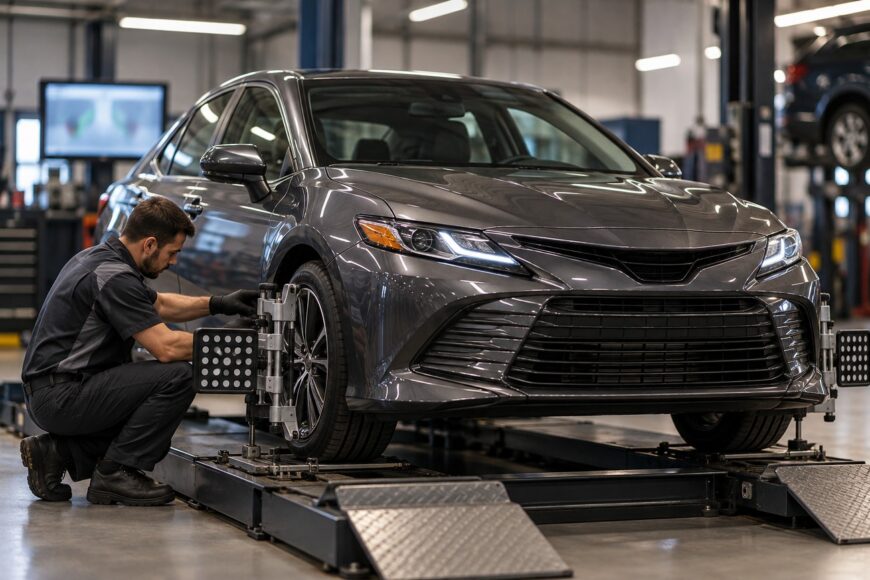
A car that drifts across a lane, needs constant steering correction, or wears one tire edge quickly may have a wheel-alignment problem. Alignment and balancing answer different questions. Balancing addresses uneven mass in a tire-and-wheel assembly, while alignment describes how the wheels and steering geometry are positioned relative to the vehicle and the road.
Three angles form the core of an alignment check: camber, caster, and toe. Each is viewed from a different direction and affects the car in a different way. Their readings can help explain a handling complaint, but no single symptom proves that one angle is at fault; tire condition, road crown, wheel damage, and worn suspension parts can produce similar clues.
- Camber, caster, and toe at a glance
- Camber: wheel tilt, cornering, and tire-edge wear
- Caster: the steering-axis angle behind straight-line feel
- Toe: small pointing errors with outsize consequences
- Pulling, crooked steering, or vibration: which clues matter?
- What a proper alignment checks before and after adjustment
- Frequently asked questions
- How bad is 3 degrees of camber?
- What does 2 degrees of camber look like?
Camber, caster, and toe at a glance
The three angles describe different parts of wheel geometry. The table shows how each is viewed and what a reading may help explain; target values must come from the exact vehicle specification.
| Angle | Viewed from | What it measures | Direction or sign | Typical clue when incorrect |
|---|---|---|---|---|
| Camber | In front of the vehicle | The wheel’s inward or outward tilt | Negative: top leans inward. Positive: top leans outward. | Uneven tire-edge wear or altered cornering feel |
| Caster | Alongside the vehicle | The steering-axis tilt | Side-to-side differences can matter; caster is not visible wheel lean. | Changes in steering return, straight-line stability, or pulling |
| Toe | Above the vehicle | The direction in which the wheel points | Toe-in: the fronts of the wheels point toward each other. Toe-out: they point apart. | Tire scrub, wandering, or altered steering response |
Toe may be reported in degrees or as a distance in millimeters or inches. Distance figures depend on wheel size and measurement method, so they cannot be borrowed from another vehicle. There is no single set of correct camber, caster, and toe targets for every car.
Camber: wheel tilt, cornering, and tire-edge wear
Camber is the wheel tilt viewed from the front. If the top of the wheel leans inward toward the vehicle, the camber is negative; if it leans outward, the camber is positive. The angle changes how the tire meets the road, especially as the suspension moves and the car corners.
A camber value outside the vehicle’s intended range can reduce the consistency of the tire contact patch. Excessive negative camber may contribute to wear on the inner edge, while excessive positive camber may contribute to wear on the outer edge. A difference between the left and right sides can also affect the car’s balance in a turn or contribute to a directional complaint.
Edge wear is a clue, not a diagnosis. Incorrect toe can scrub the tread across the road and create a similar pattern, while underinflation, overinflation, tire construction, worn bushings, or a bent suspension component can also affect wear. Looking at the tread pattern alongside the alignment readings gives a more reliable starting point than judging the wheel angle by eye.
Some performance vehicles are deliberately set with visible negative camber to support cornering, but that does not make the same stance suitable for a road car. The correct reference is the manufacturer’s specification and tolerance for the exact model, suspension version, and wheel-and-tire configuration. On some vehicles, factory adjustment is limited or unavailable, so an out-of-specification result may point to a mechanical problem rather than a missing adjustment.
Caster: the steering-axis angle behind straight-line feel
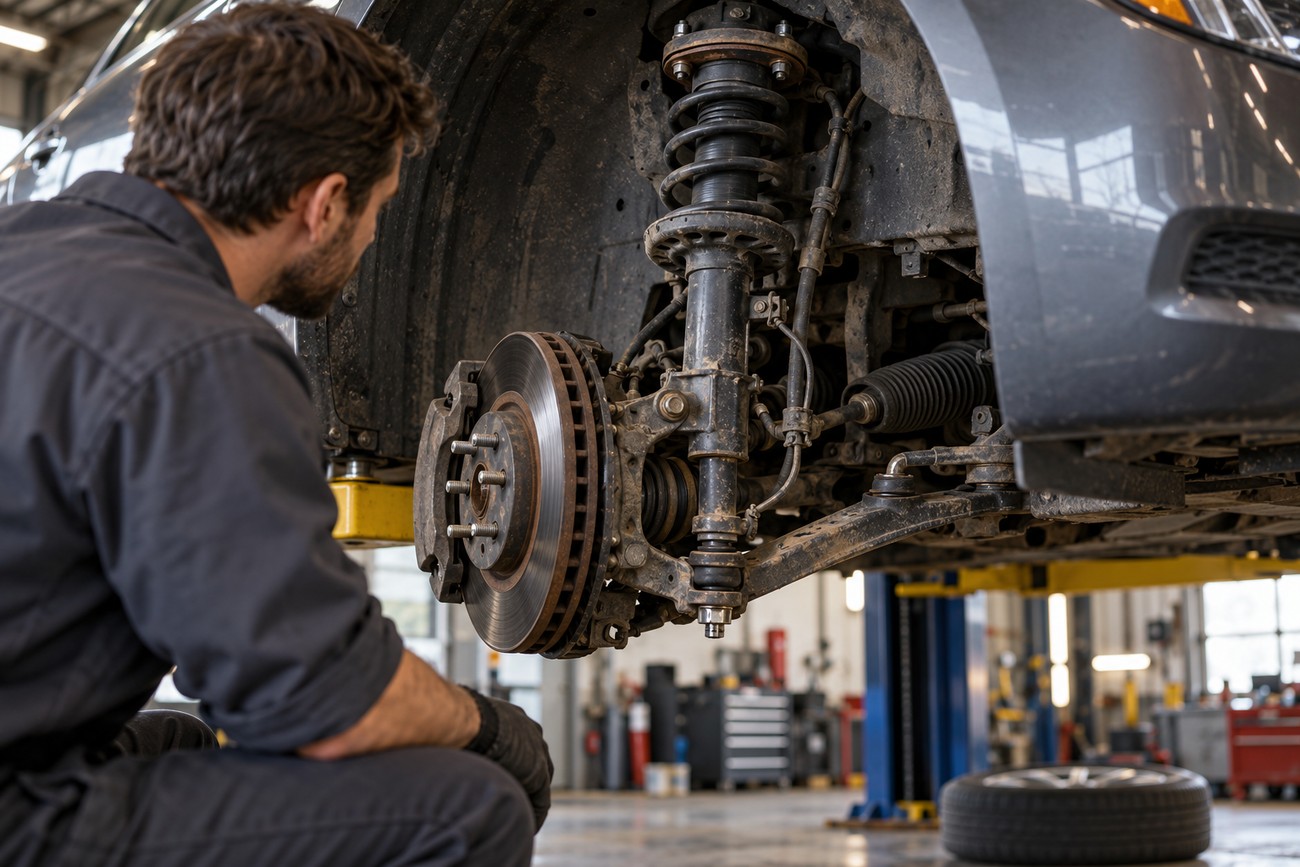
Caster is the steering-axis tilt viewed from the side. It describes the angle of the axis around which the steering turns; it is not the wheel’s visible lean, and it is not camber measured in another plane. This geometry influences how the steering returns after a turn and how confidently the vehicle tracks in a straight line.
A difference in caster from one side to the other can contribute to a pull or an uneven steering feel. The effect is assessed together with the road surface, tire construction, inflation pressure, camber, and the condition of steering and suspension components. A road that slopes toward the shoulder can make a properly aligned car appear to drift, so a short drive on more than one road surface can be useful.
Caster is often discussed as if it could be adjusted on every vehicle. Vehicle design determines whether that is possible. Some cars provide a defined adjustment, some provide only limited correction, and some have no factory caster adjustment at all. If the reading is outside specification after the basic checks, the next step may be to inspect control arms, mounts, bushings, subframes, or accident-related deformation.
Because caster is linked to steering-axis geometry, its effect may be felt through steering effort and return rather than seen as a simple tire-wear pattern. A car that feels unstable, requires repeated correction, or pulls after suspension work needs a complete geometry assessment rather than a caster number viewed in isolation.
Toe: small pointing errors with outsize consequences
Toe is the direction a wheel points when viewed from above. Toe-in means the fronts of an axle’s wheels point toward each other, while toe-out means they point apart. The setting affects how the tires move across the road as they roll, so a small error can create measurable scrub and a change in steering response.
A shop may report toe as an angle or as a distance in millimeters or inches. Distance figures are not interchangeable between vehicles because the same angular difference produces a different measured distance at different wheel diameters or measurement points. Use the manufacturer’s figures for the specific car rather than a number from a general online chart.
Alignment reports commonly show both individual toe and total toe. Total toe can look acceptable while the left and right wheels are not positioned as intended, especially if one side points inward and the other is adjusted to offset it. That condition can leave the steering wheel off-center or make the vehicle follow the rear axle’s thrust direction even though the summed number appears within tolerance.
An acceptable total-toe reading can conceal unequal individual toe or an unaddressed rear thrust angle. The steering wheel may remain crooked if the front wheels are set without accounting for the rear axle’s thrust direction.
Some performance advice favors front toe-out and rear toe-in for particular handling goals. That pattern is not a universal road-car setting. For ordinary road use, the vehicle manufacturer’s specification, tire requirements, stability systems, and intended use take priority over a blanket performance formula.
Pulling, crooked steering, or vibration: which clues matter?
Persistent drift or a need for constant correction can be consistent with incorrect alignment, but the symptom does not identify the angle at fault. Camber, caster, toe, unequal tire characteristics, incorrect pressure, a dragging brake, a worn joint, or the slope of the road may all influence the driver’s impression. A comparison on a suitable, reasonably level road can help separate a persistent vehicle behavior from normal road crown.
A crooked steering wheel after an alignment deserves a specific follow-up. The technician should consider individual front toe, rear toe, and the rear thrust angle, as well as whether the steering wheel was held and centered during adjustment. An acceptable total toe reading alone does not prove that the individual wheels are correct or that the steering wheel is centered.
Uneven wear on an inner or outer tire edge suggests that geometry deserves inspection, particularly if the wear is developing quickly or differs sharply from the other side. It still does not prove camber is the cause. Toe, tire pressure, tire damage, alignment changes after a suspension impact, and worn components can produce overlapping tread patterns.
Speed-related vibration usually calls for tire, wheel, and balance checks first. A bent rim, an out-of-round tire, a damaged tire, or an imbalance can create vibration without an alignment fault. If the complaint began after replacing a control arm, ball joint, tie rod, tie-rod end, strut, spring, or bushing, alignment should be rechecked because the repair may have changed the geometry or the position of the steering wheel.
What a proper alignment checks before and after adjustment
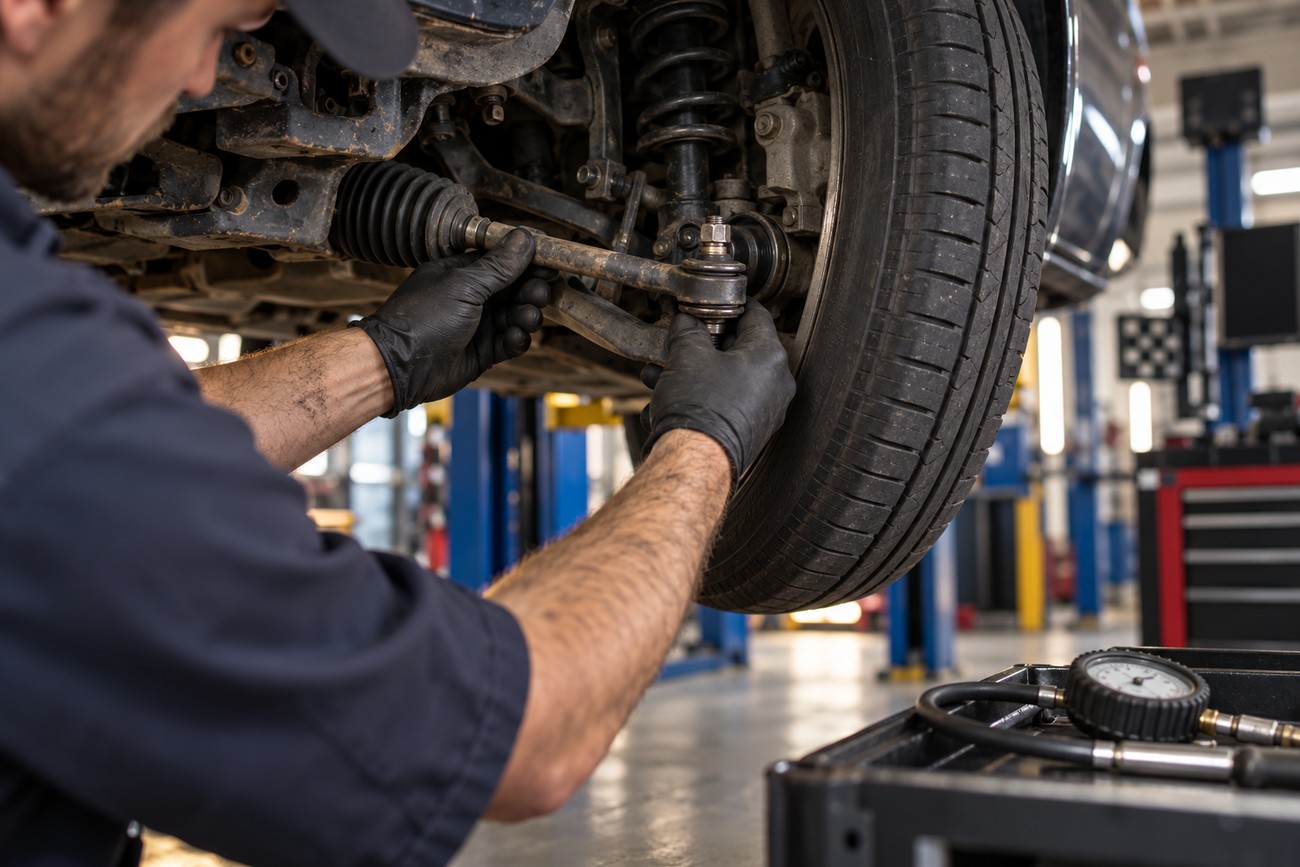
A reliable alignment starts with the vehicle in a known condition. Tire pressures should be set correctly, and the tires should be checked for damage, irregular wear, and mismatched behavior. The technician should inspect steering and suspension components for looseness or damage before attempting to set angles; adjustment cannot reliably compensate for a joint or bushing that moves under load.
The vehicle may need to be prepared with a manufacturer-specified fuel level, load, or other condition. The alignment equipment should also account for wheel or rim runout when the procedure requires it. These steps matter because a pressure error, an incorrect load, or wheel runout can change the measured position and make a sound car appear to have a geometry fault.
Measurements should be compared with the specification for the exact vehicle and configuration. Model year, suspension package, drivetrain, wheel size, and intended use can affect the published targets and tolerances. Generic “normal” figures from the internet are poor substitutes for the manufacturer’s data, particularly when a reading is close to a tolerance limit.
Adjustment on worn hardware can produce a convincing printout that does not last. If a bushing shifts after the vehicle leaves the rack, the alignment has changed even though the original adjustment was made carefully.
The process should consider individual wheel readings, total toe, rear thrust angle, and steering-wheel centering, not only the headline camber, caster, and toe values. A before-and-after printout shows what changed and whether the final readings are within the relevant tolerances. A road check, where appropriate and safe, can then confirm that the steering returns normally, the wheel is centered, and the car tracks as expected.
Some factory angles have limited or no adjustment. An out-of-specification value in that situation may require diagnosis of a bent component, shifted subframe, damaged mount, or other mechanical issue rather than another turn of an adjuster. Correcting alignment also cannot restore tread already worn away; the tire may still need replacement even after the geometry is repaired.
One professional reference suggests checking alignment at about every 10,000 km. That is guidance from one source, not a universal service interval. Follow the vehicle manufacturer’s schedule and arrange a check after relevant suspension or steering repairs, a significant impact, or the appearance of persistent pulling and irregular wear.
Frequently asked questions
Camber readings need context. A number alone does not show whether a setting suits a vehicle. Compare the measurement with the specification for the exact configuration rather than judging by appearance.
How bad is 3 degrees of camber?
Three degrees cannot be judged as acceptable or unsafe by a universal rule. It may be an intentional setting on a performance-oriented vehicle, while the same reading could be outside the specification for a road car and contribute to tire-edge wear or altered handling. If it is outside the vehicle’s specification, have the suspension and steering components inspected; adjustment may be limited or unavailable, and the number alone cannot establish the cause or urgency of the problem.
What does 2 degrees of camber look like?
Two degrees of camber may produce visible wheel lean, but eyesight is an unreliable measuring tool. Camera angle, body shape, sidewall profile, ground surface, and ride height can all change how pronounced the lean appears. An alignment measurement, compared with the vehicle specification, is the proper way to assess it.