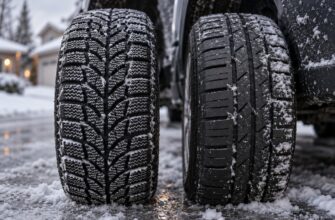
A tire can carry the size you expect and still be the wrong purchase. Its load index may fall short of the vehicle’s requirement, its winter marking may be less meaningful than a listing suggests, or its actual dimensions may leave too little clearance. A matching number on an online listing is a useful lead, not a fitment decision.
The sidewall gives you specifications you can check before buying or mounting. It cannot replace the vehicle’s approved tire information, confirm that a wheel is suitable, or reveal everything that has happened to a used tire. Start with a familiar size, 205/55R16, and read each part for the decision it supports.
- Read the tire size from left to right
- Check the load index and speed rating after the size
- Find the DOT date without mistaking it for a quality score
- Tell M+S apart from the three-peak mountain snowflake
- Decode XL, run-flat, and other markings without mixing them up
- Verify fit against the vehicle, wheel, and available clearance
- Know what the sidewall cannot tell you about tire condition
- Use a final sidewall check before buying or mounting
- Frequently asked questions
- What does “DOT 23” mean on a tire?
- What do “Outside,” “Inside,” or a rotation arrow mean on a tire?
- How do you read a code on a tire sidewall?
- What does the 65 mean on a tire?
- What does the 4-digit DOT code on a tire tell me?
Read the tire size from left to right
In 205/55R16, 205 is the nominal section width in millimeters. Section width describes the tire’s width across its sidewalls under specified measuring conditions; it is not a promise that every tire marked 205 will measure identically once mounted. Use it to narrow your search, then check the vehicle-approved size and the tire maker’s wheel requirements.
The 55 is the aspect ratio: the sidewall height is 55% of the nominal section width. It is a proportion, not a height in millimeters. A 65 aspect ratio means the sidewall height is 65% of the nominal section width, so changing that number also changes the tire’s intended overall dimensions. You cannot treat the second number as a cosmetic choice when comparing alternatives.
R means radial construction, not radius. Reading it as “radius” can lead to the mistaken idea that the number following it describes half a wheel’s diameter. Radial construction is common on passenger vehicles, but the letter still has a specific meaning: it identifies how the tire is built, separate from its width and aspect ratio.
The final 16 specifies the rim diameter in inches. The tire must match the wheel’s rim diameter, while its overall outside diameter also depends on its width and sidewall proportion. A correct rim diameter alone says nothing about required load and speed ratings, approved wheel width, or space around the mounted tire. Keep the full size together when you compare it with the vehicle specification.
Check the load index and speed rating after the size
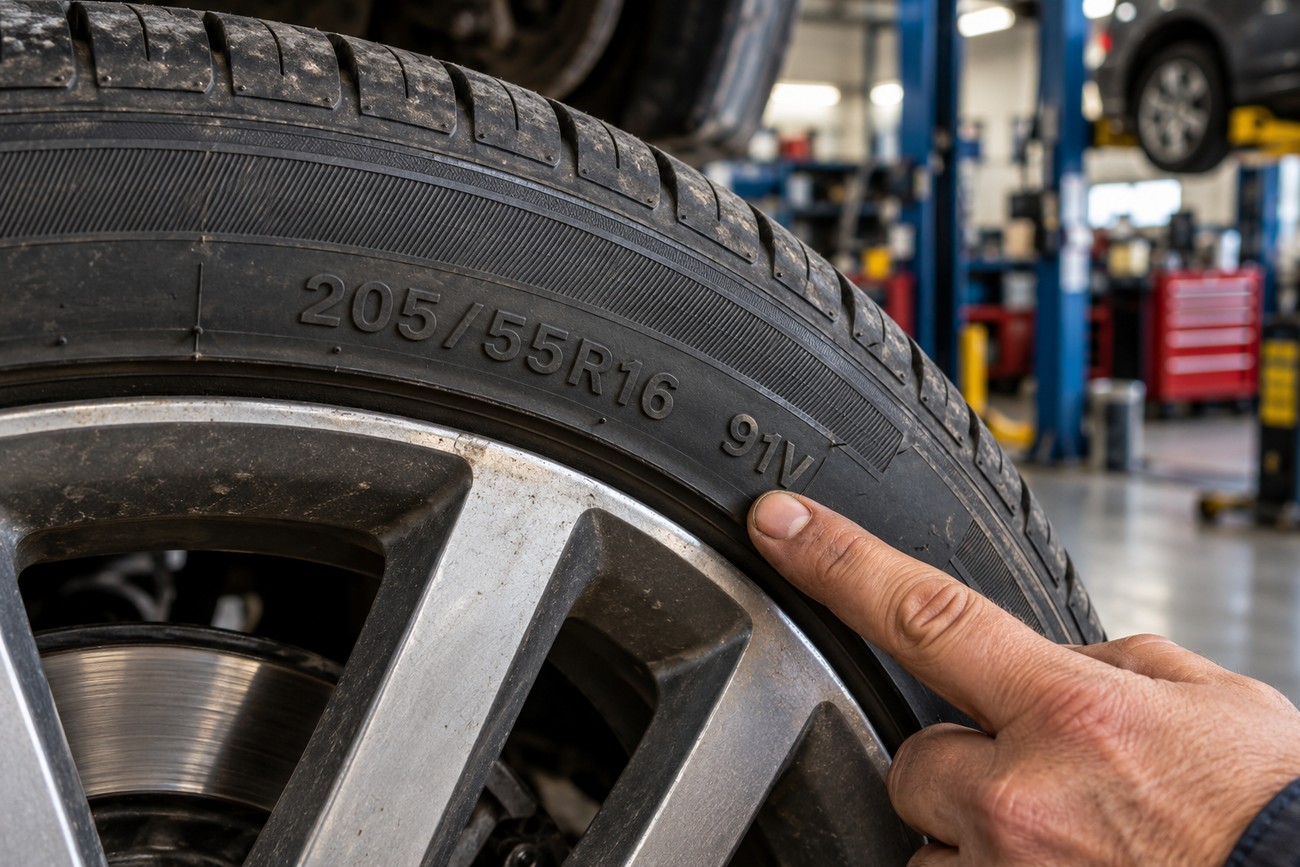
A size may be followed by a number and a letter, such as the separate load-index and speed-rating codes printed after 205/55R16. The load index corresponds to a rated load for one tire, not the combined capacity of a set of four. Find the index required for your vehicle, then use the relevant tire-rating table to interpret any index you are considering.
The speed-rating letter identifies a rated speed category. It is a tire specification, not a suggested driving speed or an exemption from road limits. Check the vehicle manufacturer’s approved rating and any applicable local requirements before choosing a different letter. A tire that fits the wheel can still be unsuitable if its speed category falls below what the vehicle requires.
Looking only at width and rim diameter creates a similar risk with load capacity. Two tires advertised in the same nominal size can carry different load indexes, particularly when their load designations differ. Read the entire service description on the actual tire, rather than relying on a shortened size in a product title, and compare it with the vehicle placard or manual.
Published load and speed capabilities assume appropriate operating conditions. Inflation pressure, temperature, tire condition, and vehicle loading all affect real-world safety; the ratings are not permission to drive continuously at their stated limits. Heavy loading or low pressure makes that distinction especially important. Use the vehicle’s approved specifications to select the tire, and maintain it according to the vehicle guidance after mounting.
Find the DOT date without mistaking it for a quality score
The DOT tire identification marking helps identify a tire and, on modern tires, its manufacturing date. Look for the complete identification number rather than an isolated pair of digits near the DOT letters. Its final four digits give the manufacturing week followed by the year. For example, you need all four date digits to establish both parts; a partial code cannot reliably tell you when a tire was made.
If the date is absent from the sidewall facing you, inspect the other side. The complete date code may appear on only one sidewall, which matters when a tire is already fitted to a vehicle or stacked among other tires. Much older tires can use legacy date formats; if you cannot establish the age of a used tire, seek clarification before buying it.
A tire sold as new may have spent time in stock. Some buyers and sellers use six years as a purchasing cutoff, but that is a rule of thumb, not a universal legal rule. The date gives you a reason to ask about storage and inspect the tire, particularly when its age is unexpected. It does not, by itself, establish whether the tire remains suitable.
A recent DOT date is no quality score either. It cannot confirm that a tire was stored properly, avoided damage, or remained free of deterioration before sale. When comparing stock, read the date on each tire you are offered and examine its condition; ask the seller about anything that concerns you. Age is one input to that decision, alongside the tire’s specification and physical state.
Tell M+S apart from the three-peak mountain snowflake
M+S stands for mud and snow. By itself, it does not prove that the tire passed a specific severe-snow traction test. An “all-season” description in an advertisement is likewise too broad to settle whether a tire meets your winter-driving needs. Check the markings on the tire you will receive, especially if a seller describes it as winter-ready.
The three-peak mountain snowflake symbol, often abbreviated 3PMSF, identifies a tire that qualifies under a severe-snow traction test. That is a more specific claim about snow performance than M+S alone. It does not guarantee grip on ice, where tire design, conditions, and driving choices still matter. Treat the symbol as evidence of a defined qualification, rather than a promise of performance on every winter surface.
Local rules may require particular winter-tire markings or set other conditions for winter use. Check the rules where you drive before ordering, especially if a listing comes from another market. If severe-snow qualification is needed, verify the 3PMSF symbol on the tire and confirm that the size, load index, and speed rating also satisfy the vehicle’s requirements.
Decode XL, run-flat, and other markings without mixing them up
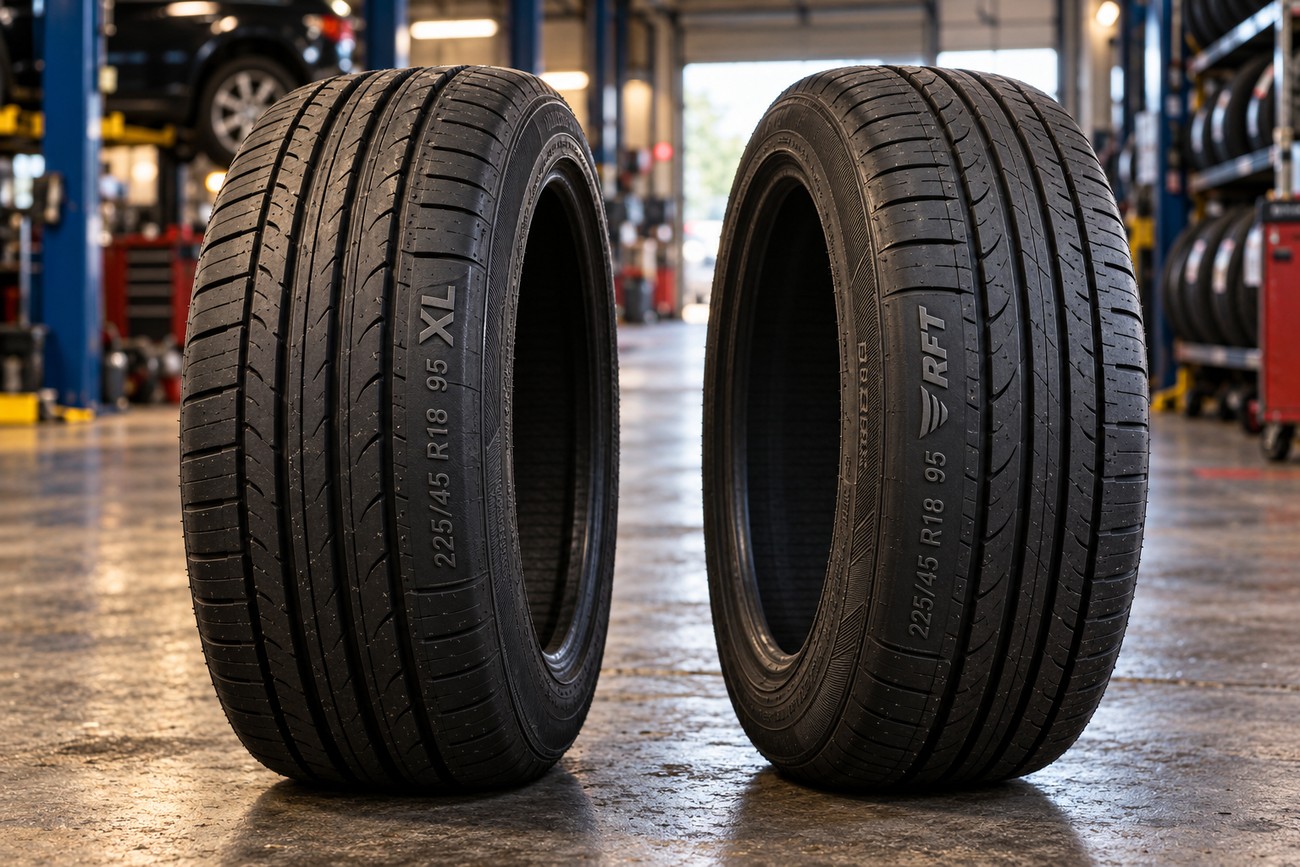
XL or Reinforced is a load designation. It signals a tire designed for a specified load capability under the applicable conditions, but it does not tell you to skip the load index printed after the size. Compare that index and the complete tire specification with the vehicle requirement. A familiar size carrying an XL mark is not automatically an approved replacement for every tire of that size.
Run-flat identifies a different characteristic: limited operation after pressure loss, subject to the tire and vehicle maker’s conditions. It is not another name for XL or Reinforced. Before replacing a run-flat tire, confirm the vehicle’s equipment and replacement guidance, including any requirements for pressure monitoring. Neither marking establishes vehicle approval on its own.
An original-equipment, or OE, marking can identify a tire specification developed for a particular vehicle application. Tires with the same basic size may differ in properties that the size code does not express, including construction details and ride behavior. If the vehicle specifies an OE version, check its exact designation in the vehicle documentation instead of assuming that any tire with matching dimensions is equivalent.
TWI marks point to the locations of tread-wear indicators in the grooves. They help you find and inspect those indicators, although a sidewall label cannot describe the tire’s full wear pattern. Manufacturer and plant identifiers may also appear as part of its identification markings. Read these codes for their intended purpose; none overrides a mismatch in size, ratings, or vehicle requirements.
Verify fit against the vehicle, wheel, and available clearance
Start with the vehicle placard or manual to identify an approved tire size and any permitted alternatives. Then check the required load index and speed rating for the intended application. A catalog match may help locate candidates, but the vehicle information decides which specifications to verify. Avoid substituting a nearby size simply because it appears to fit the wheel.
Next, confirm that the tire’s rim diameter matches the wheel and that the wheel width falls within the tire manufacturer’s approved range. Rim width affects how a tire sits and measures when mounted. Wheel offset is another relevant fitment specification, but it belongs to the wheel; you will not decode it from the tire sidewall.
A catalog may show a size as compatible while overlooking the approved rim-width range or the space a particular tire needs at full steering lock. Check the actual wheel and vehicle before treating the listing as confirmation.
Physical clearance matters after the specifications line up. Check the intended wheel-and-tire combination against the vehicle’s suspension, bodywork, and available space through steering movement, following an appropriate fitment procedure. Two models with the same nominal size can differ in actual width or profile because of their design and the rim used for measurement. A printed size therefore cannot settle every close-clearance case.
If the vehicle lists several approved sizes, each may belong to a particular wheel option or set of conditions. Match the alternative to the wheel you have, rather than mixing figures from different options. Where fitment is uncertain, have a qualified tire professional check the vehicle and proposed combination before mounting. That is safer than discovering interference after purchase.
Know what the sidewall cannot tell you about tire condition
A perfectly decoded sidewall does not record a tire’s history of underinflation, overheating, impacts, repairs, or storage. Those events can matter even when the size, ratings, and DOT date all match your requirements. This is particularly important with used tires, where a previous owner’s maintenance and damage history may be incomplete.
Inspect for visible cuts, bulges, cracking, uneven wear, and signs of questionable repair. Check the tread and both sidewalls, rather than only the face visible in a listing photograph. A recent manufacturing date does not cancel visible damage, while an older date cannot tell you how the tire was stored. Visual inspection is useful, but it cannot rule out every form of internal damage.
Load and speed markings also depend on a tire being operated in suitable condition and at appropriate pressure. The maximum pressure printed on the sidewall is not automatically the vehicle manufacturer’s recommended operating pressure; find that recommendation on the vehicle placard or in the manual. If a tire has run underinflated or suffered an impact, have it assessed before relying on its printed ratings.
Use a final sidewall check before buying or mounting

Read the full size first, then the separate load index and speed rating. Compare all of them with the vehicle’s approved specification, including the correct wheel option if more than one size is listed. This first pass can reject a tire whose printed codes fall short, but agreement on nominal size alone does not establish that it will fit.
Next, confirm any seasonal marking your conditions or local rules require and any OE specification called for by the vehicle. Find the complete DOT identification number and read the final four date digits on a modern tire as manufacturing week and year. If that complete date is not visible, look at the other sidewall before accepting a seller’s description of the tire’s age.
Finally, inspect the actual tire and confirm that its approved rim-width range, wheel, and vehicle clearance work together before mounting. The sidewall can establish what the manufacturer marked on that tire; the vehicle documents establish the required specification. Wheel compatibility and any concern about damage or storage history need a separate check, and sometimes a professional inspection.
Frequently asked questions
Some sidewall details become relevant only when you inspect a particular tire or prepare it for mounting. The following answers address codes that can be easy to read out of context, plus installation instructions that a correct size cannot replace. Where a marking is incomplete, find the full code before making a buying decision.
What does “DOT 23” mean on a tire?
“23” alone is not a complete modern manufacturing date. Its meaning depends on where it appears in the full DOT tire identification number; it might form part of another identifier or part of the final date code. Locate the number’s final four digits to read the manufacturing week and year. Check the other sidewall if you cannot see the complete code.
What do “Outside,” “Inside,” or a rotation arrow mean on a tire?
“Outside” and “Inside” tell the installer which side of an asymmetric tire must face outward or inward. A rotation arrow shows the intended rolling direction for a directional tire. These instructions still matter when the size and ratings are correct: mounting the tire the wrong way can prevent its tread design from working as intended. Have the orientation checked before the wheel is fitted.
How do you read a code on a tire sidewall?
Start by locating the size and reading its parts in order, then find the separate load-index and speed-rating codes that follow it. Look elsewhere on the sidewall for the complete DOT identification number and any seasonal, load, or mounting marks relevant to your vehicle. Compare the result with the vehicle placard or manual; the sidewall describes the tire, while the vehicle information tells you what it needs.
What does the 65 mean on a tire?
In a size such as 205/65R16, 65 is the aspect ratio: the sidewall height is 65% of the nominal section width. It is not a fixed height and does not describe the wheel diameter. If you are comparing a tire marked 65 with one marked 55, check the vehicle-approved sizes before choosing, because changing that proportion affects the intended overall dimensions.
What does the 4-digit DOT code on a tire tell me?
The final four digits of a complete modern DOT tire identification number tell you its manufacturing week and year, in that order. They do not give an expiration date or certify how the tire was stored. Use the date to establish age, then inspect the tire and check its full specification before deciding whether to buy or mount it.