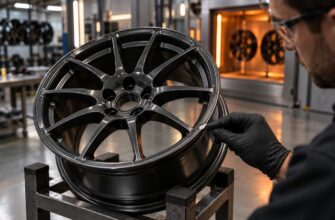
You fit aftermarket wheels, have them balanced, and still feel a shake through the steering wheel on the highway. Another balance may help, but first check whether each wheel sits squarely on its hub. A wheel that mounts slightly off-center can cause a vibration that balance weights alone will not resolve.
Hub-centric rings are one way to control that fit when a wheel’s center bore is larger than the vehicle’s hub pilot. Their job is narrow: they help center the wheel during installation. A sound diagnosis also considers tire and wheel shape, mounting surfaces, balance, and hub condition before blaming—or buying—a set of rings.
- What Hub-Centric Rings Do—and What They Do Not
- Is the Ring Behind the Highway-Speed Vibration?
- How to Measure and Choose the Right Ring
- Plastic vs Metal Hub-Centric Rings: Which Fits Your Use?
- Installation Mistakes That Create Vibration
- If the Rings Fit but the Shake Remains
- Frequently asked questions
- Can I reuse hub-centric rings when changing to another set of wheels?
- Why does the vibration happen only when I brake?
- Why does my wheel feel like it’s vibrating?
What Hub-Centric Rings Do—and What They Do Not
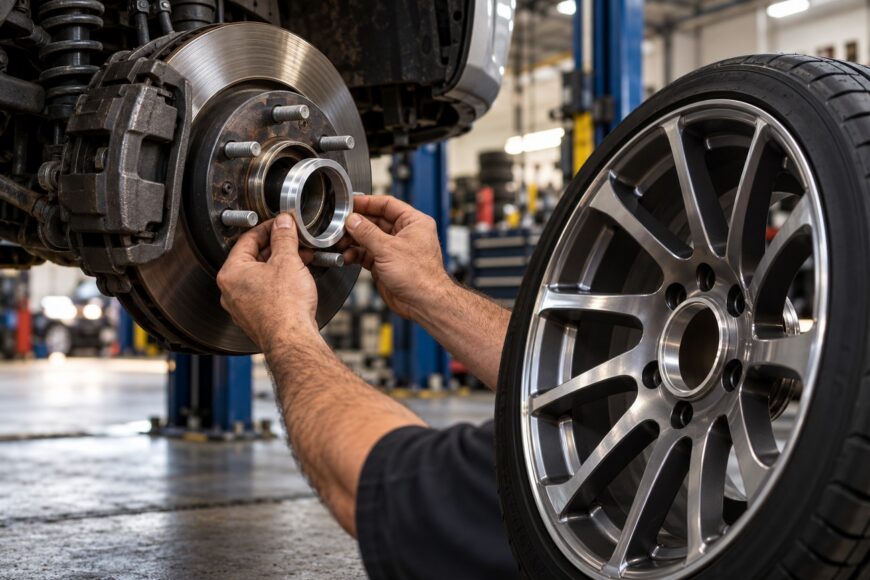
The hub pilot is the raised part of the hub that enters the wheel’s center bore. Many aftermarket wheels have a bore large enough to fit several vehicles, leaving a gap around a smaller hub pilot. A correctly sized ring fills that gap and helps locate the wheel concentrically as it is mounted.
Correctly specified fasteners clamp the wheel against the hub. Suitable lug seats may also assist centering as the fasteners are tightened, so an oversize bore does not automatically explain a vibration. Equally, the presence of those seats does not prove that every loose-bore wheel will mount centrally without a ring.
A centering ring is a fitment aid, not a cure for a bent wheel, an out-of-round tire, or poor balance. It also does not replace correct fasteners or a clean, flush mounting face. If the wheel’s center bore already fits the hub pilot, an additional ring is unnecessary and should not be forced into the assembly.
Is the Ring Behind the Highway-Speed Vibration?
A steering-wheel shake that appears after a wheel change deserves a fitment check, especially if balancing has already been repeated. Drivers sometimes report it becoming noticeable around 90–120 km/h, but that range is an observation, not a diagnostic threshold. Note whether the shake follows road speed, appears only while braking, or changes after a wheel is removed and refitted; those details help a shop narrow the search.
Start with the installation rather than the speedometer. Confirm that the wheel sits flush, its bore and any ring fit the hub correctly, and its fasteners have the right seat and specification. A loose ring may leave room for the wheel to mount off-center; a binding ring can interfere with seating.
Next, ask the shop to check balance and wheel and tire runout, along with the condition of the hub. A ring addresses hub-to-wheel centering; it cannot straighten a wheel or make an out-of-round tire round. If the vibration began with the new wheels, that timing is useful evidence, but it does not identify the ring as the cause by itself.
How to Measure and Choose the Right Ring
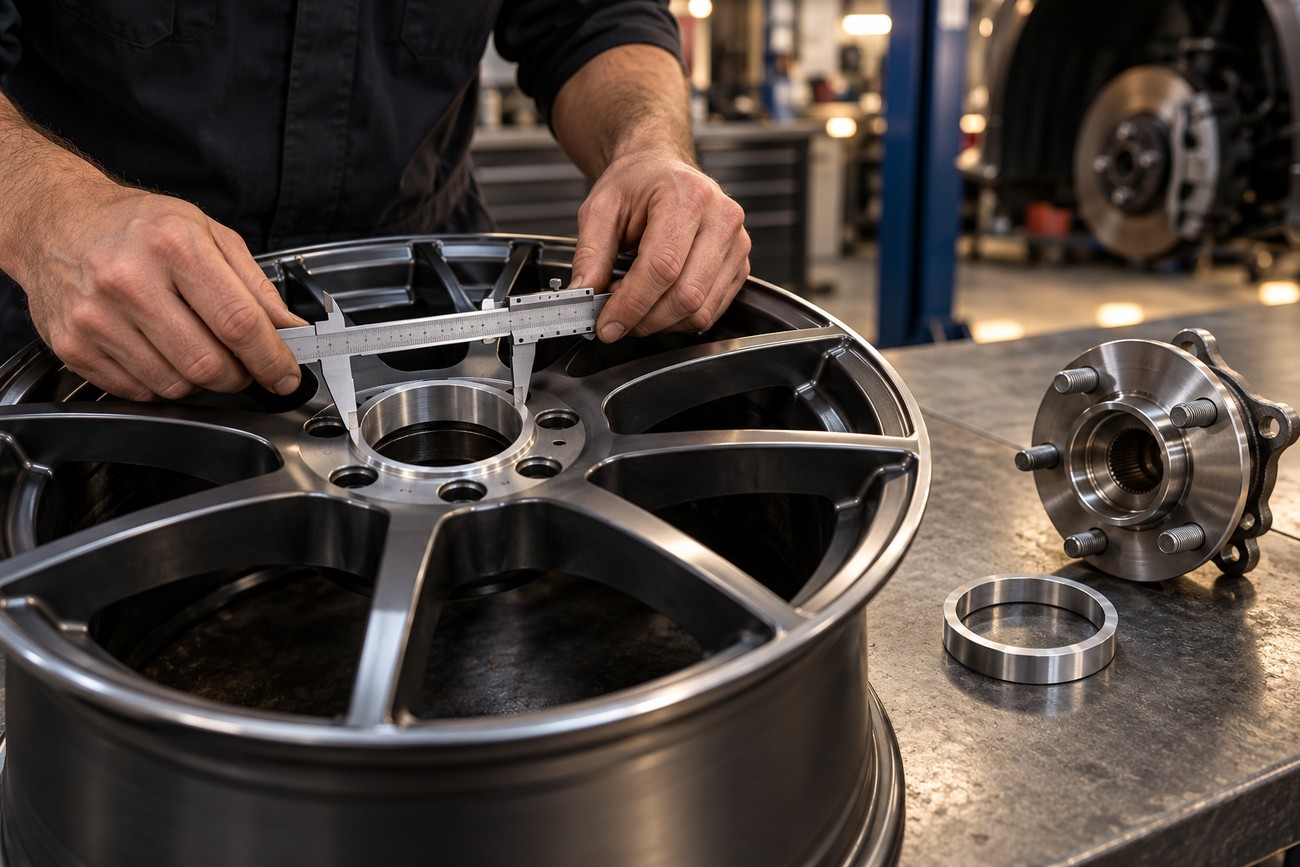
Measure the actual vehicle hub pilot and wheel center bore with an appropriate caliper, or have a fitment shop measure them. A product listing is a starting point, not a substitute for checking the parts in front of you. The ring’s inner diameter corresponds to the hub pilot, and its outer diameter corresponds to the wheel center bore.
Test the ring’s fit before mounting the wheel. It should locate securely without obvious rattling, yet seat fully without being forced or distorted. Check its profile and height as well as its stated diameters: a lip or shape that clashes with the hub or wheel can hold the mounting faces apart.
A wheel bore smaller than the hub pilot cannot be made to fit by adding a ring. Likewise, a ring that seems close enough on paper is a poor choice if it binds or leaves noticeable play on the actual parts. Avoid trying to solve either problem by tightening the wheel against an obstruction; identify the correct wheel and ring specifications first.
Plastic vs Metal Hub-Centric Rings: Which Fits Your Use?
Material matters, though neither option is automatically superior. Choose based on the wheel’s specifications and operating conditions, then inspect the rings whenever the wheels come off.
| Consideration | Plastic rings | Metal rings |
|---|---|---|
| Ordinary road use | Quality heat-resistant plastic can work well when properly fitted. | Can also work well, provided the fit and material are suitable. |
| Demanding heat | Excessive brake heat or poor-quality material may cause deformation. | Generally tolerates demanding heat better; confirm the ring is specified for the application. |
| Corrosion or seizure | Does not corrode like metal, though it can still become damaged. | May corrode or seize against adjacent parts, making removal harder. |
| Before reuse | Look for distortion, cracks, or softened edges. | Look for corrosion, burrs, and damage to the locating surfaces. |
Track use or heavy-duty service calls for particular care with wheel fit and ring specifications. Substituting metal for plastic will not rescue an imprecise bore, an unsuitable ring profile, or a wheel that cannot sit flush.
A damaged ring may leave debris behind when the wheel is removed. Clear those fragments before fitting a replacement; a small piece trapped at a mating surface can cause trouble even when the new ring is the correct size.
Installation Mistakes That Create Vibration
Remove the wheel and inspect the hub pilot, mounting face, and the matching surfaces of the wheel. Rust, dirt, old ring fragments, or raised burrs can keep parts from seating evenly. Clean the surfaces carefully and investigate damage rather than using fastener force to flatten it.
Fit the ring in its intended location and check that it seats fully. A ring with the wrong height or profile can contact a hub feature before the wheel reaches its mounting face, even if both advertised diameters are correct. Rotate and position the wheel by hand to confirm that it sits flat without rocking or a visible gap.
Use compatible fasteners with the correct seat for the wheel. Start them by hand, then tighten progressively in a cross pattern to the vehicle’s specified torque. Uneven or forced tightening can complicate an already poor fit; a correctly sized ring does not make poor mounting technique harmless.
After installation, pay attention to whether the symptom changes. If the shake disappears after cleaning and careful refitting, a seating problem is more plausible than a suddenly corrected tire imbalance. If it remains, keep investigating rather than assuming the ring has failed.
If the Rings Fit but the Shake Remains
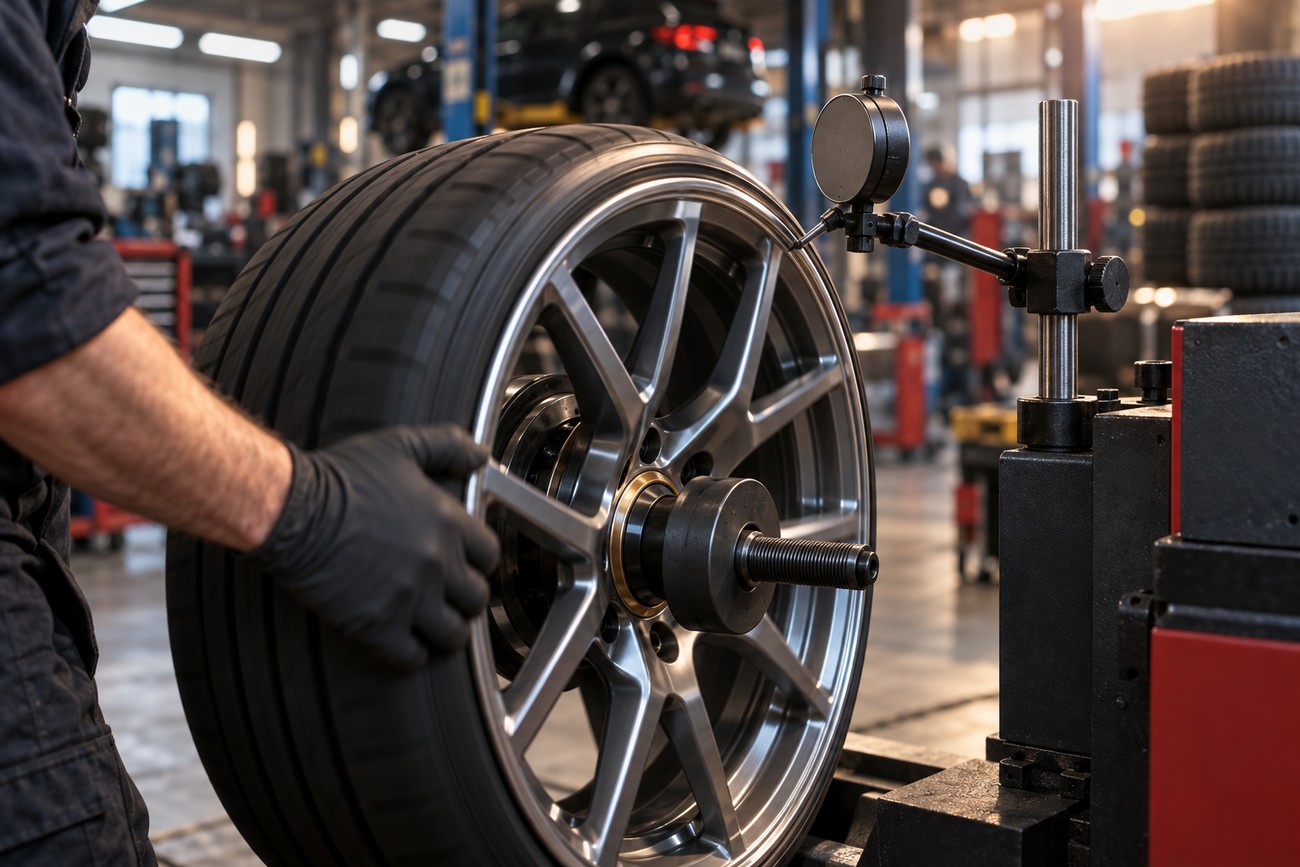
Another balance may identify a weight problem, but balancing alone does not establish that a tire is round, a wheel runs true, or a mounting face is sound. Ask the shop to inspect wheel and tire runout and the hub condition. Where the evidence points that way, checking the bare wheel and hub separately can help locate the source of the movement.
Do not overlook a fault elsewhere simply because the vibration started after a wheel change. The installation may have exposed an existing issue, or the new tire or wheel may have its own geometry problem. A ring only addresses centering between the hub pilot and center bore; it cannot compensate for those faults.
Some universal-bore wheels are marketed as usable without rings, while fitment practitioners often recommend correctly sized rings when the bore exceeds the hub. Neither blanket claim diagnoses your vehicle. The useful decision rests on the measured bore-to-hub fit, compatible fasteners, sound seating, and whether inspection actually traces the shake to centering.
Frequently asked questions
These checks cover situations in which a ring may be reusable or a vibration has a different pattern from the usual road-speed complaint. They do not replace an inspection if a wheel feels loose or fails to seat properly.
Can I reuse hub-centric rings when changing to another set of wheels?
Yes, if the second set has the same actual center-bore diameter and a compatible bore profile, the vehicle’s hub size is unchanged, and the rings remain undamaged. Measure the second wheels rather than assuming two aftermarket sets share a bore. Replace rings that are distorted, cracked, burred, or corroded enough to affect fit.
Why does the vibration happen only when I brake?
A shake that occurs only during braking points toward a braking-related or other load-dependent issue, rather than making the centering ring the default suspect. Tell the shop whether you feel it mainly through the pedal or steering wheel, and ask for a brake and mounting-surface inspection. Ring fit is still worth checking if the wheels were recently changed, but the symptom alone cannot confirm it.
Why does my wheel feel like it’s vibrating?
First distinguish a steering-wheel shake from vibration felt through the seat or body, and note whether it occurs at a steady speed, under braking, or just after a wheel change. That pattern gives a technician a more useful starting point than a request for another balance. If a wheel appears loose, makes a new knocking sound, or does not sit flush, stop using the vehicle until the installation has been checked.