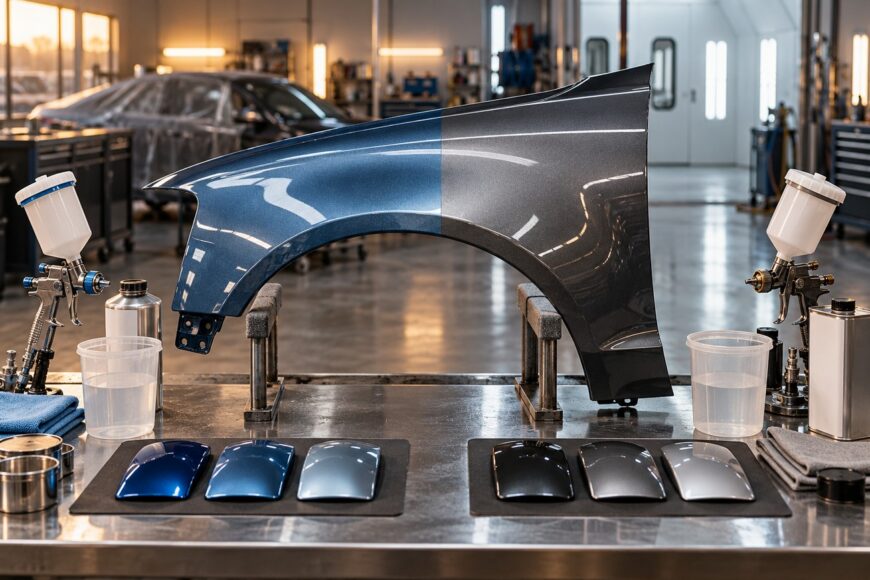
Waterborne paint can reduce emissions during the color-coat stage, while solvent-based paint may be more forgiving when temperature, airflow, or equipment control is limited. Neither option is automatically safer, cheaper, easier, or better for every repair. The useful comparison is between complete refinish processes, not between two labels on a paint can.
Your decision should account for the primer, basecoat, clearcoat, cleaners, equipment, climate, surface preparation, local regulations, and the durability you need. A waterborne basecoat still commonly receives a solventborne 2K clearcoat, and a solvent-based product can still fail if the substrate, spray setup, or flash-off is wrong. The system and the working conditions determine the result.
- What Waterborne and Solvent-Based Car Paint Actually Mean
- Waterborne vs Solvent-Based Car Paint: Side-by-Side Comparison
- Finish Quality, Color Matching, and Drying Behavior
- VOC, Odor, and the Environmental Trade-Off
- Safety, Equipment, and the Garage Reality
- Preparation, Compatibility, and Common Failure Points
- Real Cost: Material Price, Labor, and Process Control
- Which System Fits Your Job?
- Frequently asked questions
- Why can paint with the correct factory color code still look different?
- Why are Maaco paint jobs so cheap?
- What is the highest-quality automotive paint?
What Waterborne and Solvent-Based Car Paint Actually Mean
Automotive paint is a mixture of a carrier, binder, pigments, additives, and, depending on the product, hardeners or other reactive components. The carrier controls how the coating is delivered and how it leaves the film during drying. The binder remains to hold pigment together and adhere to the prepared surface, while pigments provide color, opacity, metallic effect, or pearl appearance.
Waterborne paint uses water as the main carrier. That description does not mean solvent-free: organic co-solvents and VOCs usually remain in the formulation so the paint can wet the surface, form a stable film, and dry under practical shop conditions. The amount and type of co-solvent vary by product, so “water-based” is a family description rather than a universal chemical formula.
Solvent-based paint uses organic solvents as the main carrier. Typical products may contain up to 85% organic solvents by mass and about 15% solids, depending on the formulation. That ratio should be treated as a general formulation reference, not as a specification for every product; the Technical Data Sheet (TDS) and safety documentation control the actual material.
In automotive refinishing, the comparison usually concerns the color basecoat. The basecoat supplies color, but it commonly relies on a compatible 2K clearcoat for gloss, protection, and chemical resistance. The clearcoat, primer, surfacer, cleaners, reducers, and waste can therefore have a substantial effect on the repair’s behavior, emissions, cost, and durability.
Waterborne vs Solvent-Based Car Paint: Side-by-Side Comparison
The table describes common tendencies rather than guaranteed outcomes. Product chemistry, climate, spray equipment, and the manufacturer’s TDS can change the practical result.
| Factor | Waterborne basecoat | Solvent-based basecoat |
|---|---|---|
| Main carrier | Water, with organic co-solvents and usually some VOCs | Organic solvents, with the exact formula varying by product |
| VOC interpretation | Generally lower VOC potential in the basecoat stage; the full repair may still include significant VOC sources | Usually greater solvent contribution in the basecoat, subject to product and jurisdiction |
| Drying conditions | Controlled airflow is usually important; cold, humid air and weak ventilation slow water evaporation | Flash-off is driven mainly by solvent evaporation and product-specific conditions |
| Spray technique | Requires careful film control, gun distance, pressure, overlap, and orientation passes | Often more tolerant of some application variation, but remains sensitive to setup and technique |
| Metallic and pearl control | Consistent overlap and a controlled orientation pass are especially important for color uniformity | Still requires even application; metallic can also mottle, stripe, or shade incorrectly |
| Odor and vapor | Usually less solvent odor than a comparable solvent-based basecoat, but not harmless | Stronger solvent odor, vapor exposure, and fire-safety demands are common |
| Equipment needs | Often benefits from dedicated airflow, suitable filtration, and system-approved gun-cleaning methods | Requires solvent-safe equipment, ventilation, and strict ignition-control practices |
| Durability pathway | Usually depends on a compatible 2K clearcoat for final protection and chemical resistance | Also commonly depends on a compatible 2K clearcoat for final protection and chemical resistance |
| Likely best fit | Controlled professional environments where lower basecoat VOC and process control are priorities | Some controlled or less controlled applications where the specific system permits it and solvent handling is properly managed |
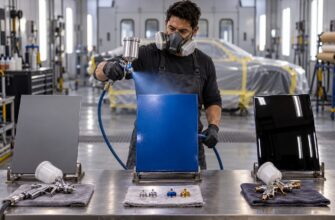
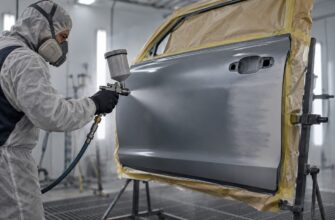
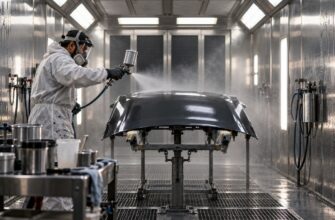
Waterborne paint generally needs controlled air movement because the main carrier must evaporate from the film. A booth with suitable air movement can make the process predictable, while a cold, humid garage with weak ventilation can make the same product slow and difficult. Waiting longer without improving airflow may leave the surface apparently dry on top while moisture remains in the film.
Solvent-based paint can feel easier to use in a marginal workspace because solvent evaporation may be less dependent on the same type of air movement. That apparent advantage does not make the product safe in an enclosed garage. Solvent vapor, ignition sources, respiratory exposure, and waste handling remain serious process controls.
Both systems can produce excellent finishes when the complete product system is followed. The TDS determines compatible substrates, reducers, cleaners, mixing, flash-off, airflow, temperature, and application limits. A comparison based only on the label or a single drying claim is too narrow to guide a reliable repair.
Finish Quality, Color Matching, and Drying Behavior
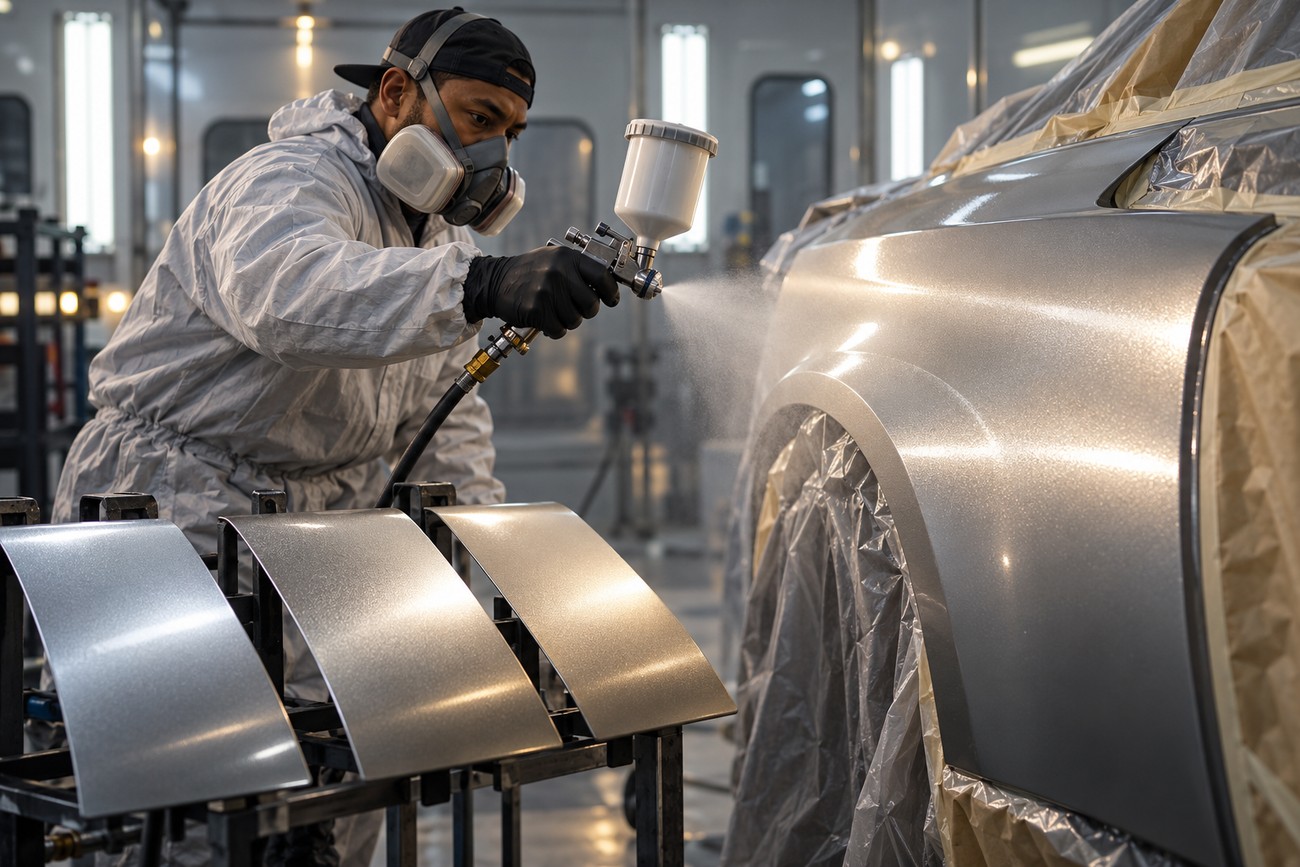
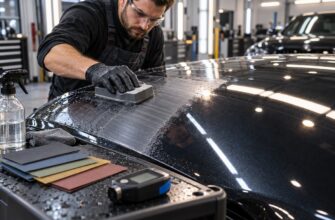
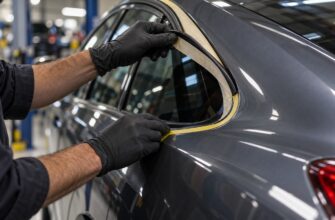
Finish quality begins before the first color coat. The substrate must be sound, clean, properly sanded, and sealed with a compatible primer or surface. Temperature, humidity, film thickness, gun setup, and flash-off then determine whether the coating levels correctly and whether the color particles settle in a consistent pattern.
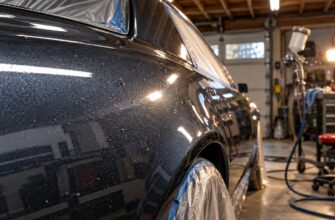
Waterborne metallic and pearl colors are particularly sensitive to application consistency. Uneven overlap, changing gun distance, incorrect pressure, or a different hand position at the end of a pass can alter the orientation of aluminum or pearl particles. The panel may then look striped, cloudy, or darker in one area even though the mixed paint is correct.
A final orientation pass, sometimes called a control coat, helps establish a uniform appearance when the product system calls for it. It must be applied with the specified technique rather than improvised as a light mist over a wet surface. Consistent air movement helps the layer release water evenly, which is why simply waiting for a visible dulling of the surface is not a reliable substitute for controlled drying.
Metallic waterborne basecoat is judged by particle orientation as well as color. Controlled airflow and a consistent orientation pass can stabilize the appearance more effectively than simply extending the waiting time between coats.
High humidity, low temperature, and weak ventilation substantially slow water evaporation. If another coat is applied while the lower layer remains too wet, the result may include mottling, runs, poor adhesion, or a finish that shifts as it continues to dry. A shop that changes from solvent-based to waterborne often needs to change its drying routine as well as its paint.
Solvent-based coatings are not immune to defects. Excess film thickness, incorrect reducer choice, poor flash-off, contaminated air, or unsuitable temperature can cause solvent entrapment, loss of gloss, sagging, or later surface problems. Drying and flash-off claims cannot be transferred between brands because formula and application conditions determine the actual time.
VOC, Odor, and the Environmental Trade-Off
Waterborne systems generally offer their clearest emissions advantage in the basecoat stage. Using water as the main carrier can reduce the amount of organic solvent required for the color coat, which may lower basecoat VOC under the relevant calculation. That advantage does not automatically describe the complete repair.
A full refinish may include solvent-containing primer, sealer, reducer, surface cleaner, and 2K clearcoat. Spray-gun cleaning, overspray, overapplication, discarded mixed material, and rework add to the process footprint. A low-VOC basecoat can therefore be part of a lower-emission process without making every stage low-emission.
VOC figures also need careful interpretation. Actual VOC means the VOC present in the product, while regulatory VOC is a jurisdiction-specific calculation that may exclude water and exempt compounds. Those values are not necessarily interchangeable, so comparing a number from one label with a number from another can create a false ranking.
Some U. S. automotive-refinish categories cite approximately 600–630 g/L for certain basecoat or topcoat products. Other application rules cite approximately 420 g/L for color coating, approximately 340 g/L for single-stage, and approximately 250 g/L for clearcoat. These are examples tied to specific categories and jurisdictions, not universal worldwide limits.
A regulatory limit also does not equal real consumption. A painter who applies excessive film, produces avoidable overspray, cleans equipment with large amounts of solvent, or repeats a defective panel can use more material than the label comparison suggests. Process control affects emissions alongside product selection.
Safety, Equipment, and the Garage Reality
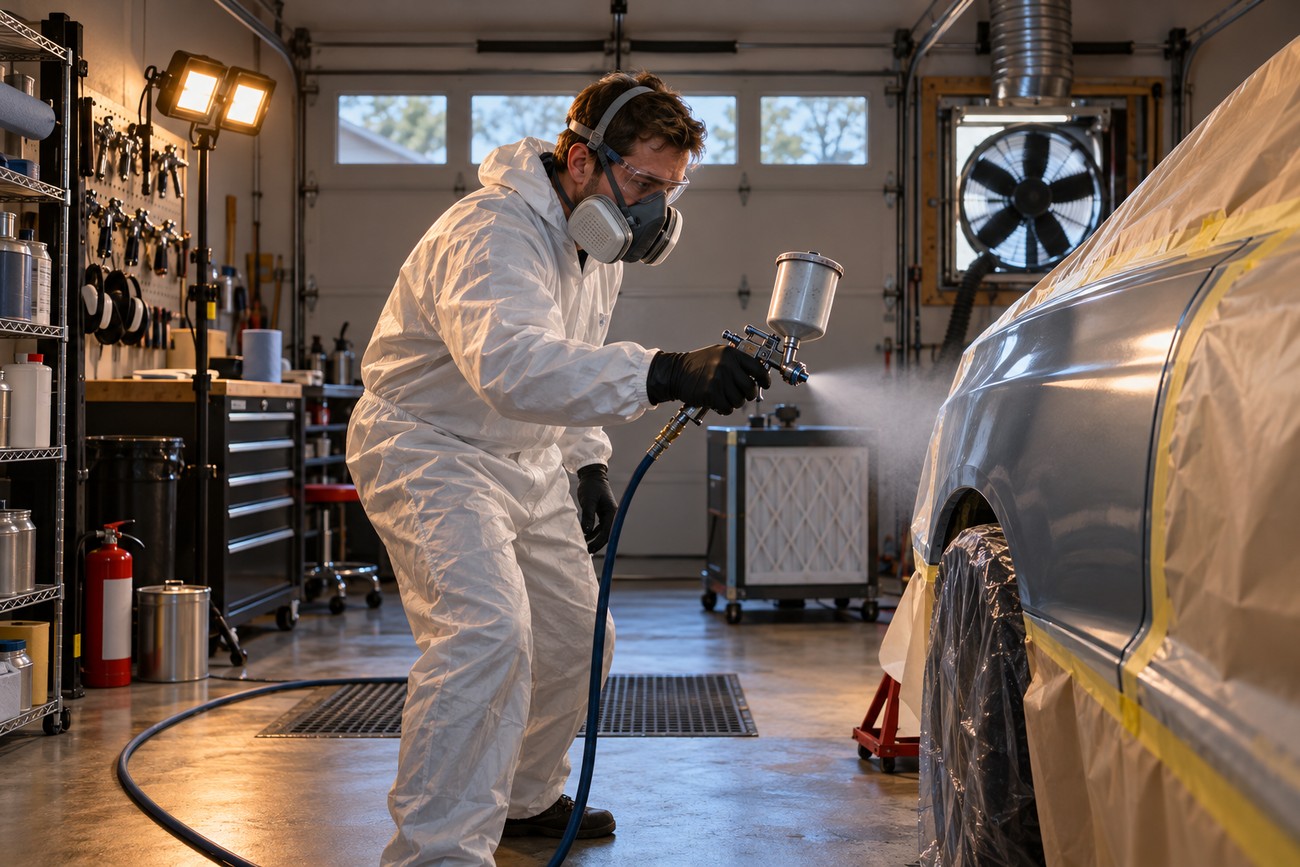
Waterborne paint reduces the role of organic solvent in the basecoat, but it does not remove occupational exposure. Organic co-solvents and VOCs may remain, and other products in the repair can contain hazardous ingredients. Ventilation, gloves, eye protection, and suitable respiratory protection remain necessary, with the product Safety Data Sheet and local rules determining the appropriate controls.
Solvent-based paint usually creates stronger odor and more vapor exposure. Solvent vapors can irritate the respiratory system and increase fire risk, so ignition control, ventilation, storage, grounding where required, and correct respirator use are essential. A household fan or an open garage door is not automatically an adequate spray-booth safety system.
Moving to waterborne often requires more than buying a different basecoat. The workplace may need suitable air movement, clean-air filtration, compatible gun-cleaning procedures, and tighter control of temperature and humidity. Waterborne paint does not mean that every tool can be rinsed with ordinary water at every stage; dried residue and some system components require approved cleaners.
Solvent-based paint may appear more convenient in a cold or poorly equipped garage because it can be less dependent on dedicated water-evaporation airflow. That convenience is limited and potentially misleading. Toxic vapor, flammability, contamination, and inadequate respiratory protection remain hazards regardless of how quickly the surface seems to dry.
Preparation, Compatibility, and Common Failure Points
Many paint failures begin with the substrate rather than the chosen carrier. A weak primer, poorly bonded old finish, incompatible repair material, or residue from wax and silicone can fail under a new coating. Solvent can soften or lift weak primer, old paint, or a poorly degreased surface, exposing the weakness that preparation should have corrected.
Waterborne basecoat has its own failure pattern. Applying another layer before the previous coat has adequately dried can trap moisture and lead to mottling, runs, or adhesion loss. A surface that has lost some gloss is not necessarily ready for recoating; the system’s drying method and TDS criteria matter more than appearance alone.
Cross-system mixing should be treated as a compatibility decision, not a shortcut. Do not dilute a product with an unapproved reducer, combine cleaners by guesswork, or assume that two products are compatible because both are labeled automotive. The brand-specific TDS controls the compatible reducer, cleaner, substrate, mixing ratio, flash time, and recoat limits.
Color and clearcoat also need to be considered as one system. A waterborne basecoat may be designed for a particular 2K clearcoat, and a solvent-based basecoat may have its own approved clearcoat options. Substituting a product without checking compatibility can affect adhesion, gloss, solvent resistance, curing, and long-term appearance.
A basic one-component aerosol clearcoat is not an equivalent substitute where a durable 2K clearcoat is required. It may be acceptable for a limited cosmetic task when the product is intended for that use, but it should not be treated as equal protection against chemicals, abrasion, weathering, or repeated washing.
Real Cost: Material Price, Labor, and Process Control
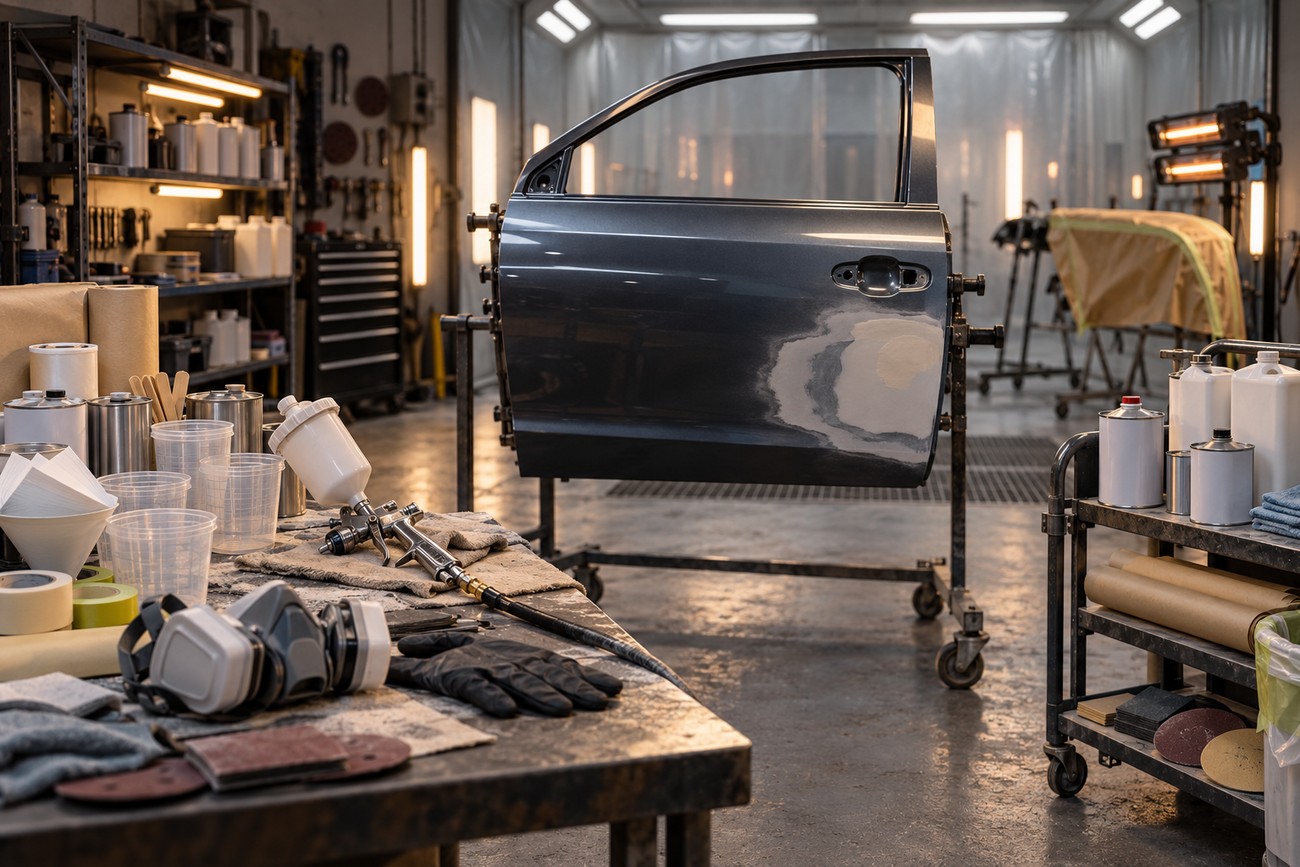
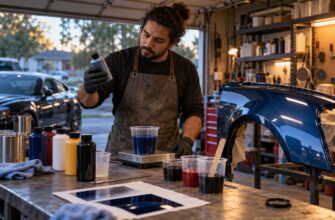
Price per liter is only one part of the calculation. A realistic comparison includes primer, activator, reducer, basecoat, clearcoat, cleaners, masking materials, spray equipment, protective equipment, waste, drying time, and possible rework. A cheaper color product can become the more expensive choice if it demands equipment or correction work that the user does not have.
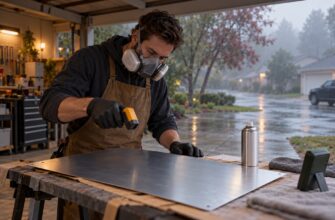
Waterborne systems may require investment in controlled airflow and climate management. In a professional booth, that investment can support repeatable drying and color application. In a hobbyist garage, the same requirement may translate into longer cycle times, more waiting, and a higher chance of recoating a layer that is still too wet.
Solvent-based paint may have a lower entry barrier in some applications, but ventilation, fire controls, respirators, approved storage, and solvent disposal still have costs. Its apparent simplicity can also disappear if solvent attacks an old finish or if stronger odor and vapor control make the workspace unsuitable.
Rework is the hidden cost in both systems. A mottled metallic panel, lifted primer, poor blend, or failed clearcoat consumes material and labor again. The most economical system is usually the one that matches the available conditions and can be applied consistently, rather than the one with the lowest price on the first can.
Which System Fits Your Job?
A professional collision-repair shop with controlled airflow, filtration, climate management, trained painters, and an approved product system is usually well placed to use waterborne basecoat. The main advantages are strongest there: lower basecoat VOC potential, a structured drying process, and repeatable spray control. The shop still needs a compatible clearcoat and must manage emissions from the rest of the repair.
A cold or humid workspace changes the decision. If the operator cannot provide the airflow and temperature control required by the waterborne TDS, drying may become unpredictable. Solvent-based paint may be more practical for a permitted application in those conditions, but only if ventilation, ignition control, respiratory protection, and substrate compatibility are properly addressed.
For a small DIY repair, the first priority should be a complete, compatible system rather than the waterborne label. Check whether the product is intended for the substrate, whether the required primer and clearcoat are available, and whether the workspace can meet the application conditions. Aerosol color may be useful for a minor repair, but a factory color code alone cannot guarantee a visual match.
Hidden or internal areas can have different requirements from an exterior panel. Some manufacturers permit specific solvent-based products for such locations because simple application and system compatibility matter more than exterior appearance. That decision belongs to the product documentation and repair specification, not to a general claim that one carrier is always superior.
Choose waterborne when lower basecoat VOC and professional airflow control are priorities. Choose solvent-based where the approved system, substrate, climate, equipment, and regulations support it. The practical decision rule is simple: select the system that you can prepare, spray, dry, clear, and protect according to its TDS under the actual conditions of the job.
Frequently asked questions
Why can paint with the correct factory color code still look different?
A factory color code identifies a color family, not necessarily one visually identical mixture for every vehicle and repair. Manufacturers may use formula variants, and vehicle paint can change through fading, oxidation, repairs, and exposure. The substrate color and primer shade also influence how the new coating is perceived.
Application changes the result as well. Gun distance, pressure, overlap, film thickness, and the orientation of metallic or pearl particles can shift the appearance. A proper repair may require a variant check, a spray-out card, and a blend into adjacent panels rather than applying the code as an isolated patch.
Why are Maaco paint jobs so cheap?
A low quote usually reflects the scope and process rather than a special type of paint chemistry. Preparation, dent repair, sanding, masking, disassembly, material tier, labor time, warranty terms, and the area being refinished can all change the price. A limited cosmetic refinish may be priced very differently from a corrosion repair or a carefully blended collision repair.
Ask what preparation is included, which panels will be painted, how defects are handled, what clearcoat system is used, and what the warranty covers. A lower price can be appropriate for a defined appearance target, but it should not be compared with a quote that includes substantially more preparation and finish control.
What is the highest-quality automotive paint?
There is no universal highest-quality brand or chemistry. Quality comes from the matched primer, basecoat, clearcoat, application equipment, color-variant process, surface preparation, and the repairer’s execution. A premium product applied outside its temperature, mixing, or drying limits can produce a worse result than a properly applied system with a different carrier.
For a durable exterior repair, evaluate the complete system and the process behind it. Look for compatible products, clear technical documentation, controlled application conditions, correct color verification, and a clear specification for gloss, chemical resistance, and curing. The carrier choice matters, but it is only one part of finish quality.