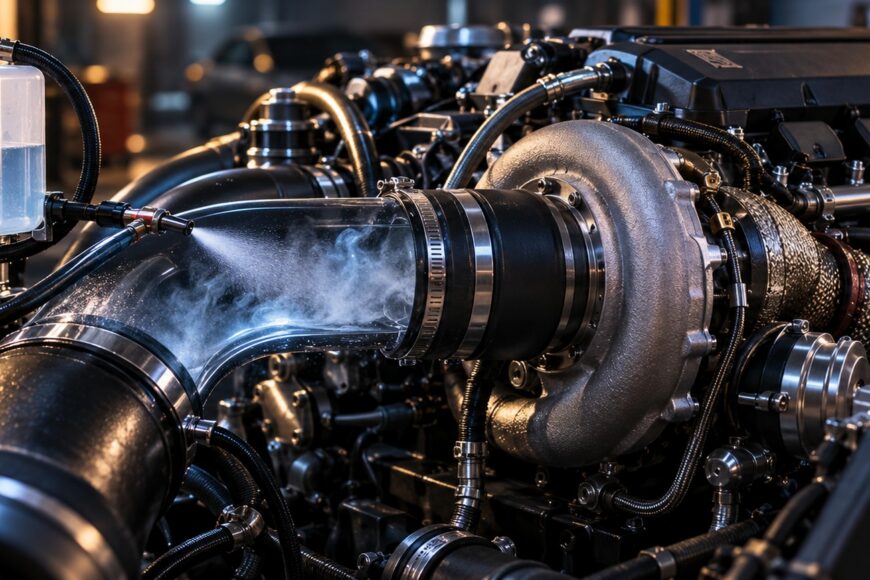
Water-methanol injection (WMI) appeals to turbo-engine builders because it can increase knock resistance while reducing intake-charge and, in some applications, combustion temperatures. That extra margin may support more boost or ignition advance when the engine calibration is designed around it.
The trade-off is dependence on correct fluid delivery, injector placement, control logic, and calibration. WMI works best as a supporting tool on an already sound setup. It does not automatically create power, repair poor fueling or ignition control, or guarantee lower fuel consumption.
- What Water Methanol Injection Actually Does
- Water-Only, 50/50, or More Methanol?
- How to Size and Control the Injection System
- Where to Inject: Placement and Cylinder Distribution
- Gasoline Turbo Engines vs. Turbo Diesels
- The Failure Modes Owners Usually Discover Too Late
- What WMI Can and Cannot Replace
- Is Water Methanol Injection Worth It for Your Turbo Build?
- Frequently asked questions
- How much water methanol should a turbo engine inject?
- Where should a water-methanol injector be installed?
- What should happen if the WMI tank runs dry during a pull?
- How can you confirm that water-methanol injection is working?
What Water Methanol Injection Actually Does
As the injected fluid atomizes and evaporates in the intake stream, it absorbs heat from the charge. Water’s primary role is charge cooling and knock suppression. Lower charge temperature can reduce the tendency toward detonation, especially during sustained boost or high ambient temperatures.
Methanol contributes an additional fuel component and anti-knock effect. Because it is combustible, the engine may require changes to fuel and ignition calibration when the system becomes part of the power strategy. The correct settings depend on the engine, fuel system, boost level, injection quantity, and the amount of detonation margin available before WMI is added.
WMI does not create power in isolation. It can create operating headroom by controlling temperature and knock, after which a tuner may use that headroom for more boost, more ignition advance, or a safer calibration at the existing output. An engine with little thermal or detonation limitation may show a modest result because there is less usable margin to recover.
Some manufacturer marketing materials claim up to 10–20% more power on charged gasoline engines, but this is not a universal result. The figure depends on the starting calibration and the changes made after installation. A stock engine with conservative settings and a highly stressed competition engine will use the same physical principle very differently.
Water-Only, 50/50, or More Methanol?

Blend choice should follow the purpose of the system. For cooling-only applications, many practitioners consider clean water sufficient because water provides the main evaporative cooling effect. This can simplify the fuel interaction and avoid adding a combustible, toxic component when the engine does not need methanol’s additional fuel contribution.
A 50/50 water/methanol mixture is commonly cited as a baseline in commercial systems and FAQs. It offers a practical compromise between cooling, anti-knock behavior, and methanol’s fuel contribution. The baseline still requires confirmation against the specific pump, injector, controller, materials, and calibration strategy.
More methanol does not automatically produce more useful cooling or more reliable power. A richer blend changes the amount of fuel entering with the spray and may move the engine away from the calibration used during testing. At least one manufacturer prohibits mixtures above 50% methanol; limits are kit-specific, so the instructions for the actual system take priority.
Fluid quality also matters. Contamination, incompatible additives, or an unverified blend can change spray behavior and combustion response. Label the reservoir, store methanol safely, and avoid treating mixture selection as a simple power ranking.
How to Size and Control the Injection System
No universal nozzle size or flow rate suits every turbo engine. Sizing should follow the engine’s airflow, fuel system, boost target, intended duty cycle, and the kit manufacturer’s documented guidance. The injector must deliver enough fluid for the intended operating range while preserving stable combustion at the point where injection begins.
Excessive delivery can produce dirty running, misfires, backfiring, or unstable combustion. A large nozzle may lower temperature during one test while making transient response and cylinder-to-cylinder behavior worse. The useful result comes from controlled evaporation and repeatable distribution, rather than the largest possible fluid volume.
Insufficient delivery creates the opposite problem. Knock can return quickly when flow or activation calibration is insufficient, particularly if ignition timing or boost has already been increased on the assumption that WMI is present. The activation threshold therefore needs to match the engine’s real load demand, with enough time for the system to reach the intended flow before the calibration depends on it.
Controllers commonly trigger or vary delivery according to engine load, such as MAP or MAF, rather than only elapsed time. A fixed timer or simple switch may activate too early during a light-load condition or too late during a rapid boost event. A proper safety strategy should also monitor level, pressure or flow, and controller faults, then reduce the WMI-dependent operating demand when delivery is missing.
Where to Inject: Placement and Cylinder Distribution
Injector location determines how much time the spray has to atomize and mix before entering the cylinders. The intake tract’s length, temperature, pressure, intercooler design, throttle-body position, and airflow volume all affect evaporation. A position that works on one engine can produce poor distribution on another.
Spray quality matters as much as nominal flow. Large droplets may collect on walls or enter some runners unevenly, while a poorly matched spray pattern can leave part of the intake charge with little cooling effect. The result may look acceptable in a shared intake-temperature reading while individual cylinders experience different knock margins.
Complex intake runners can produce unequal cylinder distribution, especially with a single nozzle. The cylinder nearest the spray path may receive a different mixture from a remote runner, and the imbalance can change with engine speed and load. There is no universal placement that delivers identical results across all turbo engines.
Installation should therefore be validated under real load. Check commanded activation, measured flow, temperature behavior, knock activity, and the consistency of the engine response across repeated pulls. Service access also matters: a nozzle that cannot be inspected or removed easily is more likely to remain obstructed until the engine is already operating outside its intended protection range.
Gasoline Turbo Engines vs. Turbo Diesels
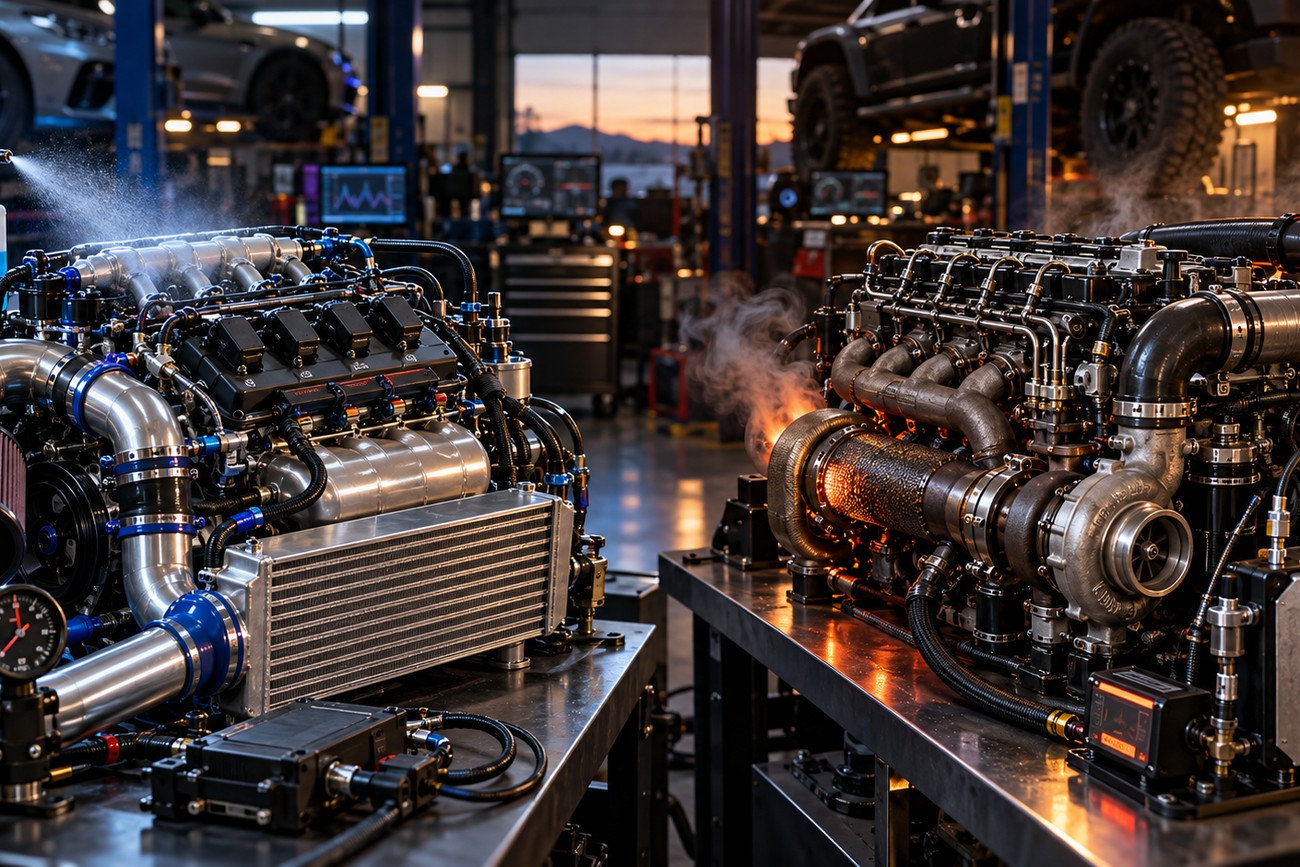
Gasoline applications commonly emphasize knock suppression and intake-air temperature control. WMI may expand the usable boost or ignition range when the base fuel system and calibration are already capable of supporting the target. The fluid contribution from methanol must be included in the fuel model if it is part of the intended strategy.
Turbo-diesel applications more often emphasize EGT reduction and smoke or efficiency behavior. Cooling the charge and combustion process can change exhaust temperature and fueling behavior, but the outcome depends on injection timing, boost control, air supply, and the diesel calibration. A lower EGT reading alone does not prove that the complete system is operating safely.
Incorrect mixture selection or excessive delivery can compromise safety on a turbo diesel. Over-injection may disturb combustion, while a blocked nozzle or empty reservoir removes the expected thermal control. Diesel systems also have different reasons for using WMI, so a gasoline-oriented blend or control strategy should not be transferred without checking the engine’s actual requirements.
Fuel-economy improvements are especially difficult to generalize. Temperature and smoke behavior may improve in a specific calibrated operating range, while other conditions show little change. Treat any efficiency result as a measured outcome of one engine and calibration rather than an inherent property of WMI.
The Failure Modes Owners Usually Discover Too Late
The reservoir is a consumable part of the protection system. Regular level checks are essential because an empty tank can leave the engine operating with the same boost or ignition settings but without the expected cooling and knock suppression. A low-level warning is useful only if the driver responds before the high-load event begins.
The pump, nozzle, hoses, sensor, and electrical connections add failure points. A clogged nozzle may leave the pump running while delivering little fluid. A loose hose can leak or admit air, and a pressure or level sensor can report an apparently normal condition when the actual flow is inadequate. Inspection and functional testing need to cover the complete path from reservoir to intake.
Flow validation and failsafe testing under load should come before increasing boost or ignition timing. A functioning pump proves that the pump runs; it does not prove equal cylinder protection or correct delivery at the engine’s highest demand.
A tune that relies on WMI can leave the engine suddenly exposed to knock if the system stops delivering. The calibration should therefore include a defined response to low level, low pressure, loss of flow, controller failure, or implausible sensor data. Depending on the system, that response may involve reducing boost, removing added ignition advance, switching to a safer map, or limiting engine load.
Methanol is flammable and toxic, which increases storage, handling, and service requirements. Use compatible containers and plumbing, keep the reservoir secure, and prevent spills or vapor exposure during filling and inspection. Chemical safety is part of the installation, alongside electrical protection and mechanical routing.
What WMI Can and Cannot Replace
WMI is a supporting tuning tool, not a substitute for correct fuel and ignition calibration. It cannot compensate reliably for inadequate fuel delivery, uncontrolled boost, unsuitable ignition timing, poor intercooling, or an engine that already has a mechanical problem. Those issues should be corrected before injection is used to add thermal or detonation margin.
The result depends on mixture, placement, atomization, airflow, and available detonation margin. A system can reduce intake temperature without creating a meaningful power gain if the engine is already limited by the turbocharger, fuel system, exhaust flow, or mechanical strength. Conversely, a highly knock-limited gasoline setup may benefit substantially after the calibration is rebuilt around verified flow.
WMI may also clean deposits in some operating conditions, but cleanliness should not be treated as a guaranteed primary benefit. Marketing often presents power, lower temperatures, improved efficiency, and cleaner combustion as a single package. Those effects do not necessarily occur together or to the same degree.
Claims of 10–30% lower fuel consumption are marketing claims from some sellers, not a universal or independently established outcome. Fuel use may change when calibration, boost, throttle position, or operating conditions change, so a meaningful comparison requires repeatable routes or test conditions and a clearly documented tune.
Is Water Methanol Injection Worth It for Your Turbo Build?
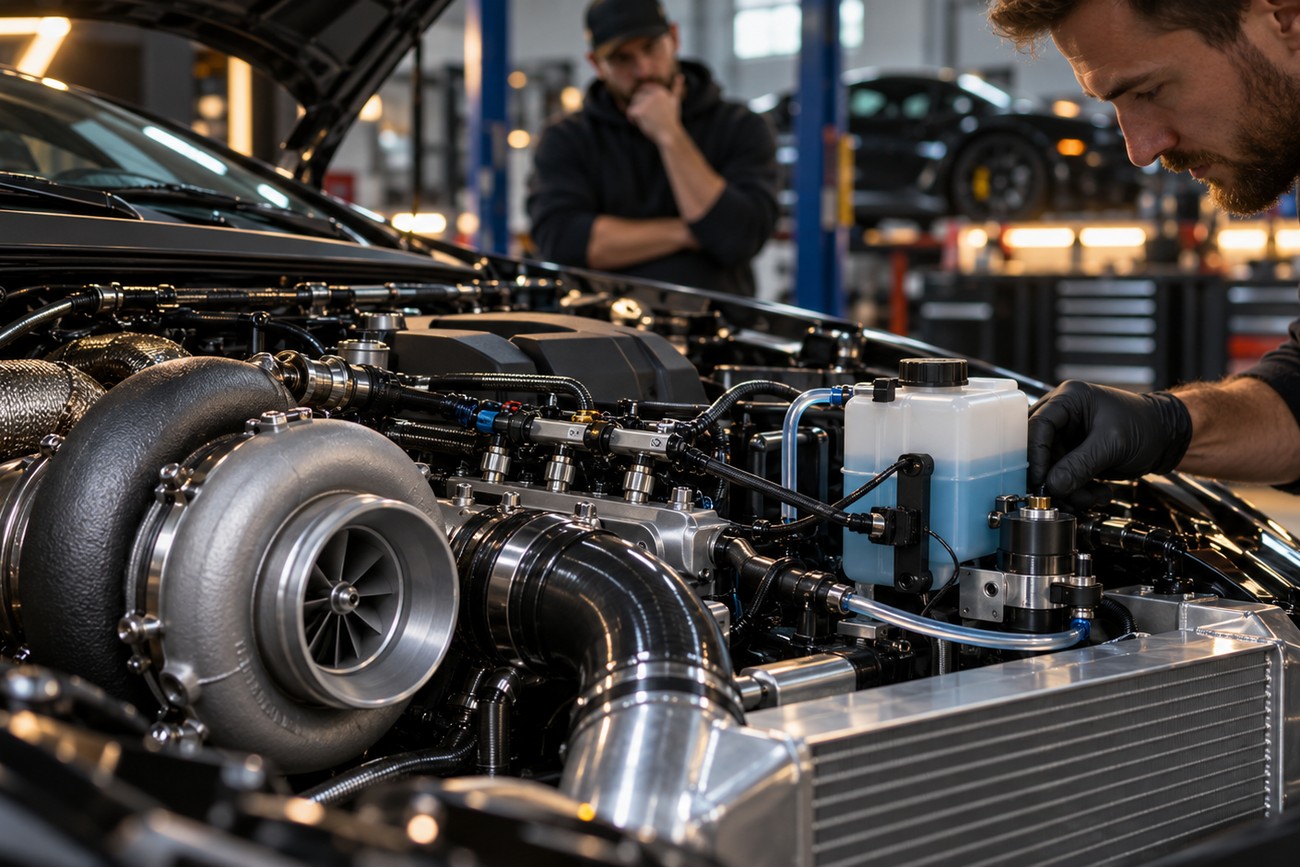
WMI can make sense for a calibrated high-boost gasoline setup with a clear thermal or knock-control objective. It may also suit a diesel application where EGT or smoke behavior is being measured and the control strategy is built for that engine. In both cases, the intended benefit should be defined before hardware is selected.
The system becomes less attractive when the vehicle has limited service access, no reliable failsafe input, poor cylinder distribution, or a driver who may ignore reservoir warnings. Chemical handling, fluid consumption, and additional failure points can outweigh a modest temperature reduction. A simple, conservative engine calibration is often the better choice when the system’s protection cannot be verified.
Use this checklist before installation:
- Define the engine goal: charge cooling, knock suppression, EGT reduction, smoke control, or a measured combination.
- Select water, a 50/50 water/methanol mixture, or another approved blend according to the kit and calibration requirements.
- Use load-based control such as MAP or MAF, with suitable activation thresholds and a response to lost flow.
- Validate injector placement, atomization, and cylinder distribution under real load.
- Monitor reservoir level, pump operation, nozzle condition, pressure or flow, and relevant temperature or knock data.
- Decide in advance how boost and ignition will be reduced if WMI protection disappears.
WMI generally works best as an addition to an already tuned setup. The benefit is application-specific, and maintenance and system-failure risk must be weighed against the intended temperature or knock-control benefit.
Frequently asked questions
How much water methanol should a turbo engine inject?
Use the specific kit and engine’s documented flow guidance, then verify delivery under load. No universal nozzle size or flow rate can account for every engine’s airflow, boost, fuel, intake geometry, and calibration. Begin with a controllable setup that the pump, injector, controller, and failsafe system can support.
A larger nozzle or richer blend should not be chosen simply because more fluid appears to promise more cooling. Excessive delivery can cause dirty running, misfires, backfiring, or unstable combustion. Confirm actual flow and combustion behavior before changing boost or ignition settings.
Where should a water-methanol injector be installed?
Choose the location by tracing the airflow path and checking how the spray will atomize before reaching the cylinders. Consider the intercooler and throttle-body layout, available mixing distance, service access, and the risk of wall wetting or pooling. The best location is the one that produces repeatable distribution on the specific engine.
Validate the installation with measured flow and load testing. A single nozzle may feed cylinders unevenly through complex runners, so intake temperature at one sensor cannot prove equal cylinder protection. Changes in engine speed and boost should be included in the validation.
What should happen if the WMI tank runs dry during a pull?
A properly designed system should detect low level or loss of flow and remove the WMI-dependent calibration strategy. The engine should move to a safer boost and ignition condition, switch maps, or otherwise limit load according to the available controls.
Continuing at the same settings assumes that cooling and knock suppression are still present. That assumption can expose the engine to rapidly returning knock, particularly when the tune was built around methanol-assisted headroom. Test the dry-tank response deliberately and at a controlled load level.
How can you confirm that water-methanol injection is working?
Confirm commanded activation first, then verify measured flow or pressure rather than relying on pump noise or a visual check of the reservoir. Observe reservoir level behavior, inspect the nozzle and hoses, and check for leaks or restrictions. A level sensor alone cannot prove that fluid reaches the intake.
Use repeatable load conditions to compare intake temperature, knock activity, boost response, and other relevant engine data. The results should remain consistent across repeated tests. If the system shows an intermittent response, treat it as a fault and remove any calibration that depends on WMI until delivery is restored and verified.