Larger fuel injectors can leave an engine running rich, unstable at idle, difficult to start, or no more powerful than before. The injector may have enough capacity, yet calibration, fuel supply, or the air system may still be the real limitation.
A sound upgrade matches injector capacity to actual power, fuel demand, pressure, engine configuration, and ECU data. The largest advertised flow rate is rarely the best choice. A properly sized, flow-matched injector with reliable scaling and dead-time data is usually easier to tune and more consistent across the operating range.
- What Bigger Injectors Actually Change
- How to Calculate the Injector Size You Need
- Injector Specifications: What the Numbers Actually Mean
- Fuel Pressure, Boost, and Real Injector Flow
- Fitment, Electrical Compatibility, and ECU Calibration
- The Rest of the Fuel System Still Has to Keep Up
- Frequently Asked Questions
- What size injectors do I need for 500 hp?
- How much horsepower do 100-over injectors add?
- How do you add 100 hp to a car with fuel injectors?
What Bigger Injectors Actually Change
An injector upgrade removes a fuel-delivery restriction. It does not create power by itself. The engine still needs enough air, suitable fuel pressure, adequate pump capacity, and calibration that commands the new injector correctly.
Oversized injectors can also make low-load operation harder to control. If the injector has poor short-pulse linearity or unsuitable dead-time data, the ECU may struggle to deliver small, repeatable fuel quantities. That can produce an unstable idle, hesitation, and poor starting even though high-load capacity has increased.
Operating near 100% duty cycle leaves little time for the injector to close between commanded events. That removes useful headroom and can make fuel delivery less predictable as engine speed rises. Injector Dynamics recommends not planning above an 80% duty cycle; 80% is a practical recommendation, not a universal mandatory limit.
A short-term power peak should not determine a continuously oversize injector. Size the system for the intended operating range, including sustained high-rpm use, while leaving sensible capacity for pressure variation and future changes. Extra flow is useful only when the engine can use it and the ECU can control it accurately.
How to Calculate the Injector Size You Need
The baseline calculation is:
lb/hr = (power × BSFC) / (number of injectors × duty cycle)
Power in this formula means the target power, while BSFC represents the engine’s fuel demand. The injector count and selected duty-cycle target determine how much work each injector must perform. Because BSFC varies with engine design, fuel, aspiration, and calibration, the formula does not produce one universal answer for a stated horsepower figure.
Injector Dynamics recommends not planning above an 80% duty cycle. Use that as a practical design target rather than treating it as a mandatory limit for every injector. The required size also depends on fuel pressure, fuel type, injector data, and the rest of the fuel system.
Convert the result carefully if the supplier lists flow in cm³/min rather than lb/hr. Keep the test pressure and fluid attached to the specification during the comparison. A number without those conditions can appear precise while describing a different test from the one used for another injector.
For boosted engines, include the actual injector-to-manifold pressure differential in the assessment. Rail pressure alone can give a misleading result because manifold pressure changes the pressure available to push fuel through the injector.
Injector Specifications: What the Numbers Actually Mean
Compare injector ratings only after checking the conditions behind the number. The following details determine whether two apparently similar injectors can be compared fairly.
| Specification | What it tells you | Why it matters |
|---|---|---|
| Rated flow | The measured or advertised fuel volume under stated conditions | It gives capacity, but does not describe every operating condition |
| Test pressure | The pressure used for the flow rating | Bosch commonly reports flow at 3 bar, while other specifications may use 2.5–2.7 bar |
| Test fluid | The liquid used during measurement | Bosch data may use n-heptane, whose properties differ from gasoline |
| Static versus dynamic flow | Continuous flow compared with pulse-mode delivery | Dead time, short-pulse nonlinearity, and spray behavior affect real dosing |
| Dead time | The time required for the injector to open and deliver consistently | Incorrect data can cause fueling errors during idle, starting, and light load |
| Electrical data | Resistance, control type, connector, and driver requirements | A connector that fits does not prove ECU compatibility |
| Spray pattern | Fuel angle, distribution, and atomization behavior | The wrong pattern can worsen mixture preparation despite matching flow |
Fuel Pressure, Boost, and Real Injector Flow
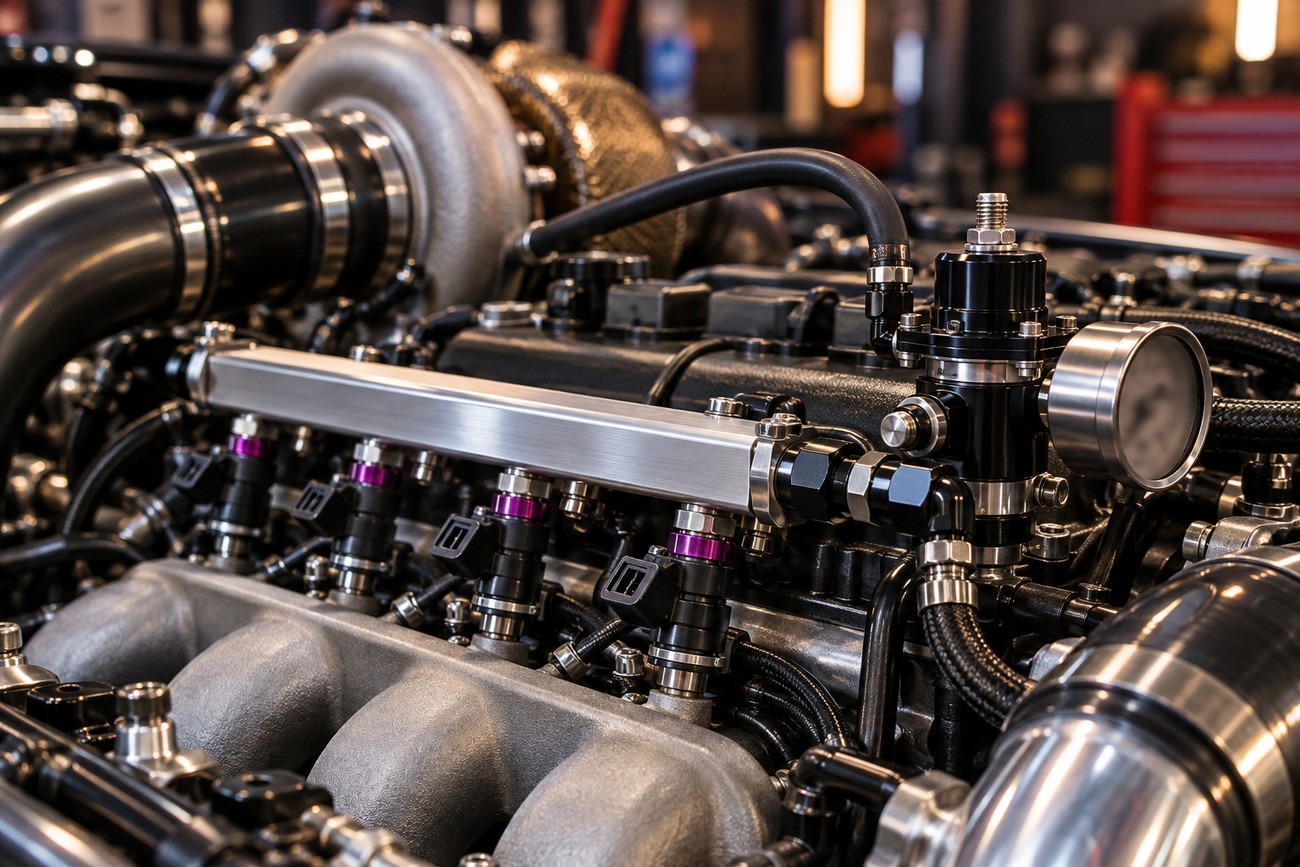
Injector flow changes approximately with the square root of the pressure ratio:
Q2 = Q1 × √(P2/P1)
Increasing pressure therefore increases flow, but the gain is not proportional to the pressure increase. A higher-pressure setup also raises pump load, fuel heating, and the demands placed on the regulator and fuel lines. Those costs can outweigh the benefit of using pressure as a substitute for the correct injector size.
In a fixed-pressure system, boost reduces the pressure differential across the injector. The injector sees rail pressure on one side and manifold pressure on the other, so rising manifold pressure reduces the effective difference and can reduce fuel delivery at the point where the engine needs it most.
A boost-referenced regulator keeps the injector pressure differential more nearly constant by increasing rail pressure as manifold pressure rises. Injector sizing under boost must use the actual injector-to-manifold pressure differential, not rail pressure alone.
Raising base pressure should be treated as a system change, not a free capacity upgrade. Confirm that the pump can maintain the required pressure and flow under load, that the regulator controls it correctly, and that the injector is rated for the pressure. A product rating at one pressure cannot automatically be extended to another.
Fitment, Electrical Compatibility, and ECU Calibration
Physical fitment involves more than matching the fuel rail. Check injector length, upper and lower seals, body diameter, rail position, mounting clips, and the need for spacers or adapters. A connector may plug in while the injector sits at the wrong height, loads an O-ring unevenly, or fails to seal securely.
Electrical compatibility is equally important. Verify coil resistance, control type, connector, and ECU-driver compatibility. A matching connector does not guarantee that the ECU can control the injector correctly; low-impedance and high-impedance systems, for example, place different demands on the driver strategy.
Dead-time behavior should be checked across battery voltage and short pulse widths, rather than accepted from a connector match or a single advertised flow number.
After changing injector size, the ECU needs correct injector scaling and voltage-dependent dead-time data. Dead time depends on battery voltage, so voltage sag can change opening behavior and fuel delivery. A calibration that works at stable charging voltage may drift during cranking, electrical load, or a weak charging event.
Leaving the original calibration unchanged commonly produces rich running because the ECU still assumes the old injector’s flow and opening behavior. The result may include a rough idle, difficult starting, hesitation, and poor fuel control. The spray pattern also matters: an injector with a different angle can direct fuel poorly in the intake port, even when its nominal flow matches the original.
The Rest of the Fuel System Still Has to Keep Up
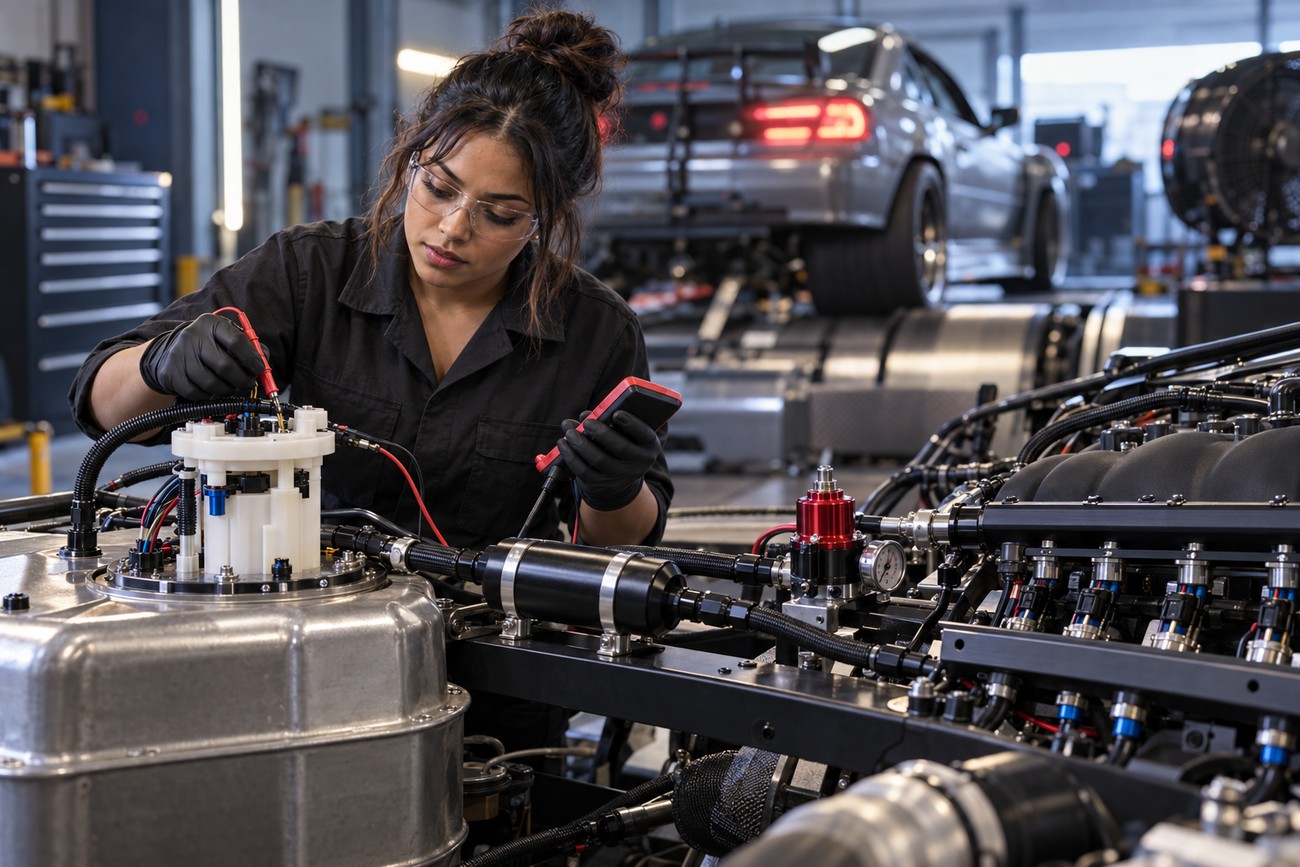
Use the injector upgrade as a reason to inspect the complete fuel system. The pump, regulator, filter, and wiring can become limiting components after injector capacity is increased. Larger injectors do not help if the pump cannot maintain pressure and flow at high rpm.
A mixture that becomes lean at high rpm can indicate inadequate fuel-system capacity rather than an injector-size problem alone. Check fuel pressure under load, pressure stability across the rev range, pump voltage, filter condition, and regulator operation. A static pressure check in the garage may miss a restriction that appears only when demand rises.
Wiring deserves attention because voltage loss at the pump reduces its ability to supply fuel. Inspect power and ground paths, connectors, and any relay or fuse arrangement that carries pump current. The same principle applies to injectors: voltage changes alter opening behavior when dead-time data is not correctly configured.
Choose flow-matched injectors when possible. Flow-matched injectors reduce cylinder-to-cylinder fueling variation, which helps maintain more consistent mixture control across the engine. Finally, validate the result under the actual operating conditions rather than relying only on the product card, whose flow is incomplete without pressure, fluid, temperature, and measurement-method context.
Frequently Asked Questions
What size injectors do I need for 500 hp?
500 hp alone is insufficient to select an injector responsibly. You still need the engine’s BSFC, injector count, duty-cycle target, fuel pressure, fuel type, and system type. A boosted port-injection engine and a naturally aspirated engine with the same power target can require different injector capacity.
Use lb/hr = (power × BSFC) / (number of injectors × duty cycle), then verify the result against actual pressure differential and available calibration data. The calculation is a starting point, not proof that a particular injector will deliver stable fuel at short pulse widths.
How much horsepower do 100-over injectors add?
“100-over” is not a guaranteed horsepower rating. It may describe additional flow relative to a particular original injector, but the reference injector, test pressure, fuel, and measurement method must be known before the label has useful meaning.
Injector capacity supports a power goal only when the engine has matching airflow, fuel-system capacity, and calibration. If airflow has not increased, additional injector capacity may simply provide more fuel that the ECU must remove through tuning.
How do you add 100 hp to a car with fuel injectors?
Injectors alone cannot supply the air or create the combustion strategy required for an additional 100 hp. They can prevent fuel delivery from limiting an engine after changes such as increased airflow, boost, or engine hardware have raised fuel demand.
The actual upgrade requires coordinated changes to airflow, fuel pressure and supply, injector selection, and ECU calibration. Confirm the result with pressure and mixture checks under load; a larger injector installed without those supporting changes may add tuning problems instead of power.