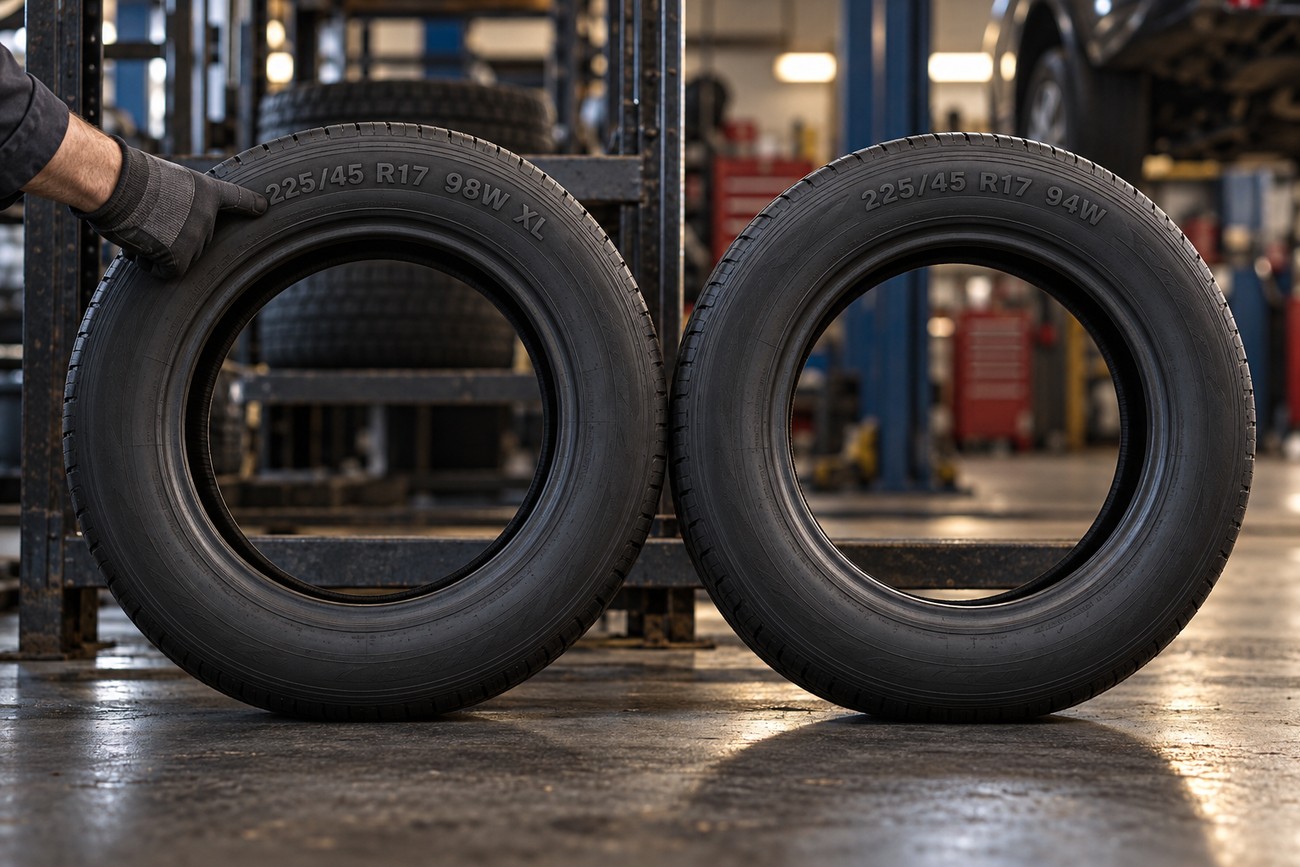
Two tires can share the same size and still have different load and speed markings. Buying by size alone can leave you with a tire that fits the wheel but falls below the vehicle’s required capacity or speed rating. A higher-rated alternative may also change ride comfort without offering the improvement in grip that buyers might expect.
The practical check is to compare the complete marking on the tire’s sidewall with the door-jamb placard or owner’s manual. Those vehicle specifications, along with the correct inflation pressure, matter more than a catalog’s claim that a tire “fits.” Getting the match wrong can affect handling, wear, safety, and compliance with local rules or vehicle requirements.
- How to Read a Tire’s Load and Speed Marking
- What the Tire Load Index Really Tells You
- Speed Ratings Explained: From S to Y
- How to Choose a Replacement Tire for Your Vehicle
- XL Tires, Pressure, Comfort, and Real-World Trade-Offs
- Common Rating Mistakes and Myths to Avoid
- Frequently asked questions
- What does a 98 load index mean?
- Which is better, load range D or E?
- Which is better, load range G or H?
How to Read a Tire’s Load and Speed Marking
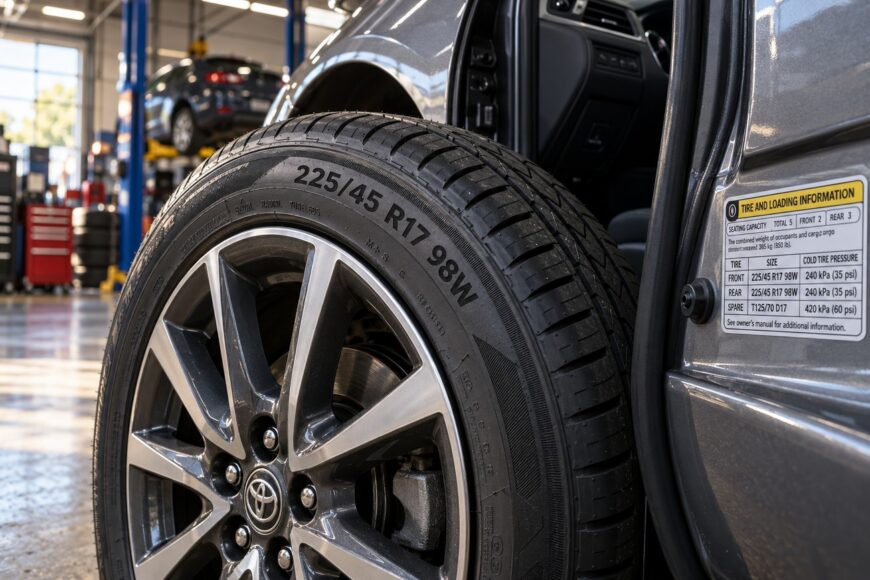
In a marking such as 225/45 R17 98W, the size comes first. The number after it, 98, is the load index; the following letter, W, is the speed symbol. Read the suffix with the size rather than treating every 225/45 R17 tire as equivalent.
The load index is a numerical code for the maximum mass one tire can carry under specified operating conditions. It is not a weight printed directly in kilograms. The speed symbol identifies the maximum sustained speed the tire is designed to withstand under specified test conditions, not a recommended driving speed.
Start with the approved marking on your vehicle’s door-jamb placard or in its owner’s manual, then inspect the full marking on the tire you intend to buy. A replacement should not fall below the manufacturer’s required load index or speed rating unless the manufacturer specifies an approved alternative. Check the actual sidewall before fitting, since an online size match does not establish that the remaining markings match.
What the Tire Load Index Really Tells You
A load index must be converted using a load-index correspondence table. An index of 98 does not mean the tire carries 98 kg, and comparing it with an index of 94 tells you only which coded capacity is higher. Look up each code, then compare the tire’s capacity with the vehicle’s approved specification and pressure requirements.
The stated maximum applies to one tire. Adding the capacities of four tires does not raise the vehicle’s permitted gross weight or its axle ratings, and it does not account for how passengers and cargo are distributed. Wheels have limits too. A heavily loaded rear axle, for example, needs to be assessed against the relevant axle and tire requirements rather than the vehicle’s total weight alone.
That is why the same tire size may be offered with different load indices and prices. Its size describes dimensions, while its load marking describes a separate capability under specified conditions. Different sizes with the same index can also have different constructions and recommended pressures, so the number cannot be considered in isolation from the vehicle’s approved configuration.
Online listings sometimes show a size while omitting part of the load-and-speed suffix. If the complete designation is missing, request it before ordering and verify it again on delivery. The sidewall marking, vehicle specification, axle requirements, and specified pressure together provide a more reliable check than a size-search result.
Speed Ratings Explained: From S to Y
The speed symbol gives a rated maximum under specified test conditions. These common passenger-tire categories show what each letter means.
| Speed symbol | Maximum rated speed | Load consideration |
|---|---|---|
| S | 180 km/h | Use the applicable rated load |
| T | 190 km/h | Use the applicable rated load |
| H | 210 km/h | Use the applicable rated load |
| V | 240 km/h | Allowable load can vary with speed |
| W | 270 km/h | Allowable load can vary with speed |
| Y | 300 km/h | Allowable load can vary with speed |
A higher speed letter does not guarantee shorter braking distances or safer handling on a particular road. Tread design, compound, temperature, wear, pressure, and surface conditions all affect how a tire performs. Select the rating required for the vehicle, then evaluate the tire’s suitability for the conditions in which you drive.
For V, W, and Y tires, allowable load can decrease as speed approaches the category limit. The load-index table alone may therefore overstate the load available at those speeds; the applicable tire standard or manufacturer guidance supplies the correction. Commercial tires can follow different load-versus-speed rules, so passenger-tire assumptions should not be carried across.
A speed rating expresses tested capability, not permission to drive at that speed or a promise that sustained driving at the limit is safe. Road rules, loading, tire condition, and inflation remain separate constraints.
How to Choose a Replacement Tire for Your Vehicle

First, check the door-jamb placard or owner’s manual for the approved tire size, load index, speed rating, and inflation pressure. Record the complete designation, including any applicable tire type or construction marking. If the vehicle lists alternatives for different wheels or conditions, use the specification that applies to your fitted setup.
Next, compare the proposed tire’s full designation with those requirements. Its load index and speed rating should meet or exceed the manufacturer’s requirements unless the manufacturer specifies otherwise. Do not substitute a marketplace fitment claim for this comparison: a listing can confirm the size while leaving out the load-and-speed suffix.
Before replacing a pair, check whether the manufacturer permits the resulting combination. Different ratings on the same axle need particular scrutiny, even if both tires are the right size. On an all-wheel-drive vehicle, replacing only two tires can also create rolling-diameter and load differences; follow its specific replacement requirements rather than assuming a matching printed size settles the issue.
XL Tires, Pressure, Comfort, and Real-World Trade-Offs
XL, or Extra Load, identifies a reinforced tire construction capable of supporting greater load under its specified conditions. The label does not state the tire’s actual load index. Two XL products still need their numerical indices checked against the vehicle’s requirement, just as standard-load products do.
That reinforcement can change how a tire feels. An XL option may ride more firmly, transmit more impacts over rough pavement, or produce more noticeable noise, depending on the tire and vehicle. Its extra capacity is useful where specified or needed for an approved application; it is not an automatic comfort or grip upgrade.
Set everyday inflation pressure according to the vehicle placard or owner’s manual, including any specified adjustment for load. The maximum pressure on the tire sidewall is not automatically the vehicle’s recommended setting. Adding pressure cannot turn a tire with an insufficient load index into an approved replacement.
Ratings also assume specified operating conditions. Underinflation increases heat and stress, while overloading, damage, and age can undermine a tire that has the correct markings on paper. If a tire is worn or visibly damaged, its printed capacity is no reason to keep using it without proper inspection.
Common Rating Mistakes and Myths to Avoid
“The load number is kilograms” leads to a basic buying error. A code such as 98 needs a correspondence table before it becomes a mass per tire. Even that table value must be considered alongside the vehicle’s axle limits, wheel limits, approved pressure, and actual loading.
“XL is always better” overlooks the trade-off. Reinforced construction can provide needed load capacity, yet an XL tire may feel harsher on uneven roads. Check the numerical index and the vehicle specification first; the XL label alone does not establish a better match.
“A higher speed letter means shorter braking” confuses a speed capability with road performance. Braking and grip depend on factors including compound, tread, temperature, wear, road surface, pressure, and tire condition. A higher-rated tire can still be poorly suited to your driving conditions.
“The same size is enough” ignores the part of the marking that confirms load and speed capability. Two tires with identical dimensions may carry different ratings, so compare the full sidewall designation with the vehicle documents. This is especially important when a listing displays an incomplete product name.
Standards define limits under specified tests. Marketing descriptions can make those limits sound like guarantees of safety at any speed up to the printed rating, regardless of road or tire condition. The rating is a necessary compatibility check, while correct pressure, sound condition, suitable loading, and lawful driving remain necessary in use.
Frequently asked questions
The load index is a coded capacity, not a weight in kilograms. Load-range letters describe a different classification and do not replace the vehicle’s approved specification. For either marking, check tire capacity, wheel compatibility, and required pressure before choosing a replacement.
What does a 98 load index mean?
It is a code that you convert to a maximum mass per tire using a load-index correspondence table; it does not mean 98 kg. For a purchase, look up the code, then confirm that the complete tire designation meets the load requirement in the vehicle placard or manual. Check the delivered sidewall as well as the listing.
Which is better, load range D or E?
Neither is universally better. D and E are load-range terms generally associated with heavier-duty or commercial tires, rather than direct substitutes for a passenger tire’s numerical load index. Choose the range specified for the vehicle and intended service, while checking the tire’s rated capacity, wheel compatibility, and required inflation pressure.
Which is better, load range G or H?
H is not automatically the right upgrade from G. A higher load range may involve pressure and wheel requirements that the vehicle was not designed to use. Match the tire to the vehicle’s approved capacity, wheels, pressure specifications, and intended service instead of selecting the largest letter available.