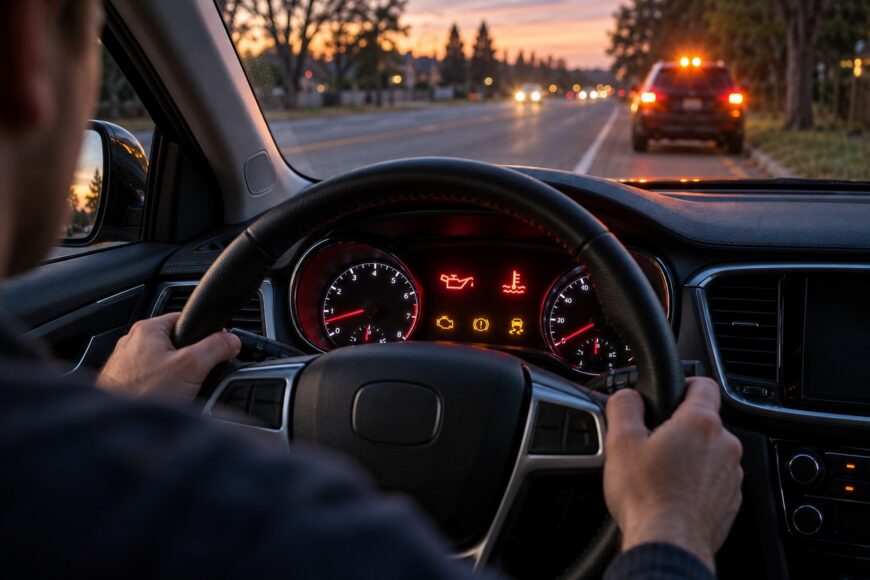
A single dashboard icon can signal anything from low tire pressure to an engine or safety-system fault. Several lights appearing together can be just as misleading: a weak battery or poor electrical ground may trigger warnings from otherwise unrelated systems. The number of lights alone does not tell you how serious the problem is.
Start with the warning’s color and whether it is steady or flashing, then consider how the car feels and what conditions preceded the alert. The exact stored fault code matters more than a guess based on the symbol. That gives you a safer way to decide whether to stop, drive cautiously to a repair facility, or arrange a tow.
- When a warning light appears: make the first decision safely
- Read color, symbol, and behavior together
- What the most common warning lights actually mean
- A diagnostic workflow that avoids parts-swapping
- Why warning lights stay on after repairs—or appear in a cluster
- When it is safe to drive—and when it is not
- Frequently asked questions
- What should I do if a warning light turns off by itself?
- Why do several warning lights appear after rain, washing, or a cold start?
- How long can a car be driven after an Airbag or ABS light comes on?
When a warning light appears: make the first decision safely
Ease off the accelerator and check the car’s behavior without taking your attention off the road. Notice any change in steering, braking, engine power, or temperature, along with smoke, unusual smells, or new noises. Signal and find a safe place to stop if the warning is red, flashes, or comes with a noticeable change in how the vehicle drives.
Red oil-pressure, overheating, brake-system, and charging-system warnings mean stop as soon as safely possible and diagnose the cause. Continue only far enough to reach a safe stopping place; a car that still moves can still suffer severe damage or lose a critical function. If braking or steering feels impaired, avoid driving farther and seek roadside assistance.
Once safely stopped, photograph the panel before switching the car off if you can do so without delaying a necessary shutdown. Note the speed, outside temperature, weather, and maneuver when the light appeared. Also record whether it flashed, whether several lights arrived together, and whether power changed. Those details can help a technician identify a fault that is absent during a later test drive.
A sudden cluster of unrelated lights can point to unstable system voltage, including a weak battery, poor ground, or charging fault. It is a useful diagnostic clue, not reassurance that the warnings are false. If the charging light is red, stop safely rather than assuming a restart will solve the problem.
Read color, symbol, and behavior together

Color gives you a starting priority. Red warnings generally demand a safe stop; yellow or orange Check Engine, ABS, ESP, and tire-pressure monitoring system (TPMS) warnings generally allow cautious travel to service only while vehicle behavior remains normal. Green and blue lights often indicate an active feature, such as lighting, although you should confirm an unfamiliar display in the owner’s manual.
Many modern warning symbols follow standardized pictograms associated with ISO 2575. Their familiar shapes help you recognize a system quickly, but the owner’s manual remains authoritative for the symbol’s meaning on your model. Wording on the display, a flashing pattern, and accompanying symptoms can change the decision even when the basic icon looks familiar.
Timing can also mislead. Some faults illuminate a warning only after the system has detected the condition over multiple operating cycles, so the problem may predate the light. Conversely, a brief fault may disappear from the display while diagnostic information remains stored. Do not use the lamp’s apparent age as a measure of the fault’s severity.
A dashboard cannot show every detail at once. Some vehicles prioritize one warning while other faults remain visible only in diagnostic data, and the Check Engine light covers many different conditions. Hybrid and electric vehicles may also use manufacturer-specific symbols for high-voltage, charging, or battery-temperature problems. Check the model manual rather than relying on a generic symbol chart.
What the most common warning lights actually mean
An oil-pressure warning concerns the engine’s ability to maintain lubrication; it is not simply an oil-change reminder or proof that the oil level is low. Stop the engine safely and have the cause checked, even if adding oil appears to help. An overheating warning likewise calls for a safe stop: the cause could involve coolant loss or another cooling-system failure. Continuing can seize an engine or distort its cylinder head. Do not open a hot cooling system.
A red brake-system warning may indicate a parking brake that remains applied, low brake fluid, or another brake fault. Confirm the parking brake is released, but stop and seek help if the warning persists or the pedal feels different. A separate yellow ABS warning can mean anti-lock assistance is unavailable even when ordinary braking still feels normal. The battery-shaped red light usually points to a charging-system fault, such as an alternator problem, rather than the battery alone.
A steady Check Engine light can reflect an emissions-related sensor or EVAP fault, but it can also indicate misfires or fuel-system trouble. A flashing light, rough running, or a strong loss of power warrants stopping and reassessment; continued misfiring can damage the catalytic converter. Treat the code as a starting point for diagnosis, rather than deciding from the icon that the fault is harmless.
A TPMS warning commonly activates at approximately 25% below the recommended tire pressure. Pull over if a tire looks damaged or the car handles differently; otherwise, measure and correct pressures as soon as possible using the vehicle’s recommended specification. Cooler weather can lower measured pressure, but repeated seasonal warnings still deserve a gauge check rather than repeated resets.
ABS, ESP, and Airbag warnings may leave a car physically drivable while reducing or removing a safety function. An Airbag fault, for example, may mean part of the restraint system will not operate as intended. These warnings require repair before normal continued use, even if acceleration, steering, and routine braking appear unchanged. Switching off a lamp does not restore the protection behind it.
A diagnostic workflow that avoids parts-swapping
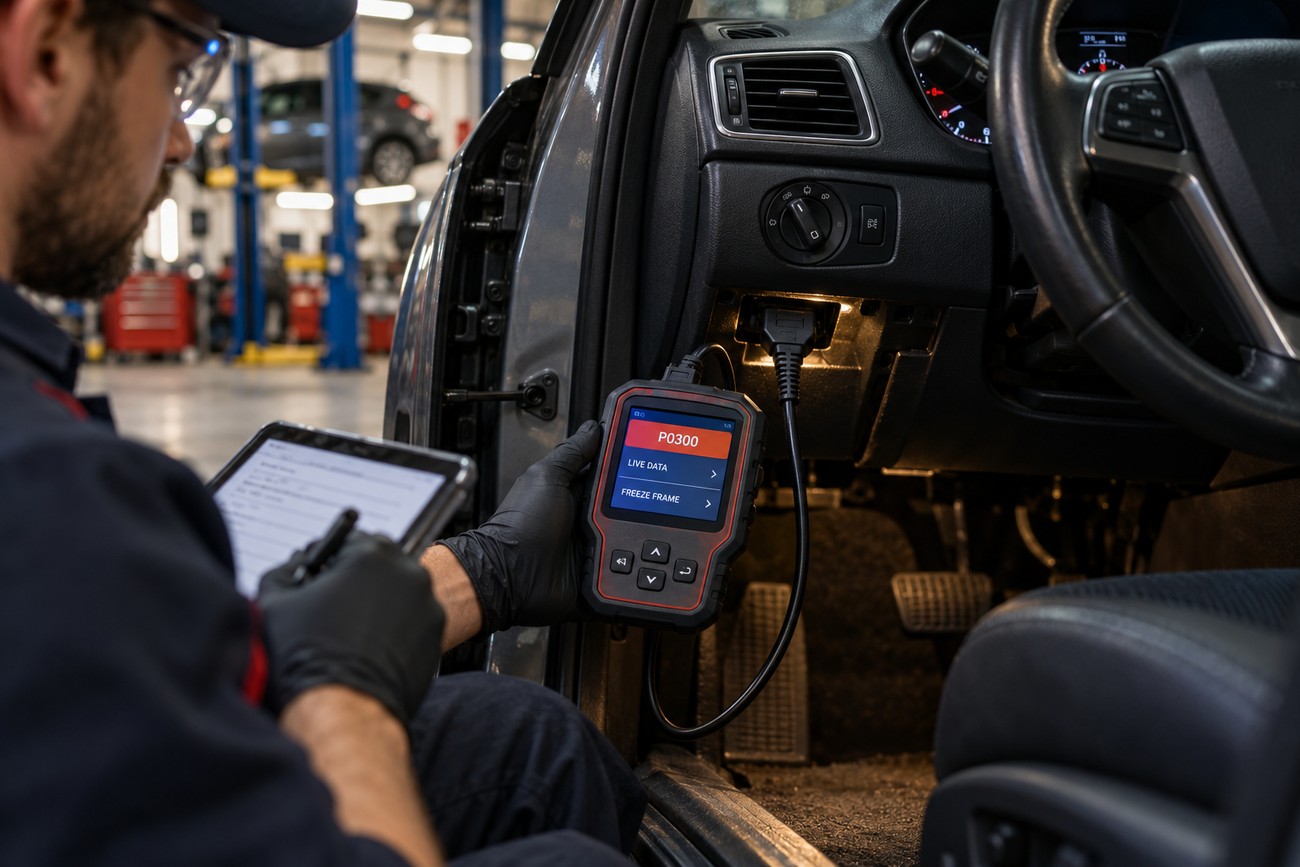
Begin with what you can confirm safely: the warning’s behavior, the driving symptoms, tire condition and pressure, and any recent service. Then have the relevant control module scanned and record the full codes and available operating context before anyone clears them. OBD-II is the common diagnostic framework for passenger vehicles; J1939 is used in heavy-duty applications. The appropriate scanner and module access depend on the vehicle and warning.
A stored code identifies a detected condition or circuit area. It does not prove that the sensor or module named in a code description has failed. A basic scanner may read an engine code yet miss manufacturer-specific information in braking, restraint, or other modules, which helps explain why its results can differ from a workshop’s deeper scan.
When several unrelated codes appear together, check supply voltage, grounds, connectors, and communication between modules before condemning individual sensors or a control unit. One shared electrical fault can produce convincing but misleading code descriptions.
After recording the evidence, the technician can test the relevant power supply, wiring, connectors, and component operation against the fault conditions. Only then does replacement become a supported decision. Clearing codes first may erase useful context and make an intermittent problem harder to reproduce; clearing them after a repair is part of verifying that the fault does not return.
Why warning lights stay on after repairs—or appear in a cluster
A light that remains after an oil change, brake job, or tire service does not automatically mean the work failed. A service reminder may need the model’s specified reset procedure, while a TPMS or other system may need initialization after parts have been changed. The distinction matters: resetting a maintenance reminder cannot repair an active fault code.
Steering-angle sensing, TPMS, throttle control, and other systems may require relearning or adaptation after electrical work or component replacement. A replacement ABS, TPMS, crankshaft, or other sensor must also be compatible with the vehicle. Before fitting another part, ask the repairer to check the part specification and any required setup procedure.
Warnings that appear after rain or a wash may involve moisture at a connector, a marginal ground, or unstable voltage. A cold start can expose a weak battery in a similar way. Lights that go out later should still be reported if they recur, especially when several unrelated systems complain together; testing the shared electrical supply may be more useful than replacing sensors one by one.
Some control and emissions faults take multiple operating cycles to illuminate a lamp. After a repair, a warning may also need a specified clearing or verification procedure, depending on the system and vehicle. “It will go away” is therefore incomplete advice. Ask what was repaired, whether initialization was performed, and how the repair was checked.
When it is safe to drive—and when it is not

For a red oil-pressure, temperature, brake-system, or charging-system warning, stop as soon as safely possible and diagnose the cause. Drive only the distance needed to reach a safe stopping place. If there is smoke, a serious fluid leak, impaired braking, or an engine that sounds damaged, switch it off when safely parked and arrange assistance rather than attempting to reach a workshop.
A steady yellow or orange warning generally permits cautious travel to a repair facility only if the car behaves normally. Check the manual for model-specific instructions and arrange a prompt assessment. A flashing warning, rough running, unusual noise, rising temperature, changed braking or steering, or reduced-power mode changes that decision: stop safely and reassess whether towing is appropriate.
Manufacturer guidance generally calls for diagnosis of any sustained Check Engine light. Some technicians may permit longer use after confirming a low-risk sensor or EVAP fault and normal vehicle behavior, but that judgment depends on an actual diagnosis. An unknown code is no basis for months of driving, and a yellow lamp is not a guarantee that the underlying fault is minor.
Hybrid and electric vehicles can display manufacturer-specific high-voltage-system, charging, and battery-overheating warnings. Follow the model manual’s safety instructions, and do not inspect high-voltage components yourself. Driver-assistance and electronic safety systems can reduce risk, but they cannot prevent mechanical failure or make an ignored warning safe.
Frequently asked questions
What should I do if a warning light turns off by itself?
Record when it appeared, what the car was doing, and whether any symptoms accompanied it. A lamp that is off means the fault may be inactive now; it does not establish that the cause has been permanently repaired. A scan may still find a stored or pending code that helps identify an intermittent fault.
If it returns, share your notes and any panel photo with the workshop. After a confirmed repair, follow the vehicle’s specified clearing and verification procedure. A reset is a check on the repair, not a way to establish what caused the warning.
Why do several warning lights appear after rain, washing, or a cold start?
Moisture around a vulnerable connector, a marginal ground, or low battery performance can temporarily disturb several electronic systems. A cold start places a demand on the battery, while water can expose an existing connection problem. The resulting lights may clear when conditions change, even though the weakness remains.
If the cluster recurs, have the charging system, battery, grounds, and relevant connectors checked. Tell the technician which lights appeared together and under what conditions; that pattern is more useful than treating every lamp as an independent failed component.
How long can a car be driven after an Airbag or ABS light comes on?
Follow the model manual first and arrange prompt repair; there is no universal safe driving period. The car may still move and brake normally, but part of the airbag system or anti-lock braking function may be unavailable. Physical drivability does not mean the vehicle is fully prepared to protect occupants in an emergency.
If braking feels different, other brake warnings appear, or the manual directs you to stop, pull over safely and consider towing. Even without those signs, limit driving to what is necessary to obtain a diagnosis rather than treating the warning as a routine status light.