A silent car horn is inconvenient in a driveway and a safety concern in traffic. The fault may be a simple fuse, yet it can also involve a corroded connector, poor ground, failed horn, relay contacts, or the steering-wheel control circuit.
A blown fuse does not identify the root cause, and a clicking relay does not prove that the horn is receiving usable power. The reliable approach is to follow power and ground through the circuit, checking connections under load where possible.
Steering-wheel symptoms create a separate safety boundary. If the horn failure occurs with lost steering-wheel buttons or an SRS warning lamp, avoid dismantling the steering wheel or airbag system unless you can follow the vehicle manufacturer’s SRS procedure exactly.
- Why a Car Horn Can Stop Working Suddenly
- Check the Horn Circuit Without Touching the Airbag
- Symptom-to-Test Guide for a Silent or Weak Horn
- Follow the Circuit: Fuse, Relay, Voltage, Ground, and Horn
- When the Clock Spring or Steering Controls Are the Real Fault
- Mistakes That Make Horn Diagnosis Harder or Less Safe
- Frequently asked questions
- How much does it typically cost to fix a car horn?
- Why does the horn work with the alarm but not from the steering wheel?
- Why did my car horn stop working all of a sudden?
- How to tell if a horn relay is bad?
Why a Car Horn Can Stop Working Suddenly
The horn usually uses a separate high-current circuit protected by a fuse and switched through a relay. The steering-wheel button often controls the relay circuit rather than carrying horn current. A fault anywhere in that chain can leave the horn silent even though the button itself feels normal.
The first fault group includes the fuse, relay, power feed, and wiring between the relay and horn. A fuse may open because of a short circuit, damaged wiring, or an internal fault in the horn. A relay may click while its high-current contacts remain burned, contaminated, or unable to carry power.
Low-mounted horn connectors and grounds are exposed to water, road salt, corrosion, and impact behind the grille. These problems can cause a weak, raspy, intermittent, or completely silent horn. Some vehicles use two horns wired in parallel, so one failed unit may produce weak or distorted sound rather than total silence.
A horn that activates by itself points toward a sticking button, a relay fault, or a short in the control circuit. Alarm or central-locking systems may also command the horn on some vehicles, but that function is model-dependent and must be confirmed with the specific wiring diagram. A change in horn operation with steering-wheel position moves suspicion toward the steering-wheel circuit.
Check the Horn Circuit Without Touching the Airbag

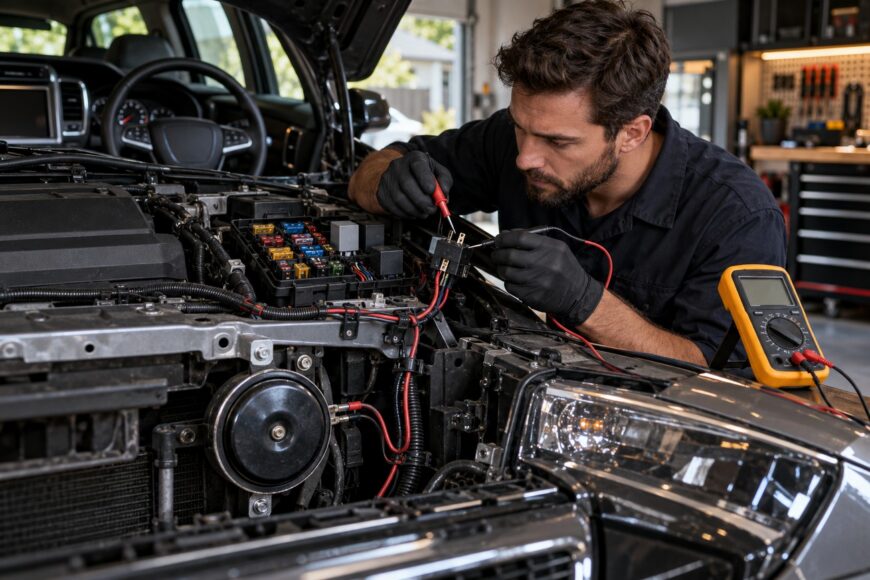
Obtain the vehicle-specific wiring information before testing. You need to know the fuse location, relay terminals, horn connector, ground path, and whether other systems share the horn fuse. A multimeter or test light, short protected jumper leads, eye protection, and a dry work area are suitable for ordinary horn-circuit checks.
Replace a blown fuse only with the same rating specified for the vehicle. A higher-rated fuse removes the intended protection and increases the risk of wiring damage and fire. The horn fuse may also supply other functions, so removing it can disable additional vehicle systems.
Keep ordinary horn testing separate from steering-wheel and SRS work. Work involving the steering wheel, clock spring, or airbag requires the vehicle manufacturer’s SRS disconnection procedure. This article does not provide instructions for removing an airbag.
If you perform a brief direct 12-volt test on the horn, use correct polarity, short protected contact, and leads that cannot create an accidental short. Keep the test away from fuel vapors and uncontrolled sparks. Stop if the connector, wiring, or fuse area becomes hot, smells of burning insulation, or shows signs of melting.
Symptom-to-Test Guide for a Silent or Weak Horn
Use the symptom as a starting point, then confirm it with a test. Each result narrows the fault; no single observation proves that every part of the circuit is working.
| Observed symptom | Most useful next test | What the result can and cannot prove |
|---|---|---|
| Complete silence, with no relay click | Check the fuse, relay control input, horn button circuit, and relevant steering-wheel wiring. | It may indicate a control-side fault, body module issue, relay problem, or open power supply. It does not identify the failed component by itself. |
| Relay clicks, but the horn is silent | Measure voltage at the horn connector while pressing the button. | The click proves only that the relay control side operates. It does not prove that the power contacts, output wiring, ground, or horn work. |
| Voltage appears at the horn connector | Check the ground under load and test the horn briefly from a suitable 12-volt source. | The horn, ground, or connector becomes more likely. A meter reading without load may conceal a high-resistance connection. |
| Horn is weak, raspy, or intermittent | Inspect both horns, their connectors, and grounds; test each horn separately if the vehicle has two. | One failed parallel horn, corrosion, poor ground, or an internal horn fault can cause reduced sound without total silence. |
| Horn works only at certain steering-wheel positions | Stop before dismantling the wheel and arrange a clock-spring or steering-control diagnosis. | This strongly suggests a clock spring or related steering-control fault. It is not proof without testing the vehicle-specific circuit. |
| Horn activates by itself | Check for a sticking button, relay fault, or short in the control circuit, following the wiring diagram. | The problem is usually in the control path or relay operation rather than a simple open fuse. |
Follow the Circuit: Fuse, Relay, Voltage, Ground, and Horn
Begin with the fuse, but treat it as a protection device rather than a diagnosis. Check whether it is open and inspect its socket for heat or corrosion. If it fails again, do not keep installing replacements; locate the short or overload before continuing.
Next, assess the relay. If it does not click when the horn button is pressed, investigate the button, clock spring, control wiring, body module, or relay control ground rather than assuming the relay itself is bad. If it clicks but no voltage reaches the horn, inspect the relay’s power contacts, fuse path, wiring, and connections between the relay and horn.
Measure voltage at the horn connector while pressing the button. The reading is most useful when the horn remains connected or the circuit is tested under an appropriate load. Voltage that looks normal with a meter but collapses when current is demanded can indicate a corroded terminal, damaged wire, or other high-resistance connection.
Check the ground side as carefully as the power side. A temporary, separately protected ground can help identify a bad factory ground, especially when the horn is mounted low behind the grille. That temporary lead is a diagnostic aid, not a permanent repair unless it is properly secured and protected from moisture and abrasion.
A brief direct test from a 12-volt source helps separate a failed horn from a vehicle-side fault. Use correct polarity and short contact, prevent the terminals from touching, and stop immediately if the horn does not respond normally or the leads heat up. If the horn works directly but not in the vehicle, continue tracing the vehicle’s power, ground, relay, and control circuits.
When the Clock Spring or Steering Controls Are the Real Fault
A clock spring carries separate circuits through the rotating steering wheel. Its internal tracks can fail independently, so the horn circuit may open while other steering-wheel buttons continue to work. Working buttons therefore do not completely rule out a partial clock-spring failure.
Horn operation that changes with steering-wheel position is a strong clue. The same suspicion increases if steering-wheel controls stop working at the same time or an SRS or airbag warning lamp appears. These symptoms point toward the steering-wheel circuit rather than automatically proving that the horn itself has failed.
The absence of an airbag warning lamp does not prove that the horn track inside the clock spring is intact. A separate horn track can fail without the SRS system detecting a fault. Model-specific diagnostic data may be needed to distinguish a clock spring from a button, connector, body module, or wiring problem.
Handling the steering wheel or clock spring is hazardous because of the pyrotechnic airbag module. Replacement generally requires the factory SRS procedure and correct clock-spring centering. Incorrect centering can damage the ribbon during steering-wheel rotation, so this repair is best assigned to a qualified technician when the required procedure or equipment is unavailable.
Mistakes That Make Horn Diagnosis Harder or Less Safe
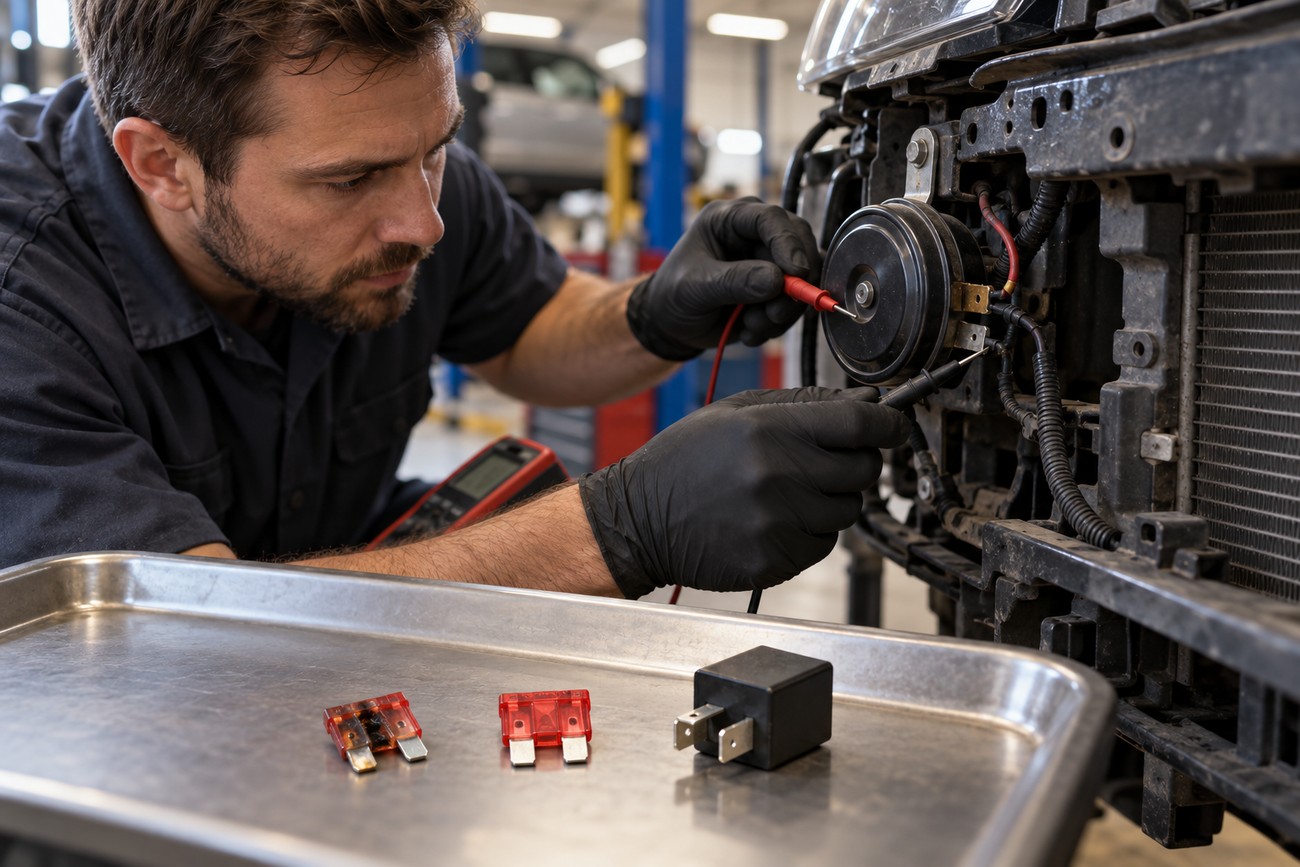
Repeatedly replacing a blown fuse does not repair the circuit. It can hide the pattern of the failure and expose the wiring to repeated fault conditions. Find the short, overload, or damaged component before fitting another fuse, and always use the specified rating.
A relay click is often treated as proof that the relay is good. It verifies only operation of the control side; the high-current contacts, output circuit, wiring, ground, and horn can still be faulty. Likewise, buying a replacement horn before checking loaded voltage and ground may replace a good part unnecessarily.
Careless probing can create a short, damage a connector, or produce sparks near fuel vapors. Use insulated, protected leads and avoid forcing probes into terminals. Do not use a long uncontrolled battery connection for a horn test.
Stop DIY work if diagnosis reaches the steering wheel, clock spring, airbag wiring, or SRS warning system and you do not have the manufacturer’s procedure, safe disconnection method, or suitable scan equipment. A silent horn is inconvenient; an unintended airbag deployment can cause serious injury.
Frequently asked questions
The correct diagnosis depends on test results rather than the symptom alone. Check the relevant power, ground, relay, horn, and control circuits before replacing parts. Steering-wheel or SRS symptoms require separate precautions.
How much does it typically cost to fix a car horn?
There is no useful universal price because the repair may involve a fuse, relay, connector, horn, damaged wiring, clock spring, or SRS diagnosis. A corroded connector or correctly rated fuse may require little parts cost, while wiring tracing or a steering-wheel component can require substantially more labor and procedure.
Ask for the confirmed fault and test results before approving parts. The estimate should identify whether the technician found power and ground at the horn, tested the horn itself, and found any SRS-related fault rather than replacing components by guesswork.
Why does the horn work with the alarm but not from the steering wheel?
This comparison suggests that the horn’s power circuit and the horn itself may be operational, while the steering-wheel control path may have a fault. Possible causes include the button, clock spring, steering-control wiring, or body-control input.
Alarm and central-locking horn behavior is model-dependent, so confirm the vehicle’s wiring design before drawing a conclusion. If the alarm uses a separate command path, its operation does not prove that the steering-wheel button circuit is intact.
Why did my car horn stop working all of a sudden?
A sudden failure can result from an open fuse, failed relay contact, an internal horn failure, or a connector or ground that finally lost continuity after corrosion or impact. A short may also open the fuse, particularly if the same problem returns after replacement.
The fastest reliable distinction is to check the fuse, listen for relay operation, and measure voltage and ground at the horn while the button is pressed. If the symptom changes with steering-wheel position, treat the steering-control circuit as a separate possibility.
How to tell if a horn relay is bad?
A relay that does not click may have a control-side problem, so silence alone does not prove the relay is defective. A relay that clicks may still have failed high-current contacts. Test for the correct control signals and verify whether power exits the relay and reaches the horn when the button is pressed.
Comparing the relay with an identical, correctly assigned relay is sometimes possible, but only when the vehicle documentation confirms that the relays have the same specification and terminal layout. A voltage test at the horn remains necessary because wiring and connector faults can produce the same symptom.