A nail in the tread can leave you choosing between a quick roadside plug and a shop patch. The plug may stop the hiss without removing the wheel; a patch requires access to the tire’s inner surface. The less obvious decision comes first: whether that tire is still repairable. A small hole, a slow leak, and a tire that holds air after being plugged do not reveal what happened inside while it was losing pressure.
Professional repair procedures treat a puncture as damage through the tire, rather than an opening to seal at one end. Its location, size, angle, and effect on the inner structure all matter. That is why an external plug can be useful for managing a leak on the road yet still leave you needing an inspection—and why a shop may decline to repair a hole that looks minor from outside. Understanding what plugs and patches each do makes the next decision easier.
- Tire plug vs patch vs plug-and-patch: what each one does
- Why stopping the air leak is only half the repair
- When is a punctured tire repairable at all?
- What a proper shop repair involves
- What to do if you only have a roadside plug kit
- The repair mistakes that turn a small puncture into a bigger risk
- After the repair: checks that still matter
- Frequently asked questions
- How long can you drive on a plugged and patched tire?
- Why don’t some shops offer plug-only tire repairs anymore?
- Why don’t they plug tires anymore?
Tire plug vs patch vs plug-and-patch: what each one does
“Plug” can mean an exterior string from a roadside kit or the repair stem installed as part of a professional repair. The distinction is access: under USTMA/TIA procedures, a permanent repair follows tire removal and internal inspection, then addresses both the injury channel and the innerliner.
| Method | Access and sealing function | What remains unresolved | Complete permanent repair? |
|---|---|---|---|
| External plug alone | Inserted from outside to control air loss through the hole. | No internal inspection or innerliner patch. | No. |
| Internal patch alone | Requires tire removal; seals the innerliner. | The injury channel remains unfilled. | No. |
| Professional stem plus patch | After removal and inspection, a rubber stem or plug fills the channel and a patch seals the innerliner. | Still depends on the tire being eligible and the repair being correctly installed. | Yes, when all procedure requirements are met. |
Why stopping the air leak is only half the repair
The innerliner is the tire’s air-retaining surface. An internal patch seals that surface around the puncture, while a rubber repair stem fills the injury channel through the tread. Filling the channel also helps keep moisture and debris from reaching steel cords. A patch alone may retain air while leaving that pathway open; an exterior plug alone does not provide the inspected innerliner seal required by USTMA/TIA procedures.
A string plug fitted beside the road and a repair stem fitted in a shop may look similar in a product description, but they are not interchangeable procedures. The roadside plug is installed from outside while the tire remains on the wheel. A technician installing a complete repair first sees the inner surface and assesses the damage, then selects components suited to the channel.
Some roadside kits describe their external plugs as “permanent.” That label may describe the intended durability of the product, but it does not establish compliance with the USTMA/TIA complete-repair procedure. An exterior-only plug might continue to hold air; that observation cannot show whether the carcass or innerliner was damaged, or whether the puncture was repairable in the first place.
This difference matters most when a tire has been driven underinflated. Restoring pressure can make the tire appear normal again even if its internal structure needs closer examination. Treat a successful roadside seal as leak control until a shop has removed and inspected the tire, rather than as a verdict on its continued service.
When is a punctured tire repairable at all?
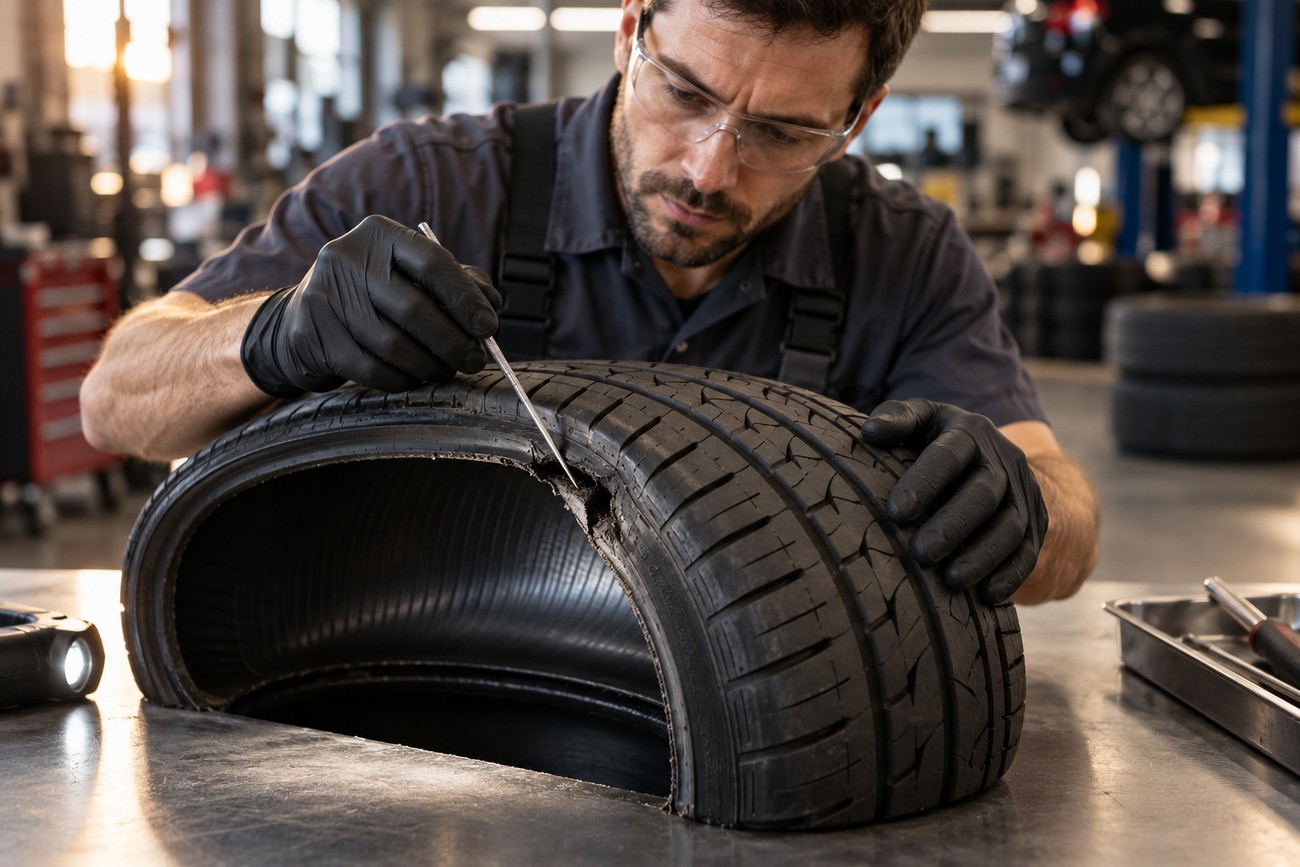
Start with the full location of the injury, not the dot where a nail entered. Under the cited USTMA procedure, repair is limited to the central tread repair area; shoulder and sidewall injuries are excluded. A hole that appears close to the shoulder can be rejected because its channel runs outward beneath the surface. The shop needs to establish where the damage actually travels before deciding whether a repair component belongs there.
Next comes measured size. The maximum injury diameter under that USTMA procedure is 1/4 inch (6 mm), a ceiling rather than permission to repair every smaller puncture. The channel’s condition and angle, any earlier repairs nearby, and the tire’s internal state can still rule out the work. Repairs must not overlap, so a new hole near an old repair needs its own assessment.
Pressure history can change the answer even when the entry point is small and central. Driving on a tire that is flat or substantially underinflated may damage the carcass or innerliner in ways an exterior examination cannot establish. Holding air after inflation does not reverse such damage. Removing the tire lets the technician look for signs that continued use or another repair would be inappropriate.
These criteria describe the cited passenger- and light-truck-tire procedure, not a blanket promise for every tire. Run-flat, commercial, high-speed, and other specialized tires may carry additional manufacturer-specific restrictions; vehicle guidance can matter too. If a shop declines a seemingly ordinary puncture, ask which finding or applicable restriction governs the decision before assuming a smaller repair method would solve it.
What a proper shop repair involves
The shop removes the tire from the wheel and inspects the inside before committing to a repair. That assessment checks the full channel, the innerliner, the tire structure, and any previous repair in the area. It also establishes whether the injury stays within the central tread repair area and within the 1/4-inch (6 mm) size limit. An exterior leak check alone cannot make those determinations.
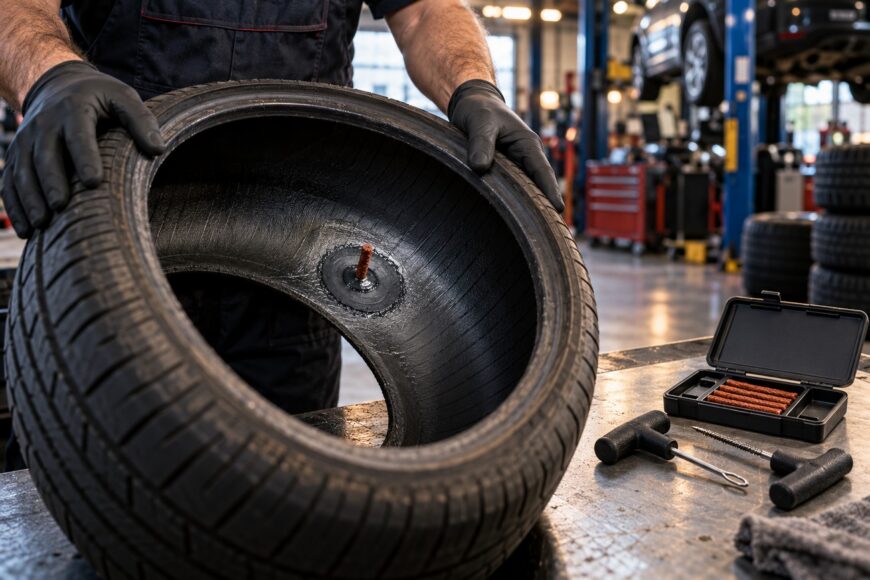
For an eligible injury, the technician prepares the innerliner surface and uses compatible repair materials according to their instructions. The finished repair must fill the injury channel with a rubber stem or plug and seal the innerliner with a patch. Simply sticking an adhesive patch over the inner opening leaves the channel unfilled; preparation and material compatibility also affect whether the seal can do its job.
Tracing the channel from the tread and innerliner sides can change the component choice: a neat-looking entry point may lead into a sharply angled path that does not suit a standard one-piece patch-plug.
A one-piece patch-plug can serve an appropriate injury. For a puncture angled more than 25°, the cited USTMA guidance instead calls for separate stem and patch components. Neither arrangement makes an otherwise ineligible tire repairable, and a new repair must not overlap an existing one. Once the work is complete, the shop checks for leaks and inflates the tire to the correct pressure, then addresses wheel balancing after tire removal as applicable.
What to do if you only have a roadside plug kit
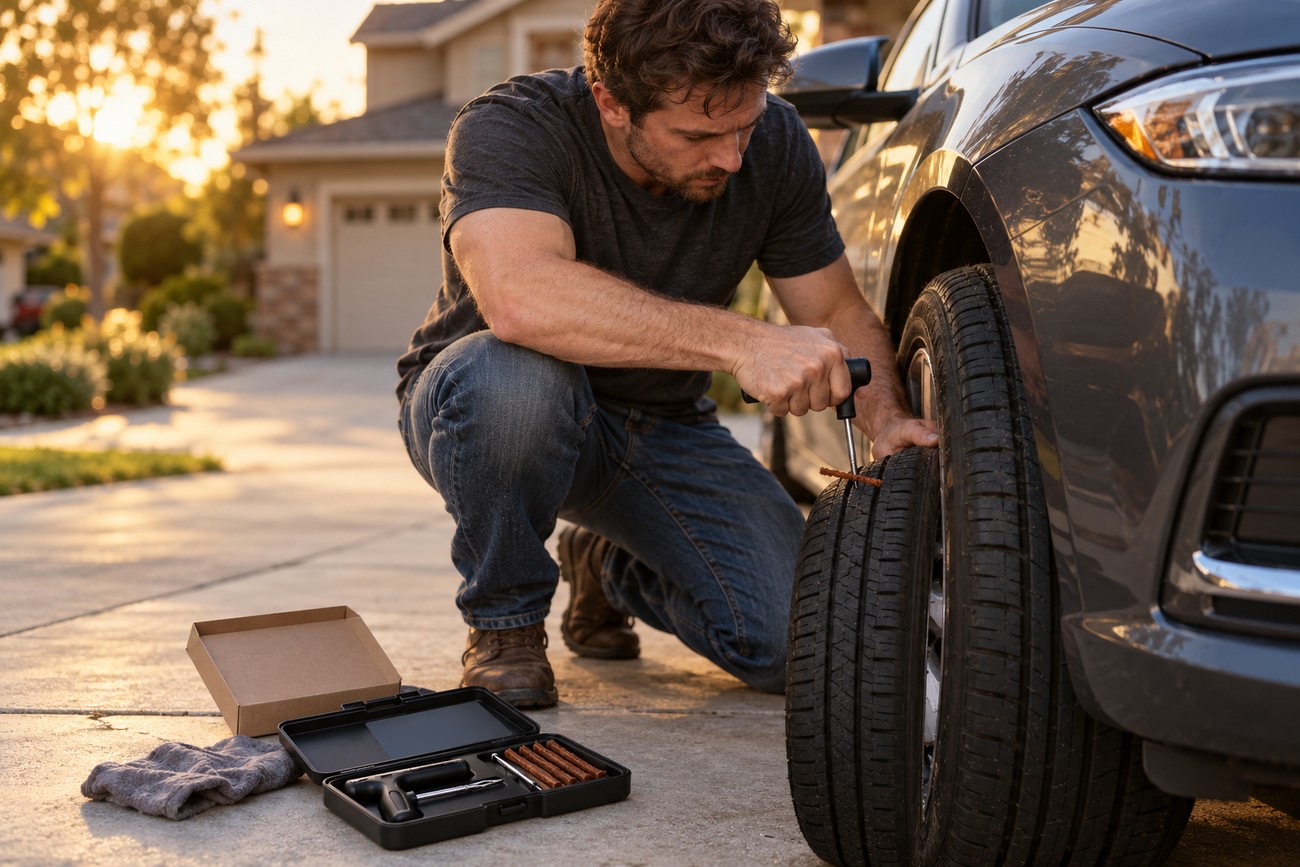
An external plug kit may help control a leak in what appears to be an eligible tread puncture until the tire can be assessed professionally. First, take stock of where the object entered and whether the tire has already been driven with little or no air. If the damage is at the shoulder or sidewall, or there is reason to suspect damage from driving flat, a spare tire or roadside assistance is the more prudent route than trying to make the puncture seal.
Do not treat the visible opening as a reliable measurement of the whole injury. A nail can leave a longer or angled channel than its entry point suggests. Forcing a rasp through an unassessed hole can widen or alter damage that a shop must later evaluate, so follow the kit’s instructions and avoid attempting to enlarge a questionable injury into something that accepts a plug.
If you do use the kit, check the tire’s pressure and whether the leak has stopped. Continuing pressure loss, visible tire damage, or unusual behavior calls for stopping use and seeking help rather than repeatedly topping up the tire. No universal driving distance or speed makes an exterior plug a substitute for inspecting that particular tire; the immediate aim is to get to a place where it can be evaluated safely.
Tell the shop what happened, including how low the pressure became, whether the tire was driven flat, and that an external plug was installed. The plug may be removed during assessment, and the shop may find that the tire qualifies for a complete repair—or that replacement is necessary. A roadside seal does not settle either outcome.
The repair mistakes that turn a small puncture into a bigger risk
The most tempting shortcut is to treat retained pressure as a safety test. A tire can hold air with an external plug in place while damage to the innerliner or carcass remains unseen. That distinction is especially important after underinflated driving. Ask whether the tire was removed from the wheel and inspected inside; if it was not, the puncture has not received the assessment required for a complete USTMA/TIA repair.
Repairing only the innerliner creates the opposite incomplete result. A patch can seal air in while leaving the puncture channel open to moisture and debris; an exterior plug fills or blocks the opening without replacing the internal patch and inspection. Ask what will fill the channel and what will seal the innerliner. A shop that offers only an exterior plug may be offering leak control, rather than the complete permanent repair described by the cited procedure.
Another mistake is enlarging a puncture before establishing its original size, angle, and path. The USTMA limit is an injury diameter of 1/4 inch (6 mm), and the injury must remain within the central tread repair area. Preparing an eligible channel is part of a proper repair; assuming every opening can be widened to fit a particular product is a different decision. Ask how the technician assessed the damage before selecting the repair.
Finally, a small hole outside the repair area does not become acceptable because a plug or patch seems to fit. Shoulder and sidewall damage call for a different tire decision under the cited procedure. An improperly assessed or installed repair can contribute to separation of tire components during driving, though that is not the inevitable result of every imperfect seal. The practical safeguard is to establish eligibility first and confirm that both parts of the injury were addressed.
After the repair: checks that still matter
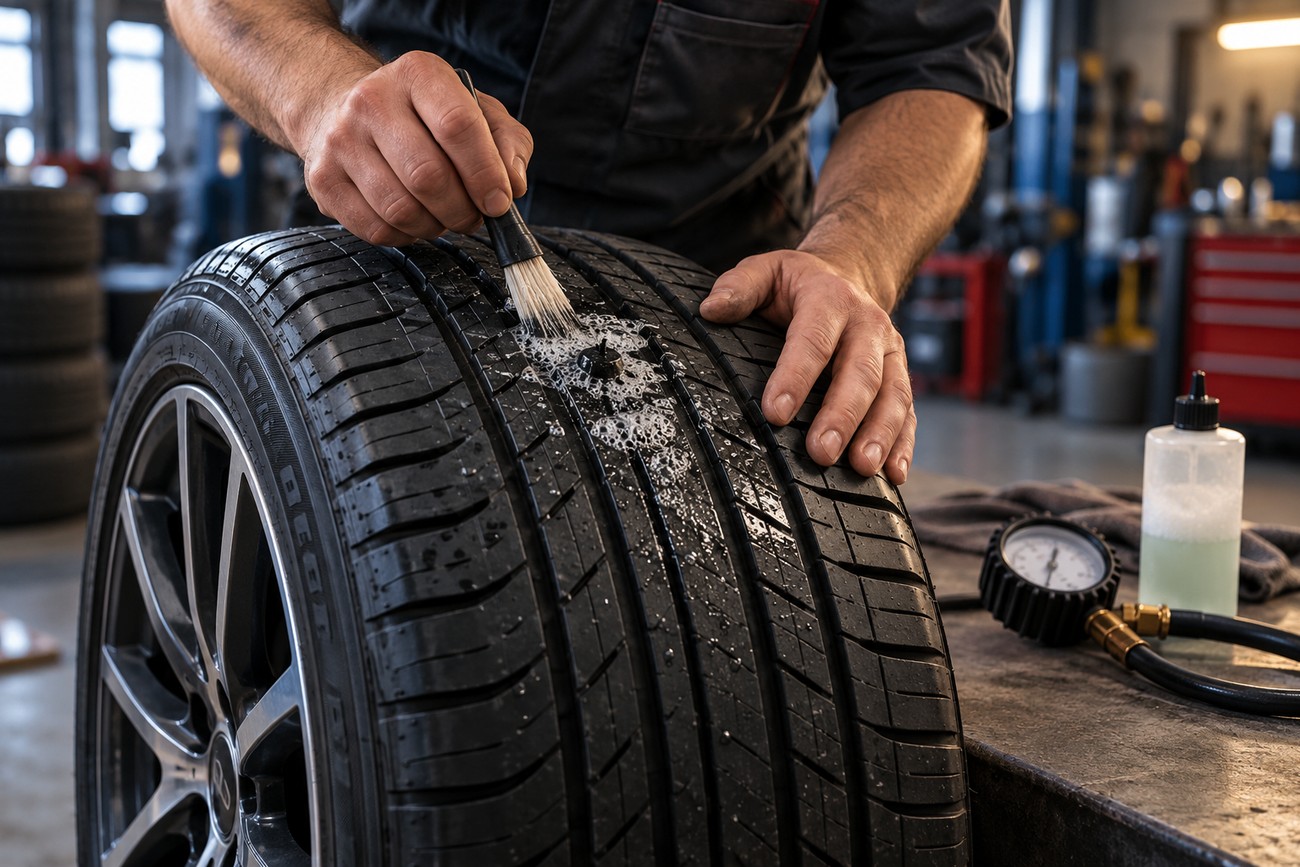
Before leaving the shop, confirm that the tire was inspected internally and that the completed repair fills the injury channel and seals the innerliner. You can also ask the technician to confirm where the full injury lay in relation to the central tread repair area. These details are more useful than a receipt that says only “puncture fixed,” particularly if the tire had already received a roadside plug.
The finished assembly should be checked for leaks and inflated to the pressure specified for your vehicle. Because the tire has been removed from the wheel, ask whether balancing was checked or carried out as applicable. Neither a good seal nor correct balance excuses a tire that failed the earlier eligibility inspection; they are checks on a repair the shop has already judged suitable.
Keep monitoring pressure as you ordinarily would after the work. Continued loss calls for reassessment rather than assuming the repaired puncture is the only possible source or repeatedly adding air. If you notice new tire damage or abnormal driving behavior, stop using the tire until it can be checked. A permanent repair depends on an eligible tire, correctly installed stem-plus-patch components, and a tire that remains sound in service.
Frequently asked questions
The answer depends on whether the tire has received an exterior-only roadside plug or an inspected combination repair. It also depends on the tire’s condition and any manufacturer restrictions. These distinctions matter more than a mileage promise attached to a repair product.
How long can you drive on a plugged and patched tire?
There is no universal mileage allowance for a temporary roadside plug, and no fixed expiry mileage for a correctly installed, inspected stem-plus-patch repair. Have an exterior-only plug assessed rather than treating the distance already driven as proof that it is sound. After a complete repair, continued use depends on the tire remaining in good condition and meeting applicable tire and vehicle manufacturer guidance; renewed pressure loss warrants another inspection.
Why don’t some shops offer plug-only tire repairs anymore?
A shop may decline exterior-only plug work because it cannot inspect the inside of the mounted tire or certify that service as a complete USTMA/TIA permanent repair. Its service policy and responsibility for the work may therefore require tire removal and inspection. That does not mean the shop has abandoned plugs altogether: a rubber repair stem or plug remains one component of a complete stem-plus-patch repair.
Why don’t they plug tires anymore?
Many shops still use a plug or stem to fill an eligible puncture channel; what they may no longer offer is a quick, exterior-only plug as the finished repair. The distinction can be easy to miss when both services are called “plugging.” If a shop says it cannot plug your tire, clarify whether it means its policy excludes exterior-only work or the tire itself failed inspection. A damaged location, internal condition, or manufacturer restriction can make replacement the appropriate recommendation even when a complete repair method is available.