A cramped garage, a balcony, and a tire storage service can all seem like sensible places for an off-season set. Yet a hot corner or moisture trapped inside a bag can leave tires in worse condition than expected when the next season arrives.
The useful distinction is between shelter and suitable storage. Tires need a clean, dry start, a space protected from heat and damaging exposures, and an arrangement that suits whether they are mounted on rims.
- Prepare Tires Before They Go Into Storage
- Choose a Space That Controls Heat, Light, and Moisture
- Store Bare Tires and Mounted Wheels Differently
- Use Covers Without Trapping Water or Heat
- Avoid the Shortcuts That Cause Storage Problems
- Check Tires Before the Next Seasonal Fitting
- Frequently asked questions
- How long can seasonal tires stay in storage?
- Should I swap tire positions when I fit them again?
- What should I confirm when using a tire storage service?
Prepare Tires Before They Go Into Storage
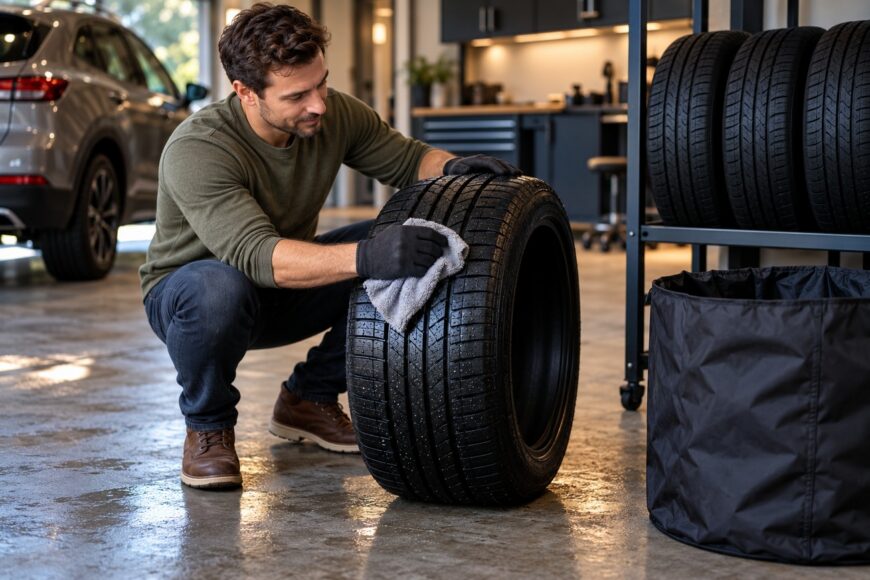
Wash off road salt, dirt, and any visible chemical residue before putting tires away. A mild cleaner suitable for tires and a thorough rinse are safer choices than gasoline, solvents, or aggressive household products. Let the rubber, tread grooves, and mounted wheels dry completely before adding a bag or cover; moisture left in the grooves can remain trapped long after the surface looks dry.
Skip protective treatments unless the tire maker recommends them for storage. An unknown dressing may leave residue without addressing the main risks: heat, light, moisture, and chemical exposure. While each tire is clean, look for cuts, cracks, embedded objects, and uneven wear, and note anything that needs attention before the next fitting.
Record each tire’s previous position on the vehicle and any directional marking, using labels or a separate note that will survive storage. Add a brief condition note if one tire has distinctive wear. Those records help you and the fitter make an informed decision later; they do not mean every set must be moved to different positions each season.
Choose a Space That Controls Heat, Light, and Moisture
A cool, dry, ventilated indoor space is the best starting point. ETRTO recommends storage below 35 °C, preferably below 25 °C; aging can accelerate noticeably above 50 °C. Those figures are guidance for choosing and managing a location, rather than a promise that every garage stays within them. A closed shed or garage can become much hotter than expected when sun falls on it for hours.
Check the proposed spot for direct sunlight, strong UV exposure, roof leaks, condensation, and a persistently damp floor. Keeping tires off wet concrete and away from a heater or boiler is more useful than assuming a room is suitable because it has a roof. Air should be able to circulate around the stored set, especially where temperatures change and moisture may collect.
Give the tires distance from fuel, oil, solvents, paint, acids, and other chemicals. Electric motors, generators, and welding equipment can produce ozone that contributes to rubber cracking, so the corner beside a compressor may be a poor choice. Continental cites an ozone guideline of no more than 0.08 ppm, although measuring ozone is not a routine household task; separating tires from likely sources is the practical step.
Store Bare Tires and Mounted Wheels Differently
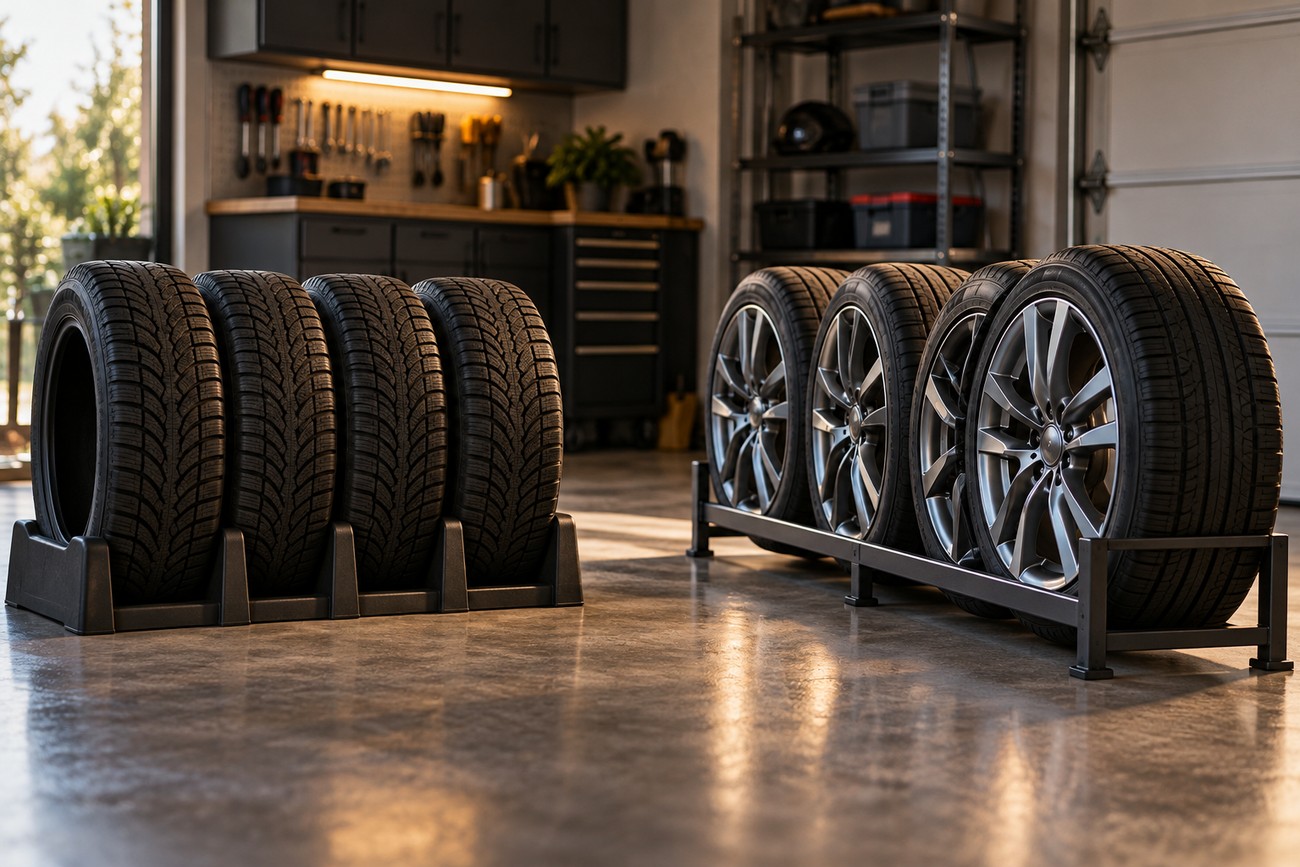
For tires removed from their rims, upright storage in a single layer is acceptable. Support them on a clean, stable surface and avoid a tall horizontal stack, which loads the tires underneath. If bare tires remain upright through a season, change each tire’s contact point occasionally. Manufacturer guidance does not establish one universal interval for doing so.
For tires mounted on rims, upright storage or a single layer on a rack is preferred. Four complete wheel assemblies can be heavy and awkward to move, so choose a rack or floor position that will remain stable when one wheel is removed. Avoid building a high stack simply to save space, and do not hang a wheel from a hook without checking the applicable manufacturer’s advice and the support’s capacity.
Check inflation in mounted wheels against the vehicle or tire maker’s guidance before storage. There is no universal storage-pressure figure that suits every wheel and tire combination. Keep the pressure information with your position record so it is available at refitting, when pressure will need checking again.
Use Covers Without Trapping Water or Heat
A cover can shield clean, fully dry tires from dust and incidental splashes, but it should prevent water ingress without trapping condensation. Sealing a tire while water remains in its grooves or around its rim can leave moisture inside the bag. If the storage area tends to develop condensation, correct that problem rather than relying on tighter plastic.
Indoor storage remains preferable to a balcony or yard. ETRTO conditionally allows outdoor storage with suitable protection from moisture, while Continental advises against outdoor storage even under a cover. The difference matters: a cover may address rain while leaving the tires exposed to large temperature swings and sunlight.
If outdoor storage is unavoidable, raise the tires off the ground and use an opaque, water-resistant covering arranged to allow ventilation. Check that rain cannot run underneath it or pool against the tires. An opaque cover in direct sun can still hold heat around the set, so shade and a cooler location matter more than the cover’s appearance.
Avoid the Shortcuts That Cause Storage Problems
A covered balcony can look protected while becoming a hot enclosure on sunny days. Move the set indoors if possible; adding another layer over the cover does not remove the heat source. Likewise, putting damp tires straight into sealed plastic may protect the floor from drips while keeping moisture against the rubber. Dry the tires first, then choose packaging that will not trap condensation.
A wheel set beside a compressor or welding bench is easy to reach but close to equipment that may produce ozone. Move it away from that equipment and nearby chemicals. If floor space is tight, use stable, appropriate storage rather than an unstable high stack: bare tires can stand upright in a single layer, and mounted wheels are preferably upright or in a single layer on a rack.
Tires do not always have to lie flat. Cold alone does not necessarily make a storage space unsuitable; prolonged heat, UV, ozone, chemicals, and moisture are the main avoidable exposures in storage guidance. A cold shed can still be a poor choice if it leaks or develops condensation.
Some drivers notice vibration after stored wheels are refitted, but storage position alone does not establish the cause. If vibration persists, have the tires and wheels assessed rather than assuming that turning or restocking them will solve it.
Check Tires Before the Next Seasonal Fitting
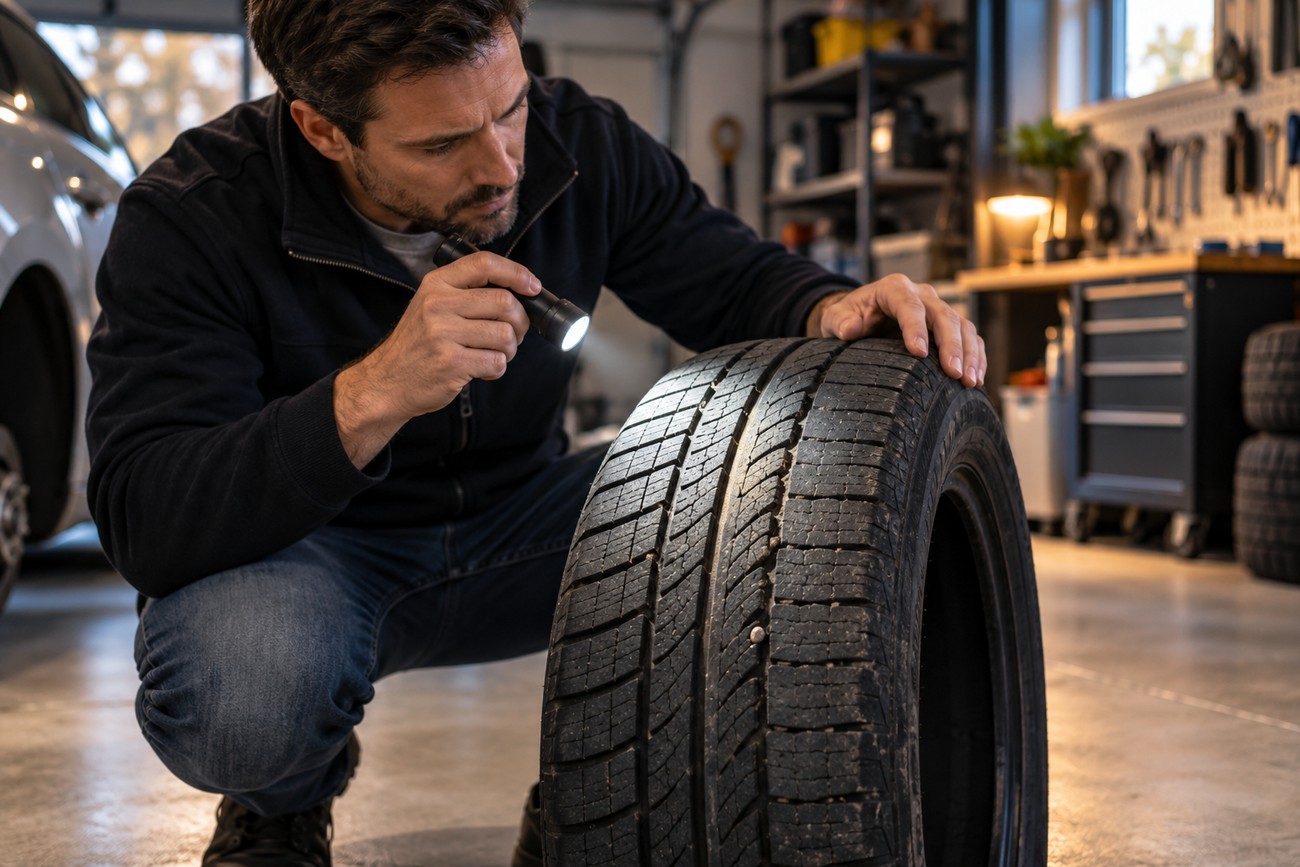
Inspect each tire before it goes back on the vehicle, even if storage conditions were good. Look across the tread and sidewalls for visible cracks, cuts, embedded objects, and unusual wear. Compare what you find with your earlier condition notes; that makes a newly noticed problem easier to identify and explain to a tire professional.
Use the recorded previous positions and directional markings when planning the fitting. A directional tire must be installed in its intended direction, while any change of position should follow the vehicle’s instructions and the tire configuration. If damage looks doubtful, ask a tire professional to assess it before the tire returns to service.
For mounted wheels, check pressure against vehicle or tire-maker guidance when they are refitted, rather than relying on the reading taken before storage. Correct storage reduces avoidable damage, but it does not stop rubber aging or guarantee a trouble-free return to use.
Frequently asked questions
Storage conditions and tire condition matter more than a simple seasonal countdown. Keep the records you made at removal, then use them when the set returns to service. The answers below address decisions that a tidy storage space alone cannot settle.
How long can seasonal tires stay in storage?
There is no single safe duration that applies to every stored tire. Proper storage does not stop rubber aging, and a tire’s condition depends in part on its age and exposure history. Check the date marking and inspect for cracking, damage, and unusual wear; if an older tire’s suitability is uncertain, seek a tire professional’s assessment before fitting it.
Should I swap tire positions when I fit them again?
There is no universal requirement to swap positions each season. Rotation depends on the vehicle’s instructions, tire dimensions, and any directional design; some sets cannot be moved between positions in the same way as others. Your record of previous positions and wear gives the fitter useful evidence for that decision.
What should I confirm when using a tire storage service?
Confirm how the service identifies each tire or wheel, records its position and visible condition, and keeps the set dry. Ask whether tires are fully dry before packaging, how the packaging avoids trapped moisture, and whether it will remain intact in storage. Before collection or refitting, establish who will check tire condition and the pressure of mounted wheels against the applicable guidance.