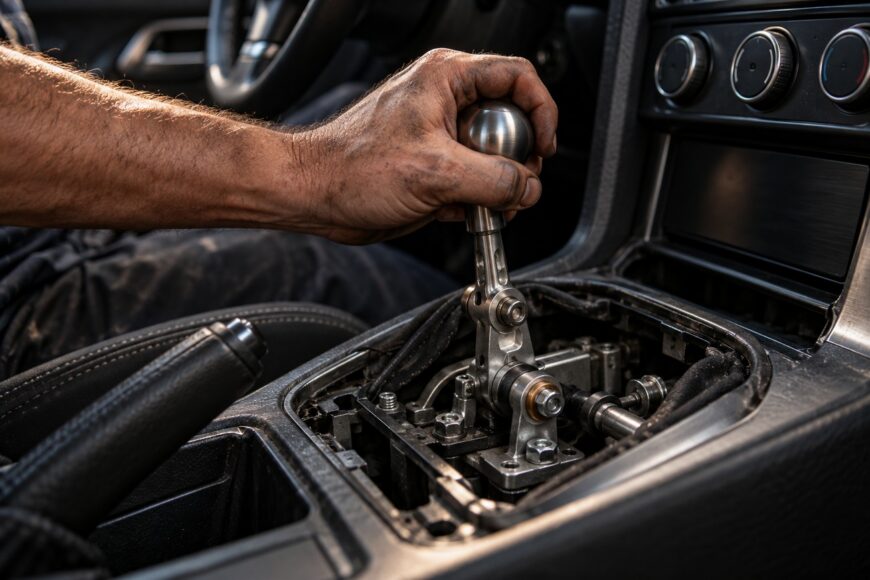
A shorter movement between gears can make a manual car feel more direct. Your hand spends less time crossing the shift pattern, and the next gear may seem easier to reach during assertive driving. That appeal is straightforward, especially if the factory throw feels long.
The choice is less straightforward in traffic. A shorter throw can demand more effort from your hand, and a firmer mechanism may pass more vibration into the cabin. Whether the change helps depends on the car’s existing shift mechanism, the kit, and its adjustment. Understanding what moves beneath the lever is the best place to start.
- What a short shifter actually changes
- Check the existing shift mechanism before buying
- Choose a kit for your car, not the biggest reduction
- Installation and adjustment decide how it shifts
- The trade-offs: effort, noise, and missed shifts
- Is a short shifter worth it for your driving?
- Frequently asked questions
- How can I change gears faster without rushing the gearbox?
- Does a short shifter change where the clutch engages?
- What are the downsides of a short shifter?
- How do I switch gears faster?
What a short shifter actually changes
A short shifter changes shift-linkage geometry and hand travel, not the internal gearbox or clutch engagement. Depending on the design, it alters the lever’s pivot relationship or the movement transmitted through a linkage or cable mechanism. Your hand then travels a shorter distance between gear positions.
Aftermarket kits commonly advertise roughly 25–50% less throw; the actual result depends on the vehicle and mechanism. That figure describes lever travel, not the time needed for the clutch, driver, and gearbox to complete a clean change. Moving your hand a shorter distance cannot make an unwilling gear engage properly.
Throw and lever height are separate choices. Some kits retain factory lever height while reducing the distance between gears. Simply fitting a shorter lever or knob can change the feel, but it is not the same as fitting a kit designed to change the linkage geometry.
Check the existing shift mechanism before buying
With the car stationary, feel for excess movement at the lever in neutral and in each engaged gear. Notice whether the lever returns consistently toward the center and whether any gear takes repeated attempts to find. These checks help establish whether the complaint is long travel, loose guidance, or both.
Inspect accessible bushings, linkage joints, cables, and mounts for wear or movement, and check adjustment against the vehicle’s procedure. Worn bushings, stretched cables, and poor adjustment can limit the benefit of a short shifter or worsen gear selection. Shortening the route your hand takes will not remove play elsewhere in that route.
Repairing a loose mechanism restores the accuracy it was meant to have; a short shifter changes how far and how firmly you move it. An already precise factory setup may therefore show a smaller subjective improvement than its advertised throw reduction suggests. If a gear is difficult to select now, diagnose that fault before adding parts.
Choose a kit for your car, not the biggest reduction
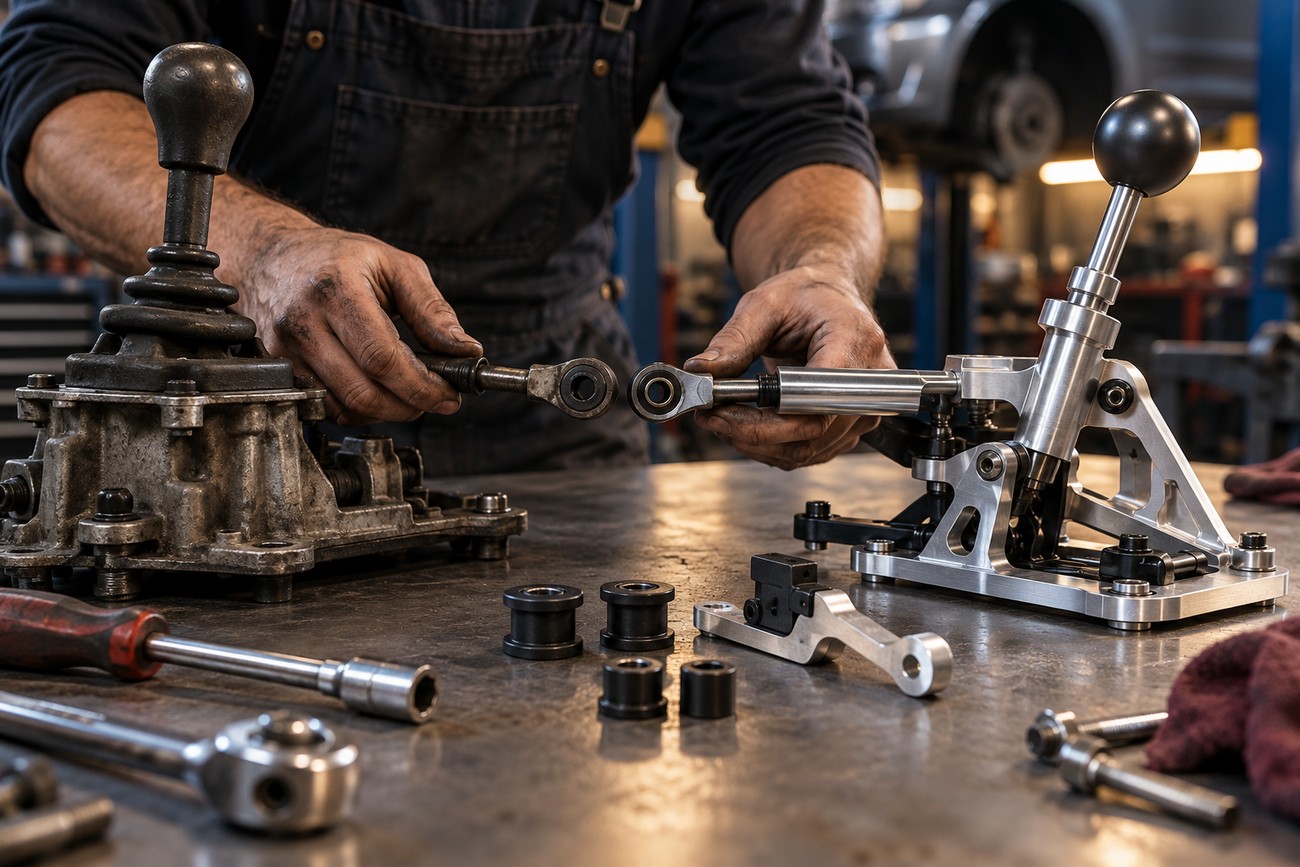
A lever-only kit can shorten travel, but it may leave tired bushings and vague guidance untouched. Other packages include a plate, bushings, or stops that shape how the mechanism moves and where it ends its travel. Compare the contents with the condition of your car rather than assuming every listed part is necessary.
Confirm fitment for the specific platform and its cable or linkage layout; a “universal” label is no substitute for a compatible connection. Check lever height, knob attachment, and any reverse-lockout arrangement before ordering. Some kits preserve factory lever height while reducing throw, which can help retain a familiar hand position.
Cabin clearance matters as much as fitment below the console. Follow the lever through its full pattern and consider nearby trim, the armrest, and the parking brake. The largest advertised reduction may leave too little useful movement for a deliberate shift, particularly for someone still learning the car’s gate.
Installation and adjustment decide how it shifts
Access and assembly vary by vehicle. Before tightening the kit, confirm that its moving parts clear the surrounding trim and linkage, and assemble fasteners and supplied components as specified for that design. A part that bolts in place can still need careful fitting and cable or linkage adjustment.
With the car stationary, check neutral movement and select every gear, including reverse, before driving. The lever should reach each position without contacting trim or requiring an awkward push. If selection has worsened, revisit the adjustment and the installed parts rather than treating resistance as proof that the kit is working.
New rattles or vibration call for a check of fasteners, bushings, and component contact points. A lever that strikes the console needs its clearance or fitment corrected, not a harder shove. Complete the stationary checks first, then make a cautious drive to confirm that selection remains consistent under normal use.
The trade-offs: effort, noise, and missed shifts
Reducing hand travel can reduce mechanical advantage, so the lever may take more effort to move. A shift that feels satisfyingly firm on an open road may become tiring in repeated city changes. The size of that difference depends on the car and kit; a shorter throw does not make every manual unpleasant.
Some installations transmit more noise, vibration, or harshness through the lever. The source may be the kit’s construction, its bushings, or an installation issue, so a new buzz should be investigated rather than accepted automatically. A distinct mechanical sensation can be appealing without making gear selection more accurate.
Less hand travel also leaves less room for an imprecise movement. With an aggressive reduction, a driver who pushes diagonally toward the next gear may find the gate harder to read and make more selection errors. Precision comes from a sound mechanism and a deliberate motion; a faster completed shift is not guaranteed.
Is a short shifter worth it for your driving?

On a healthy daily driver, decide whether you want shorter hand movement enough to accept a possible change in effort and cabin feel. If the factory mechanism is already accurate, the result may be noticeable without transforming the drive. Consider the desired lever position as well as the advertised reduction.
For more assertive driving, consistent access to each gear matters more than the shortest possible throw. Consider whether the kit includes the parts your mechanism needs, and allow for fitting and adjustment when weighing the purchase. Your shifting style and the original linkage will influence the benefit as much as the kit itself.
If the lever feels loose or gears are hard to find, restoring worn bushings or correcting adjustment is a better first step. You can then assess a short shifter against a sound baseline. It changes shift travel; it does not turn the gearbox into a sequential unit or automatically make every gear change quicker.
Frequently asked questions
Shift feel is only part of a completed gear change. These answers address driving technique and the controls a kit leaves unchanged.
How can I change gears faster without rushing the gearbox?
Coordinate clutch and throttle inputs, then guide the lever deliberately into the next gear. Let the gear engage fully before releasing the clutch; forcing the lever through resistance can turn a quick hand movement into a poor shift.
Does a short shifter change where the clutch engages?
No. Shifter geometry does not change the clutch bite point. Because your hand covers less distance, familiar clutch timing may initially feel different, so adjust your coordination rather than assuming the clutch has changed.
What are the downsides of a short shifter?
Possible downsides include greater hand effort, added noise or vibration, and less comfortable operation in frequent stop-and-go driving. Before fitting one, check that the knob and reverse-lockout arrangement will work with the specific kit and vehicle; those details affect everyday use.
How do I switch gears faster?
Choose the next gear deliberately, depress the clutch fully, and move the lever along the gear pattern without trying to overpower it. Practice smooth, repeatable changes first. Reducing wasted movement helps more than moving your hand quickly toward a gear that has not fully engaged.