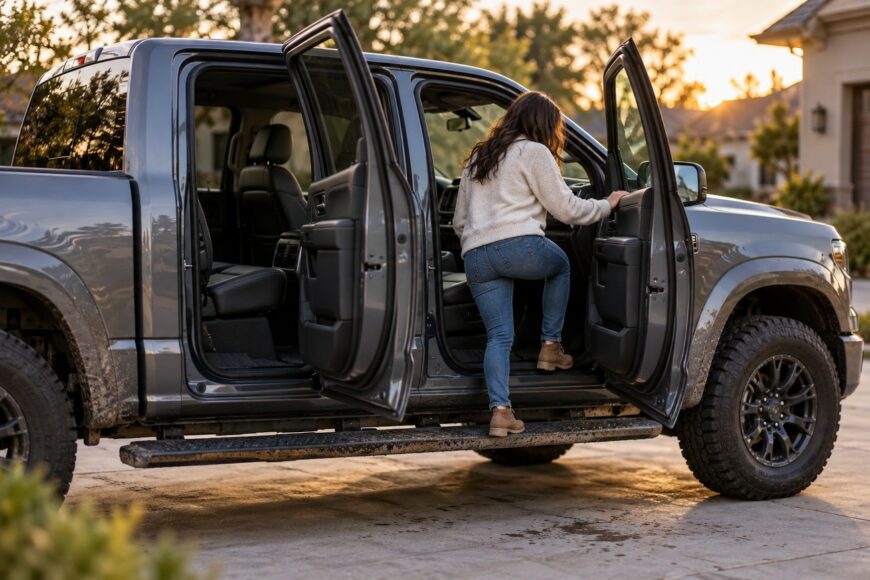
Running boards and side steps can make a truck or SUV easier to enter, but the wrong design can leave you reaching for an awkward foothold, cleaning salt from a broad platform, or losing clearance on rough ground. The useful measurement is the climb you make every day: from the ground to the step, then from the step through the doorway.
Before buying, consider who uses the vehicle, what they wear, and where it travels. A passenger who needs a broad, predictable place to stand may prefer a different surface from someone climbing in with muddy work boots. Once you know where the foothold should sit, check vehicle-specific fitment, mounting, and the clearance the installed step will leave.
- Start with the step, not the styling
- Running boards, nerf bars, drop steps, and power steps compared
- What a load rating does—and does not—promise
- Fitment and no-drill installation: checks before ordering
- Grip, corrosion, and winter maintenance
- Clearance, protection, and the ownership trade-off
- Frequently asked questions
- What should you measure before choosing side steps for a lifted truck?
- What affects the cost of installing a step on a truck?
- How should you choose side steps for a Jeep used off-road?
Start with the step, not the styling
A good step breaks the climb into two comfortable movements. Its height matters, but so does how far it projects from the sill and where it sits beneath the door opening. A large platform placed too far inward can be hard to find with your foot; one that projects too far outward can make the move into the seat feel awkward.
Continuous running boards offer a broad surface along much of the cab, which can help passengers choose their footing at different doors. That same width may force a tall driver to step around the board when getting out. Broad surfaces can also retain snow, mud, water, and road salt, so the easiest surface to stand on may take more effort to keep clear.
For muddy work boots, a more open platform with pronounced tread may shed debris better than a smooth, wide board. Passengers wearing ordinary shoes may value more surface area and a less exposed edge. Grip also depends on what collects on the step: tread that feels secure when dry still needs clearing when packed with snow or mud.
Assess the proposed foothold from both front and rear doors if both will be used. Compare its height with the ground and the cabin floor, then consider whether a foot can land on it without an exaggerated outward move. Check the product’s installed position in vehicle-specific photos or instructions rather than judging platform width alone.
Running boards, nerf bars, drop steps, and power steps compared
Product names are loose descriptions, so compare the actual platform and mounting layout. These common designs solve different access problems and expose different parts to obstacles and dirt.
| Style | Footing and typical use | Clearance trade-off | Dirt and maintenance exposure |
|---|---|---|---|
| Running board | A continuous, broad foothold can serve passengers at multiple doors. | A wide fixed board may project outward and sit in the path of obstacles. | Its upper surface can hold snow, mud, water, and salt. |
| Nerf bar or tube-style step | A narrower tube with designated pads suits drivers who want a smaller foothold. | Its height and projection vary; a tube is not automatically tucked above obstacles. | Check pad grip, tube ends, drainage, and places that trap dirt. |
| Drop step | A lowered foothold can make entry easier on a lifted truck. | The lower stepping point sits closer to obstacles. | Lower parts take more splash and may be more exposed to strikes. |
| Power step | A retractable platform extends for entry and retracts after use. | Retracted position can improve clearance, subject to the installed design. | Wiring, motors, sensors, and moving parts need attention in water and road salt. |
Many fixed designs combine features: a tube can carry a broad pad, and a running board can have an open tread. Check the installed height and surface rather than assuming the label describes either. On a lifted vehicle, a drop step may solve a difficult climb while becoming the first part to meet a rut or rock.
Power steps add another fitment question. They require wiring through a door-trigger circuit or a vehicle-specific harness, and their motors, sensors, or mechanisms may need attention in wet, salty conditions. A retracted step should also be checked against the vehicle’s actual underbody and nearby accessories.
What a load rating does—and does not—promise
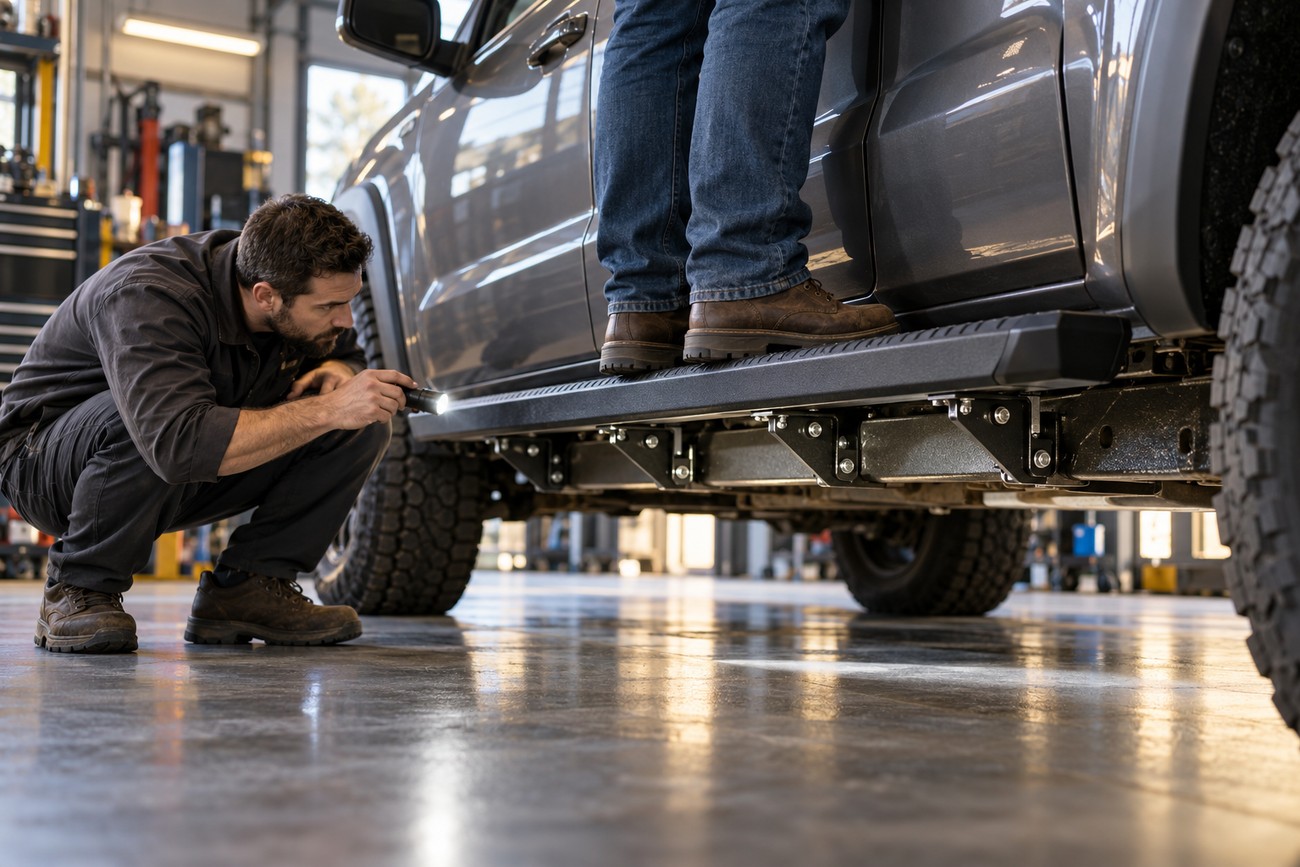
A published capacity is useful only if you know what was measured. Reported examples range from 300 lb (approximately 136 kg) per side for one product to 500–600 lb (approximately 227–272 kg) for selected models. Those claims are not directly comparable without their test conditions and stated units.
The supplied product information identifies no universal industry test standard for comparing published running-board and side-step capacities. Descriptions may omit where the load was applied, how long it remained there, and what safety margin was used. Ask whether a rating applies to one side, one foothold, or another defined part of the assembly before treating it as a buying threshold.
A static rating also does not establish the load during a sudden step, jump, or impact. A person landing hard can impose a higher momentary load than their weight at rest; an obstacle strike is a different demand again. Without a documented test method, there is no sound numerical conversion from a stated static capacity to either situation.
Look past the headline figure to the brackets and their support count. A step may attach to the frame, body sill, or both, and performance depends on bracket geometry and the vehicle’s attachment points. The product instructions should show where each support lands on your vehicle; a rating for a differently mounted kit offers little reassurance.
Fitment and no-drill installation: checks before ordering
Start with the exact vehicle year, make, model, cab configuration, and trim. Then compare the kit’s instructions with the vehicle’s sill cladding, underbody covers, and factory mounting holes. Matching body length alone cannot confirm that the brackets will clear trim or meet the intended attachment points.
A “no-drill” kit may use factory holes yet still call for trimming an underbody cover. Mounting can use the frame, body sill, or both, with bracket shape and attachment points affecting how the step carries a load. Read the kit-specific instructions before ordering if cutting trim or gaining access to a mounting point would be a problem.
Check the condition and accessibility of factory fasteners before relying on an advertised installation time. A seized bolt can turn an otherwise straightforward bolt-on job into hardware repair.
During installation, leave the assembly adjustable until its position is confirmed, then tighten fasteners to the kit’s specified torque and sequence. Overtightening can damage threaded inserts or the vehicle body; one torque value does not fit every kit. If a design calls for drilling, the new holes also need appropriate corrosion protection and sealing.
Before regular use, open every door and check its clearance over the step. Confirm access to jack points and clearance around the exhaust and suspension throughout their expected movement. A step that bolts up cleanly can still interfere with servicing or sit too close to a moving or hot component.
Grip, corrosion, and winter maintenance
Wet weather changes both footing and upkeep. Clear packed snow or mud from tread before stepping on it, and wash road salt from the platform and brackets rather than concentrating only on the visible top. Broad boards can retain water and debris, particularly where trim or textured pads make the surface harder to rinse.
Chipped coating can expose steel and allow rust to develop, sometimes within a season of salted use. Inspect the step edges, welds, brackets, and places likely to be struck by stones. Touching up a small damaged area according to the product’s instructions is easier than dealing with corrosion after it spreads beneath a coating.
Tubular steps deserve a look beyond their outer finish. Water trapped inside tubing can cause hidden corrosion, so check whether openings and drainage paths remain clear and whether you can rinse out accumulated dirt. A sealed-looking tube should not be assumed to stay dry throughout its life.
Steel is generally heavier than aluminum, but coating condition, drainage, and construction matter more than material alone. Neither label promises a maintenance-free step. On power models, cleaning also means keeping moving parts free of buildup and inspecting exposed wiring and connections as directed by the manufacturer, especially after travel on salted roads.
Clearance, protection, and the ownership trade-off
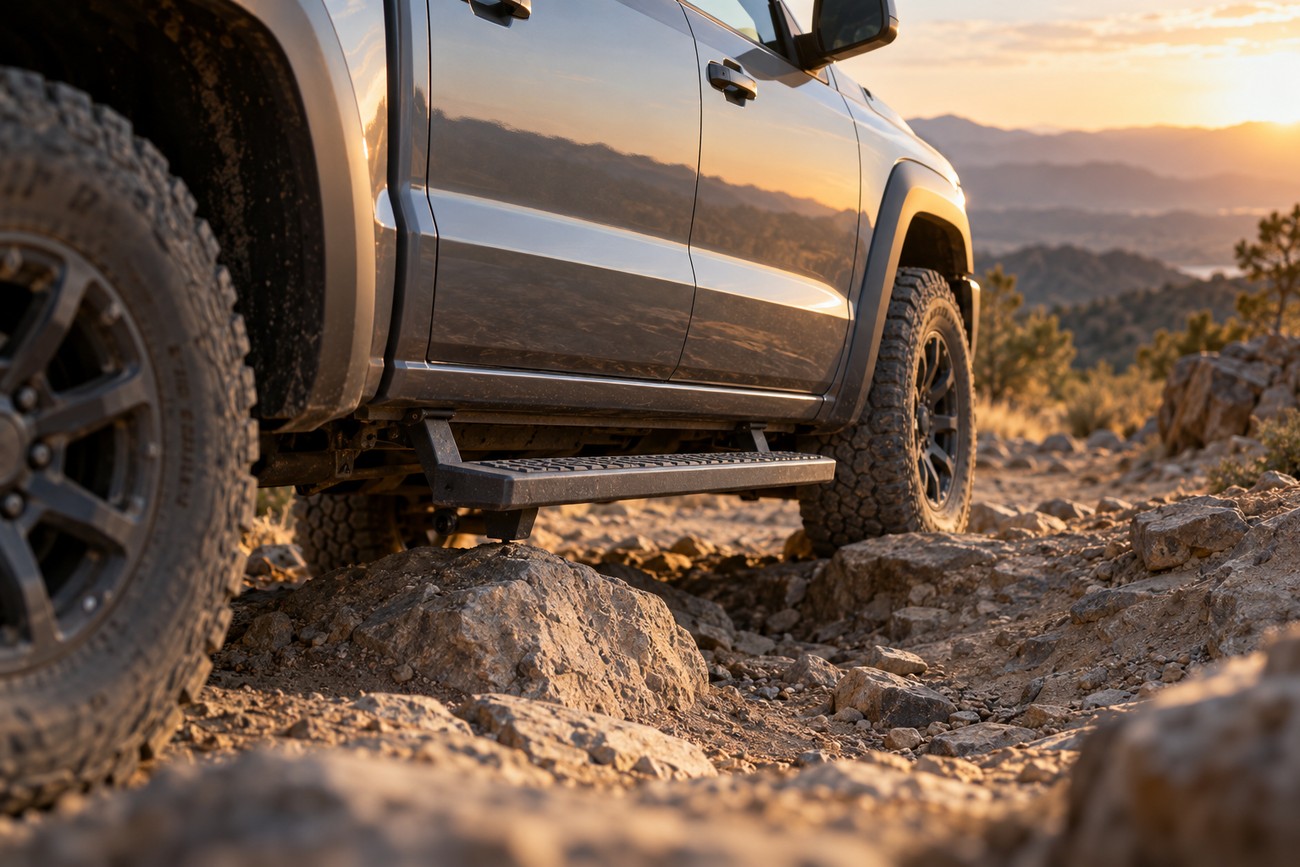
A fixed step changes the vehicle’s profile beneath the doors. Check its lowest point and how far it projects outward, particularly if the vehicle crosses ruts, crests, or rocks. A drop step lowers the stepping point for easier entry, but places part of the assembly closer to obstacles.
Side steps are not automatically rock sliders. A step may take an obstacle strike and bend its brackets rather than protect the sill; protective value depends on construction and mounting. If impact protection is a priority, examine the intended attachment points and the product’s stated purpose instead of relying on a rugged appearance or its name.
There is also an ownership cost to leaving a platform exposed: fixed steps add weight and collect road grime, while a powered design adds wiring and moving parts to inspect. Those trade-offs may be worthwhile for a vehicle whose passengers need easier entry every day. For frequent off-road use, clearance and repairability may carry more weight in the decision.
Read warranty terms alongside the installation instructions. Coverage may exclude damage linked to improper installation, overload, or corrosion after coating damage. Choosing a step you can fit correctly, clean, and inspect is more useful than choosing solely by its advertised capacity or finish.
Frequently asked questions
These decisions depend on the vehicle as it sits, rather than on a generic step category. Measurements and a vehicle-specific installation quote can settle questions that product photos cannot. Off-road accessories call for an additional check of what is already mounted beneath the doors.
What should you measure before choosing side steps for a lifted truck?
Measure the climb at the truck’s normal ride height: ground to the proposed foothold, then foothold to the cabin floor. Check both distances at the doors people use, along with how far outward a foot must move to reach the step. Lift-kit size alone cannot tell you whether a straight board is reachable or a lower drop step will feel natural.
Also compare the proposed step’s lowest and outermost points with the truck’s current clearance. That makes the access benefit of a lower foothold easier to weigh against its greater exposure near obstacles.
What affects the cost of installing a step on a truck?
Installation cost depends on the kit and the work required on the specific truck, separate from the price of the step. Ask a shop to account for vehicle-specific brackets, access to the mounting points, the condition of factory hardware, and any underbody-cover trimming. Seized fasteners can add work even when the kit is sold as bolt-on.
Power steps add electrical work: the installer may need to use a door-trigger circuit or vehicle-specific harness and verify operation at each door. A useful quote states what fitting, trim work, and electrical checks it includes, rather than assuming every no-drill kit takes the same effort.
How should you choose side steps for a Jeep used off-road?
First check the Jeep’s exact model and configuration, then identify any existing rock rails and other accessories near the sill. Confirm whether the proposed brackets can coexist with them, where the step will sit relative to obstacles, and whether it obstructs access to service points. Compatibility cannot be inferred from a Jeep label alone.
If you need obstacle protection, look for a product whose construction and mounting are intended for impacts. An entry step may offer good footing yet bend when it hits a rock. Decide which job matters most before replacing a rail with a lower, more exposed platform.