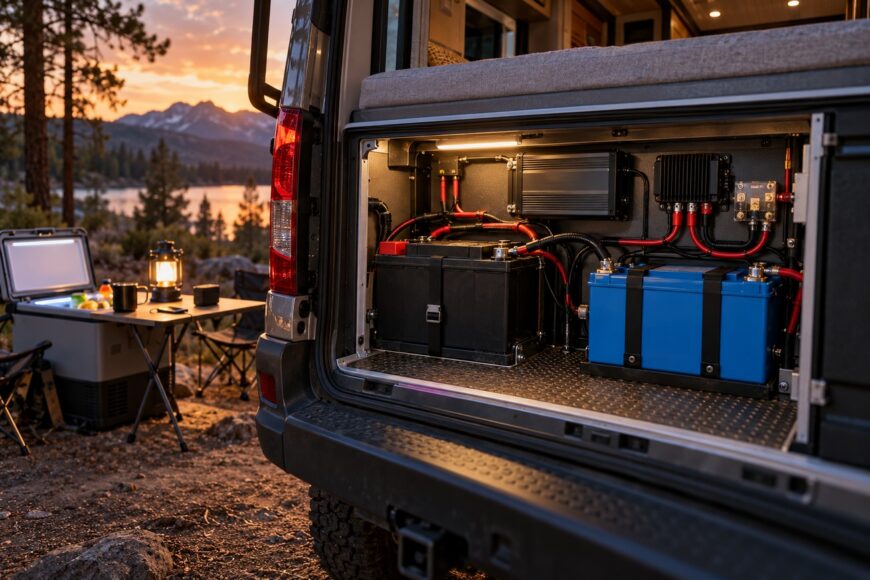
A second battery can run a refrigerator, lights, USB devices, and an inverter while the vehicle is parked. A poorly designed system can also drain the starter battery, overload the alternator, overheat the wiring, or shut down without warning. The useful distinction is between a simple isolated auxiliary system and a controlled LiFePO₄ installation matched to the vehicle.
The starter battery must remain available for engine starting. Camping loads belong on the auxiliary battery, while charging must follow a deliberate path that suits the alternator, battery chemistry, cable run, and expected loads. The right setup depends on the vehicle and trip, not on the battery label alone.
- What an Auxiliary Battery Setup Must Protect
- Choosing Battery Chemistry and Usable Capacity
- Charging from the Vehicle Without Stressing the Alternator
- Wiring, Fuses, Cable Sizing, and Battery Placement
- Sizing Loads, Inverters, and Monitoring for Real Camping Use
- Common Failures, Cold Weather, and Parallel Battery Banks
- Frequently asked questions
- What is the best battery setup for camping?
- What is the 20/80 rule for batteries?
- How long will a 100Ah lithium battery run a 12V fridge?
What an Auxiliary Battery Setup Must Protect
An auxiliary battery supplies energy when the engine is off, so lights, a fridge, chargers, and other camping equipment do not consume the battery required for starting. Isolation between the starter and auxiliary batteries is the basic safety function. A system that joins them continuously can leave you with a comfortable campsite and no reliable way to start the engine.
The starter battery serves short, high-current starting demands. The auxiliary battery is designed for repeated camping loads and is charged through an isolator, relay, or DC–DC charger. A relay may suit a simple installation with a compatible charging voltage, while a DC–DC charger provides current control and a charging profile suited to the auxiliary battery.
LiFePO₄ systems should normally use a DC–DC charger between the vehicle charging system and the auxiliary battery. Its job is separate from that of the BMS. The BMS protects against overcharge, over-discharge, and specified temperature conditions, but it does not replace fuses, correct cable sizing, grounding, or charging-current control.
Vehicle type, alternator behavior, battery chemistry, cable length, and load size determine the architecture. A conventional alternator may behave differently from a smart alternator, and a small lighting system has different demands from an inverter installation. Treat a wiring diagram as a starting point that requires verification rather than as a universal answer.
Choosing Battery Chemistry and Usable Capacity
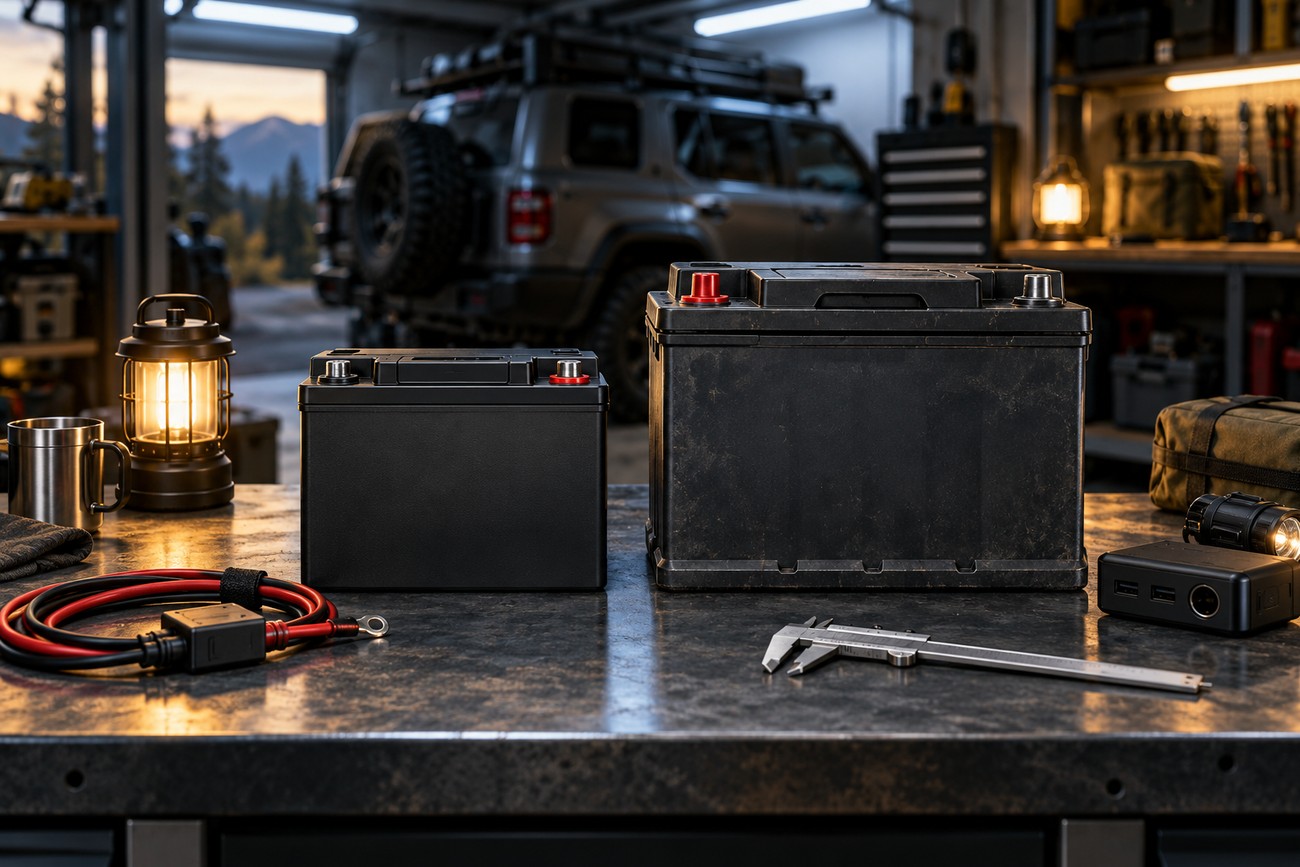
AGM and other lead-acid batteries can be practical where the charging system already suits them and weight or space is acceptable. LiFePO₄ usually offers lower weight and more readily usable energy for its nominal capacity, but it needs compatible charging settings and temperature protection. Its low internal resistance allows it to accept high current, which makes uncontrolled charging a system risk.
A 100Ah label is a nominal capacity rating, not a guarantee of identical usable energy. Actual availability varies with depth of discharge, temperature, load current, inverter cutoff, and system losses. An inverter may shut down at a voltage threshold while the battery still contains energy, especially when current causes voltage to fall under load.
Charging settings must match the battery chemistry and the specific battery or BMS requirements. AGM, GEL, lead-acid, and LiFePO₄ settings are not automatically interchangeable. Check the battery documentation for charge voltage, temperature limits, approval for parallel use, and any restrictions on charging below the permitted temperature.
Start sizing with a load list. Record each device, its running demand, expected operating time, startup or surge current, and whether it will run continuously. Add a reserve for poor weather, extra charging, conversion losses, and battery protection limits, then select capacity and charging equipment around that realistic demand.
Charging from the Vehicle Without Stressing the Alternator
A relay connects the auxiliary battery when the vehicle charging system indicates that the starter battery is being charged. This can work in a compatible vehicle, but a smart alternator varies its output voltage, so a relay may charge inconsistently. Charging may start late or fail to start if the relay does not receive a suitable voltage signal.
A DC–DC charger is the preferred controlled link between the vehicle charging system and a LiFePO₄ auxiliary battery. It limits charging current and applies a compatible charging profile. The charger can also reduce uncontrolled demand on the alternator, although it creates conversion losses and heat that must be managed with suitable mounting and airflow.
Smart-alternator installations may need a control signal or a voltage-sensing activation mode designed for that vehicle. A voltage trigger should be checked under real operating conditions because engine-control strategies can change system voltage. The charger’s input and output terminals, negative return, and activation signal all need verification rather than assumption.
Before blaming the battery, measure voltage at both charger terminals under load and inspect the negative return and trigger logic. A poor ground or incorrect activation signal can look like a failed charger or a defective BMS.
Alternator capacity requires a calculation that includes charger current, existing vehicle loads, wiring, heat, and cooling. One Victron scenario gives an indication of generator current at least twice the battery capacity, while advertising may promise compatibility without accounting for those conditions. Treat that statement as scenario-specific guidance, not universal proof that a vehicle can support a given system.
Wiring, Fuses, Cable Sizing, and Battery Placement
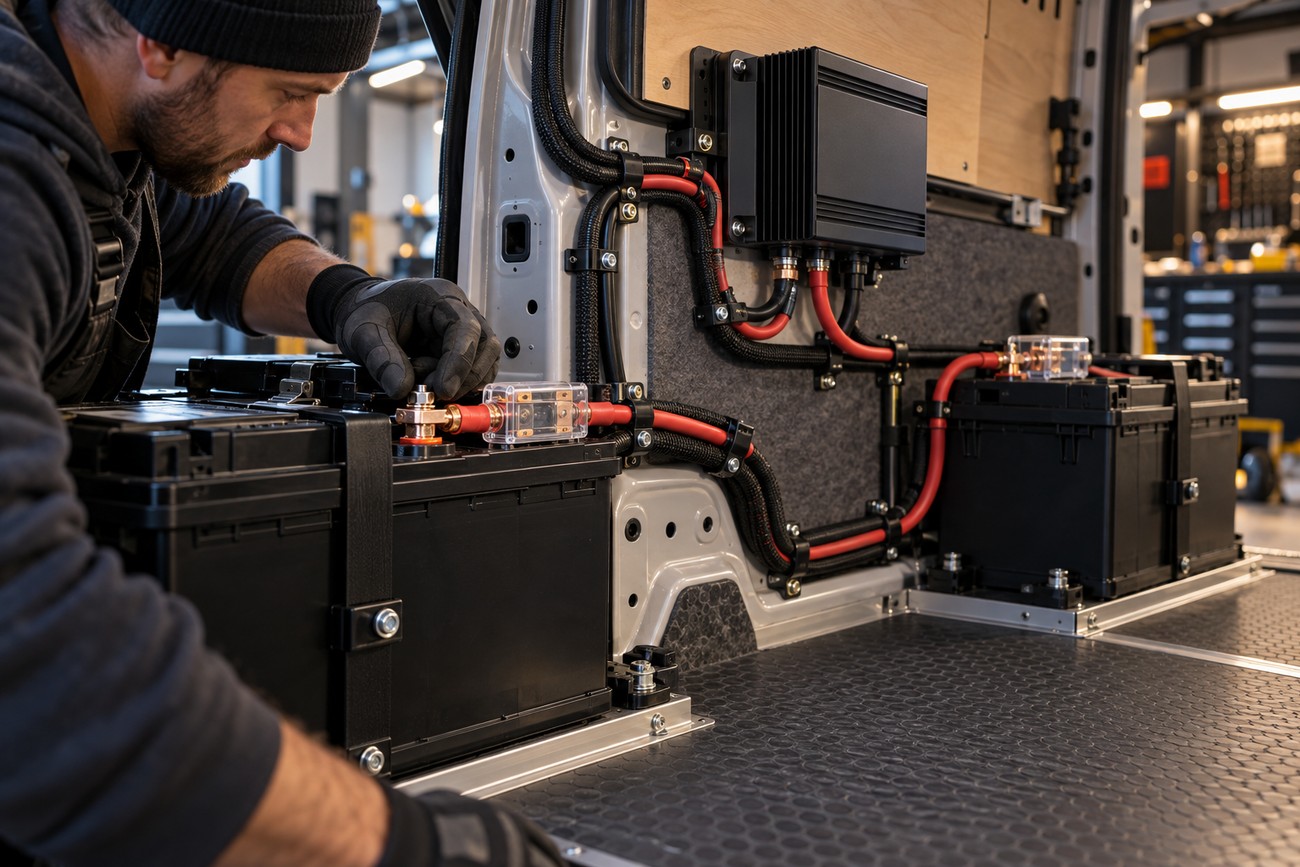
Both DC–DC charger power paths require separate fuses or breakers selected for the charger current and cable cross-section. The positive cable leaving the starter battery needs nearby overcurrent protection. Protecting only the auxiliary-battery end leaves a long unused section that can remain dangerous if it shorts against the vehicle body.
Cable selection depends on current, total route length, voltage drop, heating, and short-circuit risk. Choosing a cable only because its nominal rating matches the charger can produce excessive voltage drop or heat along a long route. Include the negative return in the calculation, whether it runs to a suitable chassis point or directly to the battery.
Poor negative connections increase voltage drop and can cause false charger or BMS faults. Clean contact surfaces, secure terminals, protected cable routing, and a reliable return path matter as much as the positive cable. Keep wiring away from abrasion, sharp edges, exhaust heat, and moving parts, and secure it against vibration.
Mount the battery and charger so they cannot shift during braking or rough travel. The enclosure must address mechanical damage, short circuits, overheating, and secure mounting. A sealed case is not automatically safe in every cabin or storage compartment; ventilation, temperature, access to protection devices, and manufacturer installation limits still apply.
Sizing Loads, Inverters, and Monitoring for Real Camping Use
Build the system around actual loads rather than the battery’s marketing label. A refrigerator, lights, USB devices, a heater, and an inverter each impose a different pattern of demand. List running watts, operating duration, and whether each load is intermittent, then account for the extra energy drawn through conversion equipment.
Compressor refrigerators and inverters can require significant short-term startup current beyond their running wattage. That surge can trigger a protection device or pull voltage below an inverter’s cutoff even when the average load appears modest. Cables, connectors, fuses, and battery discharge capability must therefore support both continuous and short-term demand.
An inverter consumes energy in standby, especially when left connected continuously. Switch it off when its output is unnecessary, or choose a system with standby behavior that matches the camping routine. Nominal capacity must also be reduced by reserve requirements, conversion losses, temperature, and the inverter’s low-voltage cutoff.
A shunt-based monitor and temperature sensor generally provide more useful information than voltage-only state-of-charge estimates. Voltage changes with load, charging, and surface charge, so it can give a misleading impression of remaining energy. Monitoring current in and out, temperature, and charger status makes intermittent faults easier to isolate.
Common Failures, Cold Weather, and Parallel Battery Banks
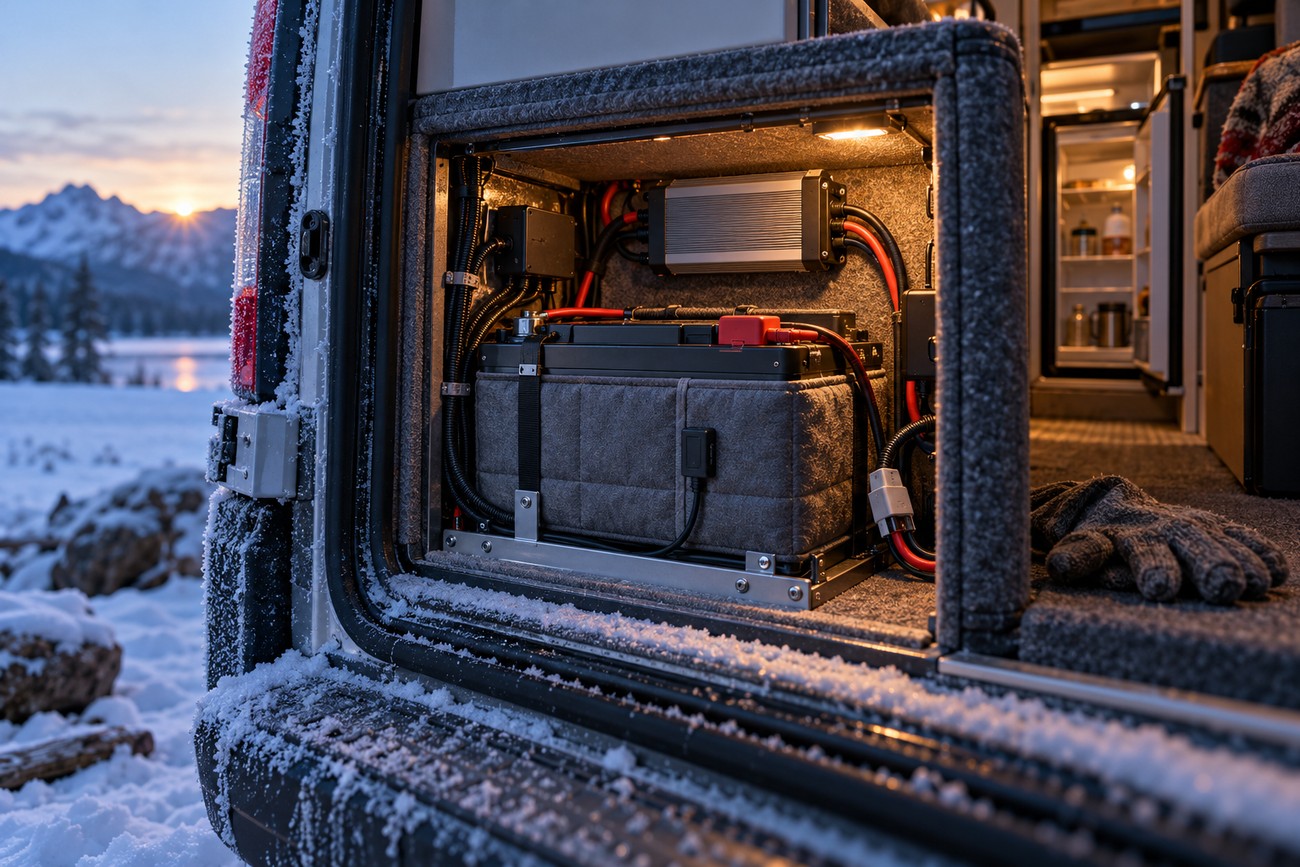
A LiFePO₄ BMS may disconnect the battery abruptly after detecting over-discharge, overcharge, or an unsuitable temperature. Connected equipment then loses power, and a charger may encounter an abnormal electrical state. The BMS is an important protection layer, but repeated disconnection usually indicates a system, setting, temperature, or load problem that needs diagnosis.
Cold-temperature protection may block charging when the battery is too cold; it does not warm the battery or make cold charging safe. Confirm the battery’s permitted charging conditions and provide an approved heating or temperature-management method where required. Do not defeat the protection simply to keep the charger running.
Fault-finding should proceed through the whole path: battery terminals, fuses, positive and negative cables, charger settings, trigger signal, and BMS status. A blown fuse, weak ground, incorrect profile, or missing smart-alternator signal can produce similar symptoms. Directly connecting LiFePO₄ through a relay does not replace current limiting, alternator compatibility, or correctly configured charging.
Parallel LiFePO₄ batteries require compatible BMS units, similar states of charge, suitable cable lengths, balanced current paths, and manufacturer approval for parallel use. Mismatched batteries can share current unevenly and create confusing protection events. AGM, GEL, lead-acid, and LiFePO₄ charging profiles should likewise be treated as chemistry-specific rather than interchangeable.
Frequently asked questions
What is the best battery setup for camping?
A simple isolated auxiliary battery can suit short trips with modest loads and a vehicle charging system that is compatible with the battery chemistry. A LiFePO₄ battery with a DC–DC charger is better suited to larger loads, frequent use, an inverter, or a vehicle with a smart alternator, provided the alternator, wiring, cooling, and battery documentation support the design.
The decision should follow the trip pattern and vehicle constraints. Match battery capacity to the load list, keep the starter battery isolated, and select the charging method before buying capacity. No battery setup is universally best without considering chemistry, charging behavior, loads, and installation space.
What is the 20/80 rule for batteries?
The 20/80 rule is a general battery-use heuristic about avoiding the lowest and highest ends of a battery’s state of charge. It is not a universal charging rule or a substitute for the battery maker’s instructions. Manufacturer limits, BMS settings, temperature restrictions, and approved charging voltages take priority.
Some systems may permit a wider operating range, while others require a narrower reserve for service life or reliable operation. Set the monitor and low-voltage protection according to the battery documentation and the loads that must remain available.
How long will a 100Ah lithium battery run a 12V fridge?
No fixed runtime follows from 100Ah alone. The result depends on the refrigerator’s duty cycle, ambient temperature, battery temperature, wiring losses, other loads, and the cutoff behavior of the power system.
Measure or obtain the refrigerator’s real energy use under expected conditions, then include startup demand, monitoring equipment, inverter standby consumption if applicable, and a reserve. The same nominal battery can deliver substantially different camping time in different installations.