A car has roof rails, so the box looks like a straightforward purchase. Then its clamps have nowhere to attach, or the installed box stops the rear hatch from opening fully. Both problems are easier to catch before the box comes home.
Start with the mounting system your vehicle accepts, then calculate the usable load and measure the space the box will occupy. The largest advertised volume may be little help if your skis will not fit inside, the roof limit leaves little payload, or the car no longer clears your garage entrance.
- Roof rack or cargo carrier: what are you actually buying?
- Match the rack to your roof, not just the brand
- Work out the load your car can really carry
- Choose box dimensions around cargo and clearance
- Mount and secure everything without the usual mistakes
- Account for noise, fuel use, and ownership hassles
- Frequently asked questions
- How much MPG do you lose with a roof box?
- How should I store a cargo box when it is off the car?
- What are the downsides of having a roof rack on a car?
Roof rack or cargo carrier: what are you actually buying?
The rack provides the mounting foundation; the carrier determines what you can pack and how you protect it.
| Equipment | Purpose and protection | Cargo and ownership trade-offs |
|---|---|---|
| Rack and crossbars | Support a compatible carrier; provide no cargo protection. | A typical box attaches to crossbars, not longitudinal rails alone. Bars must fit the vehicle and carrier mounts. |
| Hard box | Encloses gear against weather and road dirt. | Useful for luggage or long gear that fits its shape; bulky to lift and store. |
| Basket | Holds awkwardly shaped items with little weather protection. | Exposed cargo needs suitable restraints and, where needed, separate weather protection. |
| Rack-mounted soft bag | Offers variable weather protection, depending on its design. | Easier to store when empty; check its specific mounting and strapping instructions. |
Match the rack to your roof, not just the brand
A bare roof needs a compatible rack system before it can carry a typical box. Longitudinal rails, common on SUVs, are usually attachment points for crossbars rather than crossbars themselves. Even where rails are present, their shape and approved attachment method determine which rack feet will fit.
Check the vehicle’s year, make, model, and body style against the rack maker’s fit information. The feet, any required fit kit, and crossbars must work together; then the box mounts must fit those bars. A “universal” label on one component does not establish that the complete assembly fits your car.
Some roofs have designated reinforced fixed points. Use the specified positions rather than shifting the feet to where a box looks better, and follow the permitted crossbar placement. These details matter especially when a hatch or sunroof leaves little room to adjust the box later.
Wing-shaped crossbars generally produce less wind noise and drag than round or square bars. They can make an empty rack less intrusive on the highway, although airflow around a mounted box can still create a hum. Confirm the bar shape works with your chosen box clamps before treating quieter bars as an upgrade.
Work out the load your car can really carry
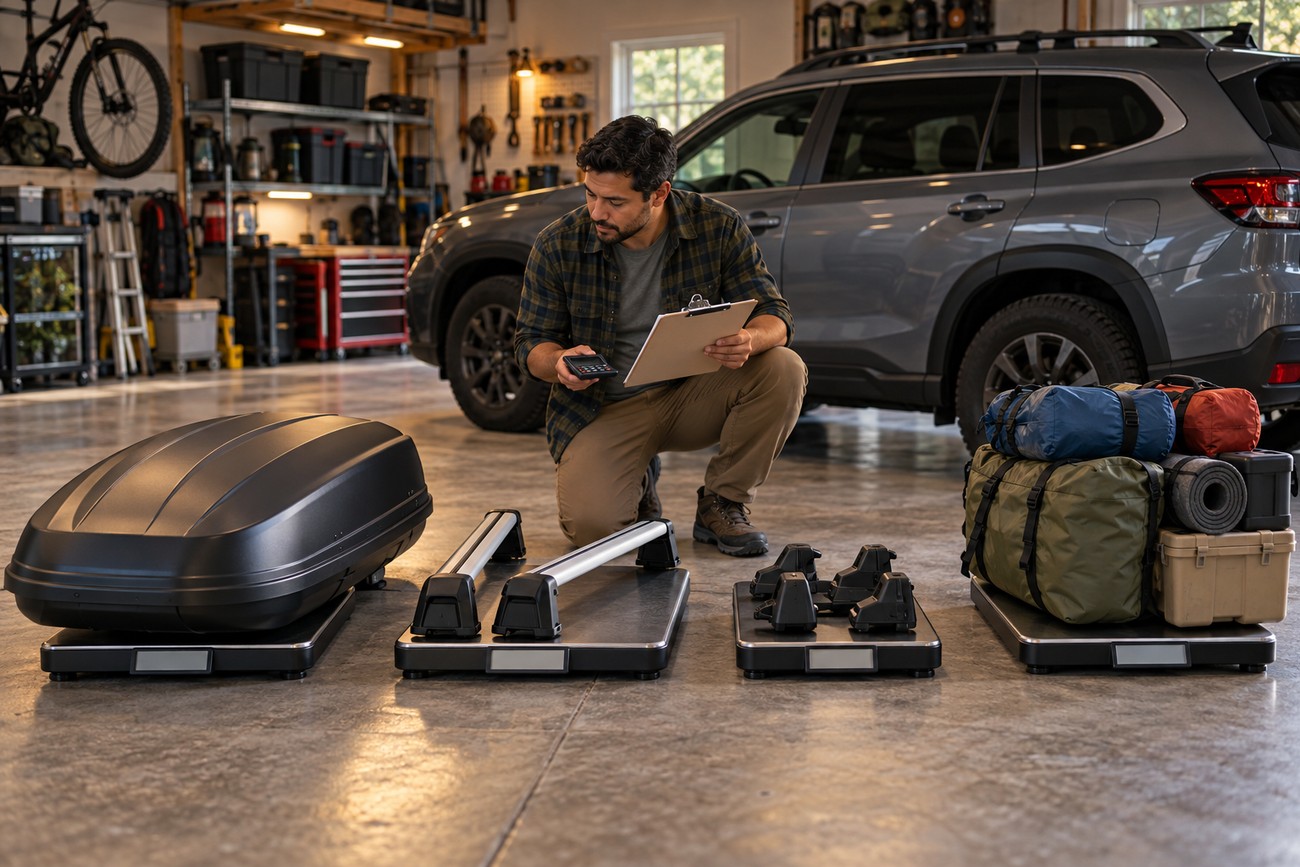
Start with the vehicle manufacturer’s permitted roof load and read what that rating includes. Where the rack, mounts, and box count toward it, subtract their weights to find the allowance left for cargo. A spacious box does not increase that allowance; the vehicle roof may be the tightest constraint.
Next, check the rack-system and box ratings, including the way each maker defines its load. The usable cargo weight must stay within the lowest applicable limit after accounting for components included in that limit. Keep the instructions together while calculating, rather than comparing headline numbers that may describe different things.
Some manufacturers or dealers cite 165 lb for a box plus its contents. That figure is not a universal limit for a vehicle roof, rack, or box: another combination may permit more or less. It cannot override a lower vehicle or rack rating, even if the box itself is approved for that weight.
Weighing gear before a long trip is more dependable than judging a full box by how easily its lid closes. Divide the available allowance among the actual bags and equipment you plan to carry, then keep within the box’s own loading guidance. Volume tells you whether belongings might fit; it does not tell you what they may weigh.
Choose box dimensions around cargo and clearance
Measure the items that drive the purchase before comparing advertised volume. Skis and other long equipment need sufficient usable interior length, while bulky bags need adequate height and an opening that lets you place them inside. Exterior dimensions and a large volume figure cannot confirm either fit on their own.
Width matters if another carrier will share the crossbars or you need to reach the box from one side of the vehicle. Check the box maker’s internal measurements and loading guidance, allowing for the way its lid, hinges, and mounting hardware affect usable space. A narrower, longer box may serve long gear better than a larger box with the wrong proportions.
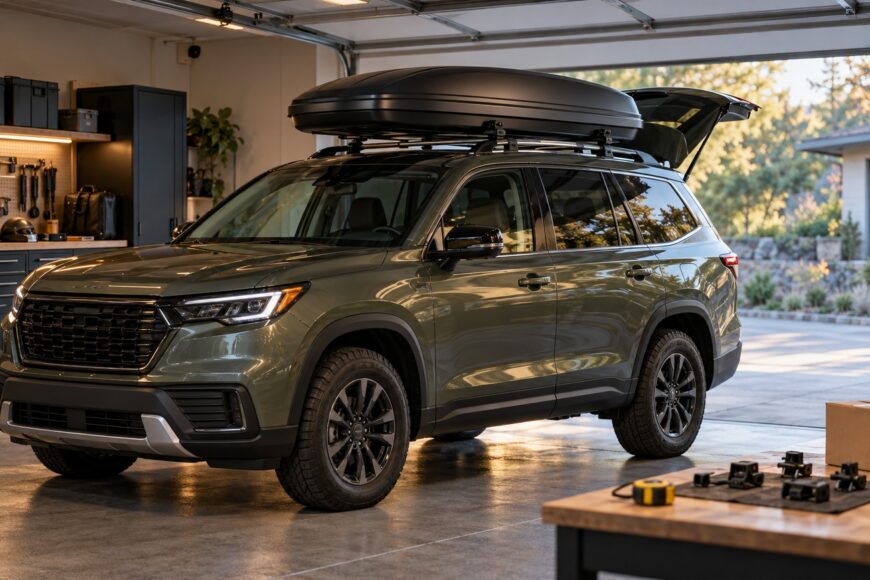
With the proposed rack and box positions in mind, check the rear hatch through its full opening arc. Confirm sunroof clearance where relevant, including the sunroof’s movement rather than only its closed position. A box that fits the roof footprint can still obstruct either opening.
Finally, establish the vehicle’s total height with the rack and box installed and compare it with garage and parking entrances you use. Do this before buying, especially if the box is likely to stay mounted between trips. Clearance on the roof and clearance above the car are separate measurements.
Mount and secure everything without the usual mistakes
Confirm that the box hardware accepts the installed crossbars and that the bars can be set at a spacing approved for the box and vehicle. Position the box within those requirements, then test the hatch and any relevant sunroof before final tightening. Do not move a fixed-point rack away from its designated positions to gain clearance.
Follow the mount maker’s sequence and use its specified torque or engagement indicator. A clamp can appear seated while still being insufficiently tightened, and forcing it beyond the instructions can damage parts. Close the box as directed and check that the lid latches properly before driving.
Secure the contents according to the box instructions so they cannot shift during braking or cornering. For rack-mounted bags and some basket loads, use manufacturer-approved anchors and restrain movement forward, backward, and sideways. Bag handles alone are not a substitute for straps attached to the rack as instructed.
Recheck attachments at the intervals and in the circumstances specified by the vehicle, rack, and carrier makers, including after installation if directed. Some sellers suggest weekly checks for a rack left on the car, but that is not a universal rule. Product instructions are the useful reference for your particular hardware.
Account for noise, fuel use, and ownership hassles
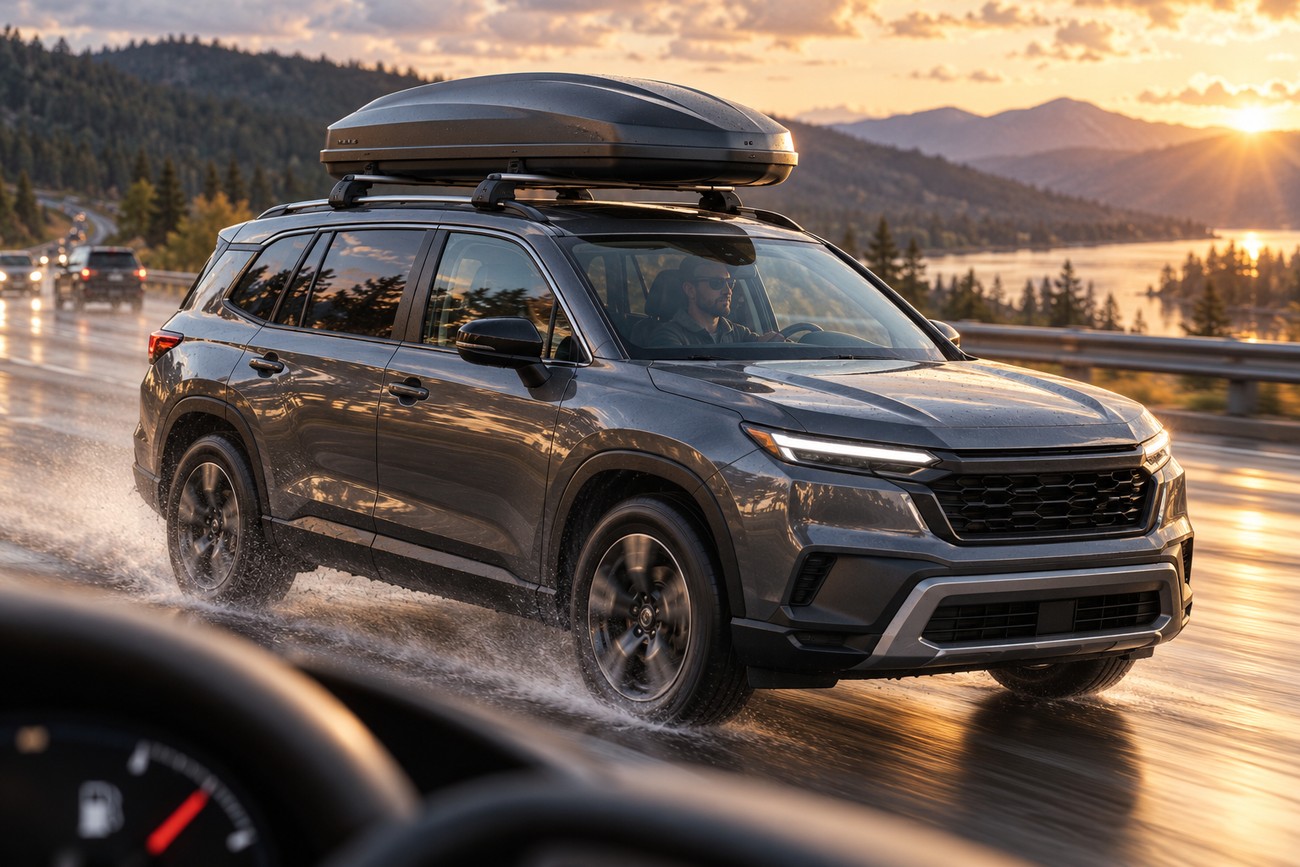
A rack can add wind noise, and a box adds another shape to the airflow above the car. Wing-shaped bars generally reduce noise and drag compared with round or square bars, yet they cannot remove the effects of the box. If a new installation produces an unexpected howl, check that every part is mounted as instructed.
A roof box can also increase fuel consumption. The change depends on the vehicle, speed, equipment, and journey, so a single MPG penalty would be misleading. For someone who drives long distances with the box installed, that ongoing trade-off deserves as much attention as its storage volume.
Living with a rigid box includes getting it onto the roof, taking it off, and finding a place that supports it safely when it is unused. A large shell can be awkward even when its empty weight is within the roof rating. Check its dimensions against your storage space before assuming removal will be simple.
If extra capacity is needed regularly, a compatible box may justify those compromises. For occasional trips, consider how readily you can remove and store the whole setup, and whether a basket or an approved rack-mounted bag suits the cargo better. Choose around the loads you actually carry, rather than leaving unused equipment on the roof by default.
Frequently asked questions
These answers cover the costs and care that are easiest to assess once you know what fits your car. Vehicle and product instructions still govern installation, use, and maintenance.
How much MPG do you lose with a roof box?
There is no reliable universal MPG-loss figure for a roof box. To estimate your own change, compare fuel use on similar routes at similar speeds, first without the box and then with it installed. Similar traffic, weather, and vehicle loading make the comparison more useful; a single journey may be misleading.
How should I store a cargo box when it is off the car?
Clean and dry the box, keep its mounting hardware together, and support the shell as its maker directs. Check the storage instructions before hanging or stacking it, since poor support can distort a large shell. Leave it somewhere you can retrieve it without dragging the lid or clamps across the floor.
What are the downsides of having a roof rack on a car?
A rack adds equipment to inspect, may create wind noise, and increases the vehicle’s height even with no carrier fitted. Depending on the car and rack, it can also complicate roof cleaning or access to a garage. If you rarely use it, check whether the maker permits straightforward removal and how its feet should be stored between trips.