A retread usually costs less than a new tire, yet the prospect of its tread peeling away on the highway can make the saving hard to trust. The answer depends on the condition of the used casing, the quality of the retreading work, and how the tire is operated.
That makes the individual tire more important than the label “retread.” Its markings, intended use, and inspection history offer a sounder basis for a decision than either a low price or a blanket warning.
Are retreaded tires as safe as new tires?
A well-made retread on a suitable casing, maintained within its limits, is not inherently unsafe. Government sources and the retreading industry regard such tires as comparable to new ones under those conditions. That conclusion does not extend to every used casing or every retreader.
Road debris is often blamed on retreads. NHTSA’s debris research does not support the claim that retreads, simply because they are retreads, fail more often than new tires. A study of debris, however, is not a direct measurement of comparative crash rates.
Maintenance matters on either kind of tire: underinflation and excessive loads can produce heat and lead to failure. Some fleets report greater risk where casing selection, production, or upkeep is poor. Those concerns point to variation in quality rather than a reason to treat every retread alike.
What can go wrong with a retread?
The serious failure drivers fear is tread separation. Damage or a history of overheating in the casing can undermine the foundation for a new tread; inadequate inspection or production control can add to the risk. Once fitted, excessive load or incorrect pressure can generate more heat and contribute to breakdown.
Retreading does not raise the casing’s permitted load or pressure. A new tread pattern may look substantial, but it cannot turn the underlying structure into a higher-capacity tire. The applicable speed rating also has to suit the vehicle’s use.
Drivers also report vibration, difficult balancing, uneven wear, and noise. These complaints deserve investigation, although they do not establish that all retreads share a defect. For example, a tire that wears faster than its partner may call for checks of pressure and alignment as well as the tire itself.
A buyer may be unable to establish a used casing’s age or whether it previously suffered impacts or overheating. A sound-looking exterior cannot tell the whole history. This uncertainty makes the retreader’s casing inspection especially important.
How to choose and maintain a safer retread
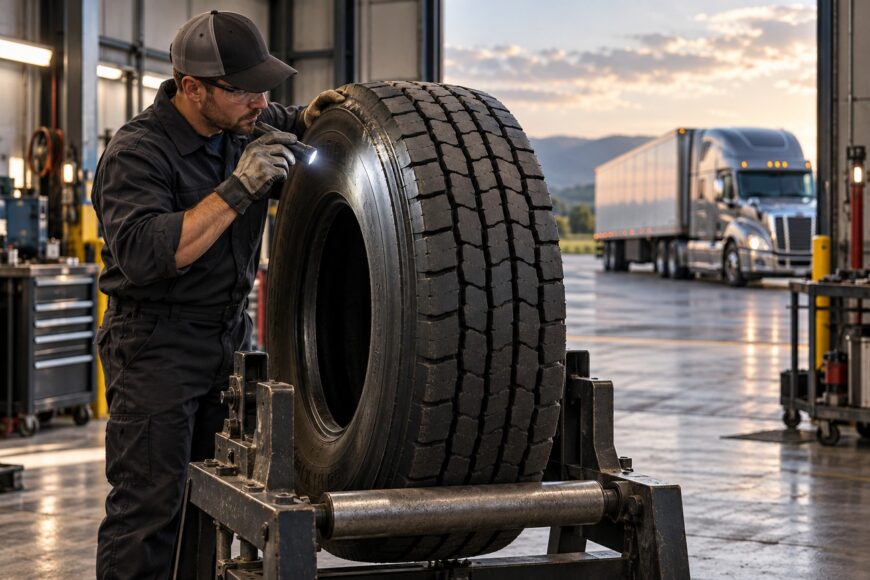
Start with a retreader that can explain how it selects and inspects casings, then check that the tire’s markings and intended application match your vehicle. Ask the seller to clarify any uncertain origin or marking before purchase. A certificate has value, but it does not guarantee identical quality from every casing or production run.
Check the load and speed ratings against the vehicle and its operating conditions, and follow the specified inflation guidance. The retread cannot exceed the original casing’s load or pressure limits. A low purchase price loses its appeal if the tire wears early, needs repeated attention, or affects fuel use through higher rolling resistance.
For a fleet, recording each casing’s origin and inspection result with a consistent retreader makes later wear or failure patterns easier to investigate than comparing suppliers on price and certificates alone.
On the same axle, use tires with compatible sizes and tread patterns, following the vehicle maker’s requirements. After fitting, address vibration promptly and check balancing, inflation, load, and alignment. These routine checks help separate an installation or vehicle problem from a suspect tire before uneven wear becomes severe.
Where retreads make sense—and where rules differ
In the United States, FMVSS 117 applies to retreaded passenger-car tires. There is no comparable federal safety standard for retreaded truck and bus tires. US DOT/TIN markings provide a way to identify a retread when checking recall information; they should not be mistaken for proof of how a particular casing was used before retreading.
Commercial fleets commonly consider retreads for drive and trailer axles. Steering positions call for particular care because a tire failure there can affect control more directly. That distinction does not mean retreads are universally banned on truck steering axles.
Rules vary by jurisdiction, vehicle, axle, and passenger-carrying use, while vehicle makers and fleet policies may impose further limits. Check the requirements that apply to your operation rather than relying on a general claim that retreads are either legal everywhere or prohibited outright.
Even where a retread is permitted, its use must stay within the original casing’s load and pressure limits and the applicable speed rating. For demanding routes, the decision should also account for inspection records, expected wear, and maintenance capacity—not purchase price alone.
Frequently asked questions
Recall checks are a separate step from judging wear or appearance. They help establish whether a specific identified tire is subject to a published action, though they cannot reveal every aspect of its earlier service.
How can I check whether a retread has been recalled?
Find the DOT/TIN marking on the tire and use it to check the relevant tire-recall database, such as NHTSA’s database for US tires. Compare the identifying information carefully rather than relying on the tread pattern or the seller’s description.
If the marking is unclear or you cannot match it to the listing, ask the seller or retreader for the tire’s identification details. Until you can identify it confidently, do not assume that an unsuccessful search means there is no recall.