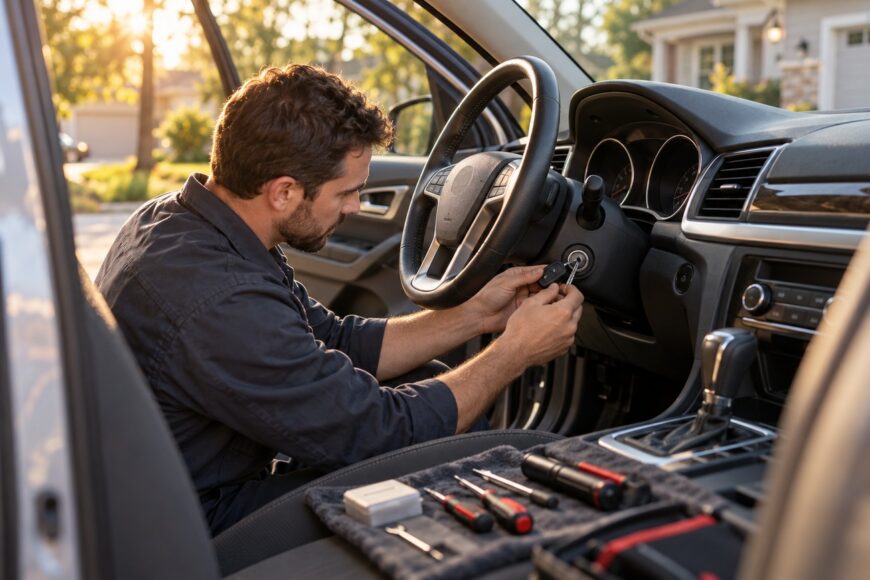
A key that sticks, turns only partway, or rotates without starting the engine can leave you unsure whether the fault is mechanical, electrical, or somewhere else in the starting system. Forcing the key may turn a small problem into a damaged cylinder, broken key, or locked steering column.
The ignition system contains several separate fault locations: the mechanical key cylinder, electrical ignition switch, steering lock, wiring, and sometimes control modules. The sensible repair may be limited cylinder service, an electrical switch replacement, complete assembly replacement, or diagnosis of the battery, starter circuit, connections, or immobilizer instead.
Begin with safe observations and vehicle-specific testing. A repair decision should follow the evidence from the key, lock, switch outputs, and starting circuit rather than the symptom alone.
- First, make the car safe to inspect
- Ignition symptoms: what to check before buying parts
- Pinpoint the fault before taking the switch apart
- Repairing a sticking key or ignition cylinder
- Repairing an electrical ignition-switch fault
- When replacement or professional help is the better fix
- Verify the repair before returning to the road
- Frequently asked questions
- What information should I have ready when calling a locksmith or repair shop?
- What should I do if the ignition fails while I am away from home?
- How can I fix a bad ignition switch without replacing it?
First, make the car safe to inspect
Park the vehicle on a stable surface with the transmission in Park or neutral, the parking brake applied, and enough space around the driver’s door and steering column. If the car is in traffic, a narrow garage, or an unsafe roadside position, arrange recovery before attempting inspection. A vehicle that starts intermittently can move unexpectedly if the starter circuit or control system behaves unpredictably.
Keep the steering wheel in a stable position and avoid applying force to the key or steering-lock mechanism. Light pressure in the direction that releases steering-lock tension may be appropriate during a basic observation, depending on the vehicle, but forcing the key can worsen mechanical damage. Do not use pliers, excessive leverage, or a substitute key.
Work around the steering column only after checking the vehicle-specific service procedure. Many vehicles place airbag components, clocksprings, wiring, and control modules near the ignition assembly. Disconnecting a battery, waiting period, trim removal, and other precautions depend on the vehicle design and service information.
Basic checks include observing key movement, checking whether the steering wheel is locked, and noting which accessories operate. Electrical testing requires the correct wiring diagram, a suitable meter or test light, and appropriate competence. Never probe airbag wiring, and do not remove electrical parts without following the specified safety procedure.
Ignition symptoms: what to check before buying parts
The same complaint can come from the mechanical cylinder, electrical switch, steering lock, or another part of the starting system. Use the symptom to choose the first safe check, then confirm the fault before ordering parts.
| Observed symptom | Plausible fault location | First safe check | When professional diagnosis is needed |
|---|---|---|---|
| Key will not turn | Worn or damaged key, mechanical cylinder, or steering lock | Try an undamaged spare key if available and gently relieve steering-wheel pressure without forcing the key | The key remains jammed, the steering lock is damaged, or the cylinder cannot be accessed safely |
| Key sticks, moves in steps, or cannot be removed | Key wear, cylinder wear, steering-lock tension, or an interlock mechanism | Compare the key with a spare and observe whether the problem changes with steering-wheel position | The key must be forced, the lock catches repeatedly, or removal may damage the key or cylinder |
| Accessories do not receive power | Electrical ignition switch, fuse, wiring, connector, battery, or control module | Check the battery condition and vehicle-specific accessory feed procedure | Power is missing at specified switch outputs or the fault is intermittent |
| Engine does not crank | Battery, connections, starter circuit, immobilizer, electrical ignition switch, or control module | Check battery voltage and connections, then follow the starting-circuit test procedure | The battery and connections are sound, or security and starter signals need circuit testing |
A weak battery or immobilizer fault may explain an electronic starting complaint, including a no-crank condition. It does not ordinarily explain a physically jammed mechanical key. A key that cannot turn calls for checks of the key, cylinder, and steering lock before assuming an electrical problem.
Pinpoint the fault before taking the switch apart
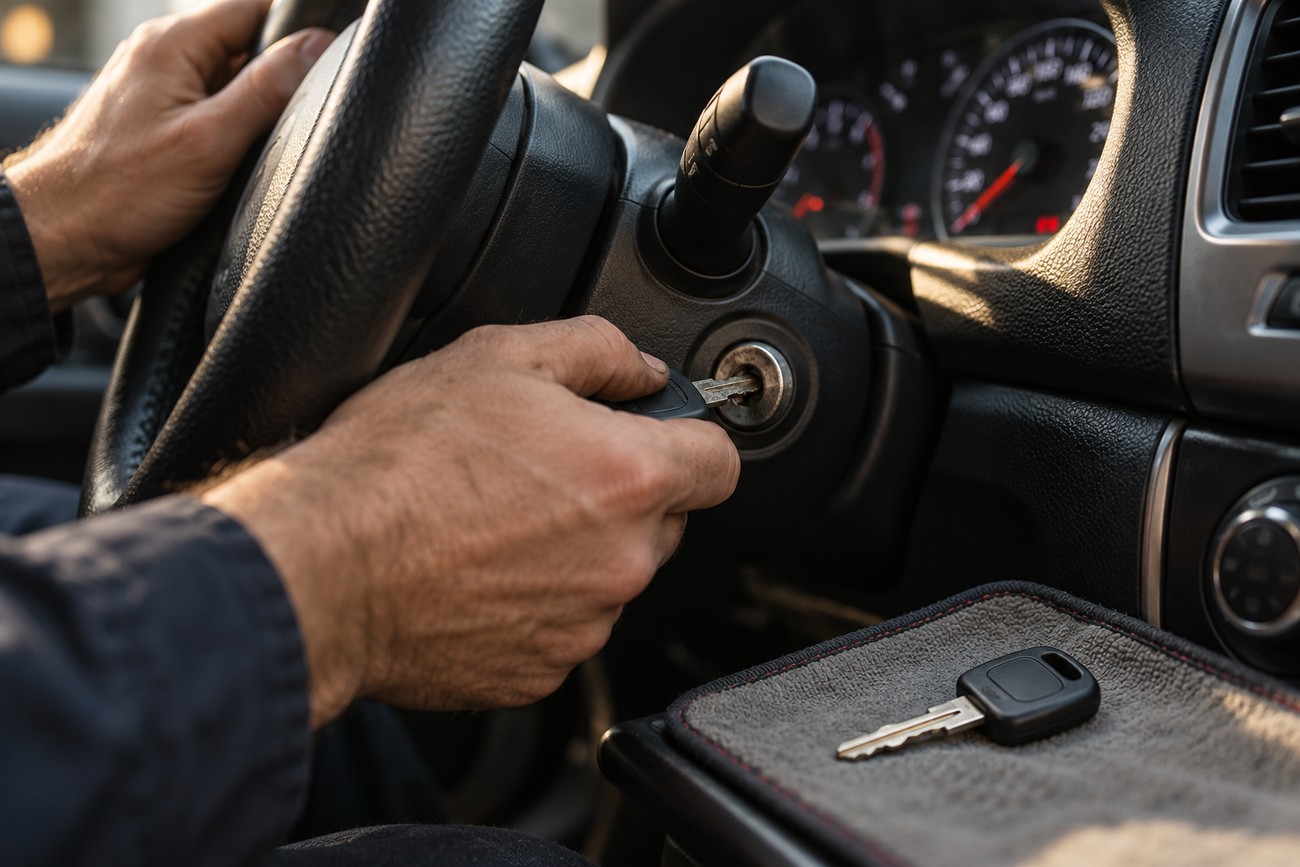
Start by recording exactly what happens. Does the key insert fully, rotate smoothly, stop at one position, or move past a detent? Common labels are LOCK, ACC, ON, and START, but positions and operation vary by vehicle. Note whether the instrument panel, accessories, warning lamps, and starter respond at each available position.
If an undamaged spare key is available, compare its operation with the usual key. A worn key may behave differently from a spare and can help distinguish key wear from a cylinder fault, although the result is not conclusive. Also check whether steering-wheel tension changes the symptom; a loaded steering lock can prevent normal key rotation.
A switch that works only while the key is held between detents deserves a check of switch actuation and alignment before a cylinder is ordered. The key may be turning the mechanical portion correctly while the electrical switch fails to reach or hold its intended position.
The electrical switch must be tested through the vehicle wiring diagram and specified test method. Continuity checks require an unpowered circuit, while powered test-light checks require the appropriate vehicle-specific procedure. The test should establish whether the required signals appear in the expected key positions, without relying on universal wire colors or pinouts.
If the key cannot turn, or trim and access prevent reliable testing, removal and disassembly may be necessary. That work can expose separate problems in the cylinder, steering lock, electrical switch, housing, or wiring. A no-crank symptom still does not establish a bad ignition switch; battery, connections, starter circuit, and immobilizer faults remain possible.
Repairing a sticking key or ignition cylinder
Inspect the key for a bent blade, damaged edges, or obvious wear, and compare it with a spare when possible. Mechanical wear can produce sticking, incomplete rotation, or unreliable detents even when the key still looks usable. The key, cylinder, and steering lock are separate components and require different checks.
Steering-lock tension may prevent the cylinder from turning normally. Follow the vehicle’s operating instructions and use only gentle movement of the steering wheel while applying light key pressure. Stop if the key begins to bend or the lock catches; continued force can make extraction and subsequent repair harder.
Use only a cleaning method or lubricant approved for that lock and vehicle. An unsuitable aerosol or heavy lubricant can attract dirt and leave residue inside the cylinder. Cleaning may help a minor contamination problem, but it cannot restore severely worn, bent, or broken internal parts.
A locksmith or qualified technician may be able to service a cylinder when the housing and internal parts remain usable. Severe wear, deformation, or damage to the steering-lock mechanism may require cylinder replacement or complete assembly replacement. The correct choice depends on the design and the condition found after inspection.
Repairing an electrical ignition-switch fault
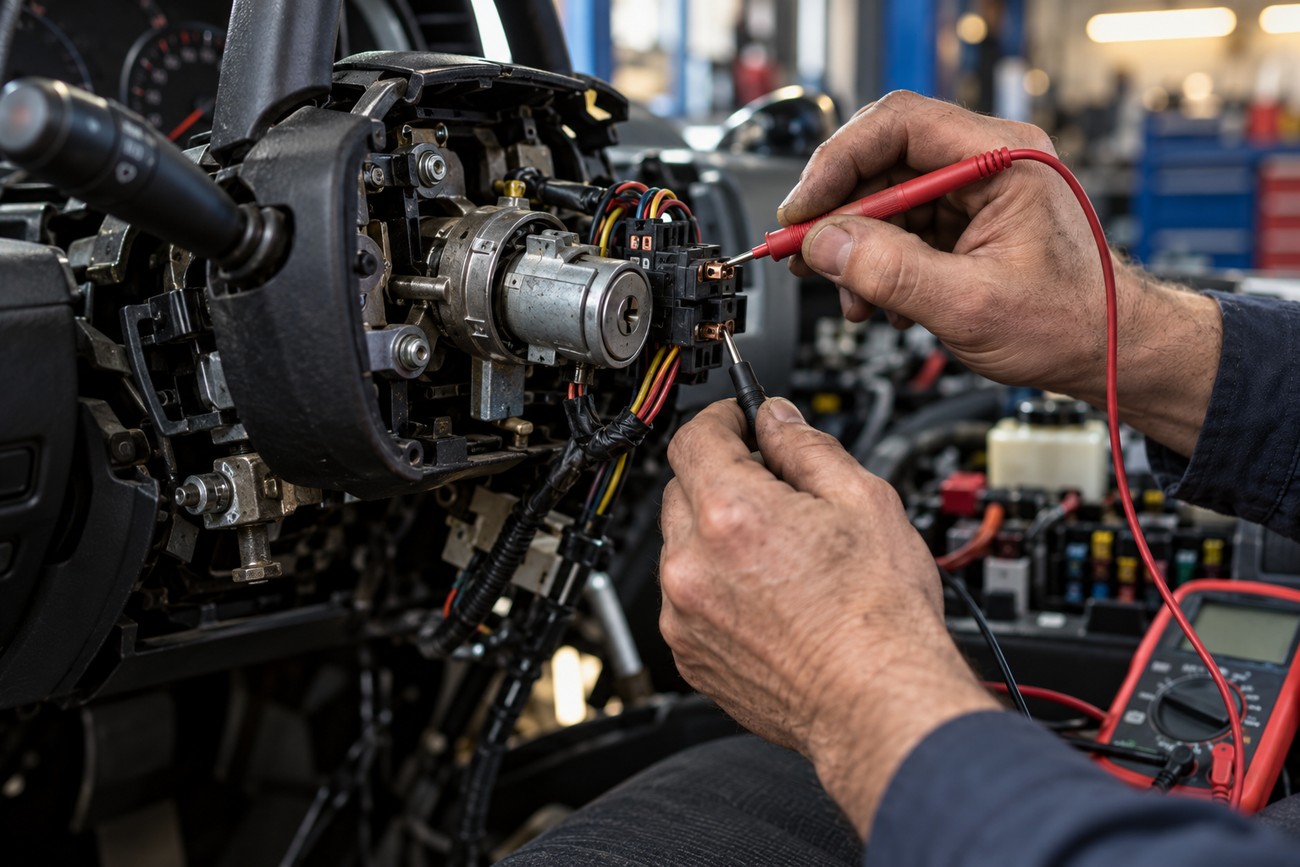
A key can rotate normally while the electrical ignition switch fails to provide the expected accessory, ignition, or start signal. The mechanical cylinder transfers the key movement; the electrical switch or contact assembly interprets that movement in the circuit. These are distinct parts, even when they are mounted together.
Diagnosis should first separate a failed switch from a loose connector, damaged wire, blown fuse, poor ground, or missing battery supply. The wiring diagram identifies the relevant inputs and outputs. Testing must follow the vehicle’s powered or unpowered procedure so that the meter or test light gives meaningful results without damaging a circuit.
A repairable connector or wiring fault may be corrected without replacing the switch. A failed electrical switch or contact assembly is often replaced as a unit rather than rebuilt in place. Access can require removal of trim or the complete lock assembly, particularly where the switch is integrated with other components.
Modern ignition systems may use the ignition input to signal control modules instead of directly switching major loads. The starter, fuel, and accessory functions may then depend on relays, modules, security authorization, and network signals. For that reason, a no-crank condition still requires diagnosis of the battery, connections, starter circuit, and immobilizer before condemning the ignition switch.
When replacement or professional help is the better fix
Replacement becomes more sensible when the key or cylinder has severe wear, the housing is damaged, the steering lock is compromised, or the key cannot be turned safely. A failed electrical switch, burned contact assembly, or damaged connector may also require replacement rather than cleaning. Repeated intermittent operation is a warning that a temporary adjustment may leave the vehicle unreliable.
A cylinder-only replacement addresses the mechanical key interface. An electrical-switch-only replacement addresses the contact or signal portion when the cylinder and housing remain sound. Complete assembly replacement may be necessary when the housing, steering lock, cylinder, and electrical section cannot be separated or have suffered combined damage.
Key or immobilizer programming may be required after replacement, depending on the vehicle and part. Some replacement assemblies also require matching to the existing security system. Do not assume that a mechanically correct installation will automatically permit the engine to start.
Before approving work, confirm whether the quote includes diagnosis, parts, trim removal, lock removal, programming, and any recovery or mobile-service charge. A promised on-site repair may be unsuitable when the lock is jammed, the wiring is damaged, or the assembly needs full disassembly. Ask which component has been identified as faulty and what result will confirm the repair.
Verify the repair before returning to the road

After reassembly, check that the key inserts and turns smoothly through the positions provided by that vehicle. Confirm correct steering-lock operation, accessory power, ignition functions, warning lamps, and engine starting. The key should also return correctly and come out only in the permitted position.
Repeat the checks several times, including after moving the steering wheel normally. An intermittent fault may appear only after repeated operation or when the key is held in a particular position. If a spare key was part of the diagnosis, test both keys and record any difference.
Make sure all disturbed trim, connectors, grounds, and safety-system components have been restored according to the vehicle-specific service procedure. Steering-column and airbag precautions depend on that procedure, so an apparently successful start does not prove that every reassembly step is complete.
If the original symptom remains, return to diagnosis of the starting circuit or security system instead of repeatedly replacing ignition parts. A no-crank condition can still originate in the battery, connections, starter circuit, immobilizer, or control modules. The repair is complete only when the vehicle operates reliably and the identified fault has been verified.
Frequently asked questions
Ignition problems can involve the key, cylinder, steering lock, electrical switch, starting circuit, or security system. The exact symptom helps determine which checks should come first. The following answers cover information to provide a repair professional, roadside steps, and limits of non-replacement repairs.
What information should I have ready when calling a locksmith or repair shop?
Provide the vehicle identification details, the type of key, and the exact behavior of the lock. State whether the key inserts, turns, sticks, stops at a particular position, fails to start the car, or cannot be removed. Mention whether a spare key works differently and whether the vehicle can be moved under its own power.
Also explain whether the steering wheel is locked, whether accessories operate, and whether any recent key, battery, security, or wiring work was performed. This helps the shop bring the correct equipment and determine whether the job is likely to involve a cylinder, electrical switch, complete assembly, or recovery service.
What should I do if the ignition fails while I am away from home?
Stop in a safe location, apply the parking brake, and avoid forcing the key or dismantling the lock at the roadside. If the vehicle cannot be operated reliably, arrange roadside assistance or recovery rather than repeatedly cycling the key or driving with an intermittent starting fault.
Tell the assistance provider whether the key is physically jammed or whether it turns normally without cranking. That distinction helps determine whether the vehicle needs a locksmith, an automotive technician, electrical diagnosis, or transport to a repair facility.
How can I fix a bad ignition switch without replacing it?
Only limited faults can be corrected without replacing the switch. A technician may repair a loose connector, damaged wire, or related supply problem after testing confirms that the switch itself still produces the required outputs. Cleaning or adjustment may help a minor contamination or alignment issue, depending on the vehicle.
Burned contacts, internal wear, or unreliable switching usually require the electrical switch or contact assembly to be replaced as a unit. Do not bypass the switch or bridge wires as a permanent repair; that can defeat safety and security functions and create a wiring hazard.