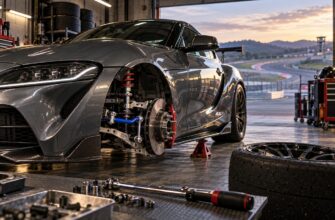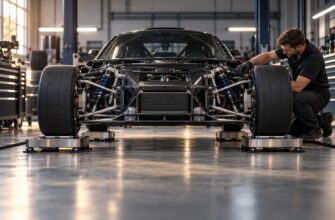
A large rear wing often looks more functional than a small spoiler. On a road car, however, the smaller device may deliver the more useful compromise: modest aerodynamic control, less drag, preserved rear visibility, and fewer structural problems. Appearance is a poor guide to the amount of useful load a part creates.
The real choice involves downforce, drag, axle balance, mounting strength, noise, legality, and daily usability. A wing can generate substantially more rear load, yet it also places greater demands on the trunk structure, tires, hubs, and front-end aerodynamics. A spoiler may have a smaller effect while still improving the way air leaves the body and preserving the car’s normal behavior.
The sensible standard is measurable performance. Controlled comparisons, vehicle balance, tire temperatures, telemetry, lap time, and direct aerodynamic measurements provide useful evidence. A dramatic shape, a forum anecdote, or a single highway impression does not establish that a part works on your vehicle.
- Rear Spoiler vs. Wing: The Difference That Matters
- Rear Spoiler or Wing: What the Aerodynamics Actually Do
- The Real-World Comparison: Spoilers, Wings, and Active Devices
- Which Setup Works for Your Car and Your Driving?
- Installation Is Part of the Aerodynamic Design
- More Downforce Can Make the Car Worse
- How to Test Whether a Spoiler or Wing Actually Works
- The Biggest Myths About Rear Spoilers and Wings
- Frequently asked questions
- At what speed is a rear spoiler effective?
- Does rain or a strong crosswind change how a rear wing behaves?
- Why do Reddit owners disagree so much about spoilers and wings?
Rear Spoiler vs. Wing: The Difference That Matters
A rear spoiler is a body-mounted device that changes or extends the vehicle’s existing rear shape. It manages airflow as the stream approaches the trailing edge, often by changing flow separation and the pressure distribution around the rear of the car. A lip spoiler on a trunk lid and a molded extension on a hatchback belong to this category, even though their shapes and effects can differ substantially.
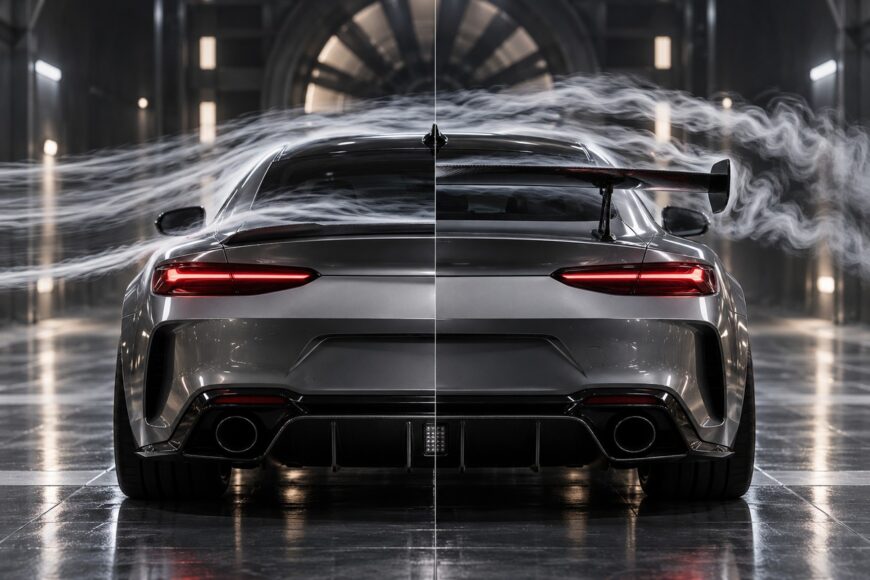
A wing is a separate airfoil mounted above or behind the body. Its geometry can generate substantially more downforce because it operates as an independent aerodynamic surface, with its own angle of attack and exposure to the airflow. That extra capability normally brings more drag, greater mounting loads, and greater sensitivity to height, position, and surrounding flow.
Size alone does not determine effectiveness. A broad wing placed low in the turbulent wake behind a rear window can perform less effectively than a smaller wing positioned in cleaner air. A lip spoiler matched to a particular trunk or hatch may manage separation efficiently, while a universal add-on with a similar visual shape can increase drag without producing useful rear load.
Road cars usually need a broad range of qualities: quiet operation, clear rear visibility, reliable trunk access, predictable handling, and modest fuel consumption. Track cars can accept more drag, noise, and structural work when the additional cornering load is useful at the speeds and on the tires being used. Neither design is universally superior; the correct choice follows from the vehicle, the speed range, and the purpose.
Rear Spoiler or Wing: What the Aerodynamics Actually Do

Airflow creates aerodynamic force through pressure differences and changes in momentum. A vehicle body can experience lift, which reduces the normal load on its tires, or downforce, which increases the load on them. A spoiler often manages the point and character of flow separation at the rear. A wing uses an airfoil section to create a larger pressure difference across its surfaces, with the resulting force directed toward the vehicle.
Aerodynamic force changes approximately with the square of speed. Under otherwise comparable conditions, doubling speed produces roughly four times the aerodynamic force. This relationship explains why a part can feel inactive during urban driving and become significant on a fast road or circuit. It also explains why subjective testing at ordinary road speed is a weak way to judge a wing intended for track use.
Angle of attack is one of the main setup variables. Increasing it generally increases downforce and drag, since the airfoil produces a stronger pressure difference and deflects the airflow more aggressively. The relationship does not continue indefinitely: as the angle becomes excessive, the flow can separate from the surface, causing stall and reducing aerodynamic efficiency.
Drag is the price of disturbing the airflow. Some drag comes from the pressure difference associated with producing downforce, while some comes from the physical size, supports, gaps, and exposed edges of the device. A high wing angle may provide a useful increase in rear load for a corner, then cost enough speed on the following straight to reduce the overall result.
Downforce is also a mechanical load, rather than free grip. The tires carry more vertical force, while wheel hubs, bearings, wing mounts, trunk structures, and fasteners see higher loads. The benefit depends on whether the tire can use that additional load efficiently and whether the chassis remains balanced. A wing mounted in turbulent wake flow or too close to the deck can carry the disadvantages of a large device without delivering the expected aerodynamic effect.
The Real-World Comparison: Spoilers, Wings, and Active Devices
The table compares common designs in practical terms. Exact behavior remains vehicle-specific because the rear body shape, diffuser, ride height, and airflow change the result.
| Device | Aerodynamic effect | Drag and airflow | Installation and structure | Visibility and usability | Best-fit application |
|---|---|---|---|---|---|
| Integrated or lip spoiler | Usually modest control of separation and rear lift; the result depends strongly on the trunk or hatch geometry. | Can reduce drag when designed with the rear body; a universal add-on does not guarantee lower drag. | Often lighter structural demands, although bonding and fasteners still need correct preparation and sealing. | Usually preserves rear visibility, camera operation, and trunk access. | Daily road cars, balanced street setups, and vehicles needing subtle rear-flow management. |
| Fixed pedestal wing | Greater downforce potential, with the final result set by airfoil, height, angle, width, and flow quality. | Normally adds more drag and can create noise or vibration; clean airflow and suitable height improve effectiveness. | Requires load distribution through suitable reinforcement, backing plates, inserts, or other strong mounting methods. | May obstruct the rear view, camera, trunk access, or a factory spoiler’s movement. | Track-focused cars with a coordinated front and rear aerodynamic plan. |
| Active factory-style spoiler | Variable effect, usually deployed when the vehicle’s control system calls for additional stability or aerodynamic load. | Can remain retracted when the extra load is unnecessary; behavior depends on the factory calibration and body geometry. | Designed as part of the vehicle system, with dedicated hinges, actuators, wiring, and load paths. | Usually retains factory integration, though aftermarket parts can interfere with deployment clearance. | Production road cars seeking speed-dependent stability with preserved everyday usability. |
An integrated spoiler may be aerodynamically efficient because its shape is developed together with the deck lid or rear body. That advantage belongs to the matched geometry. Drilling a generic lip onto a different trunk does not reproduce the original flow conditions, and a universal claim about reduced drag should be treated cautiously.
A fixed wing offers more adjustment and more potential load, but the extra capability requires a complete setup. The front axle must retain enough aerodynamic load to support the chosen rear load, and the mounting system must withstand repeated force. An active factory-style spoiler has a different advantage: it can deploy at higher speed when additional stability or aerodynamic load is required, then remain unobtrusive during normal use.
The same component can behave differently on a sedan, hatchback, or fastback. A diffuser can change the pressure and wake beneath the rear bumper, while a sharp hatchback cutoff can make a spoiler more effective at controlling the wake than a similar part on a smooth-tail sedan. Catalogue fitment identifies whether a part can be installed; it does not prove that the resulting airflow is favorable.
Which Setup Works for Your Car and Your Driving?
For a normal road car, a modest lip spoiler is often the most balanced choice. It usually preserves visibility, trunk access, camera function, and the original noise level while limiting the drag penalty. Its effect may be subtle, especially at ordinary road speeds, but the smaller compromise can matter more than a larger theoretical load that is rarely usable.
Occasional track use calls for a more careful decision. A fixed wing can help when the car reaches speeds at which the aerodynamic load is meaningful and when the tires, suspension, alignment, and front aero can use it. A large rear wing added to an otherwise stock front end can shift the balance toward understeer, leaving the driver with more rear stability and less willingness to turn into the corner.
A dedicated track car can justify a larger and higher wing, adjustable supports, a controlled angle of attack, and a matching front splitter or other front-end devices. The target should be a stable aerodynamic balance across braking, corner entry, mid-corner, and acceleration. Maximum rear load at one condition is rarely the best target if the car becomes drag-limited on the next straight or loses front confidence in faster turns.
Body style changes the decision. On a hatchback or a car with an abrupt rear cutoff, a spoiler can manage the wake effectively because it influences where the separated flow leaves the body. A sedan with a smooth trunk may benefit from a different shape and position. On a diffuser-equipped vehicle, the spoiler, diffuser, ride height, and underbody flow should be considered together.
Height can matter more than width. A larger plane in disturbed air may produce less useful load than a smaller plane in relatively clean air at the correct height. This is one reason a wing’s supports, position relative to the roofline, and distance from the rear glass deserve as much attention as its advertised width. The correct question concerns the airflow reaching the wing, not the visual size of the assembly.
Installation Is Part of the Aerodynamic Design
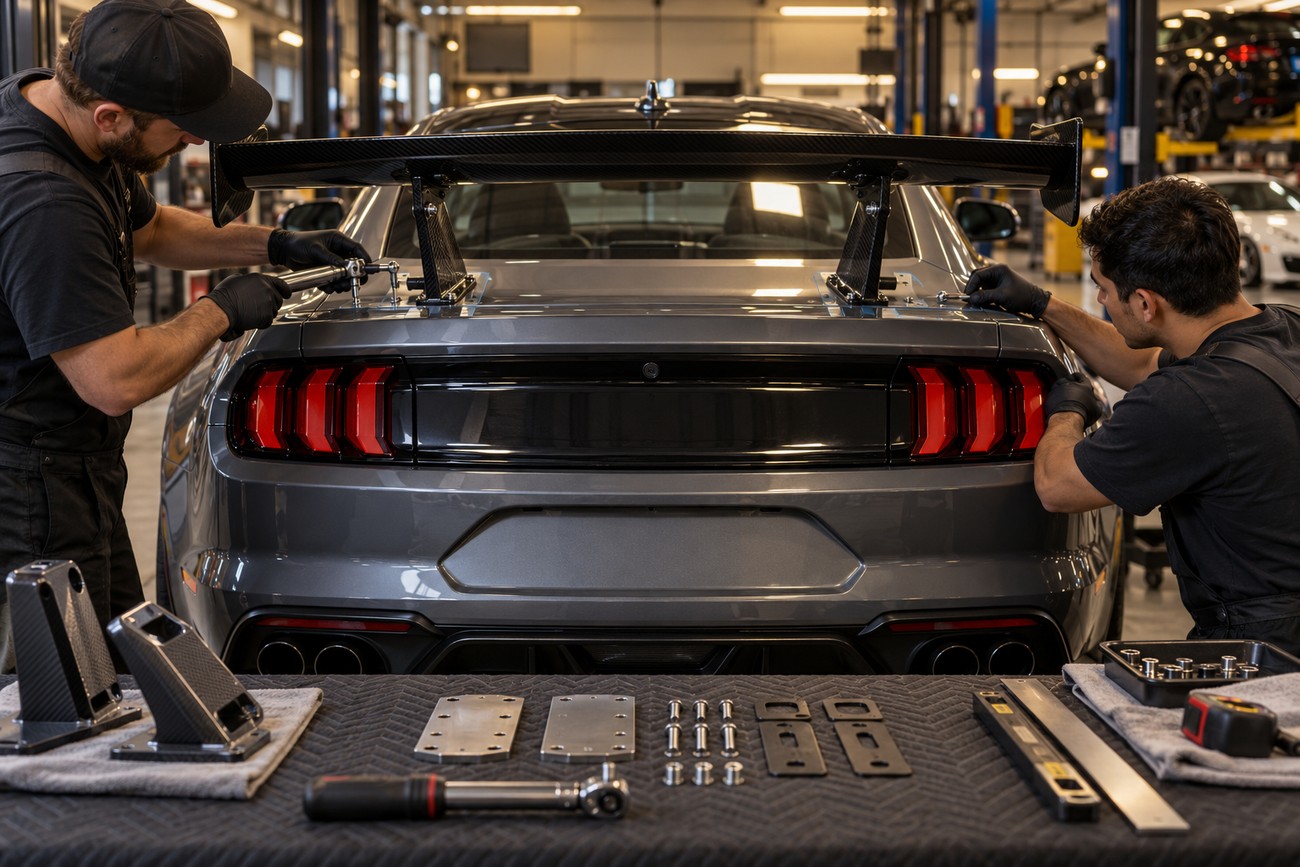
Fitment begins before the purchase. Verify the exact body style, trunk or hatch width, mounting points, allowable load, clearances, camera operation, trunk access, and interaction with any factory spoiler. A part listed for a related model may have different deck curvature, reinforcement, or glass clearance, even when the exterior dimensions appear similar.
Wing loads must reach suitable structural paths. Thin trunk metal alone may flex, crack, deform, or transfer repeated stress into the paint around the fasteners. Backing plates, inserts, reinforcement, or another load-distribution method can spread the force into stronger areas, but the appropriate solution depends on the body structure and the mounting design.
Load paths should be identified before holes are drilled. A sound installation checks the reinforcement, sealing, clearance, and vibration together, because a wing that is structurally moving cannot be judged accurately as an aerodynamic device.
Two-sided tape has a legitimate role for some light trim pieces, yet it is not a substitute for suitable mechanical mounting when aerodynamic loads are significant. Contaminated or cold surfaces reduce adhesion, and freshly painted surfaces may not provide a stable foundation. Preparation, cure time, pressure, and the manufacturer’s limits all matter when bonding is part of the installation.
Gaps around a spoiler or wing support can produce a whistle, hum, or vibration as the airflow passes through them. Poor sealing around drilled holes can allow water into the trunk and create corrosion around the fasteners. After installation, inspect the hardware, paint edges, seals, and clearances at rest, then recheck them after driving; early movement or new noise is a fitment warning, not an aerodynamic success.
More Downforce Can Make the Car Worse
A strong rear wing without corresponding front aerodynamic balance can increase understeer. The rear tires gain vertical load while the front axle receives no equivalent support, so the car may feel stable yet resist turning more strongly. This change can be acceptable for a particular track setup, but it is a poor default for a road car that was calibrated around its original aerodynamic balance.
More downforce normally brings more drag. A tall wing or high angle of attack can reduce maximum speed and increase fuel consumption, especially when the vehicle spends substantial time at higher speed. A small integrated spoiler can sometimes reduce calculated drag when matched to the body, while an unrelated universal part may increase it. The result belongs to the tested geometry and conditions.
Additional load also reaches the tires, wheel hubs, mounts, and body structures. Tire pressure and temperature behavior may change, and a component that appears secure in a stationary garage can experience repeated vibration on the road or circuit. The load is especially important when the wing is attached to a moving trunk lid, where the panel and hinges may not have been designed for the added force.
Drivers often notice the compromises before the grip change. Extra wind noise, humming, vibration, resistance on the straight, reduced rear visibility, or restricted trunk access can be obvious during daily use. At ordinary road speeds, many drivers will not feel a meaningful increase in cornering grip, even though the part may look substantial.
Large wings can obstruct a rear camera, interfere with the operation of a factory active spoiler, or make loading the trunk less convenient. They can also create inspection, insurance, and certification issues because requirements for projecting bodywork vary by country and region. These ownership factors belong in the decision before installation, rather than after a part has been painted and drilled into the car.
How to Test Whether a Spoiler or Wing Actually Works

Begin with installation integrity. Confirm that the part is centered, rigid, sealed, and free from contact with the body, camera, trunk, or factory mechanism. A loose support, damaged paint, or changing angle invalidates later comparisons because the tested configuration is moving or leaking rather than operating as intended.
Then compare the same vehicle before and after installation under closely matched conditions. Keep the tires, pressures, alignment, fuel state, ride height, and mounting configuration consistent as far as practical. Repeated runs are more useful than one fast drive, and a controlled track session can reveal changes in turn-in, mid-corner balance, braking stability, and straight-line speed.
Useful evidence includes vehicle balance, telemetry, tire temperatures, lap time, and direct lift or downforce measurements where available. Tire temperatures can help show whether the new balance is using the front and rear axles evenly, although they require careful interpretation. A faster lap with a lower top speed may be worthwhile if cornering and braking gains exceed the straight-line loss; a slower lap with more noise has no performance justification.
CFD and wind-tunnel figures describe a specific geometry, speed, ride height, and flow condition. They cannot automatically be transferred to another vehicle, especially when the roofline, rear glass, diffuser, wing height, or ride height differs. A Gurney flap deserves the same caution: its small size does not make it a minor change, because it can materially alter downforce and drag and should be evaluated as a new aerodynamic configuration.
Subjective impressions still have a place, provided they are separated from proof. A driver may identify a new understeer tendency or instability, while a passenger may identify vibration or booming noise. Neither observation alone establishes the aerodynamic load. Use impressions to identify what to measure, then use repeatable data to decide whether the part earns its costs.
The Biggest Myths About Rear Spoilers and Wings
The claim that every spoiler adds grip is false. The result depends on shape, angle, speed, and airflow, and some parts primarily change the appearance or separation pattern without producing the expected downforce. A spoiler designed for one rear body can behave differently when installed on another, even if the dimensions appear close.
The claim that bigger is always faster also fails in practice. A larger wing may produce more downforce, yet its increased drag can reduce speed on straights and limit the car’s overall performance. The useful setup is the one that produces the right balance for the circuit, tires, and speed range, rather than the one with the largest visible surface.
The claim that a spoiler automatically saves fuel depends on a narrow result being presented as a universal rule. Some optimized integrated designs may reduce calculated drag when matched to a particular body. A universal spoiler can increase drag and fuel consumption instead, so marketing language should be tied to the tested vehicle, geometry, and conditions.
Rear-only aero does not automatically improve handling. Extra rear load can increase understeer when the front end is unchanged, and the driver may interpret the resulting stability as an overall improvement until corner entry or turn-in exposes the lost front grip. A measured aerodynamic balance is more reliable than the visual impression of a complete-looking rear installation.
Frequently asked questions
At what speed is a rear spoiler effective?
There is no universal speed threshold at which every rear spoiler becomes effective. Aerodynamic force changes approximately with the square of speed, but the useful effect also depends on the device’s geometry, the vehicle’s airflow, its angle, and what is being measured: lift, downforce, drag, stability, or wake behavior.
A road impression can be misleading. A part may become noisier as speed rises without creating useful load, while a well-integrated spoiler may improve rear flow without producing a dramatic sensation. Controlled before-and-after testing at matched speeds and conditions is the reliable way to separate aerodynamic effect from appearance or noise.
Does rain or a strong crosswind change how a rear wing behaves?
Rain and spray can make the airflow less consistent and can obscure what the driver is feeling. Water on the road changes spray patterns around the car, while wet surfaces and contamination can alter the flow over a spoiler or wing. A strong crosswind adds a side component to the airflow, so the effective angle and load can vary as gusts pass.
These conditions make a single road drive especially weak evidence. Use wet-weather impressions to identify stability, visibility, or noise concerns, then compare the part in repeatable conditions when possible. A wing that feels unstable only in gusts may have a sensitivity issue, while a loose mount or vibrating support requires immediate inspection regardless of weather.
Why do Reddit owners disagree so much about spoilers and wings?
Owner reports often describe different vehicles, body styles, speeds, tires, alignment settings, and mounting quality. A spoiler on a hatchback with an abrupt rear cutoff may manage the wake differently from the same-looking part on a sedan. One owner may test at ordinary road speed, while another uses a circuit where the aerodynamic forces are substantially larger.
Separate recurring fitment and durability reports from performance claims. Consistent reports of rattles, cracked paint, poor camera clearance, or water leaks can reveal practical problems. Claims about lap time, fuel consumption, or grip require matched testing, because forum anecdotes rarely control weather, fuel state, tire condition, ride height, and the exact configuration.