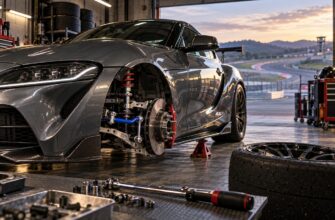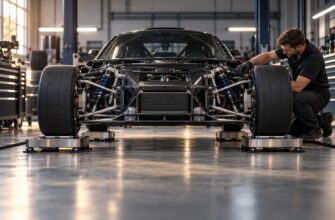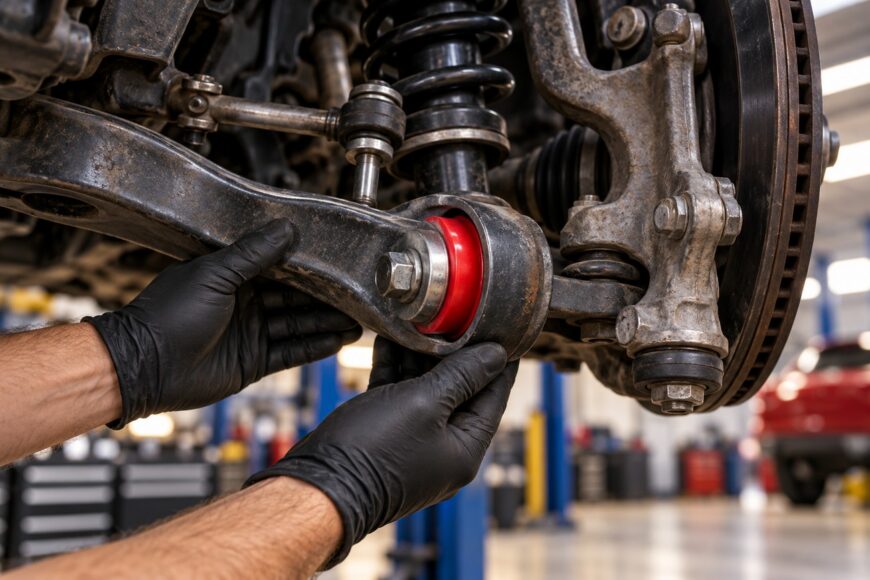
Polyurethane bushings appeal to drivers because they allow less compliance in the suspension joint. That can make steering response feel more immediate, reduce some unwanted movement, and help the car hold its alignment more consistently under load. The change is usually easiest to notice in a worn or softly supported suspension, where the original rubber allows visible deflection.
The same reduction in compliance can transmit more road texture, vibration, and noise into the cabin. A hard bushing can also squeak, resist the movement of a joint that needs to articulate, or make an existing fault in the dampers, springs, ball joints, or steering linkage easier to feel. The sensible choice depends on hardness, installation location, suspension condition, and how the vehicle is used.
- What Polyurethane Bushings Actually Change
- Polyurethane Hardness Ratings: 65A to 95A
- Choose the Bushing by Location and Vehicle Use
- The Hidden Costs: NVH, Binding, and Squeaks
- Installation and Diagnosis: Avoiding Common Failures
- Are Polyurethane Bushings Worth It?
- Frequently Asked Questions
- How tight should polyurethane bushings be?
- What should be checked after installing polyurethane bushings?
- What are the downsides of polyurethane bushings?
- What are the best bushings for heavy loads?
What Polyurethane Bushings Actually Change
A suspension bushing controls how two connected parts move relative to each other. Rubber normally permits a measured amount of compression, twist, and shear, so the joint can move without direct metal-to-metal contact. A stiffer polyurethane bushing reduces elastic deformation in that joint and may reduce suspension-geometry change under load.
That can sharpen steering response and reduce the delay between steering input and chassis reaction. It may also limit unwanted toe or camber movement during braking, cornering, or acceleration. The result is a change in compliance, rather than a guaranteed improvement in grip or precision across every road and suspension design.
Material hardness is only one part of the assembly. The bushing’s shape, clearances, inner sleeve, outer housing, and mounting method determine how much force the completed joint resists. A 70A bushing with a carefully designed split construction can behave differently from a solid bushing with the same Shore A rating.
Location matters just as much. A small change at a steering-rack mount may be felt immediately through the wheel, while a similar change in a less influential link may be subtle. The condition of the remaining suspension also sets the limit: tighter bushings cannot correct weak dampers, incorrect springs, worn joints, or poor alignment.
Polyurethane Hardness Ratings: 65A to 95A
Polyurethane bushing hardness is commonly specified in Shore A. One manufacturer offers 65A, 70A, 80A, and 95A compounds; the figures below describe general positioning rather than a universal cross-brand scale.
| Compound | Relative stiffness and likely response | Typical application | Likely NVH trade-off |
|---|---|---|---|
| 65A | Relatively compliant; retains more isolation and gives a gentler response. | Road-focused cars where comfort remains important. | Lower risk of added noise and harshness, provided the design and fit are suitable. |
| 70A | Moderately firm; may reduce deflection without making the joint excessively rigid. | Daily-driven cars with some interest in sharper response. | Some increase in road feel and vibration is possible. |
| 80A | Firm response with less compliance under cornering and braking loads. | Sporting road cars and demanding mixed-use vehicles. | More pronounced harshness and greater transmission of surface texture. |
| 95A | Very firm; strongly limits elastic movement and can expose articulation problems. | Track-focused or specific competition-related applications. | Highest risk of noise, vibration, harshness, and an unforgiving ride. |
Powerflex states that 70A is approximately 25% stiffer than standard rubber, 80A approximately 30% stiffer, and 95A up to 80% stiffer. Those are one manufacturer’s published comparisons, not universal laboratory values. Percentages cannot be directly compared across brands without matching the test method, temperature, sample, and geometry.
The hardest compound is therefore not automatically the best option. A 95A bushing may hold a race-car linkage firmly while making a road car busy over broken pavement and more prone to binding. The useful question is how much compliance the particular joint needs, rather than which product carries the largest hardness number.
Choose the Bushing by Location and Vehicle Use
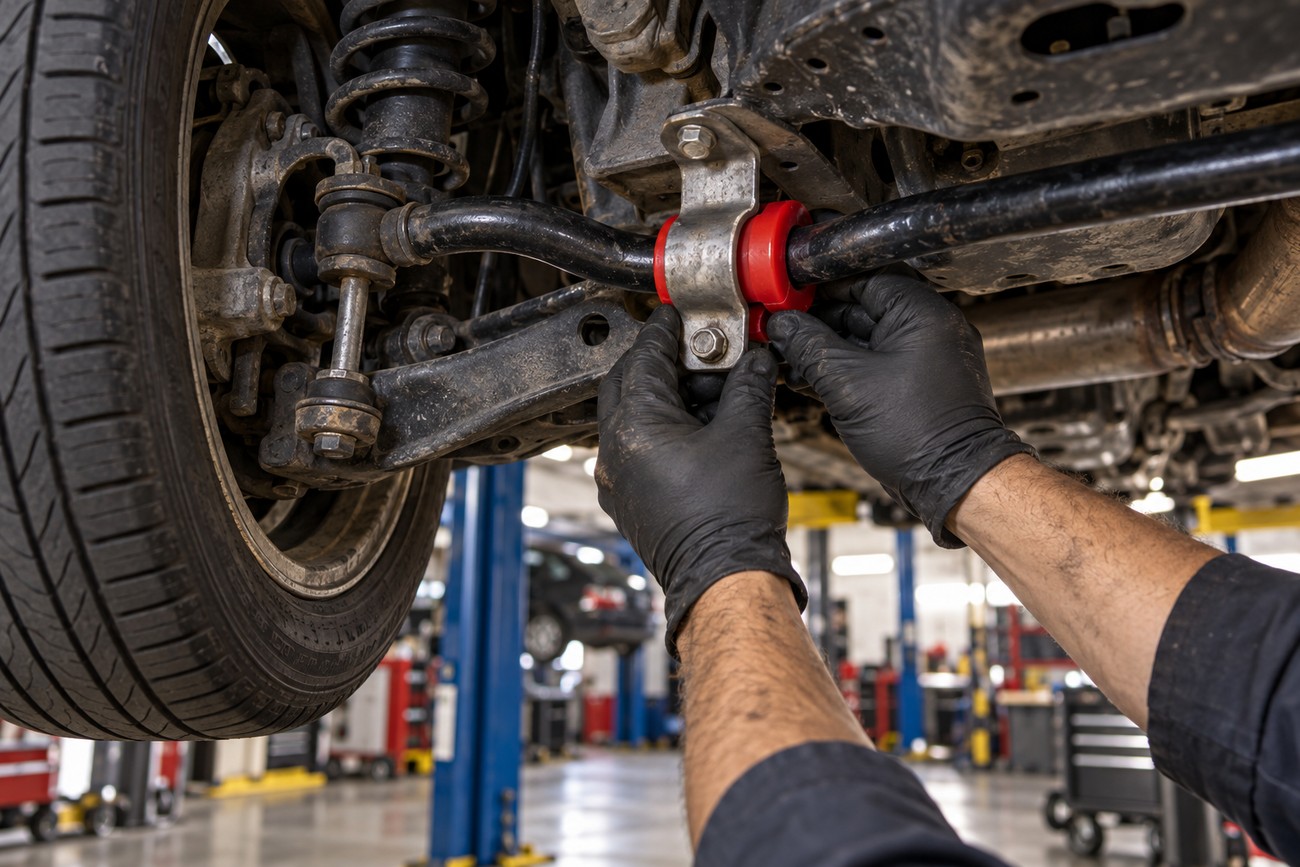
A complete kit at maximum hardness is a poor default for most vehicles. A daily road car spends much of its time dealing with expansion joints, patched asphalt, potholes, and uneven surfaces, so some compliance helps the tires follow the road and keeps the cabin tolerable. Softer compounds generally suit road-focused vehicles, while harder compounds are more appropriate for demanding sporting applications.
A track car has different priorities. Reducing movement in a control-arm, reaction-rod, or anti-roll-bar mounting can make alignment changes easier to manage during hard cornering. That benefit may justify extra NVH when the car is used mainly on smooth circuits, although the correct design still has to permit the joint’s intended motion.
Targeted replacement is often more rational than replacing every bushing at once. Anti-roll-bar mounts, steering-rack mounts, and reaction-rod bushings can have a noticeable effect on response, while leaving other locations with moderate polyurethane or quality OEM-style rubber. This approach also makes it easier to identify which change produced a benefit or an unwanted side effect.
The front and rear axles do not necessarily need the same hardness. Making both ends equally rigid can alter the balance of response and reduce the suspension’s ability to deal with rough surfaces. A comfort-focused daily driver may gain more from fresh standard rubber than from a full polyurethane conversion, particularly when the original parts are worn but the car’s basic ride and handling are already well judged.
The Hidden Costs: NVH, Binding, and Squeaks
Reduced compliance commonly comes with increased noise, vibration, and harshness. Fine road texture that the original rubber filtered out can reach the body, and a particular bushing can transmit a low-frequency resonance at certain engine or road speeds. Drivers sometimes describe the result as a car that feels busy on broken asphalt or develops a new hum after the suspension work.
Stiffer bushings can also expose weaknesses elsewhere. Worn dampers may become more obvious because the suspension no longer masks their poor control, while tired ball joints, tie-rod ends, or unsuitable springs can produce sharper knocks and less settled movement. More stable loaded geometry may come at the cost of poorer wheel contact on rough roads if the suspension becomes too resistant to following the surface.
Binding is a separate concern from ordinary stiffness. Polyurethane can create parasitic resistance in a joint that needs relative rotation between its inner and outer parts. Bushings used in such locations are more vulnerable to squeaking and binding, especially when the sleeve, mounting angle, or bushing shape does not match the joint’s working motion.
Squeak diagnosis should include movement, not sound alone. A brief noise after installation may come from friction, while a squeak combined with restricted travel, uneven return, or a changing ride height points toward a fit or articulation problem.
Dry assembly, contamination, lubricant loss, poor fit, and unsuitable kinematics can all cause squeaks. Compatible lubricant can reduce friction, but it cannot correct an incorrect clearance, a contaminated working surface, or a design that forces the bushing to twist in the wrong way. Repeatedly adding grease without checking the joint often turns a mechanical problem into recurring maintenance.
Installation and Diagnosis: Avoiding Common Failures
Begin with diagnosis rather than material selection. Check dampers, springs, ball joints, steering ends, existing play, and wheel-alignment condition before deciding that the bushings are the main limitation. Replacing them first can make an old fault feel more obvious and can lead to an expensive parts cycle without solving the original complaint.
Confirm the bushing orientation, sleeve dimensions, and seating surfaces before assembly. Working surfaces should be clean, and the supplied or specified lubricant should be compatible with the polyurethane and applied to the areas that actually move. Excess lubricant outside the working surfaces can attract dirt, while too little lubricant can encourage squeaks and accelerate service problems.
Cycle the suspension through its working range after fitting. A bushing can be lubricated and firmly installed yet still bind because its sleeve, shape, or mounting angle does not match the joint’s motion.
Check that a joint designed to rotate moves freely through its intended range, with no tight spot or sudden change in resistance. Inspect for contact between the bushing and nearby hardware, and confirm that the inner sleeve is supported correctly. Final fastener procedure must follow the vehicle and bushing manufacturer’s instructions; there is no universal tightening value for every polyurethane design.
Assess the finished installation through more than steering sharpness. Look for altered alignment angles, uneven suspension return, new squeaks, unusual resonance, and fastener security after the initial drive and inspection. If the car pulls, settles unevenly, or feels reluctant to return from a suspension movement, stop treating the change as a handling upgrade and investigate the installation or underlying geometry.
Are Polyurethane Bushings Worth It?
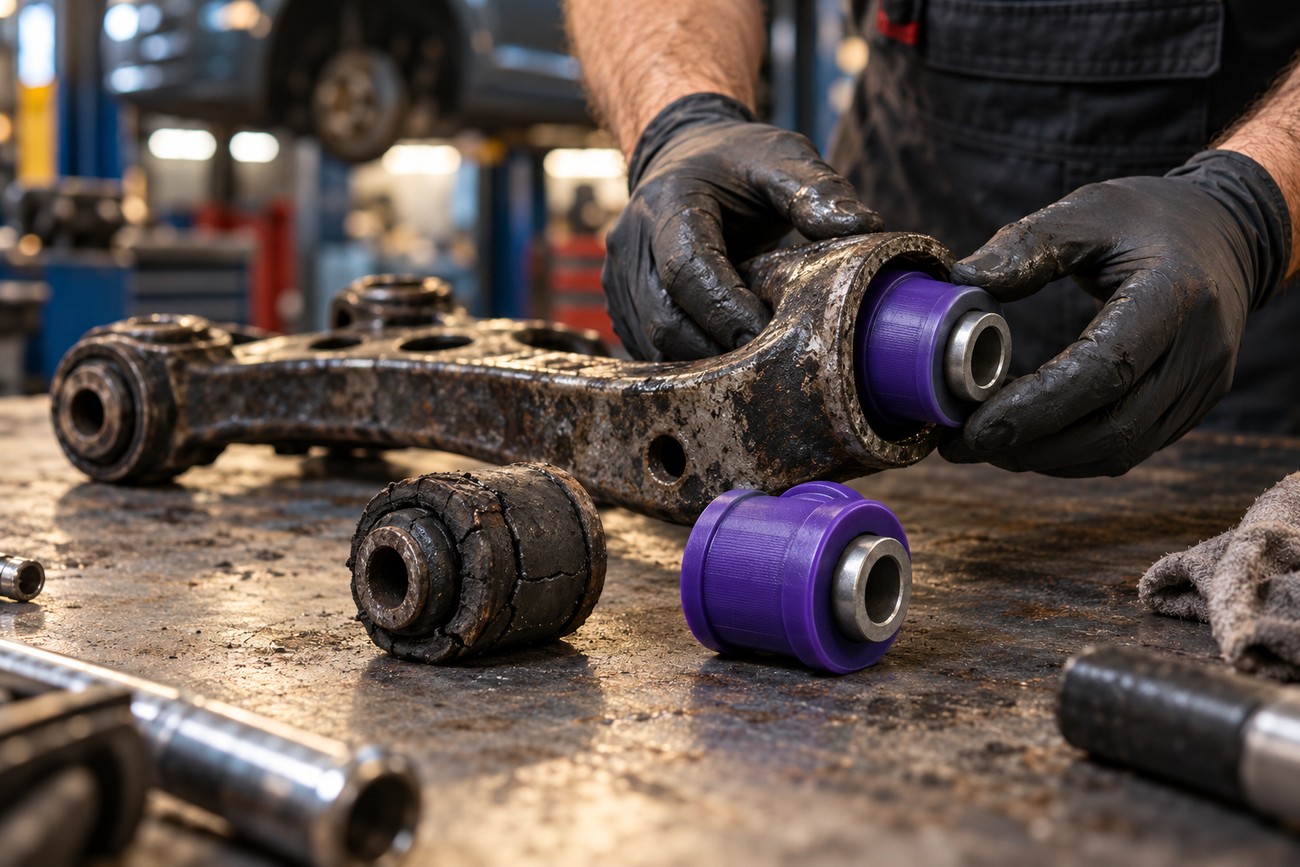
Polyurethane bushings can be worthwhile when a specific joint is allowing excessive movement and the vehicle’s use justifies a firmer response. A moderate, targeted upgrade often offers a better compromise than an all-at-once 90–95A conversion. It preserves more isolation in locations that do not need maximum stiffness and limits the number of new variables introduced during the repair.
The handling gain is easiest to justify when steering delay, alignment movement, or repeated degradation of a sporting joint is the actual problem. For a daily vehicle that is already comfortable and mechanically sound, the cost of extra NVH may outweigh a small improvement in response. Quality standard rubber remains a rational choice where isolation, quiet operation, and predictable articulation matter most.
Commercial materials sometimes claim that polyurethane lasts three to four times longer than rubber. That claim should be treated as a product-marketing statement: independent confirmation for a specific vehicle model is not established in the available evidence. Service life depends on the compound, design, environment, lubrication, installation, and the loads imposed by the particular suspension.
Use this checklist before ordering:
- Choose hardness according to vehicle use and the job of the individual location.
- Check the suspension and alignment before blaming bushing compliance.
- Verify sleeve design, clearances, articulation, and lubricant requirements.
- Consider different compounds for the front and rear axles where the suspension balance calls for it.
- Inspect movement, NVH, alignment, return behavior, and fasteners after installation.
Frequently Asked Questions
Polyurethane bushing decisions depend on the joint design as much as on the material. These answers address the installation and ownership details that are easiest to overlook.
How tight should polyurethane bushings be?
There is no universal torque or preload rule for every polyurethane bushing. Some designs clamp an inner sleeve firmly between brackets, while others rely on controlled movement between the bushing and sleeve. The correct procedure therefore depends on the sleeve-and-fastener design, joint architecture, and intended articulation.
Use the vehicle manufacturer’s and bushing manufacturer’s instructions together, including any requirement about ride height during final tightening. Afterward, verify that the joint moves as intended and that the sleeve is supported without crushing or allowing unwanted play.
What should be checked after installing polyurethane bushings?
Start with free articulation through the suspension’s working range. Then check for uneven return, tight spots, contact with nearby parts, unusual squeaks, new resonance, and secure fasteners. A short road test should be followed by an inspection rather than treated as the final proof of success.
Confirm wheel-alignment angles if the installation changed a locating joint, and reassess the vehicle if it pulls, sits unevenly, or transmits a new vibration. The finished result should be judged by movement and stability as well as by steering response.
What are the downsides of polyurethane bushings?
The main downsides are increased noise, vibration, and harshness, reduced ride comfort, possible squeaks, and a risk of binding in joints that require free rotation. A hard bushing can also make worn dampers, joints, or unsuitable springs easier to detect. Those effects are more significant when the compound is too hard for the vehicle or the installation is poorly matched to the suspension geometry.
What are the best bushings for heavy loads?
For a vehicle that regularly carries heavy loads, the best bushing is the one selected for its actual suspension load and articulation, rather than simply the hardest available compound. A moderate compound with the correct sleeve and fit may control movement without creating unnecessary binding or harshness.
Inspect springs, dampers, alignment, and existing wear before changing bushings. If the vehicle is used on the road, comfort and tire contact still matter; a maximum-hardness setup can transmit more impact without providing a proportional improvement in control.