A piggyback tuner is a removable signal-altering module installed between the engine’s sensors or actuators and the factory ECU. A full ECU flash changes the calibration file inside the original control unit and stores that file in ECU memory. Both methods can increase output, yet they involve different compromises related to power delivery, drivability, warranty scrutiny, reliability, and future reversibility.
The sensible choice depends on the platform, hardware, fuel, cooling system, calibration quality, and intended use. A cheap module can create the same type of mechanical risk as a poor flash, while a carefully developed piggyback can work predictably on a lightly modified turbo engine. The comparison therefore starts with control authority and validation, rather than advertised peak horsepower.
- How Piggyback Tuners and ECU Flashes Actually Work
- Control, Drivability, and Power Potential
- Cost, Hardware, and Reversibility
- Reliability, Diagnostics, and Hidden Failure Modes
- Warranty, Dealer Detection, and Legal Use
- Common Buying and Installation Mistakes
- Which Tuning Method Fits Your Car and Use Case?
- Piggyback Tuner vs ECU Flash: At-a-Glance Comparison
- Frequently asked questions
- What are the differences between a piggyback tune and an ECU flash tune?
- What should I do after a factory ECU software update?
How Piggyback Tuners and ECU Flashes Actually Work
A piggyback sits in the control path between selected sensors or actuators and the factory ECU. It reads signals, modifies or substitutes them in real time, and sends the altered information onward. The original ECU software remains in place, so the module works within the assumptions and protection strategies built into that software.
A full ECU flash reprograms the factory control unit with a new calibration file stored in its memory. The engine then runs from the revised tables whenever the relevant conditions occur. Depending on the platform, the calibration can address fuel delivery, ignition timing, cam timing, throttle behavior, torque limits, rev and speed limiters, and other strategies that a signal module cannot directly reach.
The distinction becomes important on modern engines because the ECU does more than react to a single boost or airflow value. It calculates torque, monitors plausibility between sensors, applies closed-loop corrections, and coordinates transmission, traction, emissions, and drive-mode functions. A piggyback connected to only a few circuits has limited authority over that wider logic, even if its marketing describes the product as a complete engine-management solution.
Wiring and ECU architecture matter more than the product label. One piggyback may adjust boost and fueling through analog or sensor connections, while another may communicate through CAN and coordinate more inputs. A flash may offer deep map access on one vehicle and limited support on another. The useful questions are which control areas are actually available, how they are validated, and whether the system understands the factory ECU’s torque model.
Control, Drivability, and Power Potential

Piggybacks commonly influence boost and fueling, with ignition control available on some systems. Their results depend on the signals connected and on how the factory ECU responds to those altered inputs. A well-developed module can produce a strong improvement on a lightly modified turbo vehicle, especially when the stock ECU already has enough range to support the change.
Practitioners report that a quality piggyback on a lightly modified turbo car may deliver roughly 80–90% of the gain of a comparable flash. That figure is a qualified comparison, not a universal result. Once the engine receives larger injectors, a different turbocharger, substantial airflow changes, or fuel with different characteristics, the limits of indirect control become more significant.
A flash can coordinate fuel, ignition, cam timing, throttle control, and torque requests across the operating range. It may also revise rev and speed limiters or support functions such as launch control and flat-foot shifting when the platform allows them. Because these changes occur inside the ECU’s own logic, throttle response and active drive modes can be calibrated as part of the same strategy.
Signal manipulation has a recognizable failure pattern when the map is crude. The driver may feel steps in power, surging, a harsh transition as boost arrives, or an unstable idle. Ride-by-wire throttle systems and complex CAN networks make these problems harder to isolate because the ECU can reduce torque when its calculated and measured values disagree.
A higher peak number also says little about the quality of power delivery. A flash with carefully shaped torque requests may feel smoother and place less stress on the drivetrain than a more aggressive module. Conversely, a mature piggyback can be more predictable than a poorly supported flash for a complex ECU, particularly when the module has platform-specific firmware and proper logging support.
Cost, Hardware, and Reversibility
Piggyback systems commonly cost about $200–$400. Quality ECU flash or remap work commonly costs about $300–$1,500 or more, depending on the platform and complexity. The lower entry price of a module can be useful for a lightly modified car, although the final cost may rise if installation, dyno validation, revised maps, or additional hardware are required.
A piggyback adds a physical box, connectors, and wiring to the engine bay. Those connections need secure routing and protection from heat and moisture, along with correct pin identification. A flash leaves no tuning box behind after programming, which simplifies the hardware package and removes one possible source of connector or electrical faults.
The module is physically removable and usually does not write a calibration change to ECU memory. That makes it easier to return the car to its original configuration before service. Removal does not guarantee that no evidence exists, and it does not guarantee warranty protection; wiring marks, stored diagnostic events, or observed modifications can still affect a dealer’s assessment.
An ECU flash remains in the control unit until the original calibration is restored or another file is written. Programming logs, write counters, or dealer diagnostic tools may show that the ECU has been reprogrammed. Returning to a stock file can restore the software behavior, yet it may not erase the programming history recorded by the vehicle or service system.
Reliability, Diagnostics, and Hidden Failure Modes

Incorrect piggyback installation can trigger Check Engine lights, sensor plausibility faults, unstable idle, poor throttle response, and electrical interference. Crude changes to pressure or airflow signals may force the ECU to compensate in ways the installer cannot see from a simple road test. A car that feels quicker for a short pull can still have unsafe fueling or excessive boost elsewhere in the operating range.
A poor flash carries a different route to failure. Excessive ignition advance, insufficient fuel, or an unsuitable boost target can contribute to detonation and excessive heat. Changes to temperature limits, traction or stability strategies, torque intervention, and other safety-related functions may also alter how the car behaves under sustained load or when grip is limited.
Fuel quality, cooling condition, engine health, and climate determine how much calibration margin is available. A file that behaves acceptably on good fuel in cool weather may have less margin in hot conditions or with lower-quality fuel. The same caution applies to a piggyback map that relies on the stock ECU’s closed-loop corrections to hide a basic signal change.
Commanded values and measured results must be checked together after installation. Closed-loop correction can make a crude piggyback appear calm during light driving, while logs and AFR data reveal that the system is working hard to compensate under load.
Factory software updates deserve a separate check. An update can change sensor scaling, torque calculations, diagnostic thresholds, or the way the ECU reacts to an altered signal. Piggyback compatibility and calibration should therefore be confirmed after an update, followed by fresh logs and AFR verification rather than an assumption that the previous map still behaves identically.
No-name modules carry additional uncertainty because the displayed adjustment may represent only a coarse offset. A developed system should provide platform-specific instructions, sensible failsafes, usable data logging, and a way to return the calibration to a known state. Neither the presence of an ECU flash nor the removable nature of a module proves that the engine is being treated conservatively.
Warranty, Dealer Detection, and Legal Use
Removable hardware can reduce obvious ECU evidence because the factory calibration normally remains in memory. That is useful for owners who need a temporary change or who expect dealer service. It still offers no universal warranty protection: a manufacturer or dealer may consider the modification, installation quality, diagnostic history, or related failure when reviewing a claim.
A flash is easier to associate with programming activity because the calibration is stored inside the ECU. Write counters, programming records, and diagnostic equipment can reveal that the control unit has been altered. The practical exposure depends on the manufacturer, dealer process, vehicle history, and local warranty rules, so claims that a flash is always invisible are unreliable.
Legal compliance is a separate issue from dealer visibility. Changes affecting catalysts, EGR, emissions controls, noise controls, or safety strategies may create inspection problems, penalties, or service consequences depending on local rules. A removable module does not make an emissions-related change acceptable, and a flash can leave the vehicle outside its approved configuration even when it drives normally.
Before choosing a file or module, establish whether the intended calibration is road-legal in the country where the car is registered. Ask whether emissions monitors, temperature protections, traction control, and factory diagnostic functions remain operational. A tuner who avoids clear answers on those points is leaving the ownership risk to you.
Common Buying and Installation Mistakes
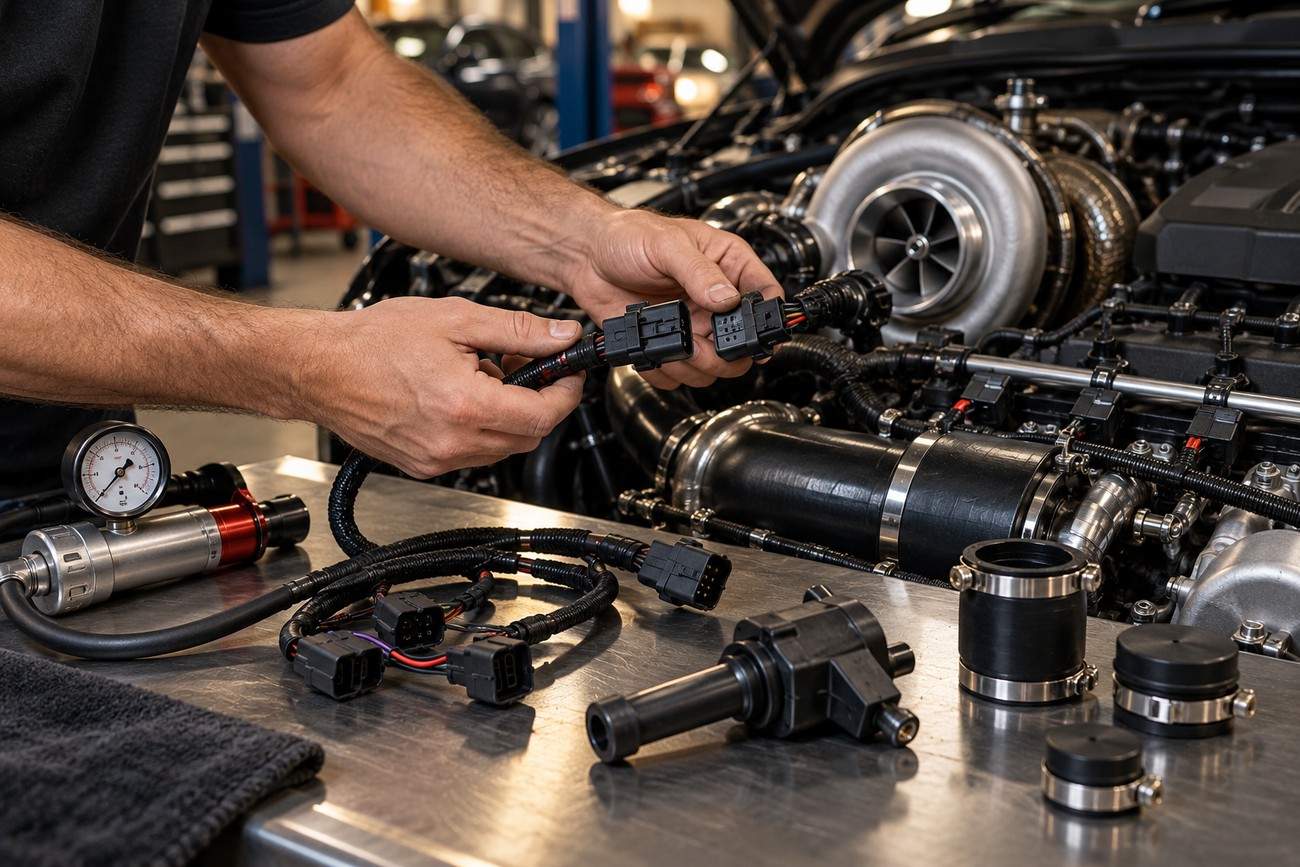
A universal piggyback is rarely universal in the engineering sense. The engine’s sensor type, wiring layout, ECU strategy, fuel system, turbo control, and transmission torque model all affect the result. Choosing a module without platform-specific documentation can produce incorrect signals, warning lights, and reliability problems even when the connectors appear to fit.
An aggressive flash should be rejected until fuel quality, cooling performance, and mechanical condition have been checked. Compression issues, boost leaks, weak ignition components, restricted cooling, or an already marginal fuel system can turn a calibration change into a durability problem. The right file cannot compensate for an engine that is not mechanically sound.
Installation from the box is also an incomplete validation method. Use real logs and AFR checks under the conditions the car will encounter, including sustained load where appropriate. Review boost target and actual boost, fuel pressure, lambda or AFR, ignition correction, intake temperature, coolant temperature, and knock-related data when the platform exposes them.
Running a piggyback alongside an ECU flash requires a defined configuration from the calibration provider. Otherwise, the module may alter signals that the revised ECU file already expects to control, creating conflicting logic and difficult-to-diagnose faults. Before purchase, ask which parameters are changed, which protections remain active, what fuel the map requires, how updates are handled, and what data the tuner needs for revision.
Which Tuning Method Fits Your Car and Use Case?
A piggyback is a reasonable direction when physical reversibility, limited modifications, warranty sensitivity, or platform limitations are the dominant concerns. It can suit a lightly modified turbo car when the system is genuinely developed for that ECU and the owner accepts a narrower control range. A removable module also makes sense when the car may need to return to stock between service visits, provided the owner understands that removal is not a guarantee.
A flash is usually more suitable when the engine needs coordinated changes across fuel, ignition, cam timing, throttle, torque management, and limiters. Track use can favor this approach because the calibration may coordinate drive modes, cooling behavior, fan strategies, and operating limits in greater detail. More extensive hardware changes also tend to require direct access to the relevant ECU maps.
Platform support should outweigh the theoretical superiority of either method. On a new or difficult ECU, a proven piggyback with stable firmware and useful logs may be a safer practical choice than an inexperienced tuner’s unsupported flash. The reverse is equally possible on a mature platform where a well-tested flash integrates cleanly with the factory torque and diagnostic models.
Experienced calibrators may use a piggyback as a temporary solution or as a fine adjustment over a well-calibrated flash. That arrangement is technically possible, though it demands a clear division of responsibility and careful validation. Treat a combined setup as a new calibration project rather than as two independent improvements.
Use this checklist before paying for either method:
- Confirm exact platform, ECU version, engine hardware, and transmission compatibility.
- Ask for the tuner’s validation process, logging channels, fuel requirements, and revision policy.
- Check cooling capacity, fuel system condition, ignition health, and boost-control hardware.
- Plan post-installation AFR checks and logs under realistic load and climate conditions.
- Verify how factory software updates, dealer service, and return-to-stock work will be handled.
- Confirm emissions, noise, inspection, and safety-system compliance in your jurisdiction.
Piggyback Tuner vs ECU Flash: At-a-Glance Comparison
This table is a decision aid, not a substitute for platform-specific calibration data or a mechanical inspection.
| Factor | Piggyback tuner | Full ECU flash |
|---|---|---|
| Control method | External module alters or substitutes selected sensor or actuator signals in real time. | New calibration file is programmed into and stored in the factory ECU. |
| Accessible parameters | Usually boost and fueling; ignition and other controls depend on connected signals and system design. | Can reach fuel, ignition, cam timing, throttle control, torque strategies, and rev or speed limiters when supported. |
| Typical cost | About $200–$400. | About $300–$1,500 or more for quality work, depending on platform and complexity. |
| Additional hardware | Requires a module, connectors, wiring, and secure installation. | Requires no tuning box after programming. |
| Reversibility | Physically removable and usually does not write a calibration change to ECU memory. | Can be returned to another file, though programming history may remain visible. |
| Dealer visibility | Often less obvious after removal, with no guarantee of warranty protection or absence of evidence. | May appear through ECU logs, write counters, or dealer diagnostics. |
| Power potential | On a lightly modified turbo vehicle, a quality system may deliver roughly 80–90% of a comparable flash gain; results vary. | Greater potential for integrated, platform-specific changes across the operating range. |
| Drivability risk | Crude signal changes can cause surging, steps in power, poor idle, faults, or electrical interference. | Poor calibration can cause detonation, excess heat, altered limiters, or unwanted safety-strategy changes. |
| Software update compatibility | Factory updates can alter behavior and may require compatibility checks and recalibration. | Updates can overwrite or invalidate the file and require a new supported calibration. |
| Best use | Limited modifications, reversible changes, warranty-sensitive ownership, or a platform with restricted flash support. | Integrated control, deeper hardware changes, multiple modes, and track-oriented calibration. |
| Major limitation | Control is limited to the signals and logic the module can access. | Quality varies heavily with the calibrator, platform support, fuel, hardware, and validation. |
Frequently asked questions
What are the differences between a piggyback tune and an ECU flash tune?
A piggyback tune changes selected signals before or as they reach the factory ECU, while an ECU flash stores a new calibration inside the ECU. Use a piggyback when removable hardware and narrower changes fit the vehicle and ownership constraints. Use a flash when the calibration needs coordinated control of fuel, ignition, cam timing, throttle, torque, or limiters.
The decision should also consider evidence and support. A piggyback can approach the gain of a comparable flash on a lightly modified turbo vehicle, but its behavior depends on the signals it can access. A flash offers deeper integration, yet the quality of the file and the tuner’s validation matter more than the word “flash” on the sales page.
What should I do after a factory ECU software update?
First, confirm the new ECU calibration version and record what the dealer update changed if that information is available. Then check whether the piggyback firmware and map support that version; factory software can alter scaling, torque logic, diagnostics, or closed-loop behavior.
Do not assume the previous map remains equivalent. Repeat baseline and loaded logs, verify AFR or lambda, boost, fuel pressure, temperatures, and correction data, and stop using the map if faults or abnormal values appear. A flashed vehicle may also need its supported calibration reinstalled after an update, depending on how the dealer programming process handled the ECU.