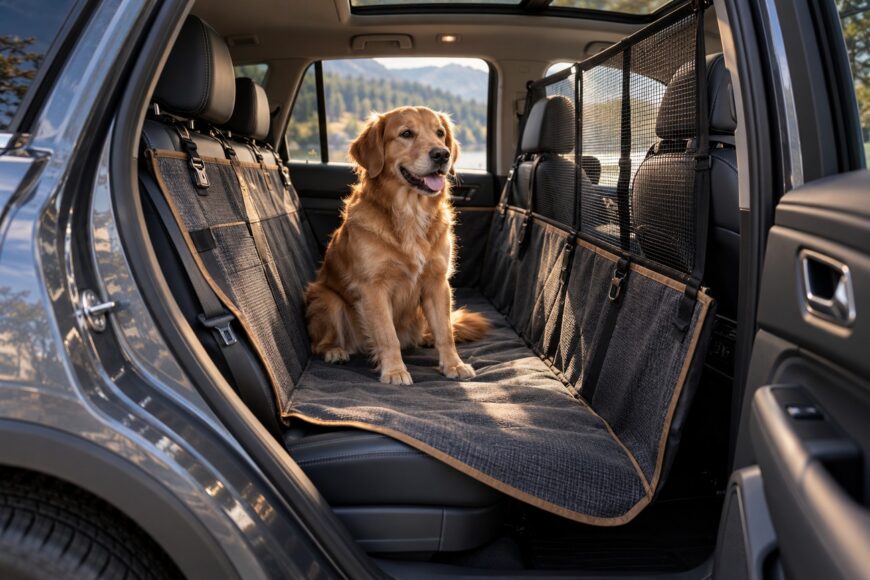
A pet barrier and a seat hammock solve different problems inside a vehicle. A barrier separates the dog from the driver, while a hammock attaches to the rear headrests, closes the space between the front and rear seats, and helps protect the upholstery. Choosing between them depends on the vehicle layout, the pet’s behavior, and whether your main concern is access to the front seats, cabin cleanliness, or controlled travel.
Neither product is automatically a crash-rated restraint. A hammock can limit wandering, and a barrier can stop a dog from reaching the driver, but neither alone is a complete crash-protection system. Safe setup therefore depends on accurate fit, suitable restraint where appropriate, and a realistic assessment of how the animal behaves during braking, turns, and unfamiliar journeys.
- Pet barriers and seat hammocks: two different jobs
- Safety first: containment is not crash protection
- How to choose the right format and fit
- Why pet-car setups fail in everyday use
- Pet barriers, seat hammocks, and covers: which solves what
- Installation, restraint, and care before the first trip
- Frequently asked questions
- What makes a good seat barrier for dogs?
- What is the best car dog barrier for a sedan versus an SUV?
- Which dog hammock is best when a passenger also needs the rear seat?
Pet barriers and seat hammocks: two different jobs
A seat hammock is a rear-seat cover attached to the headrests, usually creating a closed area between the front and rear seats. Its main jobs are to contain the pet in the back and protect the seat, footwell, and upholstery from hair, dirt, moisture, and scratches. It is especially useful when a dog moves around the rear bench or tries to step into the gap behind the front seats.
A pet barrier or mesh screen works differently. It separates the front seats from the rear or cargo area and mainly limits access to the driver. Some barriers are designed for the space behind the front seats, while cargo-area barriers suit an SUV or wagon with a genuinely separate load space. A barrier can reduce driver distraction, but it does not hold the animal in place during a collision.
Small dogs, cats, and other small animals are commonly better suited to a carrier or container than to unrestricted cabin movement. A carrier provides a defined space and can be positioned according to the vehicle and the animal’s size. A free-roaming small pet may slip under a hammock, move into the footwell, or interfere with the driver even when a cover is fitted.
Safety first: containment is not crash protection
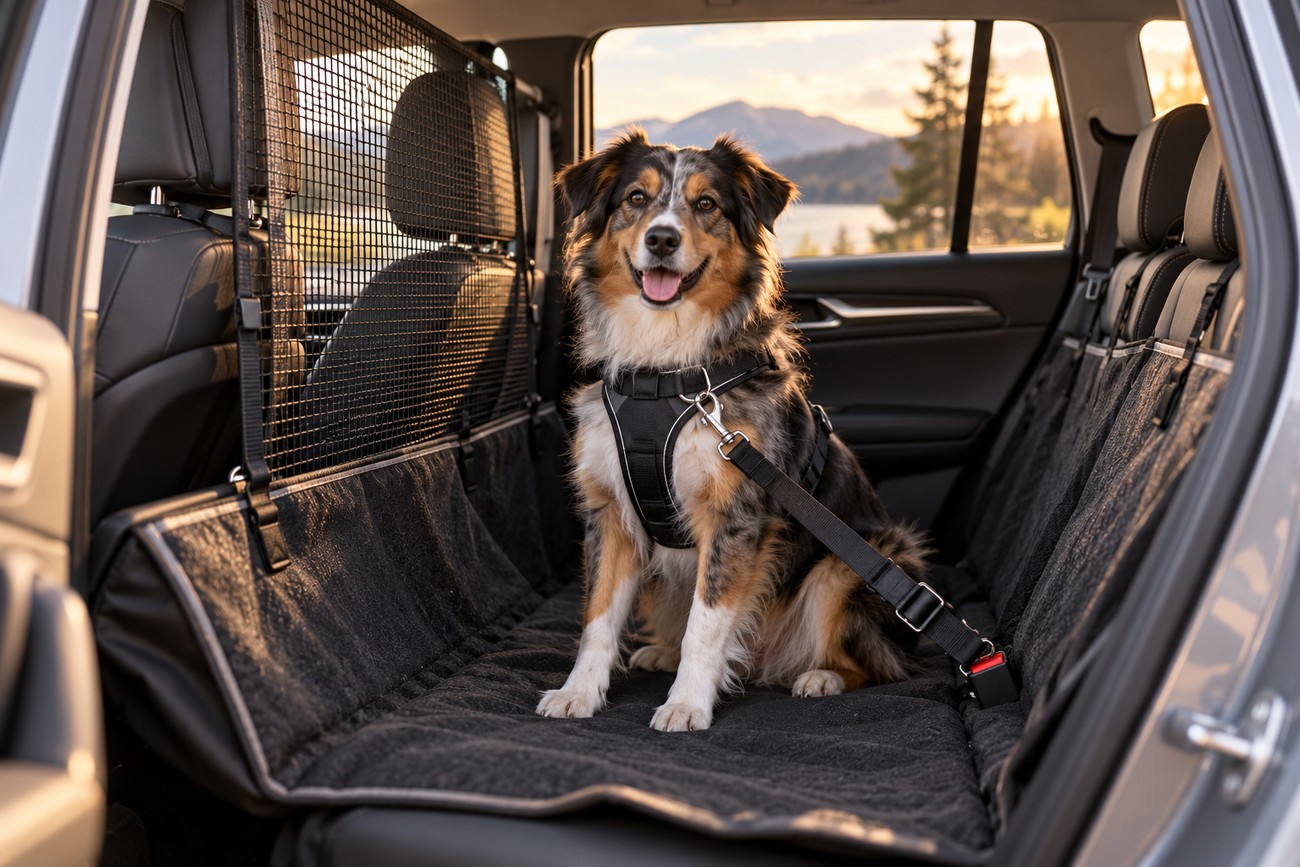
A hammock protects the interior more reliably than it protects the animal. Its fabric and headrest straps may keep a dog away from the footwell during ordinary driving, yet the hammock itself is not a complete crash-protection system. If a dog travels outside a suitable carrier, consider an appropriate harness and vehicle tether that attach as intended for that product and vehicle.
A barrier addresses driver access rather than impact forces. A determined dog may still move across the rear bench, strike the partition, or be thrown forward during sudden braking. The barrier should therefore be treated as a separation device, while restraint is considered separately.
Under Russian traffic practice, an animal in the cabin is generally treated as cargo that must not obstruct visibility, interfere with driving, or remain unsecured. This description should not be treated as a universal rule for every jurisdiction, but it reflects the practical standard: the pet must not compromise control of the vehicle.
How to choose the right format and fit
Start with the vehicle rather than the product label. A rear-seat hammock suits a dog that travels on a conventional back seat; a front-to-rear barrier suits an animal that repeatedly tries to reach the driver; and a cargo-area barrier makes sense only when the vehicle has a separate cargo zone. In a conventional sedan, a cargo barrier is often of limited use.
Measure the rear-seat length, seat depth, distance between the headrests, and the height and shape of those headrests. Also note the normal position of the front seats. A universal hammock may leave side gaps, sag in the center, or allow its attachment points to move when the vehicle’s geometry differs from the assumed design.
Many hammocks use water-repellent Oxford or PU-coated fabric and attach to four headrests or by straps. That construction helps with wet fur, dirt, and small spills, but the material does not compensate for poor dimensions. A hammock that is too short may expose the seat edge; one that is too wide may bunch against the doors and become easier for an active dog to dislodge.
A zippered or split section matters when a passenger must use the adjacent rear seat. Choose it only when the remaining attachment points stay stable after the section is opened and the pet can still be restrained without crossing the passenger’s space. Rigid edge inserts help a hammock keep its shape, although they demand more accurate fitting and may make installation less forgiving.
Why pet-car setups fail in everyday use
Slipping fabric and sagging usually begin with a fit problem, a poorly positioned headrest strap, or front seats moved farther forward than expected. Buying by eye leaves too many variables unresolved. Check the measurements against the actual interior, including the seat depth and the space between the doors.
Hair, dirt, and moisture can remain in the cabin even with a hammock. Water-resistant fabric reduces exposure, but uncovered edges, seams, straps, and door gaps still collect debris. A flat seat cover offers less protection because it does not create the closed footwell and front-seat barrier provided by a hammock.
Some individual reviews and listings report weak fasteners on universal models, along with inconvenient zippers or straps that catch when a passenger uses the seat. These reports do not prove that every universal model fails, but they justify checking buckle strength, stitching, adjustment range, and attachment movement before carrying an active dog.
Test the hammock with the front seats in their normal driving position, then load each attachment point by hand before trusting a supposedly universal fit. A setup that looks secure with empty seats may shift once the fabric is pulled sideways by a moving dog.
An anxious or determined dog may still try to reach the front, pace, or push at a gap. Do not place the animal on the front seat or the driver’s lap: it can interfere with visibility and vehicle control. Introduce the setup gradually, and use a separate, suitable restraint rather than expecting the fabric or mesh alone to manage every movement.
Pet barriers, seat hammocks, and covers: which solves what
Use the comparison below to match the product to the actual problem. The protection column describes everyday cabin protection, not tested crash performance.
| Product | Primary function | Best placement | Protection offered | Restraint limitation | Main drawback |
|---|---|---|---|---|---|
| Rear-seat hammock | Contains the pet in the rear seat and closes the gap to the front seats | Rear bench of a sedan, SUV, or wagon | Helps reduce hair, dirt, moisture, and scratches on upholstery | Alone, it is not a complete crash-protection system | Can sag, slide, or leave gaps if the fit is poor |
| Front-to-rear barrier | Limits access to the driver | Behind the front seats | Separates the front and rear cabin areas | Does not hold the animal in place during a collision | Does little to protect seats from hair, moisture, or dirt |
| Cargo-area barrier | Separates the pet from the passenger cabin | Distinct cargo area in an SUV or wagon | Helps keep the animal within the load space | Still requires separate consideration of restraint | Often has limited use in a conventional sedan |
| Flat seat cover | Protects a seat surface | Rear bench or cargo floor | Reduces contact with hair, dirt, and moisture | Provides no restraint system and no front-seat barrier | Leaves the footwell and access to the front open |
| Carrier | Provides a defined container for a small animal | Positioned securely in the vehicle according to its design | Protects the cabin around the container | Must be suitable for the animal and secured appropriately | Can cause distress if the pet has not been acclimated |
Installation, restraint, and care before the first trip
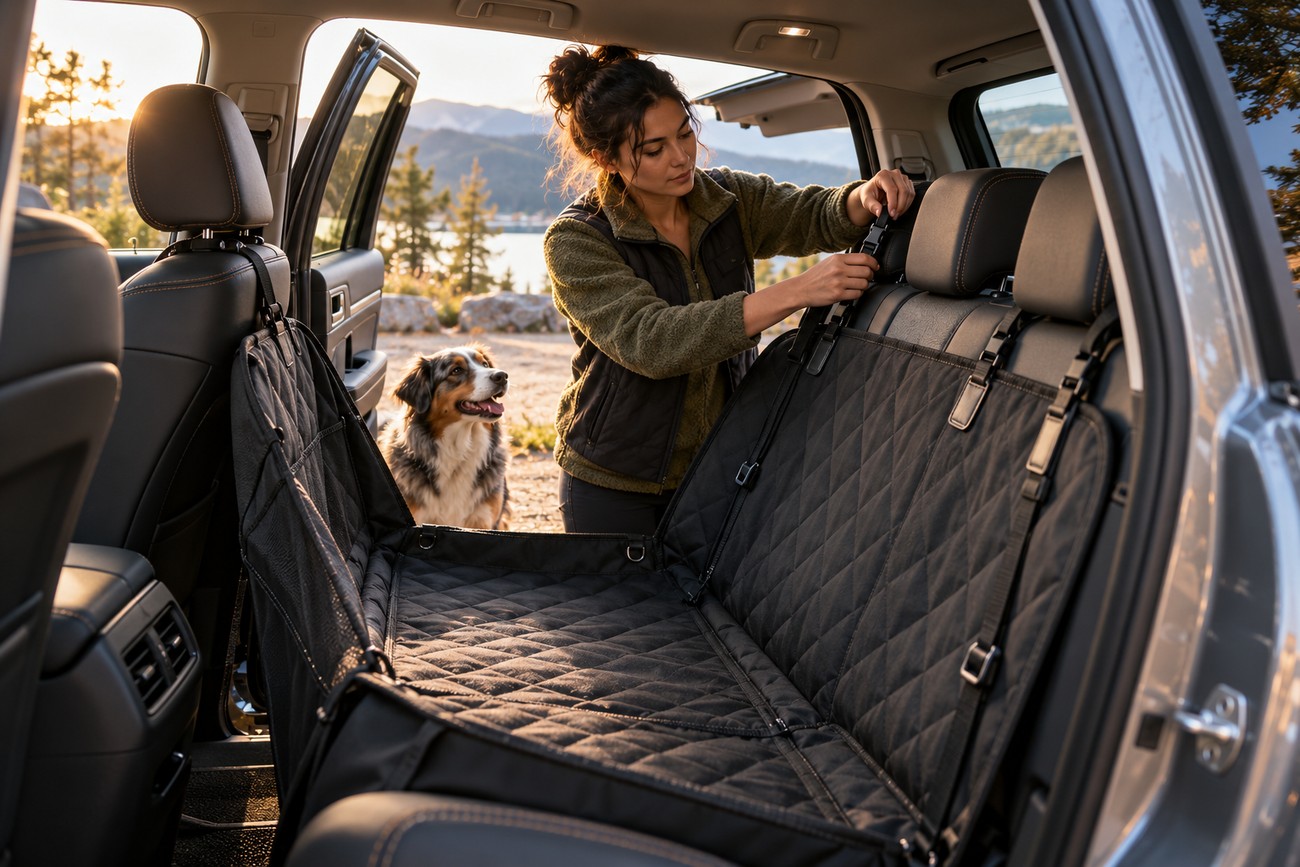
Install the hammock or barrier on the actual vehicle, not on a similar model. Check every strap on the real headrests or cargo fittings, tighten the adjustment points, and inspect the edges for escape gaps. Move the front seats through their normal adjustment range to confirm that the setup does not interfere with driving or passenger use.
Where a dog travels outside a carrier, add an appropriate harness and vehicle tether separately, following the restraint maker’s fitting instructions. The tether should not be treated as a substitute for a hammock’s attachment points, and the hammock should not be treated as a substitute for the restraint. A barrier also needs secure attachment because its purpose is lost if it shifts away from the front-seat opening.
Let an anxious pet investigate the equipment while the vehicle is stationary. Begin with short, calm sessions and increase exposure gradually rather than forcing the animal into a closed rear-seat area. Restlessness, chewing, or repeated attempts to escape may indicate that the chosen format, restraint, or acclimation process needs to change.
Water-resistant fabric helps manage wet fur, dirt, and spills, but seams and straps still need regular cleaning and inspection. Remove trapped hair from zippers and attachment points, check stitching for pulled threads, and allow damp material to dry before storage. Replace or repair components that no longer hold their adjustment securely.
Frequently asked questions
What makes a good seat barrier for dogs?
A good barrier has stable attachment, no driver-side gaps large enough for the dog to pass through, and fittings compatible with the vehicle’s headrests or cargo points. Check whether the frame or mesh stays in place when pushed from the rear, and confirm that it does not obstruct seat adjustment, mirrors, controls, or access to seat belts.
A barrier should match the vehicle rather than rely only on a “universal” label. A DIY separator may block a visible opening, but it should not be treated as equivalent to a purpose-built barrier or a tested restraint. It still does not replace a suitable harness, tether, or carrier where those are appropriate.
What is the best car dog barrier for a sedan versus an SUV?
For a sedan, a front-to-rear barrier is usually the relevant format because it separates the rear bench from the driver. A cargo-area barrier is generally more useful in an SUV or wagon with a distinct load space where the dog travels behind the rear seats.
Choose according to the actual interior layout and the dog’s behavior. If the animal travels on the rear bench and also soils the upholstery, a hammock may address more of the daily problem; if it repeatedly approaches the driver, a barrier addresses access more directly. Neither format alone provides complete crash protection.
Which dog hammock is best when a passenger also needs the rear seat?
Choose a hammock with a zippered or split passenger section, provided the design remains stable when opened. Before buying, check where the remaining straps attach, whether the exposed seat edge stays covered, and whether the dog can remain restrained without crossing into the passenger’s legroom.
A narrow shared-seat arrangement may work better with a suitable carrier or a different travel setup. The passenger should be able to sit, buckle up, and adjust the seat without pulling the hammock loose or placing the restraint across the passenger’s space.