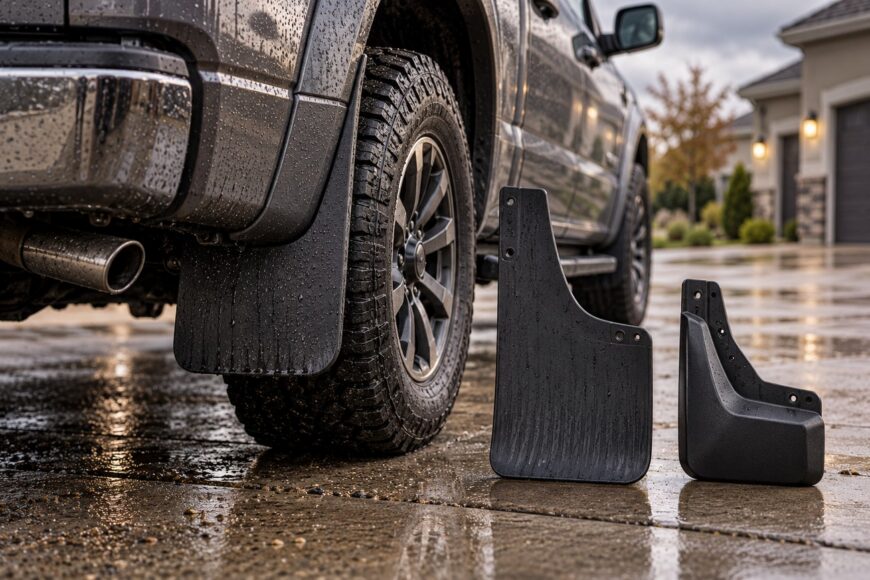
A compact guard can look tidy yet leave the doors streaked with road grime. A longer flap may catch more spray, but it can also drag through deep snow or snag an obstacle. The choice is less about which shape looks protective and more about where the tire throws debris during the driving you actually do.
Tire coverage, ground clearance, and secure mounting matter more than the name on the package. A guard that fits the body poorly may leave an exposed strip behind the wheel; a flap mounted too low may lose its working position after one hard contact. Both designs involve a compromise between coverage and clearance.
- What Mud Flaps and Splash Guards Actually Do
- Mud Flaps vs. Splash Guards: Fit and Trade-Offs
- Choose Coverage Around Your Actual Tires
- Length, Material and Weather: Where Protection Backfires
- Installation Checks That Prevent Rubbing and Tear-Out
- Are Mud Flaps Required? Check the Rule for Your Vehicle
- Frequently asked questions
- Which is better for my Subaru Outback, mud flaps or splash guards?
- How should I care for mud flaps after winter driving?
- When should a mud flap or splash guard be replaced?
What Mud Flaps and Splash Guards Actually Do
Rotating tires throw water, mud, and stones outward and rearward. Mud flaps and splash guards interrupt some of that path, reducing spray and debris from the wheel area. Neither eliminates it: tire tread, speed, road surface, and the shape of the wheel arch all affect what escapes.
Mud flaps are commonly larger and flexible; splash guards are commonly compact and molded. Those names are not standardized, so check a product’s dimensions and construction rather than assuming its label tells you how much tire it covers.
At the front wheels, suitable guards can reduce grime reaching the vehicle’s own sills, doors, handles, mirrors, and side cameras. That matters if a short factory guard keeps the paint nearest the wheel clean while leaving the rest of the door coated after a wet drive.
At the rear, the main concern often extends beyond your vehicle: spray and loose debris can reach traffic behind. Adequate width and a stable position help, but even a well-fitted flap cannot guarantee that every stone stays off another vehicle.
Mud Flaps vs. Splash Guards: Fit and Trade-Offs
These are typical designs, not fixed product categories. Compare the installed shape with your tires and wheel arches.
| Consideration | Larger flexible mud flaps | Compact molded splash guards |
|---|---|---|
| Coverage | Can extend lower and farther across the tire | Usually cover a smaller area near the arch |
| Ground clearance | More lower-edge coverage, with greater snag risk | Generally less exposed below the body |
| Fit | May need trimming to suit the tire and body | Often shaped for particular bodywork and trim |
| Mounting | Needs support that holds its position in airflow | Depends on matching holes and sound mounting surfaces |
| Impacts | Can flex, but may fold back in airflow | May crack or transmit a blow to its mounts |
Neither style wins for every vehicle. Longer coverage can improve body protection while reducing ground clearance and increasing the chance of a snag; a shorter guard may be the better fit where obstacles frequently reach the lower edge.
Choose Coverage Around Your Actual Tires
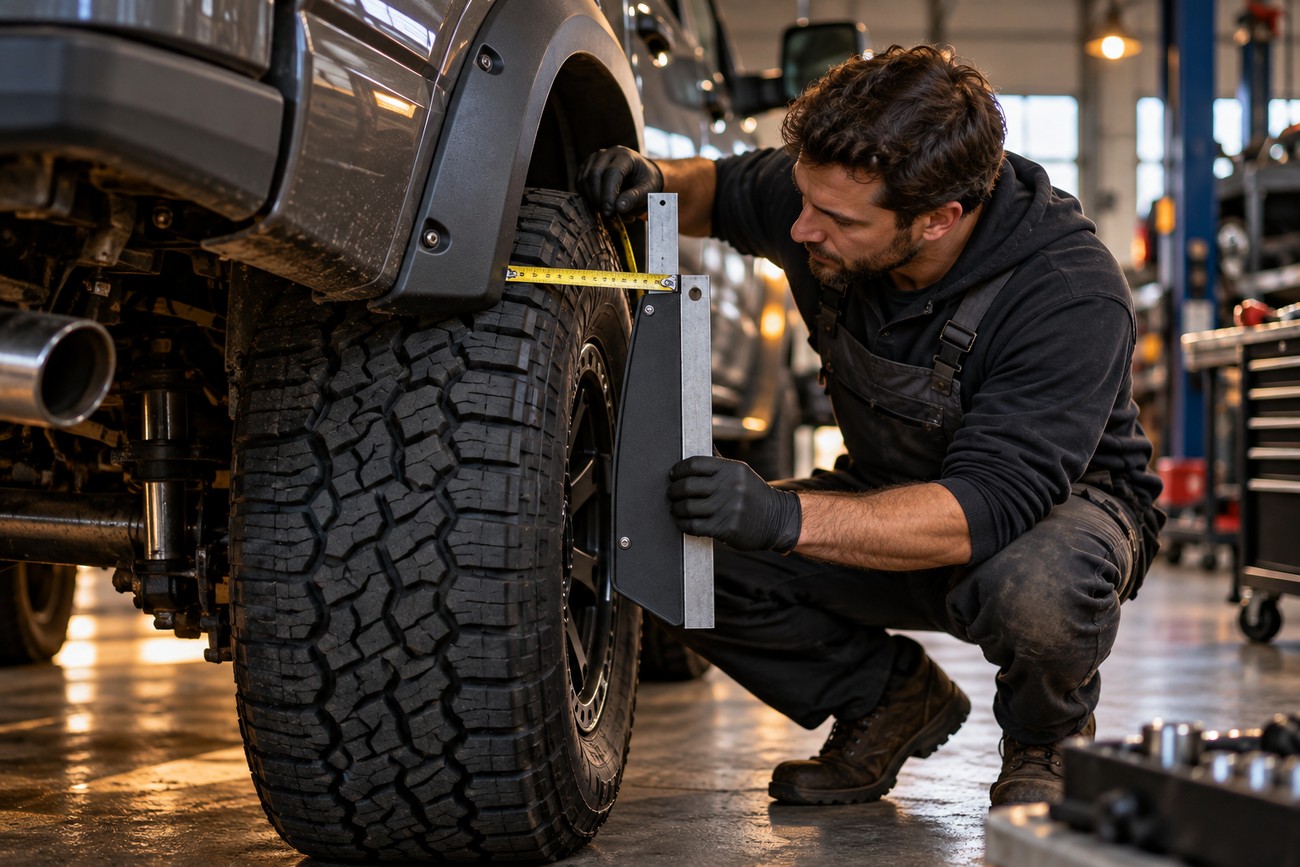
Fit depends on tire width, wheel offset, fender geometry, and mounting points—not the vehicle model alone. Before ordering, look at the installed tire from behind and note where its tread sits relative to the fender and the proposed guard. A different tire size, wheel offset, or fender flare can change the answer even within the same model range.
Check whether the guard spans the area that sends grime toward the body. A narrow piece behind a wider tire leaves an open path for spray; a short front guard may do little for the sill and lower door. Product photos can obscure these gaps, so compare listed dimensions with the vehicle rather than relying on a “direct fit” description.
Existing mounting points matter as much as the outline. Factory guards, trim pieces, and liners can occupy the holes a replacement expects to use. Confirm which parts stay in place, which must be removed, and whether the proposed attachment still has a firm surface behind it.
If the tire projects beyond the body, a flap alone may not provide adequate coverage: the fender or a suitable flare may also need to cover the protruding portion. Some local rules address coverage across the tread or exposed tire width. A flap is no remedy for an unsuitable wheel setup or insufficient fender coverage.
Length, Material and Weather: Where Protection Backfires
A lower edge closer to the road can intercept more debris, but it also has less room to clear ruts, curbs, and packed snow. Measure the proposed length with the vehicle’s normal load in mind. A flap that hangs safely on an empty, parked vehicle may drag when the suspension settles or snow builds beneath it.
Deep snow can pull at a front guard, while reversing over a ridge can catch an edge that passed over it going forward. Repeated contact may bend the flap out of position or strain its fasteners. Choose enough length to protect the area you care about without treating the lowest possible edge as the goal.
Material stiffness needs balance. An overly flexible flap may fold back in airflow and expose the area it was meant to cover. A rigid guard may hold its shape better at speed, yet crack on impact or pass the force into its mounts and nearby bodywork.
Temperature adds another variable. Some materials become less flexible in cold weather or soften in heat, so a durability claim means less without a stated temperature range suited to your use. Ice can also accumulate on a guard and add weight to its mounts; inspect the attachment after winter driving rather than judging the material alone.
Installation Checks That Prevent Rubbing and Tear-Out
A vehicle-specific kit may align with existing holes, but confirm its stated model year, trim, and any restrictions for factory guards or flares. A universal kit can work well when there is room to position it, though “universal” may mean trimming, drilling, or making brackets. Lay out the parts against the vehicle before altering the liner or bodywork.
Where fasteners pass through a thin plastic wheel-arch liner, a single unsupported layer may tear as the guard flexes or collects ice. Use suitable load-spreading hardware, an existing reinforced point, or a proper bracket where the installation calls for it. Avoid assuming that adding another screw to the same weak surface solves the load problem.
A parked clearance check can miss two faults at once: the tire may touch the guard as steering or suspension changes, while movement gradually pulls a fastener through an unsupported liner. Check the gap and the strength of the mounting surface separately.
Before final tightening, turn the front wheels through full steering lock and check the closest points on both sides. Check again with the suspension loaded to reflect normal use; static clearance on an empty vehicle is insufficient. Allow for snow buildup around the tire and guard rather than fitting them with a gap that only works when both are clean.
Finally, consider what happens while reversing over an obstacle: an exposed lower edge can be pushed in a direction its mount handles poorly. Confirm that the flap sits clear of the tire, stays in its intended position, and does not pull the liner out of shape. Recheck fasteners after the first drives on rough or snowy roads.
Are Mud Flaps Required? Check the Rule for Your Vehicle

Legal duties vary by jurisdiction and vehicle category. There is no single mud-flap dimension or passenger-vehicle requirement you can apply everywhere. Check the current rule for where the vehicle is registered and used, particularly after changing tires, wheels, or fender coverage.
Missouri’s cited rule applies to trucks over 24,000 lb without rear fenders: it calls for coverage across the full tread and a lower edge within 8 inches of the ground. That is a specific truck requirement, not a buying specification for every car or truck.
Saskatchewan’s cited rule calls for full tire-width coverage and generally a lower edge no higher than 10 inches from the road, or compliance with its alternative one-third wheel-center-distance rule. Alberta has an axle-center requirement for specified vehicles, but passenger cars are exempt from that separate requirement. These examples show why vehicle classification matters alongside measurements.
In the EU, Regulation (EU) No 109/2011 concerns spray-suppression type approval for applicable vehicle categories; it is not a blanket requirement for every car. Where a rule applies, width, lower-edge position, and a mounting that retains its working position in use can all matter. Verify the applicable text locally rather than treating a package’s “road legal” claim as proof of compliance.
Frequently asked questions
Use these checks to narrow the choice for your vehicle and to keep an installed guard working as intended.
Which is better for my Subaru Outback, mud flaps or splash guards?
Choose based first on your driving conditions and how much side-body coverage you want. If snow, gravel, or muddy roads regularly coat the lower doors, a longer flap may be useful, provided it clears obstacles; for mostly paved driving, a compact guard may be enough. Before ordering, verify your Outback’s exact model year, trim, tire setup, factory guards, and available attachment points. The model name alone does not establish fit.
How should I care for mud flaps after winter driving?
Gently remove packed snow and ice rather than striking or sharply bending the flap in the cold. Clean grit trapped between the guard and bodywork, then check that the fasteners remain tight and the mounting holes are sound. Repeat the inspection after heavy icing or an impact, since accumulated ice adds load and cold can change how the material flexes.
When should a mud flap or splash guard be replaced?
Replace or repair it when cracks, persistent deformation, torn mounting holes, or missing hardware prevent it from staying securely in position. Tire contact is a reason to stop and correct the fit before driving further; a new guard of the same shape will rub too if the underlying clearance problem remains. There is no useful replacement interval that substitutes for checking its condition and mounting.