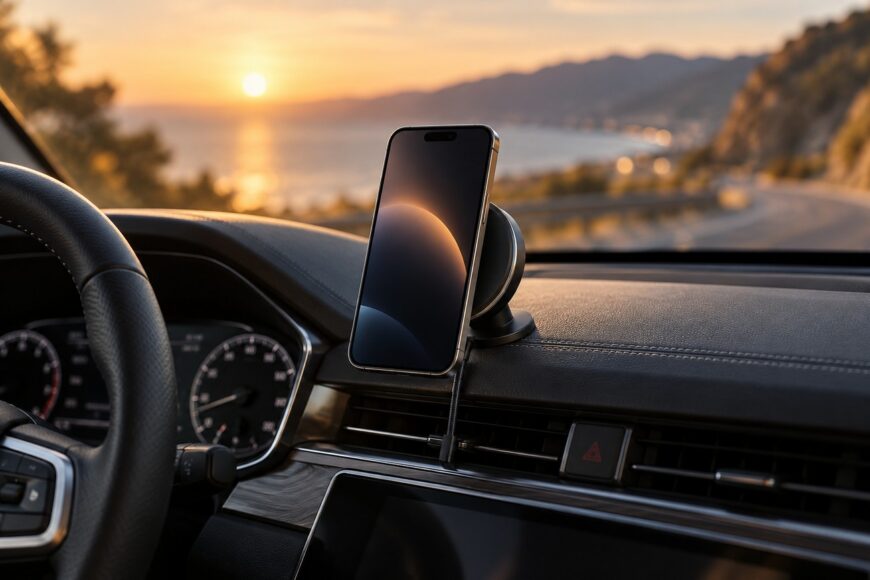
A car phone mount has two jobs that can conflict: it must hold the phone securely while keeping the charging coils aligned, cool, and unobstructed. A magnetic connection may feel strong in the hand yet lose contact over bumps, while a metal plate that improves retention can interfere with wireless charging.
The sensible choice depends on the phone’s magnetic standard, case thickness, road conditions, heat, and mounting position. A mount rated for up to 15 W does not guarantee that output during navigation in direct sun. In a real vehicle, temperature, alignment, the phone’s charging limits, and the vehicle power source often matter more than the headline specification.
- How Magnetic Wireless Car Mounts Actually Work
- Choosing the Right Mount for Your Phone and Road Conditions
- Magnetic Strength, Cases, and Charging Compatibility
- Charging Speed, Heat, and Battery Wear in a Car
- Safe Installation: Dashboard, Vent, or Adhesive Mount?
- A Practical Buying Checklist: Which Mount Fits Your Setup?
- Troubleshooting Failures and Separating Myths from Facts
- Frequently asked questions
- What should I do if the compass points the wrong way near the mount?
- Why does my phone attach firmly but still stop charging while driving?
- What is the best car mobile holder with wireless charging?
- What is the best magnetic phone holder for car use?
- What is the best magnetic phone holder for cars?
How Magnetic Wireless Car Mounts Actually Work
Qi is the main wireless charging standard for smartphones. A charging mount contains an induction coil that transfers power across a small gap to the coil in the phone. The transfer works best when the two coils are centered; even a secure-looking attachment can charge poorly if the phone sits slightly high, low, or off to one side.
Qi2 added the Magnetic Power Profile, abbreviated MPP, to position the phone’s coil more precisely. This is the principle behind newer magnetic charging mounts: the magnets help the phone settle into the correct charging position instead of leaving alignment to chance. Better positioning can reduce interruptions and wasted energy, although it cannot remove heat or the phone’s own charging limits.
Apple MagSafe is built into iPhone 12 and newer models. A MagSafe-compatible car mount uses the phone’s magnetic ring around the charging coil and supports Qi charging, commonly with a rating of up to 15 W. A Qi2 mount uses the MPP alignment system, while a generic magnetic ring or adhesive accessory may provide attachment without delivering the same standardized alignment behavior.
A conventional magnetic holder is a different product. It often relies on a solid metal plate attached to the phone or hidden under its case. If that plate sits over the charging coil, it can reduce efficiency, block Qi charging, or create localized heat. Combining such a holder with a separate wireless charger therefore tends to produce unreliable results, even if the magnet itself holds firmly.
Choosing the Right Mount for Your Phone and Road Conditions
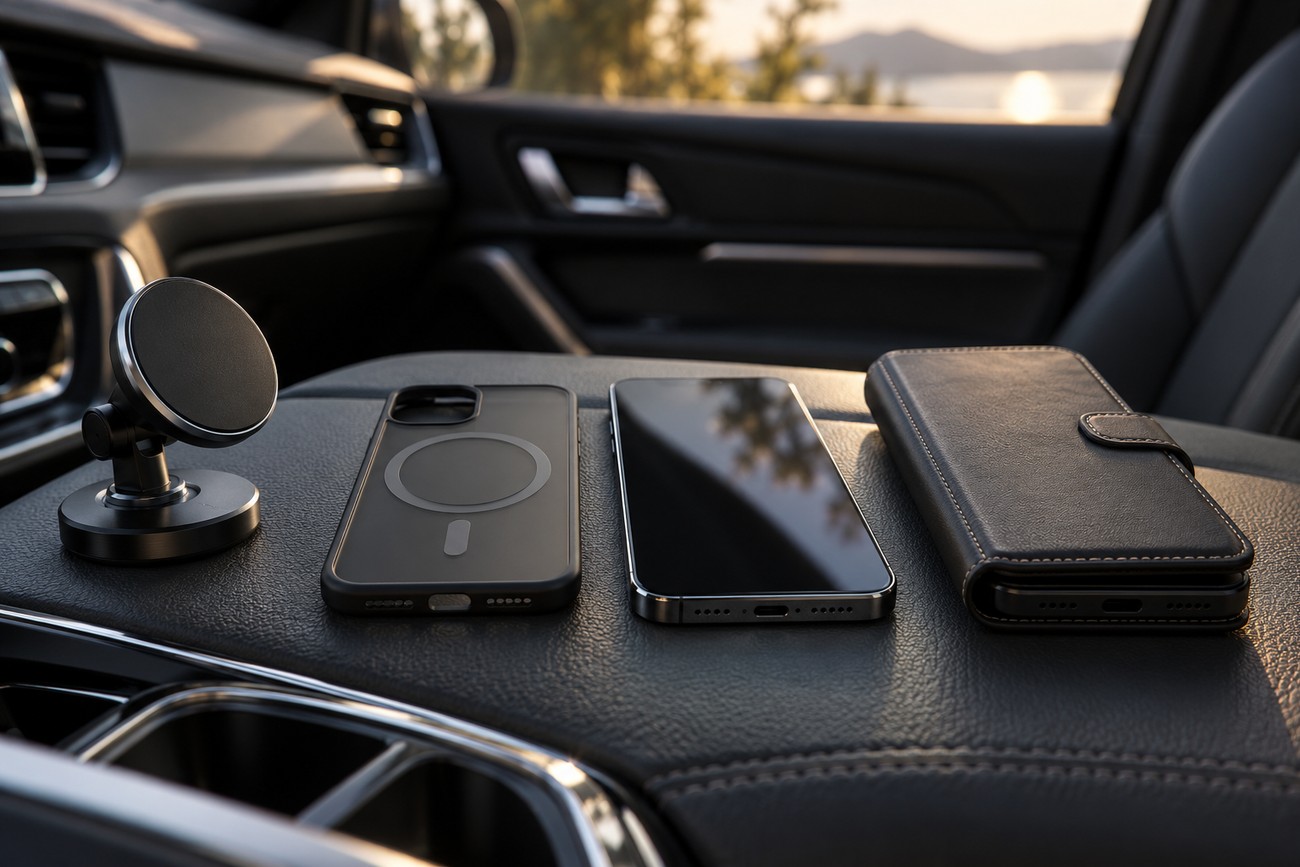
Start with the phone rather than the mount’s maximum wattage. An iPhone 12 or newer with a correctly aligned MagSafe case is a natural match for a MagSafe-compatible mount. A phone that supports Qi2 can use a mount with the Qi2 Magnetic Power Profile, while a phone without a built-in magnetic system may need a compatible case or a different retention method.
Case design is as important as phone compatibility. Stable magnetic retention and Qi alignment commonly require a case no thicker than about 1/8 inch (2–3 mm), with no metal parts over the charging coil. A thick rugged case, a wallet case, or a case with a poorly positioned ring can create enough distance or offset for the phone to detach on rough pavement or for charging to cut out.
Large and heavy phones expose weak designs quickly. Many magnetic mounts use four or more neodymium magnets in one or two rows, and typical designs are intended for phones weighing up to about 1 pound (500 g). That figure is only a rough product-design reference: case weight, road vibration, the angle of the mount, and the quality of the magnetic ring all affect actual retention.
Rough roads favor a hybrid solution with a mechanical cradle or side support plus magnetic alignment. A pure magnetic mount can be suitable for a lighter phone on smooth roads, while a mechanical-and-magnetic mount adds a physical backup against sudden braking and vibration. Claims of universal compatibility deserve caution when the product does not specify case thickness, phone weight, or how its magnets are positioned.
Magnetic Strength, Cases, and Charging Compatibility
The most common failure is a phone that attaches successfully yet charges intermittently. The magnets may hold the handset while the charging coils remain offset. A weak ring, a thick case, or a mount whose magnetic pattern does not match the phone can allow small movements that become significant each time the car hits a bump.
Four or more neodymium magnets arranged in one or two rows are typical in magnetic mounts. Their number alone does not establish reliable retention. The mount’s surface, the phone’s center of gravity, the case material, and the distance between the magnets all matter. A phone that stays attached while parked may still slide or rotate during cornering.
Third-party magnetic cases require particular care. If the ring is slightly off-center, the phone can sit securely enough for the magnets to engage while leaving the coils misaligned. This can cause repeated charging starts and stops, extra heat, or a complete failure to charge. Checking the ring position against the phone’s charging coil is more useful than judging the case by magnet strength alone.
Metal plates create a separate compatibility problem. A plate in the coil area can reduce Qi efficiency, stop charging, or produce localized heating. Removing the plate, using a case designed for magnetic charging, or choosing a mechanical cradle is usually safer than adding more power to compensate for the obstruction.
Charging Speed, Heat, and Battery Wear in a Car
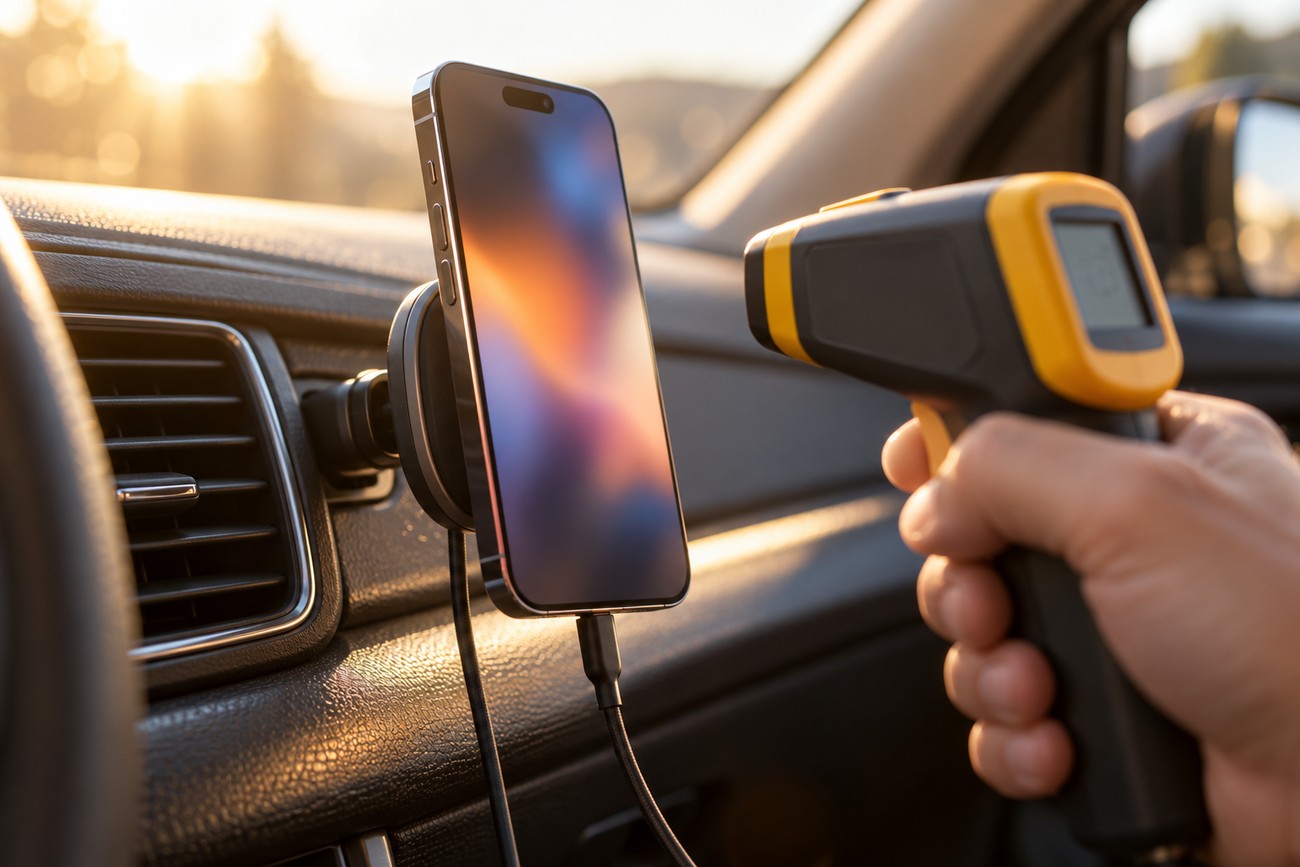
Automotive Qi and MagSafe-compatible mounts commonly advertise up to 15 W. That is a rated ceiling, not a promise of sustained output. Real-world charging is often around 5–10 W when heat, alignment, phone limits, or vehicle power constraints reduce output, and the actual result varies with the phone and conditions.
The phone can dynamically lower wireless charging power to control battery temperature. Navigation adds processor and screen load, while sunlight heats the display and rear panel. In a hot cabin, the charger may continue operating while the battery receives power slowly, or it may pause charging until temperatures fall.
High wattage can therefore be a poor buying priority for a phone that spends most of its time running maps in summer. Screen dimming, interface lag, and slow charging can indicate thermal throttling rather than a defective mount. Repeated exposure to high temperatures during charging can also accelerate battery degradation, although the effect depends on the device, climate, and charging pattern.
Placing the phone slightly below the upper dashboard and away from direct climate airflow often helps more than choosing a higher wattage rating. This position reduces solar heating while avoiding the hot winter air or cold summer air that can push the battery toward its temperature limits.
Vent airflow creates an easy-to-miss problem. A phone mounted in front of a heater can become hot even when the cabin feels comfortable, while cold air from air conditioning can cool the device unevenly. A lower position with some shade and no direct vent blast usually gives the charging system a more stable environment.
Safe Installation: Dashboard, Vent, or Adhesive Mount?
Placement is a safety decision before it is a convenience decision. The mount must stay clear of airbags, the instrument panel, and the driver’s field of view. Avoid locations where the phone or mount could interfere with an airbag deployment path, obscure traffic, or force the driver to look far away from the road.
Vent mounts are easy to move and avoid adhesive preparation, but their disadvantages are substantial. The clip places weight on the vent slats, and cheap clips may damage them or allow excessive vibration. The phone is also exposed to hot airflow in winter or cold airflow in summer, both of which can worsen charging behavior and battery temperature.
Adhesive mounts can be stable on a suitable hard surface. Common 3M-style adhesive pads need a mounting surface at about 60°F (15°C) or higher for reliable bonding. Clean and dry the area, press the pad evenly, and allow it to bond before adding the phone. Textured, soft, dirty, or cold surfaces reduce reliability, and a dashboard with a rubberized finish may resist adhesion even when it appears smooth.
Do not judge the installation immediately after pressing the mount into place. A heavy phone adds leverage, especially when the arm extends away from the dashboard. Keep the mount close to a structurally firm area, place it slightly below the upper dashboard when possible, and test it on a stationary vehicle before relying on it for navigation.
A Practical Buying Checklist: Which Mount Fits Your Setup?
The table below separates magnetic alignment from simple magnetic retention and shows where each design tends to fit.
| Mount type | Phone compatibility | Case requirements | Rough-road stability | Charging reliability | Heat risks | Best use case |
|---|---|---|---|---|---|---|
| MagSafe or Qi2 magnetic mount | Phones with MagSafe or Qi2-compatible magnetic alignment | Usually no more than about 1/8 inch (2–3 mm); no metal parts over the coil | Good on smooth and moderately rough roads when the ring is correctly positioned | Good alignment, though output still depends on temperature and phone limits | Heat can reduce power during navigation or direct sun | Compatible phones needing quick attachment and wireless charging |
| Conventional magnetic mount with metal plate | Broad phone compatibility for magnetic retention | Plate placement may conflict with Qi; often requires removing the plate for wireless charging | Depends on magnet, plate position, case, and phone weight | Potentially poor or unavailable if the plate covers the coil | Localized heating and reduced efficiency are possible | Simple magnetic holding when wireless charging is unnecessary |
| Cradle-style wireless charger | Most Qi-compatible phones, subject to cradle size | Case must fit the cradle; thick cases may prevent proper seating | Usually strong because the phone is mechanically supported | Consistent when the phone rests centrally on the charging coil | Heat still rises with sunlight, navigation, and high charging power | Drivers who prioritize physical retention over one-handed magnetic attachment |
| Hybrid mechanical-magnetic mount | Broad compatibility, including heavier or non-MagSafe phones | More forgiving, though excessive thickness can still affect Qi alignment | Best suited to heavy phones and rough roads | Usually dependable if the mechanical support keeps the coils aligned | Same thermal limits as other wireless chargers | Large phones, rugged cases, and vibration-prone driving |
MagSafe and Qi2 mounts have a clear advantage in coil positioning, while conventional metal-plate mounts remain useful when charging is not required. A cradle or hybrid design adds physical support and is often the safer choice for a heavy phone, a thick case, or poor road surfaces.
Compare the power source as well as the mount. The vehicle adapter, cable, and charging controller can limit the result before the phone reaches the advertised ceiling. A 15 W label does not guarantee 15 W of sustained charging in a hot vehicle, so stable alignment and sensible temperature control should carry more weight in the decision.
Troubleshooting Failures and Separating Myths from Facts
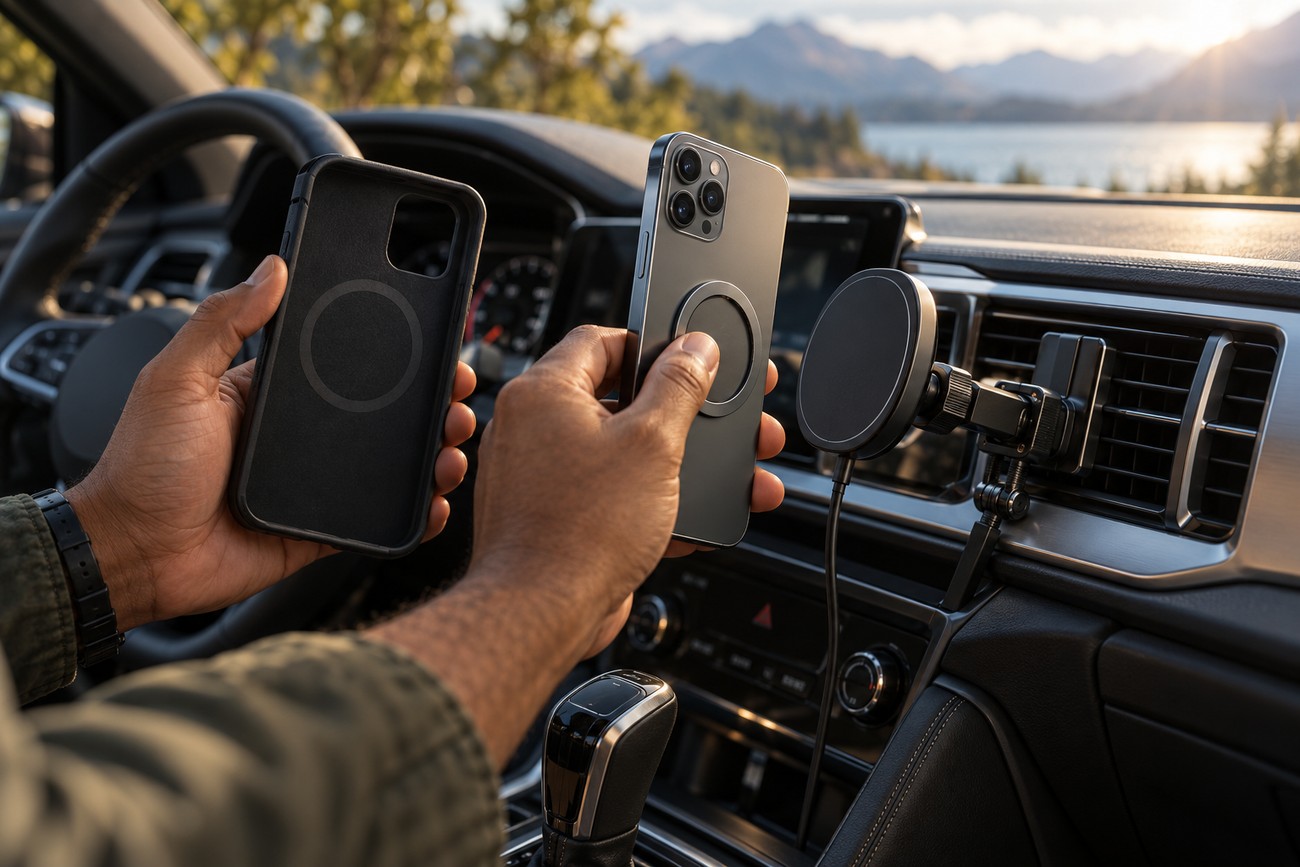
If charging stops on bumps, begin with alignment. Remove the phone from its case and check whether the bare phone charges consistently. Then inspect the case for thickness, a metal insert, a wallet component, or a third-party magnetic ring that sits off-center. If the phone shifts when the car vibrates, the magnet may be too weak for the combined phone-and-case weight, even if it feels strong while stationary.
If the phone becomes hot, reduce the number of heat sources before blaming the charger. Move it out of direct sun, stop directing heated air at the rear of the phone, and check whether navigation and wireless charging are running together. A phone may lower charging power automatically, so slow charging in these conditions can be a temperature-control response rather than a failure.
A slipping mount usually points to the installation or the retention system. Check whether the adhesive was applied to a clean, dry, sufficiently warm surface, and whether the dashboard texture is too soft or irregular. For a vent mount, inspect the clip and slats for movement. A heavy phone on an extended arm can create leverage that a small clip was never designed to handle.
Screen dimming and lag during navigation can also signal thermal throttling. Let the phone cool, improve airflow without directing an extreme temperature stream at it, and compare behavior with wireless charging disabled. This test separates a heat-related performance limit from a problem with the navigation application or the vehicle’s power supply.
Magnets do not erase modern phone flash memory and do not normally damage phone chips. A nearby magnet can temporarily affect the digital compass and some sensors, so navigation orientation may be inaccurate while the phone is attached. The effect should usually disappear after the phone is moved away. Certified wireless chargers are designed to operate within applicable non-ionizing electromagnetic exposure limits.
Frequently asked questions
These answers explain common charging, mounting, and heat-related problems. They also compare magnetic, cradle, and hybrid designs. Use them alongside the phone, case, road, and vehicle conditions described above.
What should I do if the compass points the wrong way near the mount?
Move the phone away from the magnetic mount and check its orientation again. If the compass recovers, the magnet is temporarily affecting the digital compass rather than damaging the phone. Recalibrate the compass in the navigation app or phone settings if needed, then test the phone away from the mount before changing hardware.
Why does my phone attach firmly but still stop charging while driving?
Check the problem in sequence: confirm coil alignment, test without a case thicker than about 1/8 inch (2–3 mm), inspect for metal inserts, and test for movement over bumps. Then check heat from sunlight, navigation, or climate airflow, followed by the vehicle power source and cable. A strong magnetic connection only proves that the phone is held; it does not prove that the charging coils remain aligned or that the charger can maintain its rated output.
What is the best car mobile holder with wireless charging?
The best match is a mount that supports the phone’s actual charging standard, holds the case securely, and fits a safe location in the vehicle. MagSafe or Qi2 is a strong choice for a compatible phone, while a hybrid mechanical-magnetic mount is more suitable for a heavy phone, thick case, or rough roads. Prioritize alignment and heat control over the highest wattage label.
What is the best magnetic phone holder for car use?
For a compatible iPhone 12 or newer, or a phone with Qi2 magnetic alignment, choose a purpose-built charging mount that uses the magnetic ring around the coil. For other phones, use a compatible case or choose mechanical support instead of relying on a random metal plate. The safest option is the one that holds the phone without blocking visibility, airbags, or essential controls.
What is the best magnetic phone holder for cars?
There is no single best design for every car and phone. A MagSafe or Qi2 mount offers precise magnetic alignment, a cradle offers stronger physical support, and a hybrid design covers heavy phones and rough surfaces. Check the phone weight, case thickness, road vibration, mounting temperature, and distance from the driver’s view before choosing.