A lightweight flywheel can make an engine rev more freely and give the throttle a sharper response. The effect comes from reducing rotational inertia, so the engine spends less torque accelerating its rotating parts. Revs rise faster, fall faster, and a downshift blip usually needs less delay.
The trade-off is reduced stored energy and, especially after a dual-mass-to-single-mass conversion, less torsional isolation between the engine and transmission. That can make launches less forgiving, increase gearbox rattle, and expose weaknesses in idle control or drivetrain condition. The useful decision therefore depends on the complete rotating system, vehicle use, gearing, engine torque curve, and desired drivability rather than flywheel weight alone.
- What a Lightweight Flywheel Actually Changes
- Why Throttle Response Feels Sharper
- The Real Benefits—and the Daily-Driving Costs
- Dual-Mass Versus Single-Mass: The Damping Trade-Off
- How to Compare and Choose a Lightweight Flywheel
- Flywheel Choices: Response, Damping, and Drivability
- Dyno Evidence, Common Mistakes, and the 15% Claim
- Frequently asked questions
- How can you tell normal gearbox rattle from a flywheel or clutch problem?
- What are the downsides to a lightweight flywheel?
- What are the benefits of a lightened flywheel?
What a Lightweight Flywheel Actually Changes
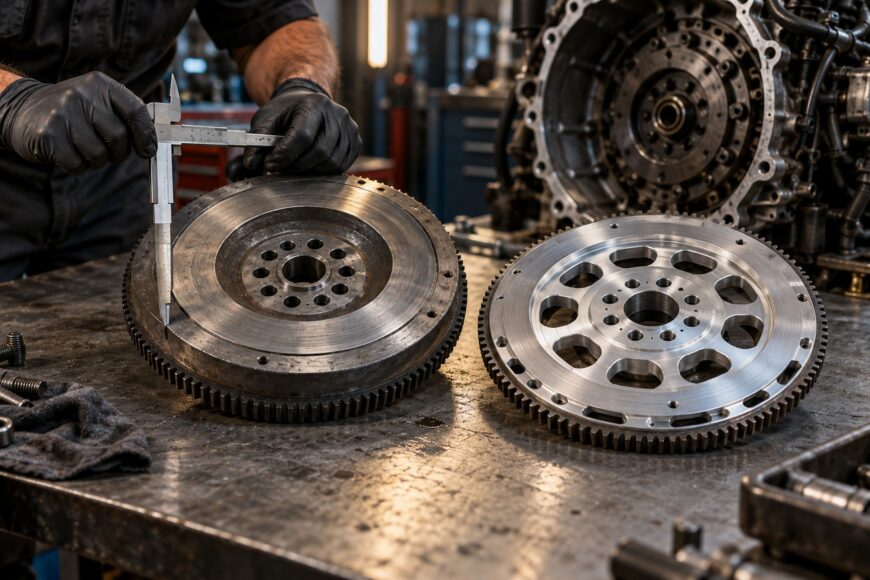
Rotational inertia describes how strongly a rotating component resists a change in speed. It depends on total mass and on how that mass is distributed around the axis. Two flywheels with the same weight can therefore produce different throttle-response results if one keeps more of its mass near the outer rim.
Mass at the outer radius contributes more strongly to inertia than an equal amount of mass close to the center. Removing material from the rim can reduce inertia more effectively than removing the same mass around the hub. This is why a quoted flywheel weight is an incomplete performance specification.
The engine accelerates more than just the flywheel. The complete rotating system includes the flywheel, clutch disc and pressure plate, crankshaft, pulleys, and other rotating components. A lighter flywheel may produce a smaller real-world change if the clutch assembly or other parts still contribute substantial inertia.
For a meaningful comparison, check the design, mass distribution, and complete clutch package. A supplier’s total weight can help confirm fitment and construction, but it does not by itself predict how quickly the engine will gain or lose rpm.
Why Throttle Response Feels Sharper
The engine must supply torque to accelerate every rotating part connected to it. Lower rotational inertia reduces the torque required for that acceleration, leaving more of the available torque to change engine speed. The immediate result is a faster rise in rpm after a throttle input.
The same principle works during deceleration. When you lift off the throttle, the engine speed falls faster because the rotating assembly stores less energy. That behavior makes rev matching and heel-and-toe downshifts more responsive, since the revs reach the target sooner and the throttle blip requires less delay.
Quick rev changes also make mistakes easier to notice. A throttle blip that is too large can overshoot more abruptly, while a small error during clutch release can produce a sharper driveline response. The car may feel more communicative to an attentive driver and less forgiving during rushed inputs.
A lightweight flywheel does not create additional combustion power. It changes the acceleration of the rotating assembly and the driver’s perception of response; it does not inherently increase the engine’s generated torque or guarantee higher peak dyno power.
The Real Benefits—and the Daily-Driving Costs

The main benefit is easier control of engine speed. Faster rev rise helps during acceleration and gear changes, while faster rev fall can improve rev matching. These gains are most apparent when the engine repeatedly changes speed, rather than when the vehicle simply cruises at a steady rpm.
A flywheel with lower inertia stores less kinetic energy. That energy normally helps smooth torque pulsations between combustion events and gives the engine a buffer during clutch engagement. With less stored energy, a poorly timed launch can pull the engine below stable idle more quickly and make stalling easier.
Uphill starts, parking maneuvers, and stop-and-go traffic expose this characteristic clearly. The driver may need more precise clutch release and throttle control, and frequent small throttle corrections can become part of normal low-speed driving. A heavy vehicle, a short first gear, or an engine with limited low-rpm torque can make the change more apparent.
Low-cylinder-count engines and engines with an uneven or unstable idle can also feel less smooth after inertia is reduced. The lighter assembly has less capacity to mask speed fluctuations, so calibration quality and engine condition matter more. Anti-stall software can reduce some symptoms, while the mechanical reduction in stored rotational energy remains.
High-revving sports engines generally show the response benefit more clearly because they are used through larger and faster rpm changes. A low-revving road engine may gain useful response, yet its low-speed refinement, launch behavior, and transmission noise can matter more in daily service.
Dual-Mass Versus Single-Mass: The Damping Trade-Off
A dual-mass flywheel is an engineered damping device as well as a rotating mass. Internal springs filter torsional oscillations between the engine and transmission, reducing the amount of crankshaft pulse energy that reaches the gearbox. Replacing it with a single-mass flywheel changes the drivetrain’s damping system as well as its inertia.
The single-mass design can sharpen rev changes, but it may transmit more torsional fluctuation and gear backlash into the transmission. Gearbox rattle is often most noticeable at idle or with the clutch engaged. Some owners find that it becomes less prominent around 1400–1500 rpm, although that range is neither a universal cure nor a fault threshold.
Noise levels depend on more than flywheel type. Gear backlash, clutch-disc damper behavior, manufacturing accuracy, alignment, balance, and gearbox condition can all influence the result. A conversion that sounds acceptable in one vehicle may be intrusive in another with different clearances or transmission wear.
Unusual vibration, noise that changes sharply with clutch position, or symptoms that worsen with temperature deserve inspection rather than automatic acceptance as a normal conversion characteristic. The practical question is whether the noise follows the expected operating pattern and whether the complete installation is correctly balanced and aligned.
How to Compare and Choose a Lightweight Flywheel
Start with the intended use and the complete rotating system. A track-focused vehicle may tolerate more noise and launch sensitivity than a commuter, while a heavy street car can expose the disadvantages of low inertia during every parking maneuver. The right comparison describes behavior, damping, and compatibility together.
- Compare moment of inertia and mass distribution, especially the amount of mass retained near the outer radius.
- Evaluate the flywheel, clutch disc, pressure plate, and damper type as one package.
- Confirm compatibility with the clutch components, starter and ring gear, sensors, balance requirements, and engine interface.
- Check whether the clutch and transmission can handle the engine’s torque output and the intended use.
- Consider idle calibration and anti-stall behavior, since faster rpm drop can expose limitations in those systems.
- Review the condition of the transmission, mounts, crankshaft interface, and related rotating components before installation.
Balance and alignment deserve particular attention because a lightweight part does not compensate for inaccurate machining or installation. Excess runout, incorrect hardware, or poor balance can create vibration that is wrongly attributed to the design’s lower inertia.
Product data should identify the compatible clutch arrangement and damping strategy, rather than presenting weight as the only meaningful specification. Comparing a bare flywheel with a complete factory clutch assembly can produce an inaccurate expectation of the final response.
Flywheel Choices: Response, Damping, and Drivability
These configurations serve different priorities. The practical result depends on the complete rotating system, gearing, vehicle mass, engine torque curve, and damping design.
| Configuration | Inertia behavior | Rev changes | Torsional isolation | Low-speed refinement and noise | Typical fit |
|---|---|---|---|---|---|
| Stock dual-mass setup | Higher system inertia with a design matched to the vehicle | More measured rise and fall | Strong isolation through internal damping springs | Usually the quietest and smoothest option at idle and during launches | Daily driving, heavy vehicles, and applications where refinement matters |
| Lightweight single-mass setup | Lower inertia, depending on the flywheel, clutch, and radius distribution | Sharper rise and faster fall | Reduced torsional filtering compared with the dual-mass arrangement | More sensitivity to stalling and possible gearbox rattle, especially at idle or with the clutch engaged | Drivers prioritizing direct response and accepting more noise and launch effort |
| Lighter setup retaining the relevant damping strategy | Reduced inertia while preserving more of the intended damping behavior where the design allows | Quicker changes with a more controlled transition than some single-mass conversions | Greater isolation than an undamped or lightly damped conversion, subject to the specific design | Potentially better refinement, although compatibility and durability still require verification | Applications seeking response with less compromise in everyday drivability |
The third category is design-specific and cannot be assumed from the word “lightweight.” Some systems retain meaningful damping, while others primarily reduce mass. Check the actual clutch and flywheel architecture before treating the configuration as an equivalent replacement.
A stock dual-mass unit may feel slower to rev yet remain easier to drive smoothly and quieter in traffic. A single-mass conversion may feel more immediate on a spirited road or track drive, while its extra rattle and faster rpm loss can become tiring during commuting.
Dyno Evidence, Common Mistakes, and the 15% Claim
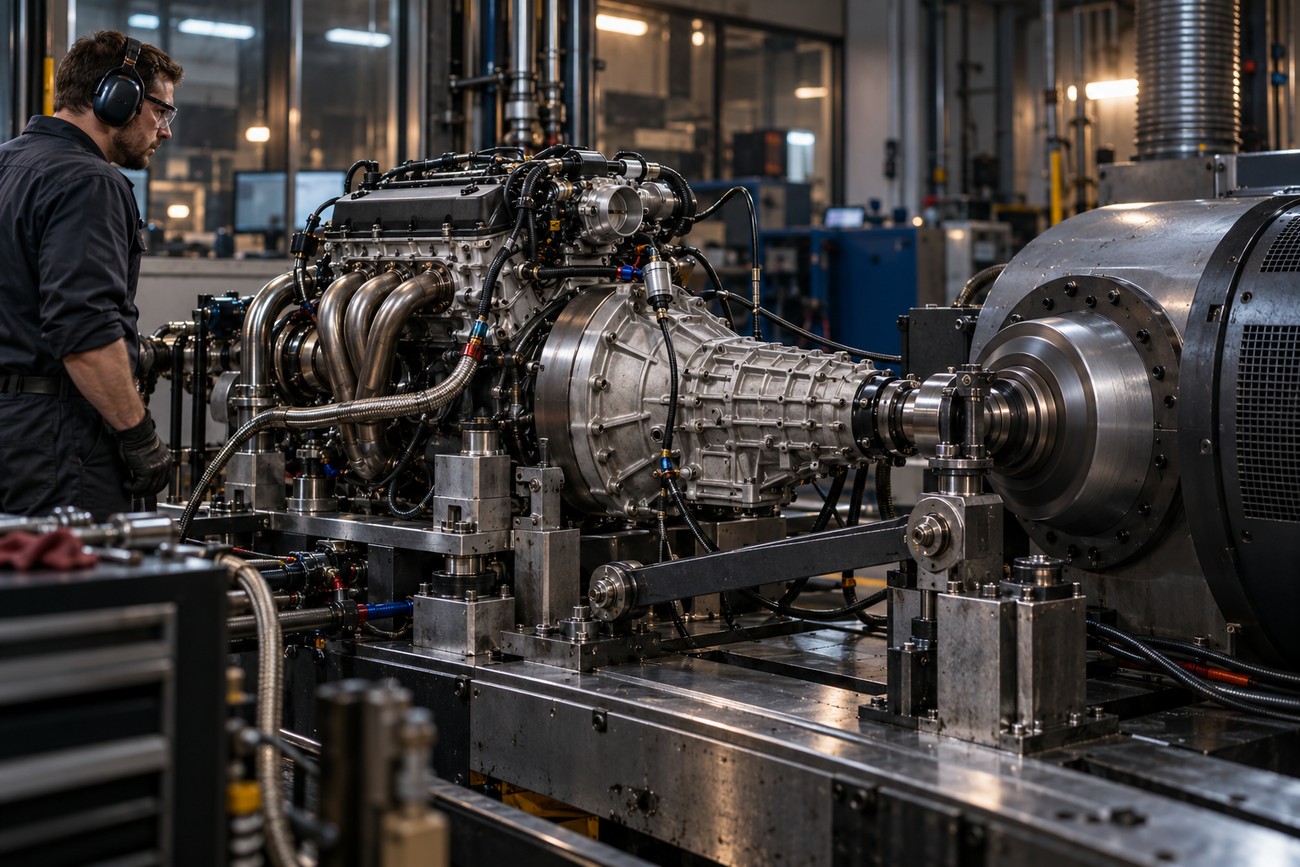
Driver sensation and measured acceleration answer related but different questions. SAE-style inertia dyno methods evaluate torque and power from the acceleration of a known inertia. They do not measure throttle response from subjective feel alone.
A test system with different inertia can change the rate at which the engine accelerates and therefore affect how results are interpreted. That does not mean the flywheel has created combustion power. At a constant speed, the benefit of reduced inertia is usually much smaller because inertia primarily affects changes in engine speed, while maintaining established rotation requires far less acceleration torque.
Buying by advertised weight is a common error. The relevant comparison includes moment of inertia, mass distribution, the clutch disc and pressure plate, and the remaining rotating parts. Expecting a horsepower increase is another mistake, since the primary change is engine-speed acceleration and deceleration.
Compatibility failures can create more serious consequences than a disappointing response change. The starter and ring gear, sensors, balance, clutch components, damping, and transmission torque capacity all need to match the application. Idle control and anti-stall calibration also deserve attention because the engine may lose rpm faster than the original system expected.
Commercial material sometimes presents an “up to 15%” response improvement. That is a product-specific marketing claim with insufficient universal verification, not a transferable benchmark. No universal response percentage applies across different gearing, vehicle masses, engine speeds, torque profiles, and complete rotating systems.
Frequently asked questions
The questions below address common differences in noise, launch behavior, and engine response. They also explain how installation quality and drivetrain condition affect the outcome. Use the symptoms and operating conditions together when assessing a conversion.
How can you tell normal gearbox rattle from a flywheel or clutch problem?
Begin by recording when the noise occurs: at idle or higher rpm, with the clutch engaged or depressed, and with the engine cold or fully warm. A conversion-related rattle often follows a repeatable rpm and clutch-position pattern and may lessen around 1400–1500 rpm. A noise that changes unpredictably, is accompanied by vibration, clutch slip, difficult engagement, or worsening temperature-related symptoms requires further inspection.
Check backlash, clutch-disc damper condition, flywheel balance, alignment, fasteners, and transmission condition before assigning blame to the flywheel. Comparing the sound with the clutch engaged and disengaged helps isolate whether the noise is coming from unloaded transmission gears, the clutch assembly, or the engine-to-flywheel interface.
What are the downsides to a lightweight flywheel?
The main disadvantages are easier stalling, less smooth launches, faster rpm loss during shifts or uphill driving, and more sensitivity to clutch and throttle timing. A single-mass conversion can also increase gearbox rattle because it provides less torsional isolation than a dual-mass design.
These effects are more intrusive in heavy vehicles, engines with weak low-rpm torque, and vehicles used in traffic or frequent parking maneuvers. Installation quality, clutch damping, gearbox backlash, and idle calibration can determine whether the compromise is mild or unacceptable.
What are the benefits of a lightened flywheel?
A lightened flywheel reduces rotational inertia, allowing the engine to gain and lose rpm faster. That can improve throttle response, make rev matching quicker, and give the driver more immediate control during acceleration and gear changes.
The benefit is strongest during engine-speed changes and depends on the complete rotating system and gearing. It does not inherently increase combustion power, and a commercial percentage claim should be treated as a product-specific statement rather than a general performance expectation.