An inconsistent launch and a harsh no-lift shift can both look like an RPM-setting problem. In practice, activation logic, torque reduction, clutch-switch behavior, and the driver’s inputs often matter just as much as the target speed. Launch control manages engine torque around a target RPM, while flat shift briefly reduces torque during a throttle-open gear change.
A calibration-first approach starts with signals and logs, then moves to cut strength and duration. Neither function guarantees traction, protects the drivetrain, or compensates for a clutch that is released slowly or a surface with limited grip.
- What launch control and flat shift actually control
- Tune the launch around grip, not just an RPM target
- Set flat-shift intervention to match the gear change
- Diagnose missed cuts before adding more intervention
- Frequently asked questions
- What should I save before changing either calibration?
- What should I check if launch control or flat shift does not activate?
- How can I tell whether torque returns too early during a shift?
What launch control and flat shift actually control
Launch control is ECU torque intervention used to manage a target engine RPM during a launch. Depending on the strategy, the ECU may use ignition cut, fuel cut, ignition retard, throttle intervention, or a combination. The target is controlled by reducing effective engine torque, so the displayed RPM is only one part of the result.
Flat shift, also called a no-lift shift, keeps the accelerator pressed while the ECU temporarily reduces engine torque for a gear change. A clutch-pedal signal may trigger the intervention, although the exact requirements differ by ECU. The throttle can remain open while ignition timing, fuel delivery, or another torque path is being controlled.
Ignition cut, fuel cut, and retard are distinct calibration choices. They produce different engine responses and different effects on exhaust temperature, torque return, and driveline shock. A longer fuel cut is therefore not automatically safer than a shorter ignition intervention or a controlled retard strategy.
Soft and hard cut also need careful interpretation. In Speeduino, soft cut slows RPM rise, while hard cut stops ignition pulses until RPM falls. A soft cut may fail to hold a precise launch speed, and these definitions should not be generalized to every ECU because manufacturers use different control strategies.
Tune the launch around grip, not just an RPM target
Begin by confirming the activation conditions in the ECU documentation and in the log. Throttle position, vehicle speed, RPM, and sometimes clutch-switch state can govern launch activation. Thresholds are calibration-specific, so a value that works on another engine or ECU is only a reference for investigation, not a safe baseline.
Establish a conservative baseline before changing the cut method. Check that the launch input activates consistently, then evaluate how the engine responds as RPM rises through the target. Hysteresis matters: without sensible entry and exit behavior, the ECU can switch repeatedly around a threshold and make the launch feel erratic.
Clutch release and tire grip determine how much of the available torque reaches the surface. A slow clutch release can keep the clutch in its slipping zone, producing heat and a burned smell even when the ECU controls RPM correctly. Launch control limits torque; it does not remove clutch heat or loads on gears, CV joints, driveshafts, and the differential.
Launch behavior is also an exhaust-temperature decision. Sustained retard, a rich or lean mixture, boost-building behavior, and the time spent holding the launch can all change the thermal risk, so a brief test result does not describe every operating condition.
Use controlled tests and allow the clutch and driveline to cool between attempts. Watch wheelspin, RPM oscillation, boost response, and the driver’s clutch timing together. A launch that sounds clean may still be loading the drivetrain sharply if torque returns while the tires are still slipping.
Set flat-shift intervention to match the gear change
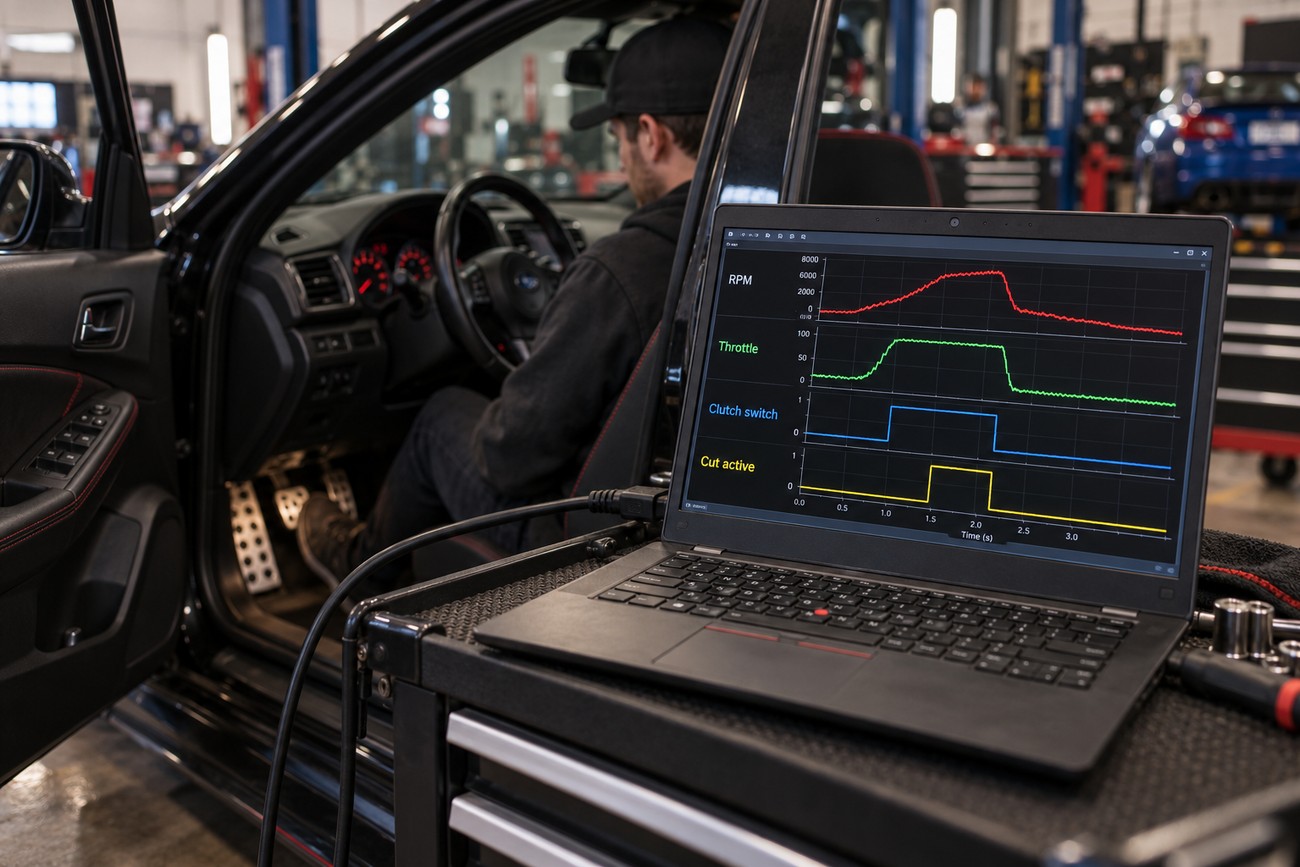
Flat shift depends on a reliable trigger. On Speeduino, launch and flat-shift functions depend on the clutch-switch signal; other ECUs may use a different input or logic path. Confirm the switch state in the log during pedal movement, including whether it changes cleanly or bounces near the activation point.
Log RPM, accelerator position, clutch-switch state, and cut timing for each test. The useful comparison is the relationship between clutch movement, torque intervention, gear engagement, and torque return. If the cut ends too early, the engine can reapply torque before the next gear is fully settled, creating a sharp jolt or wheelspin.
An overly long cut creates the opposite problem: the car loses acceleration while the ECU delays restoring torque. There is no universal flat-shift duration because gear ratios, shift mechanism, engine response, and ECU strategy all affect the event. The aim is enough torque reduction for the mechanical change, followed by a controlled return.
The 1→2 upshift deserves particular caution. Engine RPM normally falls to match the higher gear, and mistimed torque return can make this shift especially abrupt. Ignition cut, retard, and fuel cut should be assessed as separate methods rather than compared through one setting or treated as equivalent safety measures.
Diagnose missed cuts before adding more intervention
If the function does not activate, check the clutch-switch transition, throttle threshold, speed condition, RPM window, and arming logic before increasing cut strength. An incorrect or bouncing switch can prevent activation or create an unexpected cut. A clean-looking calibration table cannot compensate for a signal that changes at the wrong point.
An unexpected cut usually points to an input or condition being met earlier than intended. Compare the logged switch state and pedal position with the ECU’s activation rules. If torque returns harshly, inspect the return timing, clutch release, and gear engagement before simply extending the intervention.
Repeated launches and flat shifts accumulate clutch and drivetrain stress, even when every event appears successful. Torque returning abruptly can load gears, CV joints, driveshafts, and the differential. Stop testing if clutch smell, worsening shift quality, unusual noise, or persistent wheelspin appears; cooling and mechanical inspection are more useful than another run.
Copying another vehicle’s map is an unreliable shortcut because ECU logic, engine torque, transmission, tires, and drivetrain layout differ. A prolonged fuel cut is not automatically safer or better than a calibrated ignition cut or retard strategy. Change one relevant parameter at a time, save the previous version, and compare logs under repeatable conditions.
Frequently asked questions
Keep the original calibration and comparable logs before testing. If a function misses or triggers unexpectedly, verify its inputs and activation rules first. For a harsh shift, compare the end of the cut with clutch movement and gear engagement.
What should I save before changing either calibration?
Preserve the original map as a separate, read-only baseline and save a comparable log showing RPM, accelerator position, vehicle speed, clutch-switch state, and the relevant cut event. Record the test conditions with it: gear, surface, tire condition, clutch temperature if available, and whether the test was a launch or a flat shift.
Make each change traceable by noting the parameter, previous value, new value, and test result. Keep the original calibration available for rollback, and restore it if the change introduces harsh torque return, missed activation, excessive heat, or prolonged loss of drive. Comparable logs make it easier to decide whether the change improved control or merely changed the symptom.
What should I check if launch control or flat shift does not activate?
Check the clutch-switch transition, throttle threshold, vehicle-speed condition, RPM window, and arming logic in both the ECU configuration and the log. A switch that bounces or changes too late can prevent activation even when the calibration values appear correct.
Confirm each input during pedal movement and compare the recorded states with the ECU’s activation rules before increasing cut strength or duration.
How can I tell whether torque returns too early during a shift?
Compare clutch movement, gear engagement, RPM, accelerator position, and the end of the torque intervention in the log. If torque returns before the next gear is fully engaged, the shift may produce a jolt, wheelspin, or driveline shock.
Adjust one relevant parameter at a time and test under comparable conditions, allowing the clutch and drivetrain to cool between attempts.