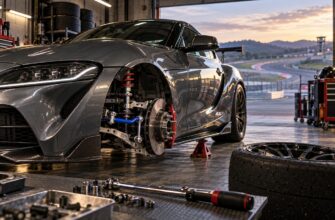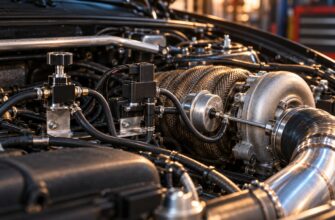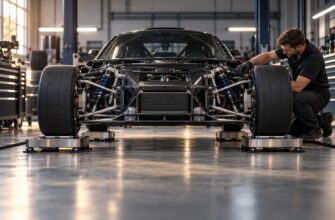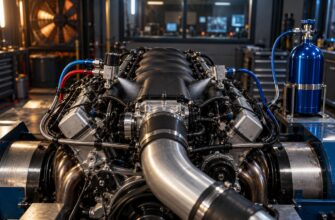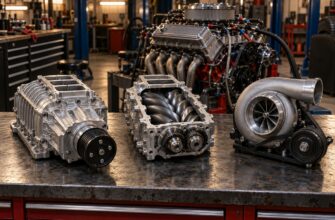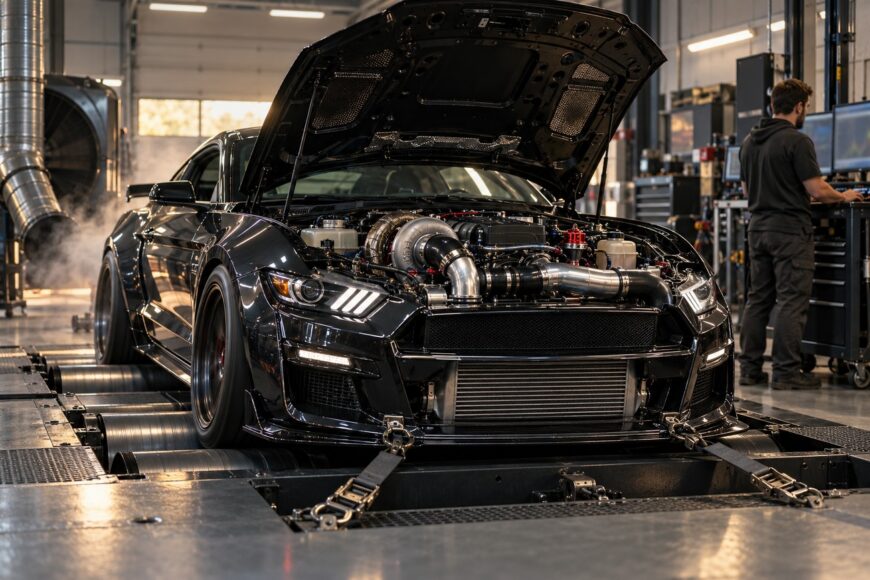
More boost can produce impressive dyno numbers while increasing knock risk, heat, turbocharger wear, and drivetrain stress. A car may feel strong during one pull, then lose power after heat soak, enter limp mode, or expose clutch slip once the extra torque reaches the road.
Safe power comes from the complete system: fuel delivery, charge-air cooling, oil control, ECU calibration, engine condition, and transmission capacity. The turbocharger supplies airflow, yet every supporting system determines whether that airflow becomes repeatable performance or an expensive failure.
The practical standard is controlled output under realistic conditions. That means stable fueling, controlled knock and temperatures, predictable torque delivery, and mechanical loads that the engine and drivetrain can tolerate over repeated use.
- What Safe Power Actually Means
- How a Turbo Upgrade Creates More Power—and More Risk
- The Supporting Hardware That Makes Extra Boost Sustainable
- ECU Calibration: Preserving the Safeguards That Matter
- A Practical Validation Process: Logs Before Numbers
- Why Turbo Builds Fail in Real-World Driving
- A Safer Turbo Upgrade Path
- Upgrade Decisions at a Glance
- Frequently asked questions
- How can you make a turbo more powerful without simply raising boost?
- How much horsepower does an upgraded turbo add?
- What kills a turbocharger first?
What Safe Power Actually Means
Safe power is repeatable power with controlled knock, temperatures, fueling, and mechanical load. A single peak dyno figure says little about how the car behaves after repeated acceleration, in hot weather, or under a high-gear load. A useful calibration continues to deliver consistent output without relying on uncontrolled detonation or excessive thermal stress.
The same boost level creates different risks on different engines. Compression ratio, combustion-chamber design, fuel quality, cooling capacity, exhaust flow, factory torque limits, and the condition of the piston-and-rod assembly all affect the available detonation margin. The transmission, clutch, half-shafts, and differential also impose limits that may appear only after torque rises.
Increasing boost without correcting fuel delivery and ignition timing raises detonation risk. A factory turbocharged engine may have useful hardware capacity, yet that does not make it automatically ready for aggressive tuning. Its original calibration may depend on specific airflow, exhaust backpressure, fuel quality, and thermal conditions.
Load does not always rise in a neat proportion to the power figure. A modest power increase can create a disproportionate increase in exhaust heat, piston loading, valve temperature, turbocharger speed, and drivetrain shock. This is why “safe” cannot be defined by a universal horsepower or boost limit.
How a Turbo Upgrade Creates More Power—and More Risk
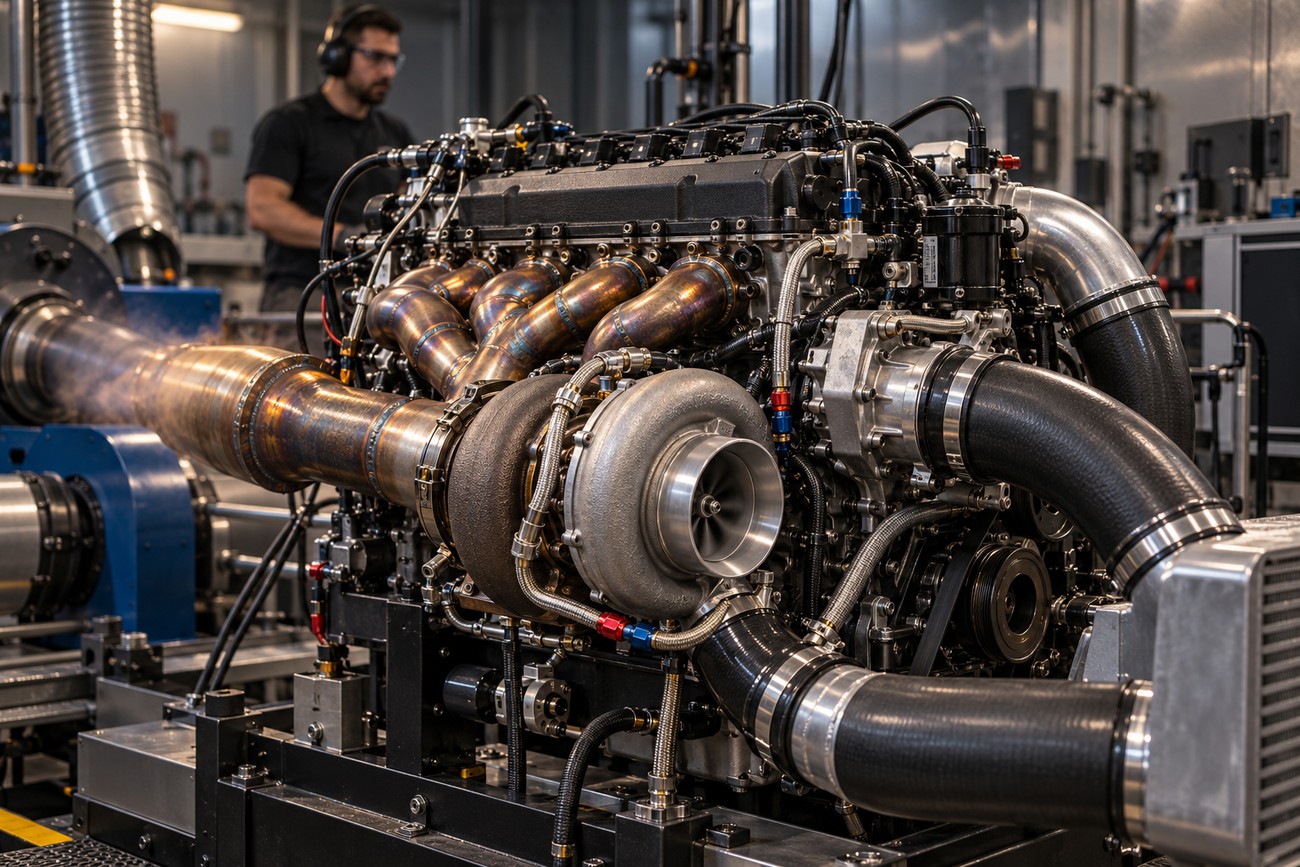
A turbocharger raises engine airflow by using exhaust energy to drive a turbine connected to a compressor. More air can support more fuel and therefore more power, provided the compressor, turbine, fuel system, and calibration operate within a suitable range. A turbo can reduce parasitic losses compared with a mechanically driven compressor, although it still depends on efficient exhaust flow, intake sealing, and quality lubrication.
Boost pressure alone is an incomplete measure of power or safety. Two turbochargers can produce the same manifold pressure while moving different amounts of air, operating at different efficiencies, and creating different exhaust backpressure. A less efficient combination may generate more charge heat and turbine work, leaving less useful energy for the engine.
A larger turbo may support more airflow at higher engine speed, yet it often worsens low-rpm response and city drivability. If the turbine is too large for the intended use, the car may feel less responsive before it reaches the part of the rev range where the turbo works well. The best choice therefore depends on the desired torque curve, operating range, fuel, and supporting hardware.
Turbocharger reliability also depends on details that are easy to overlook during a parts-focused build. Correct oil supply, an unrestricted and correctly routed oil drain, suitable oil, a sealed intake, and a functioning PCV system are prerequisites for stable operation. Poor oil control or an intake leak can create unstable boost, oil consumption, smoke, or rapid turbocharger damage even when the compressor itself is capable of the target airflow.
The Supporting Hardware That Makes Extra Boost Sustainable
Extra boost makes the fuel system, cooling system, ignition system, and exhaust system work as one package. A weak fuel pump, dirty injector, worn spark plug, or loose intake connection can undermine an otherwise capable turbo upgrade. Hardware selection should begin with the expected airflow and thermal load, then account for the engine’s existing condition.
Higher intake-air temperature generally causes the ECU to remove ignition timing and can increase knock tendency. This explains the common complaint that a car feels strong on the first acceleration and dull after several more. An intercooler with insufficient heat capacity may reduce temperature briefly while still allowing heat soak during repeated use.
More boost usually raises thermal load on pistons, exhaust valves, the turbocharger, and the catalytic converter. An intercooler and oil cooler are therefore part of the power system rather than cosmetic add-ons. Exhaust flow, downpipe design, intake restriction, and heat management influence how hard the turbo must work to deliver the required air.
Oil temperature and oil quality matter because the turbocharger uses the lubricant for bearing protection and often for cooling. The PCV system must also remain functional: excessive crankcase pressure can disturb oil control and contribute to leaks. Intake and charge-pipe connections should be checked under pressure, since a small leak can create mixture errors, compressor work, and inconsistent boost control.
Supporting hardware should include the drivetrain. Higher torque can exceed clutch capacity or trigger slip in an automatic or dual-clutch transmission. Half-shafts and differentials can also become weak links. A build that survives a dyno pull may still impose damaging shock loads during road use, especially when torque arrives early.
ECU Calibration: Preserving the Safeguards That Matter
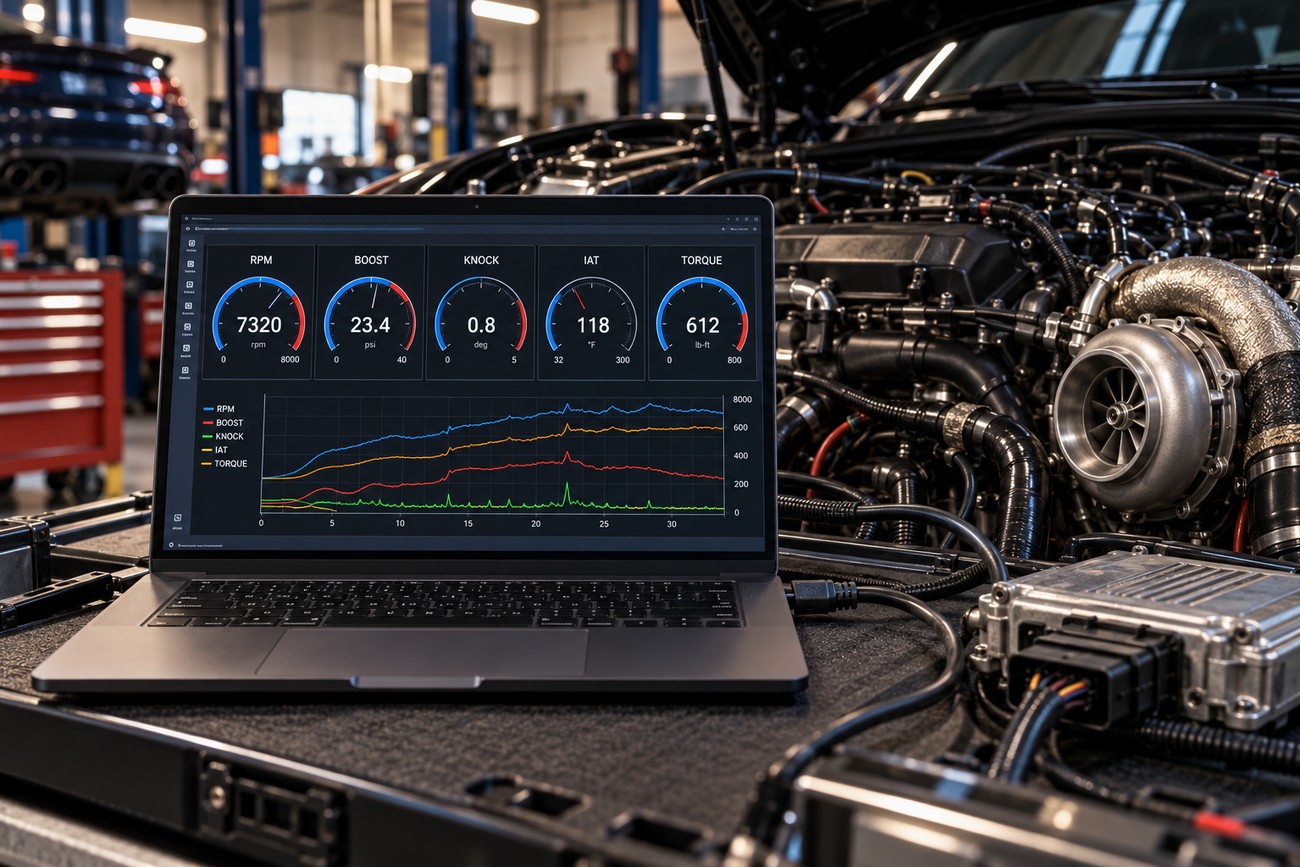
A turbo upgrade requires revised fueling, ignition timing, boost control, and torque management. A generic map cannot account for every combination of turbocharger efficiency, injector behavior, fuel quality, exhaust backpressure, intercooler performance, and engine condition. Calibration must describe how the specific hardware behaves across load, speed, temperature, and gear.
Factory ECU strategies commonly use knock sensors, MAF/MAP data, modeled EGT, and torque limits as protective controls. These systems can reduce ignition advance, close the throttle, limit boost, enrich the mixture, or request torque intervention when conditions move outside the expected range. Retaining some factory safeguards is valuable, although they cannot compensate for incorrect hardware or calibration.
A suitable calibration may deliberately limit low-rpm boost and early torque to protect the piston-and-rod assembly and drivetrain. That choice can produce a smoother torque curve and better traction, even if it reduces a headline peak. Early torque is often harder on rods, pistons, clutch components, and transmission parts than a controlled increase higher in the rev range.
Fuel delivery must remain stable during the complete load event. The tuner needs to account for injector capacity, pump performance, fuel pressure behavior, and the fuel actually available to the driver. Ignition timing should respond to the engine’s detonation margin rather than to an attractive dyno number.
Claims of roughly 20–50% more power from software alone are not universal. Actual gains depend on fuel quality, temperature, turbo headroom, and supporting hardware. A calibration that works on a cool day with suitable fuel may require different limits in a hot climate or under repeated road use.
A Practical Validation Process: Logs Before Numbers
Validation starts with a baseline inspection. Check compression or other available indicators of engine condition, inspect plugs and fluid levels, verify intake and exhaust sealing, confirm fuel pressure behavior, and assess clutch or transmission operation. A baseline log helps separate a genuine upgrade effect from a pre-existing fault.
After installation, use controlled pulls and record AFR, knock corrections, IAT, modeled EGT, fuel pressure, and transmission slip. These values should be reviewed together because a normal AFR reading does not prove that temperatures, combustion stability, or mechanical load are acceptable. The absence of audible knock also does not prove that combustion and thermal loads are safe.
Compare runs under similar conditions, then retest after each meaningful hardware or calibration change. Hot weather is especially useful for validation because it exposes charge-air and cooling weaknesses that may remain absent during a cool dyno session. A car that feels faster can still be losing timing or entering protective intervention.
Dyno output remains useful when its method and conditions are understood, yet it is only one piece of evidence. Road logs show how the car manages heat, gear changes, traction, and transmission load. Repeatable behavior across those conditions is a better safety indicator than the highest recorded peak.
Why Turbo Builds Fail in Real-World Driving
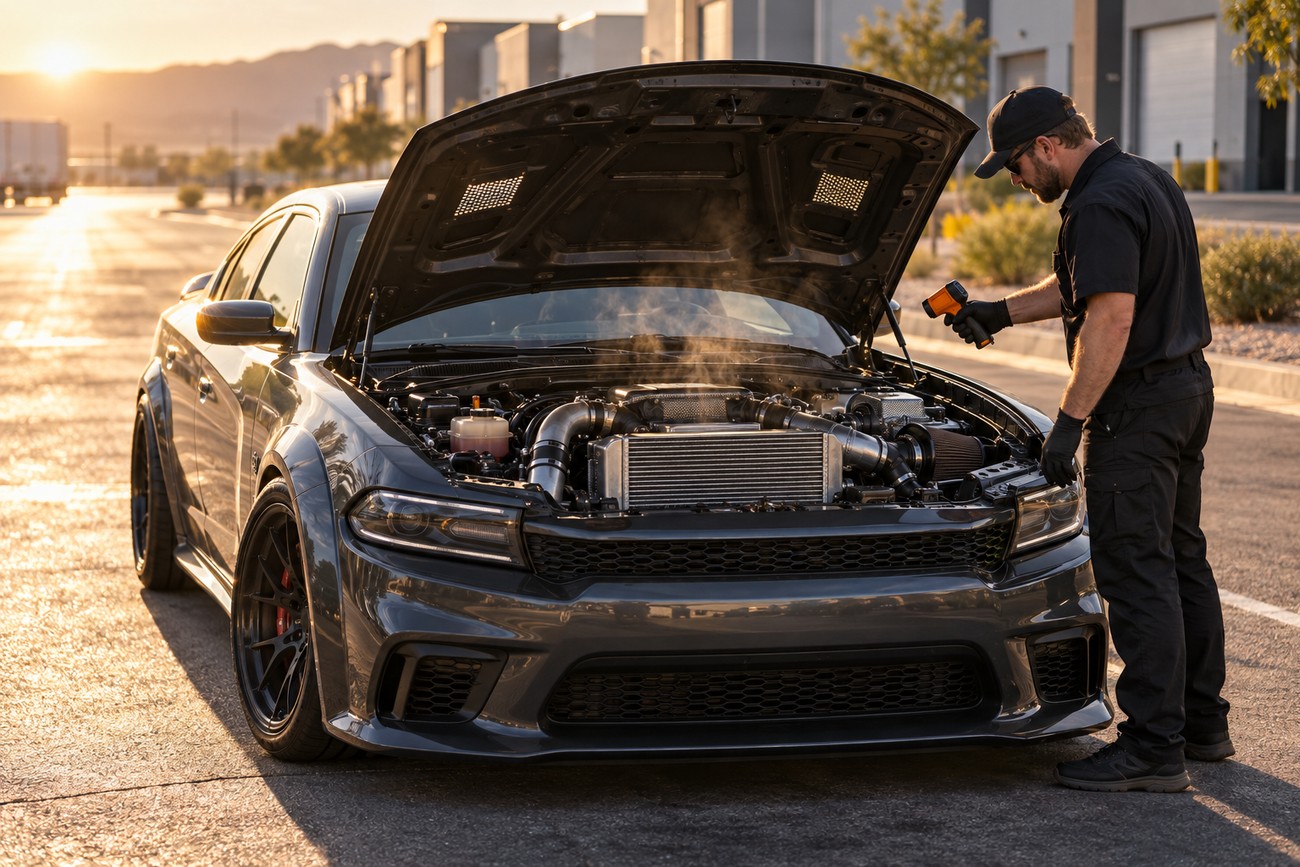
Power reduction in hot conditions commonly reflects rising intake temperature and ECU protection rather than a simple lack of peak boost. As IAT rises, the ECU may remove ignition timing or limit torque to control knock tendency. A marginal intercooler, restrictive airflow path, or inadequate heat management can therefore make a car feel inconsistent after repeated acceleration.
Detonation warnings, mixture faults, or check-engine lights can result from several system-level problems. Possible causes include insufficient fuel delivery, an intake leak, incorrect sensor scaling, unsuitable spark plugs, poor fuel, or a calibration that does not match the hardware. Diagnosis requires logs and inspection; the fault code alone rarely identifies the complete cause.
Persistent high IAT after an intercooler installation may indicate poor airflow through the core, heat soak, incorrect ducting, or a charge leak. Turbo smoke or oil use may relate to oil supply, drain routing, crankcase pressure, bearing damage, or an intake-side problem. These symptoms should be investigated before further power runs.
Limp mode can be a protective response to overboost, underboost, knock correction, fuel-pressure deviation, or torque-model disagreement. Repeatedly clearing the fault without correcting the cause increases risk. The same applies to clutch or gearbox failure: the first weak link after torque rises may be the clutch, automatic or dual-clutch transmission, half-shafts, or differential rather than the engine.
A marketed stage package may exceed the capacity of stock cooling, fueling, torque management, or drivetrain hardware. Thermal overload, poor oil control, and uncontrolled knock can shorten service life faster than the headline power increase suggests. Greater output also brings practical costs, including reduced low-speed smoothness, more frequent inspection, and faster wear of components that were already aged.
A Safer Turbo Upgrade Path
Begin with engine health. Check for existing oil consumption, boost leaks, PCV faults, ignition problems, cooling issues, and unstable fuel pressure before selecting a turbocharger. Installing a larger unit over unresolved faults makes calibration harder and can turn a minor defect into a major failure.
Define the use case, available fuel, climate, and desired torque curve before choosing the turbo. A street car used in traffic may benefit from earlier response and controlled torque, while a track-oriented car may accept later response in exchange for airflow at higher engine speed. Engine condition and drivetrain capacity belong in the same decision.
Match the supporting hardware to the turbocharger. This may include the intercooler, fuel pump, injectors, spark plugs, oil cooler, exhaust, intake, PCV system, and clutch or transmission strategy. Intake and exhaust sealing, PCV health, and oil-feed and drain integrity are prerequisites for stable turbo operation.
Calibrate conservatively, with boost control and torque management shaped around the engine and transmission. A controlled torque curve can be safer and more usable than a sharp early torque spike with a higher peak. The calibration should also preserve appropriate ECU interventions where possible and avoid treating protective limits as obstacles to remove.
Finish with logging and real-world retesting. Review AFR, knock corrections, IAT, modeled EGT, fuel pressure, and transmission slip under representative conditions. The upgrade sequence is complete only when the car behaves consistently after heat soak, across the intended gears, and with the fuel and climate the owner will actually use.
Upgrade Decisions at a Glance
Each component should be evaluated as part of the complete system. The evidence after installation must cover thermal behavior, fueling, knock control, and drivetrain response rather than peak power alone.
| Upgrade area | Problem addressed | Risk if neglected | Evidence after installation |
|---|---|---|---|
| Turbocharger | Insufficient airflow or poor efficiency at the intended load | Slow response, excessive compressor or turbine work, overspeed, or high exhaust heat | Boost behavior, airflow data, modeled EGT, IAT, and repeat logs across the useful rev range |
| Intercooler | Charge-air temperature during sustained or repeated load | Timing reduction, increased knock tendency, heat-soak power loss, and inconsistent output | IAT behavior before and after repeated pulls, with ambient conditions recorded |
| Fuel system | Stable fuel delivery for the required airflow | Fuel-pressure deviation, mixture faults, detonation risk, and possible engine damage | AFR, fuel pressure, injector behavior, and logs at the highest intended load |
| ECU calibration | Correct fueling, ignition, boost control, and torque management | Knock, poor drivability, limp mode, uncontrolled torque, or excessive heat | Knock corrections, AFR, IAT, modeled EGT, torque intervention, and repeatability |
| Oil cooling | Lubricant temperature control under higher turbo and engine load | Oil degradation, bearing wear, coking, and unstable turbocharger lubrication | Oil-temperature behavior, inspection of supply and drain routing, and fluid condition |
| Drivetrain | Transmission of the increased torque without slip or shock | Clutch slip, transmission faults, half-shaft or differential damage | Transmission slip data, clutch behavior, shift quality, and inspection under load |
Frequently asked questions
How can you make a turbo more powerful without simply raising boost?
Improve the amount of useful air the engine receives at the same pressure. A compressor operating in a more efficient part of its map can move air with less heat, while a less restrictive turbine and exhaust path can reduce turbine backpressure. Better wastegate control can keep the turbo near the required operating point instead of forcing unnecessary pressure.
Charge-air temperature is equally important. A more effective intercooler, sealed intake path, and suitable ducting can preserve denser air and reduce the ignition timing reduction caused by high IAT. The result may be more repeatable power at the same pressure because the engine spends less energy overcoming heat and backpressure.
How much horsepower does an upgraded turbo add?
There is no universal horsepower gain. The result depends on the engine’s airflow capacity, fuel quality, turbo sizing, calibration, exhaust system, intercooler, temperature, and the dyno method used to measure output. A turbo with substantial airflow capacity may deliver little useful gain if the fuel system or calibration cannot support it.
Compare claims only when the test conditions are comparable. Check whether the same fuel, intake, exhaust, correction method, ambient conditions, and drivetrain were used, then look for logs showing stable fueling, knock control, IAT, and modeled EGT. A peak figure without that context does not establish safe or repeatable power.
What kills a turbocharger first?
Oil starvation is a primary failure risk, along with a blocked or poorly routed oil drain. Incorrect supply pressure, unsuitable oil, contaminated lubricant, and oil coking after high heat can damage the bearing system quickly. The turbocharger also needs correct operating procedure, including sensible heat management after heavy load.
Foreign objects entering through the compressor inlet can damage the wheel, while overspeed can occur when the turbo is pushed beyond its intended operating range or the wastegate cannot control drive pressure. Intake filtration, charge-pipe inspection, oil-feed and drain checks, and boost-control validation should therefore accompany any turbo upgrade.