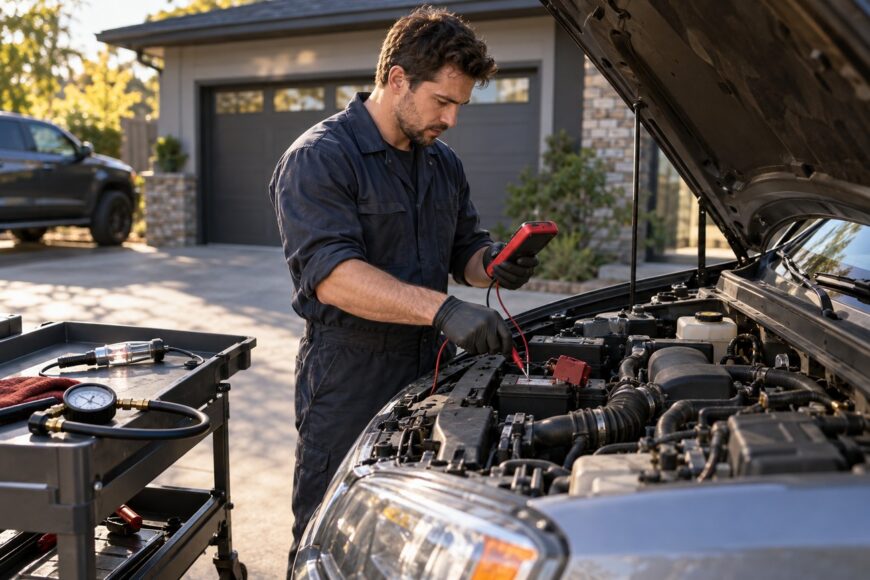
An engine that turns over without firing can make you want to keep the key turned or replace the part that seems most likely to have failed. That approach often converts a starting fault into a flat battery, an overheated starter, or a second problem caused by flooding. A turning starter proves only that some electrical power is reaching the starter motor and that the engine is being rotated.
Cranking does not rule out the battery, fuel system, ignition system, engine-control signals, security system, or mechanical condition. A battery can show a reasonable resting voltage and still lose too much voltage under load. The quickest route is to use the observed behavior to choose the next check: establish how strongly the engine cranks, then separate fuel, spark, control, security, and mechanical possibilities with evidence.
- First, confirm what the car is doing
- Crank-no-start symptoms and the next check
- Check the easy electrical and security causes
- Find out whether fuel is reaching the engine
- Verify ignition without guessing at parts
- If fuel and spark seem present, check signals and mechanical clues
- Why it happens only when cold or only sometimes
- Know when to stop cranking and seek a repair diagnosis
- Frequently asked questions
- Why did the car stop starting right after I refueled?
- How to diagnose a car cranking but not starting?
- What causes a vehicle to crank but not start?
- What sensor can cause a crank-no-start?
- How to start a car that turns over but won’t start?
First, confirm what the car is doing
True crank-no-start means the starter turns the engine at a reasonably consistent speed, yet the engine never runs on its own. That differs from a single click, repeated clicks, no crank, or unusually slow rotation. Clicking or weak cranking points first toward battery power, battery connections, or ground paths; it does not automatically condemn the starter.
Listen to the rhythm of the engine while it turns. A normal, even rhythm generally supports moving toward fuel, ignition, and control checks, although it still does not prove that voltage remains adequate during cranking. An unusually fast or uneven rhythm can point toward a mechanical timing or compression concern and deserves more caution before further attempts.
An engine that fires briefly and then stalls follows a different diagnostic path from one that never catches. Security authorization, fuel delivery, and engine-control faults can all produce that pattern, depending on the vehicle. Before trying again, note warning lights, a flashing security indicator, fuel odor, smoke, unusual clicking, and any metallic or grinding sound.
Use short starting attempts with pauses rather than prolonged repeated cranking. Long attempts can drain the battery and overheat the starter, while repeated fuel injection can wet the plugs and make the next test less clear. The sequence below primarily describes gasoline engines; diesel cold-start concerns, including glow plugs, require a different ignition assessment.
Crank-no-start symptoms and the next check
These symptoms help select the next test. Each is a clue rather than proof that a particular component has failed.
| Observed behavior or clue | Useful next check |
|---|---|
| Slow, weak cranking or repeated clicking | Inspect battery state, terminal tightness, ground connections, and vehicle-specific load-test results before condemning the starter. |
| Brisk, even cranking without firing | Check fuel delivery, gasoline-engine spark, and engine-control signals; a voltage drop under load still needs to be ruled out. |
| Engine fires briefly, then stalls | Check security authorization, fuel delivery, and control signals, using the model-specific scan and starting procedure. |
| Strong fuel odor after attempts | Stop and check for flooding or a leak safely; odor does not prove adequate fuel pressure or identify the failed system. |
| Unusually fast or uneven cranking | Limit further attempts and arrange checks of compression and mechanical timing after basic electrical causes are considered. |
Check the easy electrical and security causes
Start with the fuel level itself, even if the gauge appears to show fuel. A misleading level sender, a gauge that has not moved as expected, or an empty tank can send the diagnosis toward expensive fuel-system parts. If the vehicle has recently been parked on a steep slope, the displayed level may also be less informative than usual.
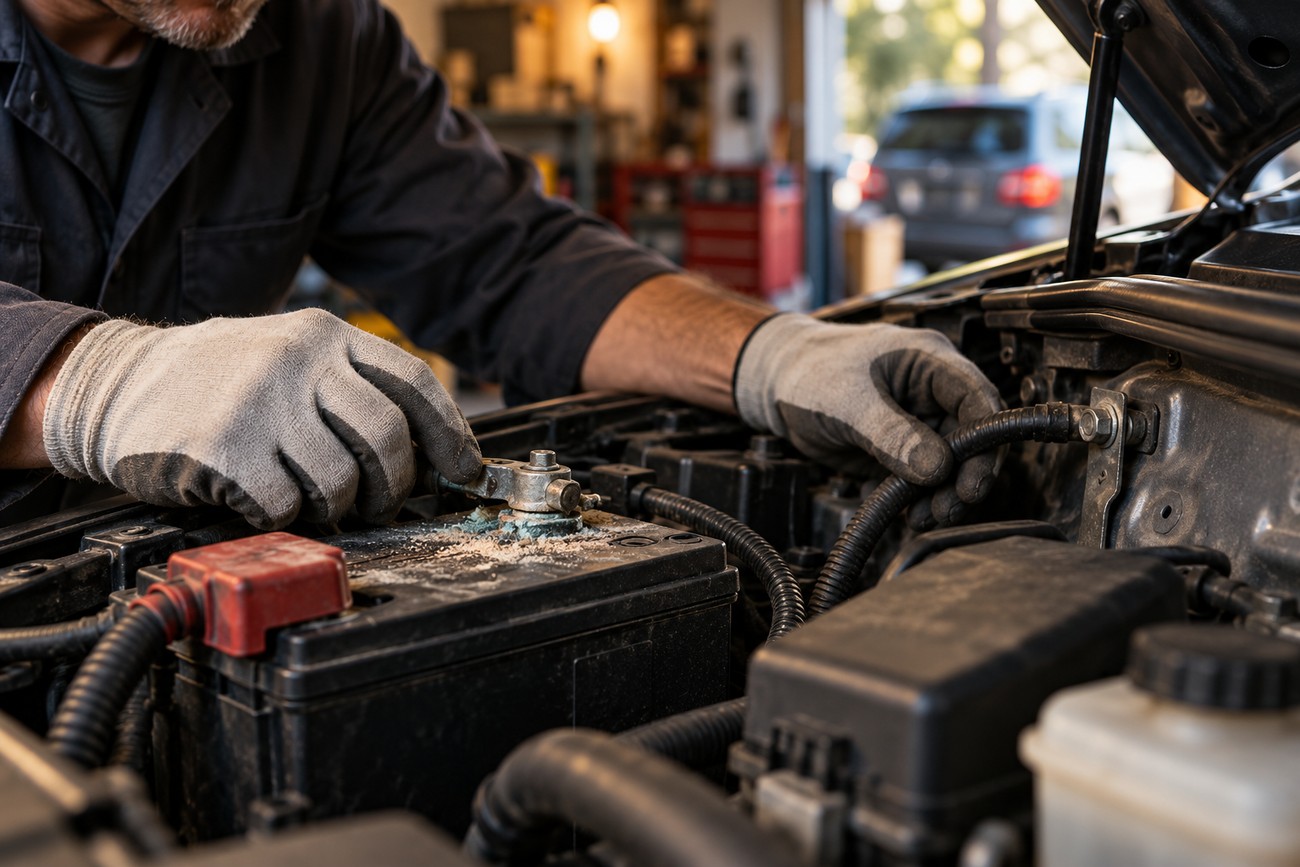
Inspect the battery terminals for looseness, corrosion, or movement, and check the accessible ground connections between the battery, body, and engine. A poor connection can allow enough current for some electrical functions while restricting starter current or creating unstable engine-control voltage. Do not treat a clean-looking terminal as proof of a sound connection; tightness and voltage-drop testing provide better evidence.
A resting 12-volt battery commonly reads about 12.4–12.7 V; resting voltage alone does not prove it can sustain starting loads. A battery may look acceptable before the attempt and fall too far when the starter is engaged. Follow the vehicle-specific procedure for a load test and cranking-voltage test rather than applying one universal pass/fail threshold to every design.
Check the owner’s manual for fuses and relays associated with engine control, ignition, injection, and the fuel pump. A blown fuse may reflect an underlying short, so replacing it repeatedly is unsafe. Also observe the security indicator and try the manufacturer-approved key or start procedure; depending on the vehicle, an immobilizer fault may allow cranking, cause a brief start and stall, or prevent starting in another way.
Find out whether fuel is reaching the engine
With the ignition switched on, many gasoline vehicles produce a short pump hum from the rear seat or tank area. That sound suggests the pump runs; it does not prove adequate fuel pressure or delivery. The pump may be receiving power while a filter, relay, wiring fault, pump-control module, or internal pump problem limits the result.
Fuel-pressure testing requires the correct connection point, pressure specification, and safety procedure for the vehicle. Do not casually open a pressurized fuel line to see whether fuel comes out. A proper test can establish whether pressure is insufficient, while a scan tool or electrical test can help determine whether the pump is being commanded and supplied correctly.
A gasoline spark plug removed after unsuccessful attempts can provide a useful clue. A dry plug may suggest that little or no fuel reached that cylinder; a wet plug shows fuel is present but does not prove correct delivery or identify the failed system. Wetness can also accompany flooding, especially after repeated attempts, so interpret the observation in light of the cranking history.
Verify ignition without guessing at parts
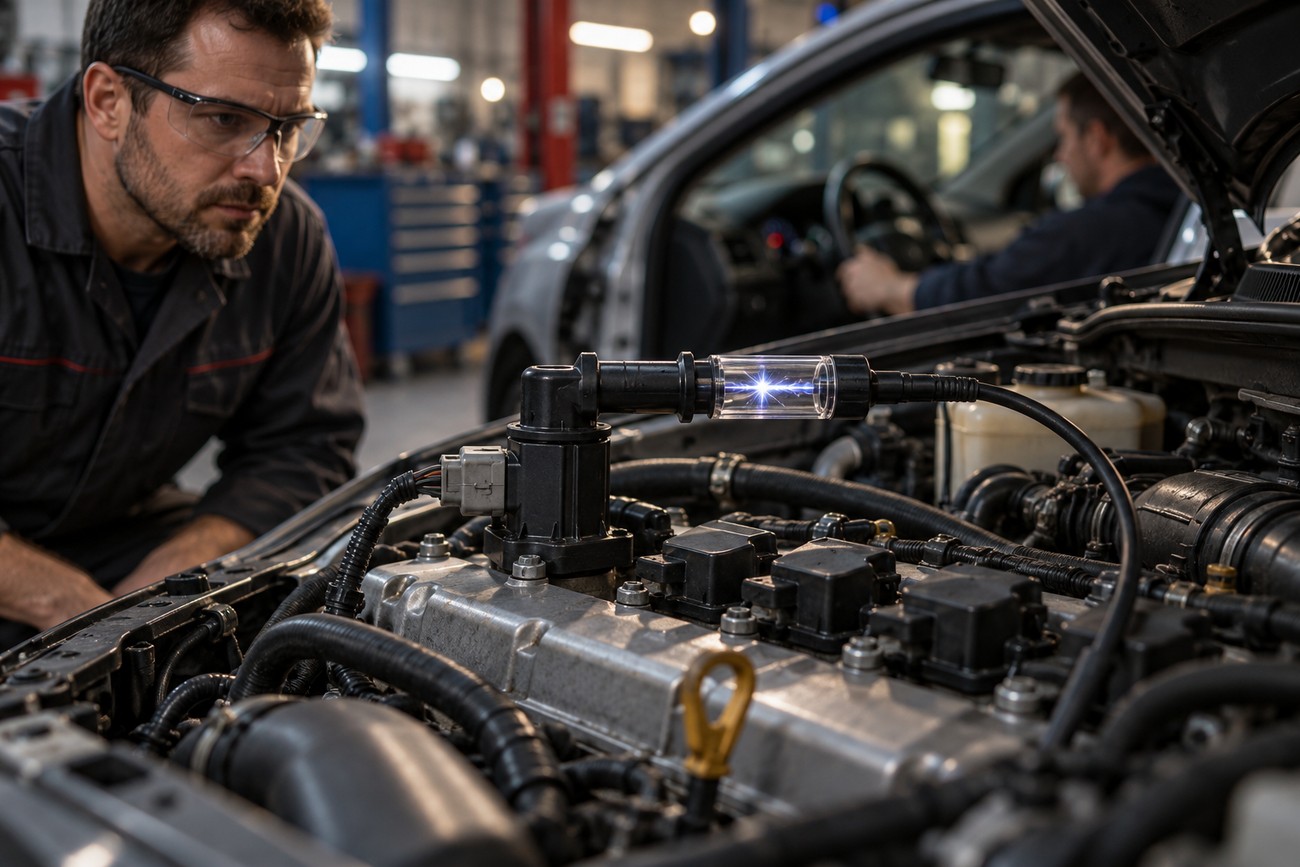
On a gasoline engine, a suitable spark tester can separate a genuine no-spark finding from a fuel-supply suspicion. Use equipment and a connection method intended for the vehicle, and follow the manufacturer’s safety guidance. Ignition systems can generate high voltage, and testing near spilled fuel or fuel vapors creates an avoidable fire risk.
If one cylinder lacks spark while others test normally, the investigation can focus on that cylinder’s plug, coil, boot, wiring, or connector. A loss of spark across the engine points toward a shared power supply, ground, control signal, crankshaft-position information, or another common circuit. Neither pattern identifies a replacement part without confirming power, command, and circuit condition.
Plugs, coils, and high-voltage leads are possible causes on systems that use them, yet changing all of them because the engine will not start is poor evidence-based repair. A wet plug and gasoline odor may indicate flooding, while a dry plug may suggest missing fuel. Both observations help choose the next test; neither establishes that ignition alone is the fault.
Do not hold a plug against the engine and create an improvised spark test beside fuel vapors. If the vehicle is diesel, glow plugs belong to the cold-start path and are not tested as gasoline spark components. Diesel injection timing, fuel pressure, and glow-plug control require the procedures specified for that engine.
If fuel and spark seem present, check signals and mechanical clues
Fuel and spark must arrive at the right time. A crankshaft-position sensor or its circuit can disrupt the engine-control unit’s knowledge of engine speed and position, which may affect injection timing, ignition timing, or both. A sensor fault is therefore one possible cause of crank-no-start, though the same symptom can result from damaged wiring, a connector problem, missing power, or a mechanical timing issue.
A scan tool can show whether engine speed is being seen during cranking, reveal relevant data, and identify codes that narrow the next check. Treat a code as evidence about a circuit or operating condition, not automatic proof that the named sensor is defective. Inspect the related wiring and compare live data with the vehicle’s service information before authorizing a part.
Security systems deserve a separate check. Some vehicles allow the starter to operate even when the engine controller withholds fuel or ignition authorization; others start for a moment and stall. Check the indicator behavior, spare-key procedure, and model-specific relearn instructions in the owner’s manual, especially after a weak battery, key replacement, or electrical work.
Unusually fast cranking can indicate loss of compression or a mechanical timing problem, while an uneven rhythm can suggest that cylinders are no longer contributing equally. Confirming those possibilities may require compression testing, a relative compression test, or inspection of timing components. These are distinct from driveway observations and are best performed with the correct equipment.
A normal-looking scan result does not guarantee a healthy engine. Some faults occur only during the start attempt, and some mechanical failures leave little useful data in the control module. The value of the scan is that it narrows the next measurement; it should not replace fuel, spark, voltage, and mechanical verification.
Why it happens only when cold or only sometimes
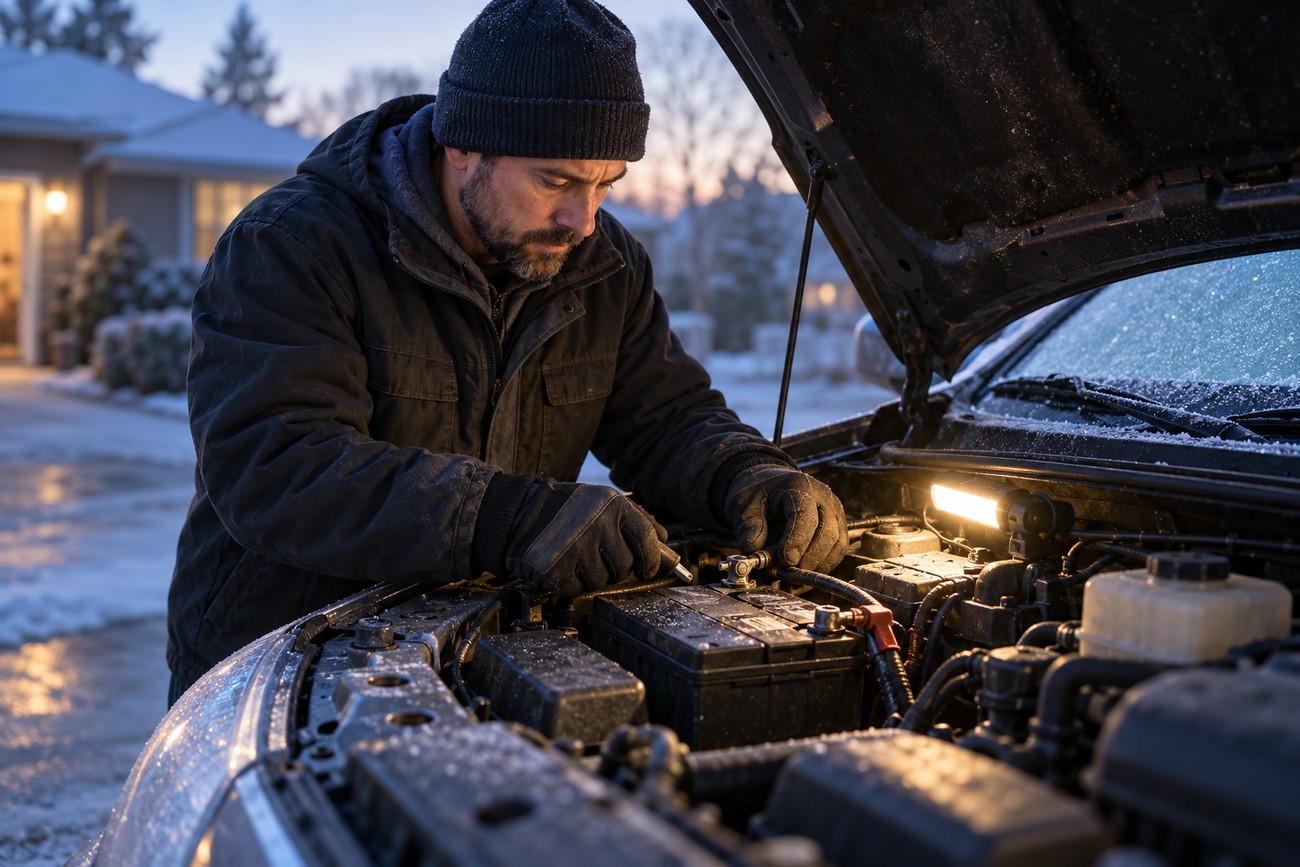
Cold conditions expose marginal systems. Battery output falls, engine oil resists rotation more strongly, and weak terminal or ground connections become more consequential. A battery that starts the car easily in mild weather may fall below the needed cranking performance after an overnight freeze.
Intermittent faults can follow the same pattern without being caused by temperature alone. A loose connection, aging relay, heat-sensitive sensor, failing pump, or damaged wire may work on one attempt and fail on the next. Repeated successful starts can therefore hide a developing fault rather than prove that the earlier no-start was random.
Gasoline engines may need a reliable ignition, fuel mixture, and sensor signal during cold enrichment. Diesel engines have a distinct cold-start concern involving glow plugs and their control circuit. Neither a gasoline spark test nor a diesel glow-plug suspicion should be transferred to the other engine type without checking the design.
Record when the failure occurs, how the engine cranks, the outside temperature, warning-light behavior, fuel level, and whether the engine eventually starts after sitting. This record can expose a pattern that disappears by the time the vehicle reaches a repair facility. A car that starts only after several retries still warrants diagnosis if the event repeats.
Know when to stop cranking and seek a repair diagnosis
Stop attempts if you smell strong fuel and see signs of a leak, or if smoke, arcing, or a hot electrical odor appears. Metallic knocking, grinding, or a sudden change to unusually fast or uneven cranking also calls for stopping. Continuing to crank through those signs can increase damage and make a safe inspection harder.
Repeated short attempts are safer for the starter and battery than one long session, but even short attempts have a limit. Prolonged repeated cranking can drain the battery and overheat the starter, while excess fuel may wet the plugs or enter the oil on some engines. Ventilate the area and follow the vehicle’s instructions for clearing a flooded engine rather than improvising.
Give a technician the exact sequence: whether the engine cranked slowly or briskly, whether it fired, how long it ran, what the security lamp did, and whether the pump was audible. Add resting and test measurements, scan data, fuse findings, plug condition, and any fuel-pressure or spark-test result. This information is more useful than saying only that the starter works.
Before approving a starter, battery, pump, coil, or sensor, ask which test identified that system and what result confirmed it. A turning starter does not justify replacing fuel, ignition, or sensor parts without testing. A targeted measurement usually saves time and prevents the common cycle of replacing one plausible part after another.
Frequently asked questions
The questions below cover common starting patterns and the checks they suggest. Cranking speed, fuel delivery, ignition, security signals, and mechanical condition can all help narrow the cause. No single symptom identifies a failed part without a confirming test.
Why did the car stop starting right after I refueled?
The timing makes fuel-related causes worth checking, including incorrect fuel, contaminated fuel, or a fuel-system disturbance. A purge-valve fault can also create a hard-start or no-start condition after refueling on some vehicles. Timing alone does not prove that refueling caused the failure, so confirm the fuel used, preserve any receipt, and compare the symptom with fuel pressure, mixture data, and the vehicle’s diagnostic codes.
How to diagnose a car cranking but not starting?
Begin by confirming cranking speed and battery connections, then establish whether the engine receives adequate fuel and, on a gasoline engine, whether spark is present. Use scan data to assess engine-speed and security information, and move to compression or timing checks if the cranking sound is abnormal. Symptoms narrow the next test; they do not establish a component-level diagnosis.
What causes a vehicle to crank but not start?
Common categories include insufficient battery voltage under load, poor connections, inadequate fuel pressure, no spark, incorrect engine-speed information, immobilizer authorization problems, and loss of compression or mechanical timing. An empty tank, blown fuse, or contaminated fuel can produce the same headline symptom with less obvious warning. Testing the affected system identifies the cause; the sound of the starter alone does not.
What sensor can cause a crank-no-start?
The crankshaft-position sensor is a key possibility because its signal helps the engine controller determine when to inject fuel and trigger ignition. Camshaft-position information, temperature inputs, and other control signals can also matter on particular vehicles. A related code or symptom does not prove a bad sensor; check its applicable supply or reference, return path, wiring, signal, and connector before replacement.
How to start a car that turns over but won’t start?
Use the owner’s manual for model-specific starting and flooded-engine procedures, make only short attempts, and pause between them. Confirm fuel level, battery connections, security indications, and obvious warning signs first. Stop if there is a fuel leak, smoke, a strong hazardous odor, or abnormal mechanical noise, and arrange a diagnosis instead of continuing to crank.