A high-flow catalytic converter can reduce exhaust-flow resistance, yet the trade-off may include weaker emissions control, slower warm-up, uncertain legality, or shorter service life. The “high-flow” label describes a design goal, not a guaranteed result on every vehicle.
The outcome depends on the engine, catalyst volume, substrate, pipe diameter, installation position, oxygen-sensor arrangement, fuel control, and local certification rules. A properly matched unit may help a heavily modified engine; on a healthy stock car, the performance change is usually minimal.
- What Is a High-Flow Catalytic Converter?
- Does High Flow Actually Add Power?
- OEM vs High-Flow vs Budget Universal Catalytic Converters
- How to Choose the Right High-Flow Converter
- Emissions, Certification, and Check-Engine Risks
- Common Failures, Hidden Costs, and Installation Mistakes
- Frequently asked questions
- How can I tell whether my existing catalytic converter is clogged?
What Is a High-Flow Catalytic Converter?
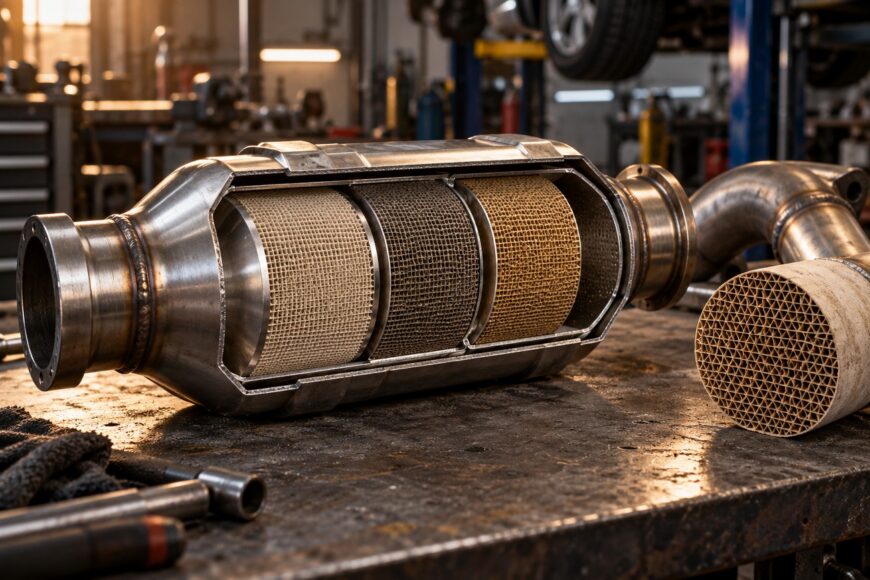
A high-flow catalytic converter remains a three-way catalytic converter. Its active coating uses platinum, palladium, and rhodium to convert hydrocarbons, carbon monoxide, and nitrogen oxides under the right operating conditions. The “high-flow” designation refers to substrate and housing geometry intended to reduce exhaust-flow resistance.
Manufacturers may use thinner substrate walls, larger channels, a different substrate material, or a larger housing. A larger internal diameter can also reduce restriction when it matches the rest of the exhaust. These changes reduce resistance, although they can reduce active surface area or heat retention if the converter is made too small, too short, or positioned poorly.
Cell count, measured as cells per inch, is only one specification. It cannot determine flow, emissions performance, durability, or legality by itself. Catalyst length, diameter, volume, wall thickness, substrate material, housing, and location all affect the result.
Fuel control remains central. A gasoline engine must operate near an air-fuel ratio of approximately 14.5–14.7:1 for effective three-way conversion. A converter cannot compensate for a rich mixture, ignition misfire, oil consumption, or a calibration problem that prevents the engine from maintaining the required conditions.
Does High Flow Actually Add Power?
A healthy modern OEM exhaust system is designed to keep power loss from the catalyst small in the stock configuration. That means replacing it with a freer-flowing unit on an otherwise standard vehicle usually produces a minimal performance difference. A change in sound or throttle feel can be noticeable before any meaningful power increase appears in measured testing.
More measurable gains are plausible when the original converter is damaged, restricted, unusually small, or part of a heavily modified engine system. Large displacement changes, forced induction, increased airflow, and a revised exhaust may expose a restriction that was insignificant in the stock configuration.
The converter is only one part of that system. Exhaust manifold design, turbocharger position, pipe diameter, resonators, mufflers, valve timing, fuel calibration, and measured backpressure all matter. Installing a high-flow converter while leaving a major restriction elsewhere can produce little change while adding certification and durability risks.
Fuel economy claims deserve caution. A high-flow converter alone does not guarantee better fuel economy or throttle response. On a stock vehicle, any efficiency change is likely to be small and can be overwhelmed by fuel-trim problems, tire pressure, driving conditions, or a calibration that was never adjusted for the hardware.
OEM vs High-Flow vs Budget Universal Catalytic Converters
Many modern OEM converters already provide low restriction for their intended engine output. A reputable certified high-flow unit can suit a modified configuration, while a cheap universal or race-oriented unit may compromise emissions control, fitment, and service life.
| Converter type | Flow potential | Emissions and warm-up | Durability and sensors | Legality and best use |
|---|---|---|---|---|
| OEM | Matched to the stock engine and exhaust; restriction is usually small when healthy. | Designed around the vehicle’s cold-start strategy and emissions calibration. | Usually the strongest fit and sensor compatibility; typical service life is about 150,000–200,000 km or 10 years or more under normal conditions. | Usually the safest choice for a stock road vehicle, subject to local rules. |
| Reputable certified high-flow | Potentially lower restriction when correctly sized for a modified engine. | Can perform well, though warm-up and NOx control depend on volume, substrate, and position. | Quality materials and correct sensor locations reduce risk, but service life may still differ from OEM. | Suitable only where the exact part has the required CARB, EPA, Euro, or local certification. |
| Cheap universal or “race” unit | Advertised flow may be good, inconsistent, or worse than the original if dimensions are unsuitable. | Lower precious-metal loading and poor heat retention can weaken conversion, especially during cold start. | Greater risk of rattling, cracking, melting, sensor faults, and short service life. | Often unsuitable for public-road use; intended use and local approval must be verified before purchase. |
How to Choose the Right High-Flow Converter
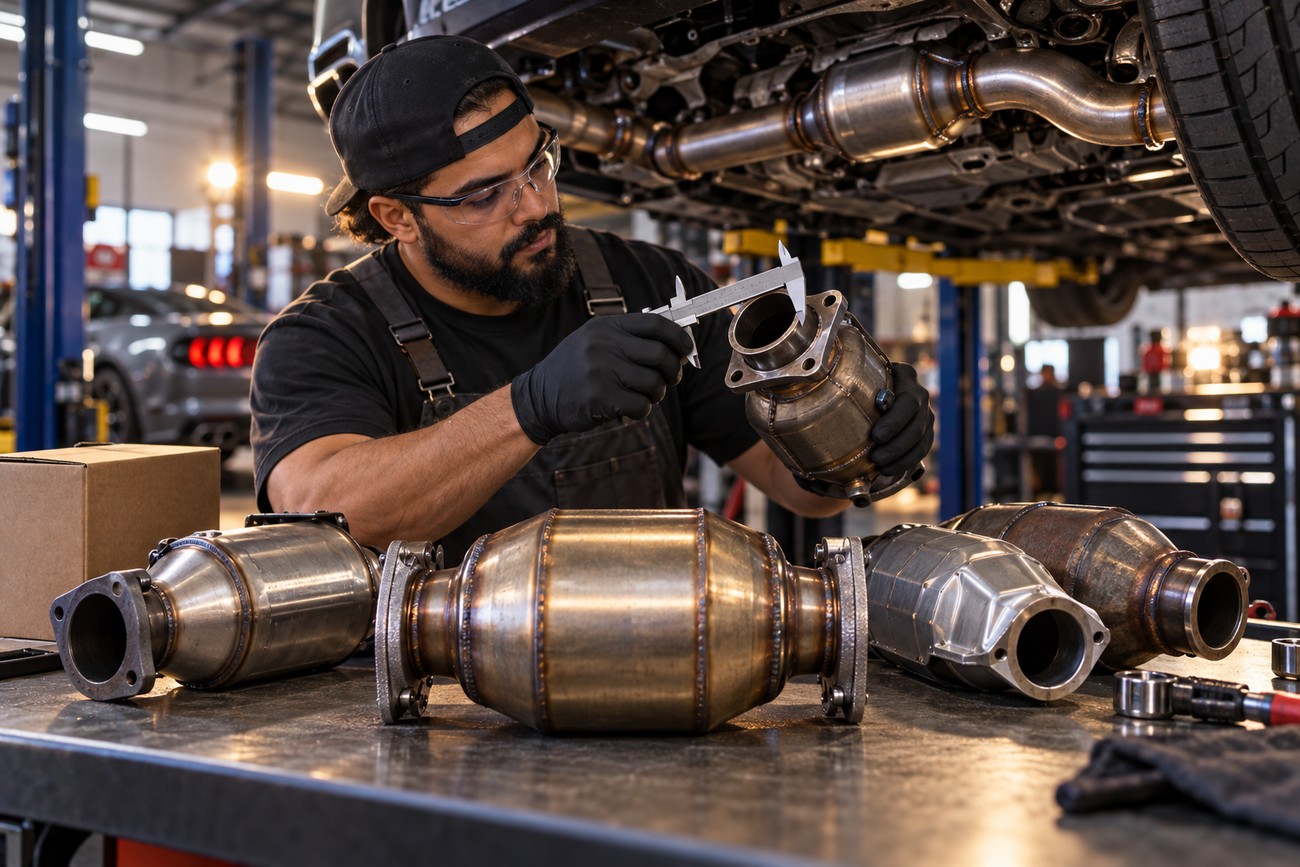
Start with the engine’s displacement, output, fuel system, exhaust layout, and intended use. The correct converter must handle the engine’s gas volume without creating excessive restriction. It also needs enough catalyst volume and active surface area to control emissions across the operating range.
Match the inlet and outlet diameter to the complete exhaust system rather than selecting the largest available part. An undersized converter can raise backpressure and temperature, increasing the risk of early failure. An oversize converter may increase thermal mass and delay light-off, increasing cold-start emissions.
Length and location are equally important. A converter moved farther from the engine may fit more easily or reduce underbody heat, yet it receives less heat during cold start. A unit placed close to the exhaust manifold can reach operating temperature sooner, provided the substrate and housing can tolerate the thermal load.
Cell count is a starting specification, not a complete selection method. Catalyst volume and placement often determine whether the part can control emissions while flowing adequately, so installation checks should include pre- and post-catalyst temperatures and oxygen-sensor behavior.
Substrate material also changes the compromise. A metallic substrate often tolerates impacts and thermal cycling well, but the material alone does not guarantee faster warm-up, better emissions, or longer life. Ceramic and metallic designs can both work when their dimensions, coating, position, and thermal limits suit the vehicle.
Turbocharged engines require additional care. Converter position near the turbocharger affects backpressure, turbo spool behavior, exhaust temperature, and thermal management. A freer-flowing unit can help a restricted system, while an unsuitable design can disturb heat control or fail under repeated high-load operation.
Emissions, Certification, and Check-Engine Risks
Passing a tailpipe emissions test is not the same as using a legally approved part. Many jurisdictions require a specific CARB, EPA, Euro, or equivalent certification for the exact vehicle and application. A converter may produce acceptable measured emissions and still be formally unsuitable for road use if its approval does not match the vehicle.
The rear oxygen sensor monitors catalyst behavior by comparing exhaust oxygen patterns with the upstream sensor. A non-OEM or poorly matched converter may trigger a catalyst-efficiency Check Engine Light, even when the car seems to drive normally. The same installation can prevent readiness monitors from completing, which may cause an inspection failure.
Cold-start behavior is a frequent weak point. The converter needs sufficient heat and active surface area before it can clean the exhaust effectively. A low-volume unit, a remote installation, or a substrate with poor heat retention may show acceptable performance after warm-up while producing more emissions during the first part of a drive.
Oxygen-sensor spacers and software changes that disable catalyst monitoring can mask a fault, yet they do not restore emissions performance. They may also interfere with diagnosis, create legal problems, and hide an engine condition that is damaging the converter. Proper calibration and verified sensor operation are safer diagnostic paths.
Before installation, check the exact approval documentation, sensor locations, flange or pipe dimensions, and vehicle application. Keep records of the part number and certification. Local requirements can differ substantially, so a general statement that a converter is “street legal” is not sufficient evidence.
Common Failures, Hidden Costs, and Installation Mistakes
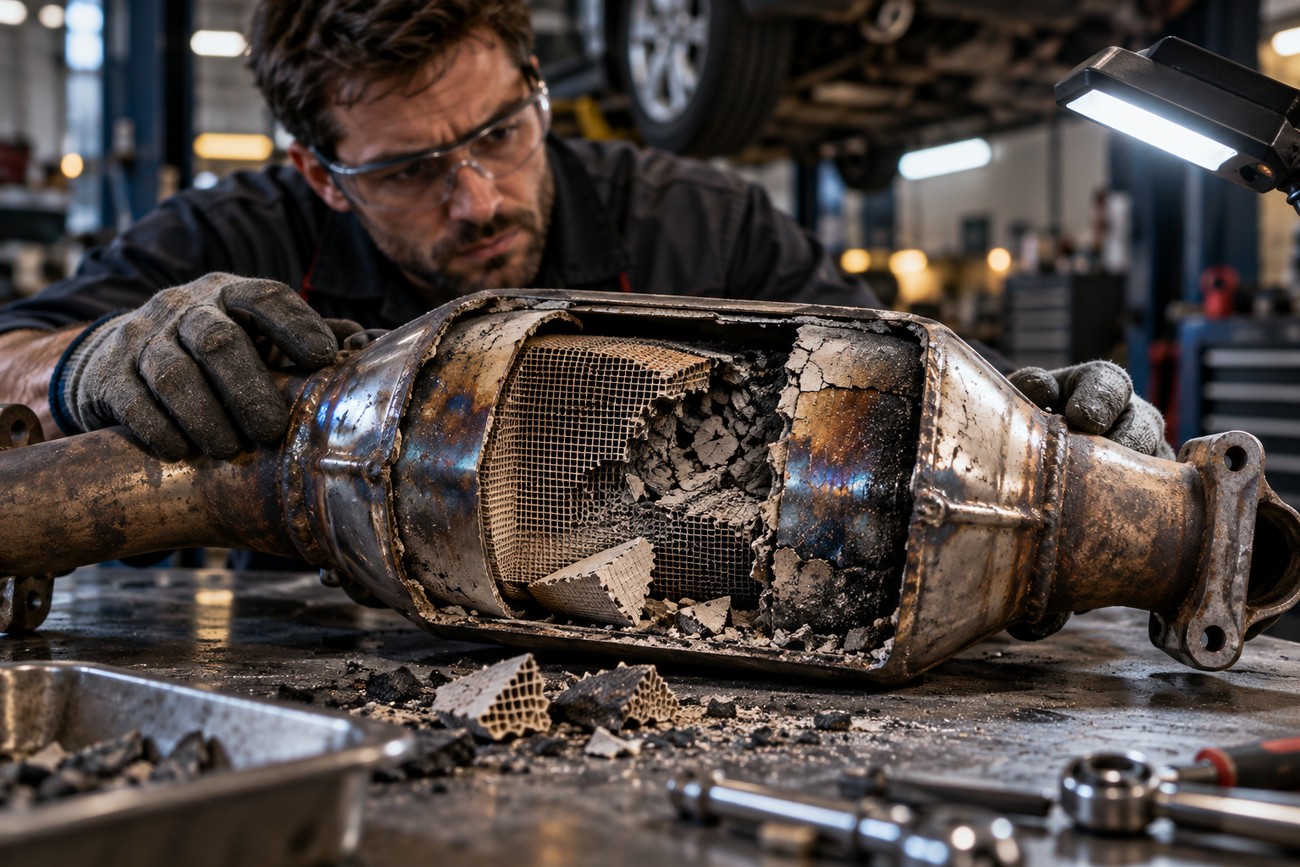
A new converter often fails because the original engine fault remains. Misfires and rich mixtures send unburned fuel into the substrate, where it can create destructive heat. Oil consumption can poison the catalyst coating, while poor fuel quality and turbocharger heat add further thermal stress.
Typical failure signs include a rattling substrate, loss of power, rising exhaust restriction, unusual odor, and a recurring catalyst-efficiency fault. A melted substrate may initially feel like a calibration problem because the vehicle becomes progressively less responsive. A cracked substrate can move inside the housing and later restrict the outlet.
Cheap performance converters may use lower precious-metal loading or inadequate catalyst volume. Their lower purchase price can be offset by repeated replacement, inspection problems, exhaust leaks, and additional labor. A universal part can also create poor sensor placement, fitment strain, heat-shield issues, or exhaust drone after the rest of the system is opened up.
Diagnosis should precede replacement. Check ignition operation, fuel trims, injector behavior, oil consumption, boost control, and stored fault data. A technician can also compare exhaust temperatures, inspect oxygen-sensor activity, and use exhaust backpressure or vacuum testing when restriction is suspected.
An OEM converter commonly lasts about 150,000–200,000 km or 10 years or more under normal conditions. If a replacement fails after a short period, installing another converter without correcting the cause usually repeats the failure. Warranty or insurance coverage may also be affected by an uncertified modification, depending on the vehicle, policy, and jurisdiction.
Frequently asked questions
How can I tell whether my existing catalytic converter is clogged?
A clogged converter often causes falling power at higher engine speed, poor acceleration under load, increased exhaust heat, or a restriction-related fault. These symptoms overlap with fuel, ignition, turbocharger, and transmission problems, so they do not prove that the converter is blocked.
Diagnosis should combine several checks. A workshop can measure exhaust backpressure through an appropriate test port, use a vacuum gauge during steady and raised engine speed, compare temperatures before and after the converter, and review scan data for fuel trims, oxygen-sensor activity, and misfire counts. A hot inlet with an abnormal outlet temperature pattern can support a restriction diagnosis, while a damaged substrate may be confirmed by noise or inspection. Replacing the converter becomes more defensible after these tests identify restriction and the underlying engine fault has been corrected.