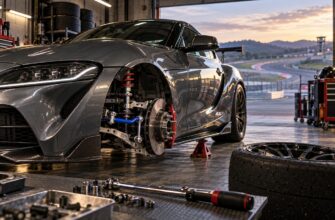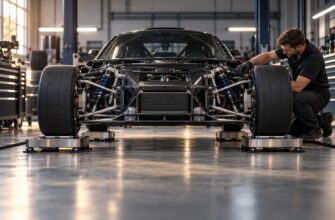
Aggressive-looking canards can add little usable grip while bringing more wind noise, drag, and visual drama than measurable performance. On a road car, the disappointment is common: the parts look like race hardware, yet the steering feels almost unchanged in normal driving.
The central choice is simple. A front splitter usually supplies the main front aerodynamic load by managing airflow at the nose, while canards refine local flow and front-to-rear balance. Both need speed, suitable geometry, and a rigid installation before their effect becomes meaningful.
Useful downforce depends on the whole car, not the appearance of an isolated part. The splitter, underbody, wheel arches, diffuser, rear aero, ride height, and mounting structure must work together. The sensible test is therefore the amount of repeatable grip gained for the drag, cost, and handling compromise accepted.
- How Front Splitters and Canards Create Downforce
- Front Splitter vs. Canards: What Each Part Actually Does
- Choosing Canards for the Car, Not Just the Look
- Installation, Stiffness, and the Hardware Behind the Aerodynamics
- Speed, Downforce, and the Drag You Actually Pay For
- Why Aero Upgrades Feel Worse: Balance, Errors, and Hidden Trade-Offs
- Frequently asked questions
- How much downforce do canards add?
- At what speed does a front splitter work?
- How can I tell whether a canard is adding downforce or only drag?
How Front Splitters and Canards Create Downforce
A front splitter works at the leading edge of the car. It separates airflow traveling above the front edge from airflow traveling below it and the floor. That separation creates a pressure difference, with lower pressure beneath the front area helping add front downforce. The result depends on the splitter’s shape, clearance, stiffness, and the quality of the airflow reaching it.
The splitter does not create the same load at every ride height or speed. A road car moving over bumps constantly changes its distance from the ground, while braking and pitch alter the angle at which air meets the front assembly and steering changes local flow around the front wheels. A flat, rigid splitter with poor clearance or disrupted upstream airflow can therefore produce less useful load than its visual size suggests.
Canards, also called dive planes, are auxiliary devices usually placed near bumper corners or front wheel arches. Their job is more local: they redirect flow, generate vortices, and influence how air moves around the bumper and through the wheel wells. Properly positioned canards may help extract or redirect air from the front wheel wells, reducing front lift and changing the balance of the car.
That makes a canard a flow-control tool rather than a guaranteed source of major front downforce. Its effect depends on speed, area, angle of attack, mounting stiffness, and the surrounding bodywork. A canard that sits in clean, useful airflow on one vehicle may sit in separated or turbulent flow on another and produce mostly drag.
Front Splitter vs. Canards: What Each Part Actually Does
The two devices can appear similar in aftermarket catalogs, but they perform different jobs. The comparison below describes their usual role on a complete road-car or track-car package, rather than promising a result from any universal bolt-on part.
| Aspect | Front splitter | Canards or dive planes |
|---|---|---|
| Primary aerodynamic role | Separates airflow above and below the front edge and creates the main front pressure change. | Controls local flow near the bumper corner or wheel arch and refines balance. |
| Usual location | Across the lower front edge, extending from or beneath the bumper. | At bumper corners, beside the front openings, or near the wheel arches. |
| Relative downforce contribution | Usually the larger contributor to front-end load in a coherent aero package. | Usually a smaller, auxiliary contribution that can alter local flow and front balance. |
| Drag tendency | Can add drag, but practical tuning generally gives it more front aero per unit of drag. | Often adds comparatively high drag for the amount of load produced. |
| Setup sensitivity | Strongly affected by ride height, ground clearance, pitch, floor shape, and upstream airflow. | Strongly affected by speed, area, angle of attack, wheel-arch flow, and the rest of the aero package. |
| Installation demands | Needs a rigid structure, reliable ground clearance, and support across its working span. | Needs rigid, reinforced, symmetrical mounting that prevents vibration and angle changes. |
In practical tuning, a splitter generally delivers more front aero per unit of drag than canards. This is why a car with a properly supported splitter can gain a more useful front-end response before small dive planes are added. Canards may still be valuable when the basic package is already working and the remaining problem is local flow or balance.
A canard’s performance is particularly sensitive to its position. Moving it a small distance can change whether its vortex reaches the wheel arch, tire shoulder, brake opening, or underbody edge. The same part can therefore have different results on two cars with similar bumper shapes, and even on one car after ride height or wheel-and-tire dimensions change.
Replacing a splitter with canards reverses the normal aerodynamic priority. The canards may make the bumper look more purposeful, yet they do not provide the same broad separation of airflow at the nose. Treat them as a refinement to an existing front aero system, unless testing demonstrates that the specific design is solving a clearly defined flow problem.
Choosing Canards for the Car, Not Just the Look
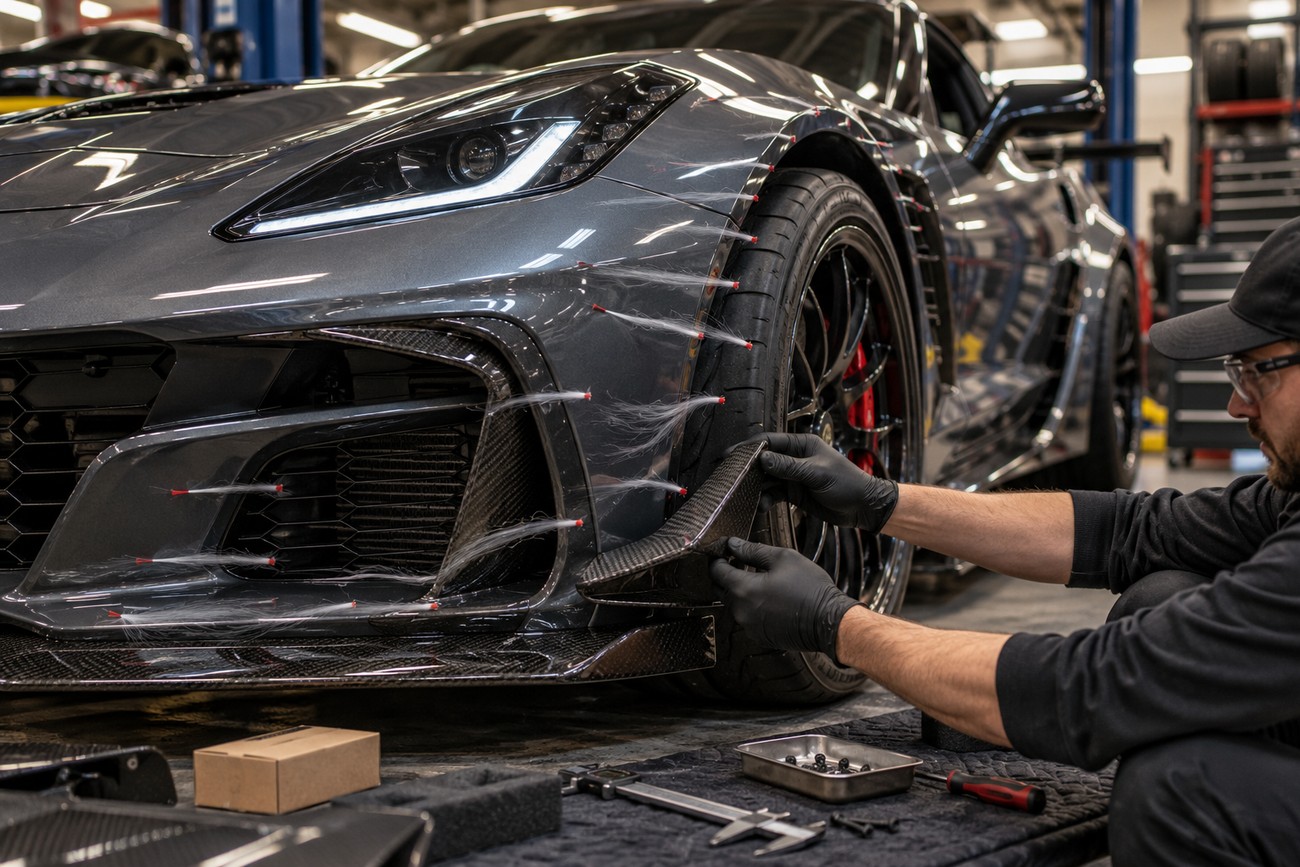
Start with the air around the actual car, especially the bumper corners and front wheel arches. These areas contain strong local effects from the tire, fender opening, cooling ducts, and bumper curvature. A canard should be placed where it can influence that flow in a controlled way, rather than where it merely fills an empty section of bodywork.
Wheel-well airflow is often the reason a canard has value. Air entering the front opening and moving around the tire can contribute to lift and turbulence. A correctly located device may help redirect or extract that air, but the result depends on the arch shape, liner, wheel width, ride height, and the rest of the front bodywork.
Ground clearance also changes the answer. A splitter working close to the ground may respond strongly to ride height and pitch, while a canard mounted higher on the bumper can remain exposed to cleaner air during suspension movement. Neither arrangement is automatically better. The useful position is the one that produces a stable flow effect across the operating range of the car.
Compatibility matters more than copying a visually aggressive design. Existing splitter shape, underbody coverage, diffuser performance, rear wing or spoiler load, and tire behavior all influence the correct front balance. Adding front bite without checking the rear can make the car feel sharper initially, then less settled in braking zones and fast transitions.
A visually large canard may also sit outside the effective flow path. If the bumper already sheds separated air at that point, increasing the device’s size can increase drag without creating a useful, repeatable vortex. The practical selection process should therefore begin with the intended function—wheel-well control, balance refinement, or local flow management—and only then consider shape and appearance.
Installation, Stiffness, and the Hardware Behind the Aerodynamics
A canard changes direction in the airflow only if its mounting holds that direction. Thin bumper plastic is usually a poor primary structure because it can flex under aerodynamic load, vibration, temperature changes, and road impacts. A part that looks correctly aligned while parked may oscillate or change its angle as speed rises.
Flex creates two problems at once. First, the aerodynamic effect becomes inconsistent because the device is no longer presenting the same angle to the air. Second, repeated movement can loosen the attachment and enlarge the mounting holes, eventually leading to vibration or detachment. The shape may be theoretically suitable, yet the installation prevents it from working consistently.
Correct geometry attached to a flexible bumper skin can oscillate in the airflow, changing its angle before the fasteners begin to loosen. The mounting structure must preserve the part’s position under load, not merely support its weight in the garage.
Rigid reinforcement and repeatable positioning are therefore part of the aerodynamic design. Both sides should sit at matching heights and angles, with the intended clearance from the tire, wheel arch, ground, and nearby body panels. Small asymmetries can make testing difficult because the car may receive different flow conditions on the left and right sides.
Clearance deserves a practical inspection rather than a visual check from above. Turn the steering from lock to lock, compress the suspension where possible, and inspect the tire’s relationship with the canard and its supports. Road debris, curb strikes, and body flex can produce loads that a show-car installation never encounters.
Use a mounting arrangement that can be removed and refitted in the same position. Marking reference points and recording the angle helps isolate aerodynamic changes from installation changes. If the part moves, rattles, or leaves witness marks around its fasteners, further testing is premature.
Speed, Downforce, and the Drag You Actually Pay For
Aerodynamic force rises with speed, so small devices become more meaningful as speed increases. That does not create a universal activation speed for either a splitter or a canard. Vehicle geometry, ride height, angle of attack, airflow quality, and the driver’s sensitivity determine when the effect becomes detectable.
At ordinary city speeds, a small canard may produce too little load to separate from steering effort, road camber, tire temperature, and suspension movement. This explains why a driver can fit a visually substantial part and feel only more noise. On a track, where speed is higher and the car is loaded repeatedly in the same corners, a balance change may become easier to identify.
Frequently cited race-aero discussion places illustrative dive-plane coefficients around Cl 0.03 and Cd 0.01. These are small coefficients, and they describe an aerodynamic reference rather than a guaranteed vehicle-level result. The actual force on a road car depends on the part’s area, speed, local flow, angle, and interaction with the rest of the body.
Canard efficiency is also commonly discussed at approximately a 3:1 lift-to-drag ratio. That is closer to spoiler-like efficiency than wing-like efficiency. In plain terms, a canard can create useful load, but the drag penalty may be substantial relative to the downforce gained.
One source reports approximately 10–40 lb of canard downforce at road speeds. That is a source-specific estimate, not a universal promise. It cannot be transferred directly between different vehicles, mounting positions, canard areas, and test conditions, especially where ride height and wheel-well airflow differ.
Idealized testing can also flatter an aero part. A clean, accurately aligned test vehicle on a smooth surface does not behave like a road car covered in dirt, moving through crosswinds, changing ride height, and crossing uneven pavement. Published or advertised figures should be treated as a reference until the specific installation shows a repeatable handling benefit.
Why Aero Upgrades Feel Worse: Balance, Errors, and Hidden Trade-Offs

The most common mistake is using canards as a substitute for a splitter. This leaves the main front-edge airflow problem unresolved while adding small, drag-producing surfaces at the corners. The car may look more aggressive and sound different, but the expected front grip does not appear because the primary aerodynamic load was never established.
Choosing by appearance creates a related failure. A broad, steep, or dramatically curved canard may produce more disturbance without producing more usable downforce. Its position relative to the wheel arch and tire matters at least as much as its visible size, and an unsuitable position can make the part a source of drag rather than controlled flow.
Installation errors are equally damaging. A weak bumper attachment allows flex, while an uneven left-to-right position makes the car’s response difficult to interpret. Drivers then change several parts at once, hear more wind noise, and try to judge the result from a short road drive where the aerodynamic forces are small and inconsistent.
Front and rear balance must remain part of the decision. Adding front load without matching the rear aero can reduce the margin at the rear during fast cornering, braking, or rapid lane changes. An overly sharp front response may feel impressive at first, then nervous when the car transitions quickly or the road surface is imperfect.
Drag is the quiet cost. A canard can raise resistance even when the driver cannot identify a corresponding increase in grip. Extra noise, reduced high-speed efficiency, and a more sensitive front end are poor trade-offs if the device does not improve a defined corner, braking zone, or stability problem.
Low-speed impressions are also easy to misread. A sharper steering response may come from altered airflow, but it may also be a consequence of changed balance, tire condition, alignment, or expectation. Reliable judgment requires repeatable conditions and a complete aero package, with one change made at a time where possible.
Frequently asked questions
How much downforce do canards add?
One source reports approximately 10–40 lb of canard downforce at road speeds. This range should be treated as a single-source estimate, not a standard result that applies to every car.
The number can change with canard area, angle of attack, speed, bumper geometry, wheel-arch airflow, ride height, and mounting stiffness. A canard placed in clean flow may influence the car differently from one operating in separated air, so the figure cannot be transferred directly between vehicles or mounting positions without testing.
At what speed does a front splitter work?
There is no universal on/off speed threshold at which every front splitter begins producing useful downforce. Aerodynamic force builds progressively with speed, while the driver’s ability to detect it depends on the splitter’s shape, ground clearance, ride height, pitch, and the quality of airflow reaching the front edge.
A road car may produce measurable load before the driver can feel it clearly. On an uneven road, suspension movement and changing tire grip can mask the effect; on a track, repeated high-speed corners and braking zones make balance changes easier to compare. The relevant threshold is therefore vehicle-specific rather than a fixed speed.
How can I tell whether a canard is adding downforce or only drag?
Look for a repeatable change in high-speed balance, steering response, and stability under comparable conditions, while also monitoring new wind noise and any loss of high-speed efficiency. A useful canard should produce a consistent handling change that matches its intended role, such as improved front stability or altered wheel-well flow, rather than only making the car louder.
Subjective impressions cannot quantify aerodynamic load by themselves. Compare the same tires, pressures, alignment, ride height, and route, and change one aerodynamic variable at a time. If the part flexes, moves, or produces an inconsistent response, correct the mounting before deciding whether its shape works.