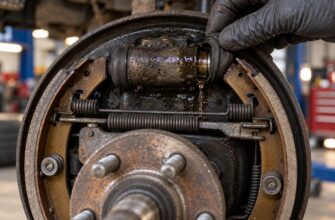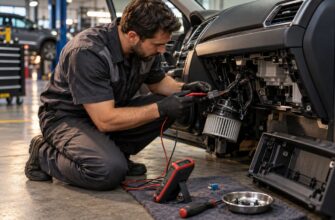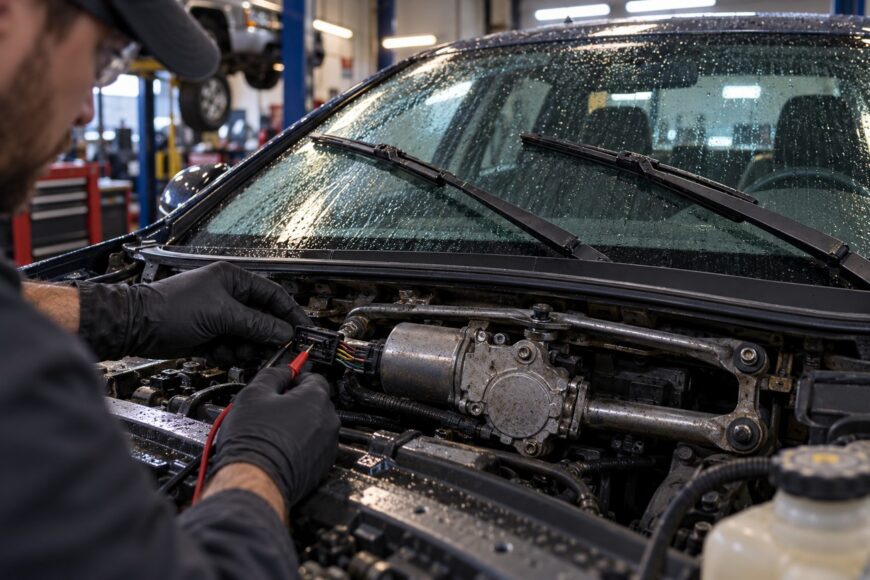
Windshield wipers that stop halfway across the glass, make one extra sweep, or fail only in one operating mode usually have a fault in the park circuit or drive system. The cause may be the park contact, linkage, power supply, ground, fuse, relay, connector, or electronic control module. The motor itself is only one possibility.
A reliable repair starts with testing before replacement. Confirm the symptom, check the electrical supply and grounds, inspect the linkage under load, and verify that the crank and wiper arms are correctly indexed. This approach avoids installing a new motor when corrosion, seized bushings, or incorrect arm positioning prevents the final park movement.
- What It Means When Windshield Wipers Won’t Park
- Use the Symptom to Narrow the Fault
- A Test-First Diagnostic Process
- Inspect the Linkage, Bushings, and Wiper Arm Position
- Check the Park Contact, Motor, and Control Module
- Repair Choices and Mistakes That Make the Problem Return
- Frequently asked questions
- How much does it cost to fix a windshield wiper linkage?
- When does a wiper fault need a BCM scan?
- What could be the reason why my windshield wipers won’t park?
- How much does it cost to fix wiper linkage?
- How to fix a windshield wiper that won’t move?
What It Means When Windshield Wipers Won’t Park
“Park” is the wiper system’s rest position, usually at the lower edge of the windshield. On most modern vehicles, a separate park circuit or park contact, commonly inside the wiper motor, keeps the motor running after you switch the stalk off. The motor normally stops when the park switch opens at the end of travel.
If the blades stop in the middle of the windshield, the park circuit may not be completing or opening correctly. A damaged contact track, poor ground, voltage drop, worn gears, or a faulty relay can interrupt the final movement. Mechanical resistance from the linkage can produce the same result even when the motor still runs.
A park fault must also be distinguished from incorrect wiper-arm positioning. If the arms were removed and reinstalled on the wrong splines, the drive may complete its normal cycle while the blades stop too high, too low, or at an angle. The crank, linkage, and arms must be synchronized with the motor in its specified rest position.
Patterns provide useful direction. A random stopping point suggests an intermittent electrical or mechanical problem, while an extra sweep can indicate incorrect indexing or a park contact that opens at the wrong point. A fault limited to one speed or mode often indicates partial park-contact wear or a control-circuit problem rather than total motor failure.
Use the Symptom to Narrow the Fault
Symptoms can narrow the diagnostic path, but none of these patterns proves a particular component has failed. Use the vehicle’s wiring diagram and service procedure before testing terminals or replacing parts.
| Symptom | Possible electrical causes | Possible mechanical or setup causes |
|---|---|---|
| Blades stop in the middle or at random points | Worn park contact, poor ground, voltage drop, faulty relay, corroded connector, or control-module fault | Seized linkage, worn gears, excessive friction, or an incorrectly indexed crank or arm |
| Wipers make an extra sweep after switch-off | Park contact opening late, an incorrect park signal, or a control-circuit fault | Incorrect arm position or crank-to-linkage synchronization |
| Only one speed or mode fails | Partial park-contact wear, a relay or switch-circuit fault, or an electronic control problem | Resistance that becomes significant only under a particular operating load |
| Wipers become slow or stop on dry glass | Low supply voltage, poor ground, or a motor drawing excessive current | Dry-glass resistance, stiff replacement blades, seized bushings, or unsuitable grease |
| Fault began after the arms were removed | Possible disturbed connector, ground, or service-position procedure | Arms installed on the wrong splines or linkage assembled out of synchronization |
A Test-First Diagnostic Process
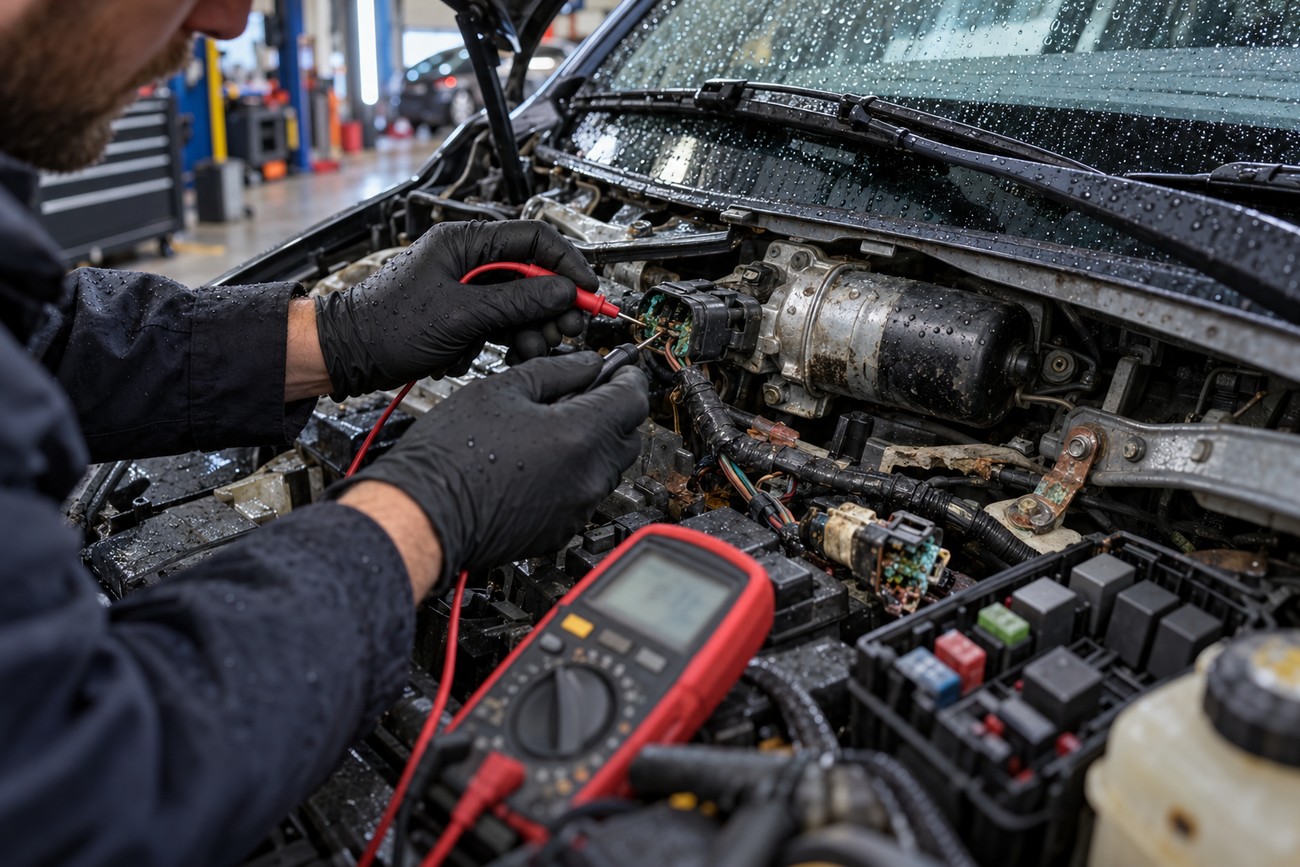
Begin by confirming the exact symptom with the vehicle parked safely and the windshield wet. Note whether the wipers work at every speed, whether they continue running after the stalk is switched off, and where they stop. Avoid repeated operation if the mechanism is binding or the fuse is blowing, because continued attempts can overheat the motor or wiring.
Check the fuse, relay, connectors, and grounds before condemning the motor. Look for loose terminals, water intrusion, green or white corrosion, damaged insulation, and a ground connection that is loose or contaminated. A running vehicle’s 12-volt electrical system is normally about 13.5–14.8 V, but the important result is the voltage available at the motor while it is working under load.
Use voltage-drop testing to check both the power side and the ground side while the wipers operate. A supply or ground voltage drop can interrupt the final park movement even when the battery voltage appears normal at rest. If the system has a relay, verify its input, output, and control signals according to the wiring diagram rather than assuming the relay is good because the wipers move.
Test the park circuit using the vehicle-specific terminal identification and switching sequence. On some vehicles, the park contact is integrated into the motor; on others, a separate park signal is monitored by an electronic controller. Do not bridge terminals or apply power to an unknown connector, because bypassing a model-specific circuit can damage the motor, wiring, or control module.
If the fuse blows during parking, inspect the linkage for a seized pivot before installing another fuse. A motor forced against a stiff mechanism may draw excessive current, while a weak motor or worn gear set may fail only at the end of the sweep. The exact test order, park-signal design, and calibration procedure must follow the vehicle’s wiring diagram and service instructions.
Inspect the Linkage, Bushings, and Wiper Arm Position
The linkage transfers motor rotation to the wiper arms through a crank, connecting rods, pivots, and bushings. Seized bushings or worn pivots increase resistance and can stop the motor before the park contact reaches its correct position. The mechanism may still move when pushed by hand, although that does not prove it will operate freely under load.
Inspect for stiff pivots, side play, bent rods, loose fasteners, and movement that becomes harder near the bottom of the sweep. Water entering through worn seals can corrode the pivot shaft and create an intermittent fault. Clean and lubricate only the specified points with a suitable lubricant; heavy or unsuitable grease can increase resistance in cold conditions.
Before removing the arms, mark their rest position and follow the manufacturer’s service-position procedure if the vehicle has one. After placing the motor and linkage in the specified rest position, install the arms at the prescribed angle. Fitting them by eye can leave the blades away from the factory rest position even when the motor parks correctly.
Check crank-to-linkage synchronization after any motor or linkage work. One incorrect spline position can imitate a park failure, produce an extra sweep, or make the blades contact the windshield edge. Stiff replacement blades or an incorrect arm angle can add resistance on dry glass, so final testing should be performed with the windshield wet.
Check the Park Contact, Motor, and Control Module
The park-contact track inside the motor can wear unevenly because the contact repeatedly passes over the same part of the track. The motor may run at normal speeds yet fail when the blades reach the rest position. This explains why a parking fault can appear without a complete loss of wiper operation.
Inspect the motor’s park-circuit behavior with the connector and terminals identified from the wiring diagram. A motor with worn contacts may show an incorrect open or closed condition near the end of travel. Worn gears can also create excess play, allowing the motor to stop inconsistently or fail to drive the linkage through the final movement.
Compare electrical results with mechanical load and current draw. If power and ground remain stable but the motor draws excessive current, the linkage may be binding or the motor may be mechanically worn. If the motor circuit tests normally while the commanded park state is missing or incorrect, the fault may be in the switch input, wiring, or electronic wiper controller.
Some vehicles use a separate park signal or contact that the body control module monitors. On those models, a BCM or electronic wiper controller can cause a parking fault without a motor failure. A module scan becomes useful after the power, ground, connectors, linkage, and motor park circuit have been tested and do not explain the symptom.
Repair Choices and Mistakes That Make the Problem Return

Repair the fault that testing identifies. A corroded connection may need cleaning, terminal repair, and protection against further water entry. A seized bushing or damaged linkage may require a pivot or complete linkage replacement, while incorrect arm indexing requires resetting the mechanism to its specified service position.
Replace the motor only after its park circuit, power supply, ground, and mechanical load have been checked. Installing a motor without correcting a stiff linkage can damage the replacement or leave the symptom unchanged. The same is true when the real fault is a corroded connector, a faulty relay, or a control-module command.
Common failed approaches include setting the arms by eye, applying heavy grease to every joint, and testing only on dry glass. Dry glass increases blade and linkage resistance, which can make a marginal system appear worse, while unsuitable grease can become an additional source of drag in cold weather.
After the repair, verify the correct rest position, every operating mode, and reliable parking during wet-glass operation. If the vehicle has a dedicated service position, enter and exit it exactly as specified. Model-specific service instructions override generic procedures, particularly for calibration, park-signal testing, and electronic control systems.
Frequently asked questions
The correct repair depends on whether the fault is mechanical, electrical, or electronic. These answers provide a practical starting point, but vehicle-specific wiring and service instructions remain decisive.
How much does it cost to fix a windshield wiper linkage?
There is no universal price. The total depends on how easily the linkage can be accessed, whether a single bushing or pivot can be repaired, whether the complete linkage is required, and how much diagnostic or calibration work the vehicle needs.
A simple connection or accessible pivot repair is different from removing trim and replacing a complete assembly. Ask for the diagnosis and parts requirement to be separated on the estimate so a motor is not replaced before the linkage has been tested.
When does a wiper fault need a BCM scan?
A BCM scan is most useful when the mechanical system and motor park circuit test normally, but the commanded park state, park-status signal, or intermittent control fault remains unexplained. The scan may show stored faults or live data that cannot be confirmed with a basic visual inspection.
Scanning should not replace basic checks. Power, ground, connectors, linkage freedom, and motor operation should be verified first, because a module code can result from low voltage or excessive mechanical load rather than the original cause.
What could be the reason why my windshield wipers won’t park?
Possible causes include a worn park contact, seized linkage, worn motor gears, poor power or ground, a failed fuse or relay, corroded connectors, incorrect arm positioning, or a BCM or electronic wiper-control fault. If the problem began after arm removal, incorrect spline indexing is especially important to check.
A system that stops only in one mode may still have a working motor with partial park-contact wear or a control-circuit fault. Testing the park signal and mechanical load is more reliable than replacing parts based on the symptom alone.
How much does it cost to fix wiper linkage?
The cost depends on vehicle access, labor time, and the part required. Replacing one damaged bushing may involve a different procedure from replacing a seized complete linkage, and some vehicles also require arm positioning or calibration after the repair.
Water damage, corroded pivots, and additional trim removal can increase the work involved. A useful estimate should identify whether the technician has tested the linkage under load and confirmed the motor’s park circuit.
How to fix a windshield wiper that won’t move?
First, check the fuse and confirm whether the motor receives power and ground when commanded. Then inspect the connector and linkage for corrosion, seized pivots, loose rods, or a disconnected crank. Do not repeatedly install a replacement fuse if it blows again, because a binding mechanism or short circuit may damage the system.
If the motor receives correct power but does not run, it may have an internal electrical or mechanical failure. If it runs with the linkage disconnected but stalls when connected, investigate mechanical binding and arm installation before replacing the motor.