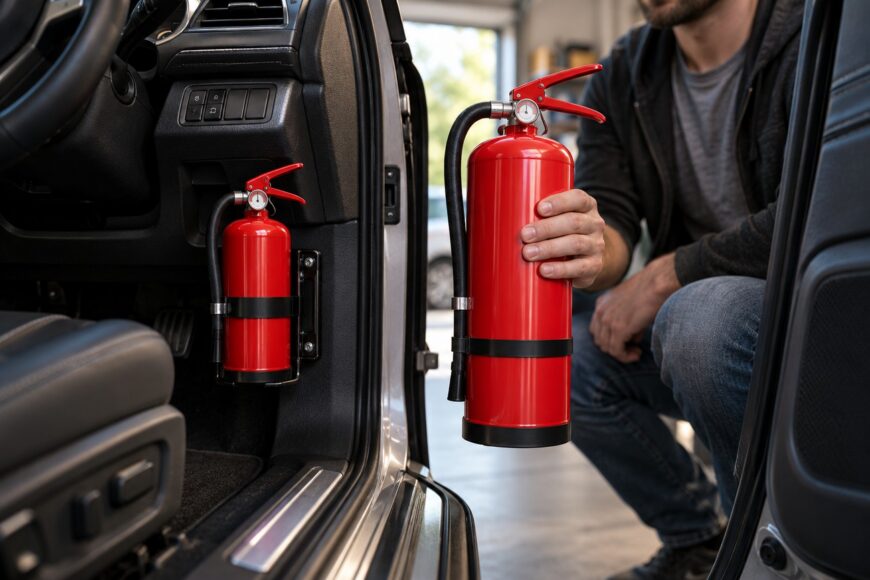
Advice on car fire extinguishers often jumps between numbers: a 2.5-lb unit in one guide, a 5-lb unit in another, and a rating such as 1-A:10-B:C printed on the label. Those figures describe different things. The weight in pounds usually refers to the extinguishing-agent charge, the UL rating describes the fires the unit was tested against, and the complete extinguisher has a separate total weight. A product listing that blurs these measures can leave you with a smaller unit than you intended to buy.
Size matters, but it will not help if the extinguisher is marked for the wrong fire risk, buried in the trunk, or past its service date. The useful choice is a unit that meets the requirements applicable to your vehicle, can be reached quickly, and is ready to operate.
- What Size Fire Extinguisher Should a Car Have?
- Pounds, UL Ratings, and Total Weight: What the Label Really Means
- Dry Chemical or CO₂: Which Type Works Best in a Car?
- Where to Keep It: Access Beats a Perfect Specification
- Vehicle Type and Extinguisher Sizing: A Practical Reference
- Buying and Checking a Car Fire Extinguisher
- Frequently asked questions
- What if my fleet or state rules specify a different extinguisher?
- How many fire extinguishers should I carry in a car?
- What size fire extinguisher should I have in my car?
- What is the best fire extinguisher to carry in a car?
- What type of fire extinguisher is recommended for a car?
What Size Fire Extinguisher Should a Car Have?
For a private passenger car, there is no general federal requirement in the United States to carry a fire extinguisher. Many safety guides suggest a compact multipurpose unit, commonly a 2.5-lb ABC dry chemical extinguisher rated around 1-A:10-B:C, kept in the cabin within reach of the driver. Treat these as practical recommendations, not as one universal legal minimum.
Rules do apply to some vehicles. The Federal Motor Carrier Safety Administration (FMCSA) requires power units of commercial motor vehicles to carry a properly filled, securely mounted, readily accessible extinguisher under 49 CFR 393.95, and some states set their own requirements for vehicles such as school buses, taxis, or other for-hire vehicles. If the vehicle is used for work, check the federal rule, your state’s rules, and any fleet policy before buying: a generic online recommendation may use a different measure or apply to a different vehicle category. If the wording remains unclear, confirm which specification the fleet operator or inspecting agency expects.
A small extinguisher may satisfy a cited minimum yet give you less agent to work with during an incipient fire. A slightly larger, serviceable extinguisher is generally a more useful choice if it can be mounted securely and reached without delay. Extra size does not compensate for an unsuitable fire-class rating or a unit you cannot access.
Pounds, UL Ratings, and Total Weight: What the Label Really Means
Agent charge is the amount of extinguishing material, usually stated in pounds on US products, for example 2.5 lb or 5 lb. The UL rating, such as 1-A:10-B:C or 5-B:C, comes from standardized fire tests: the number before A indicates relative effectiveness on ordinary combustibles, the number before B indicates the approximate area in square feet of flammable-liquid fire a non-expert operator can be expected to put out, and C means the agent is suitable for energized electrical equipment. Total weight includes the cylinder, agent, valve, and other components, so it will be greater than the charge alone.
A listing marked “5 lb” may be identifying the agent charge; it does not tell you the UL rating. Likewise, the weight printed in shipping details may be the complete packaged product. Check which measurement an applicable requirement names before deciding that a product matches it: the FMCSA rule, for example, is written in UL B:C ratings rather than pounds.
Read the markings on the extinguisher itself and consult its owner’s manual when a listing is vague. Look for the listing mark of UL or another nationally recognized testing laboratory, the UL rating, the charge, the agent type, and service information as separate fields. A photograph may show a bracket, but check whether it is included; confirm the rating from the label or documentation rather than the product title.
This distinction also helps when comparing two units that appear similar in size. Different agents and cylinder designs can change the relationship between capacity, charge, and carrying weight. Select against the stated specification rather than estimating from the shape of the bottle.
Dry Chemical or CO₂: Which Type Works Best in a Car?
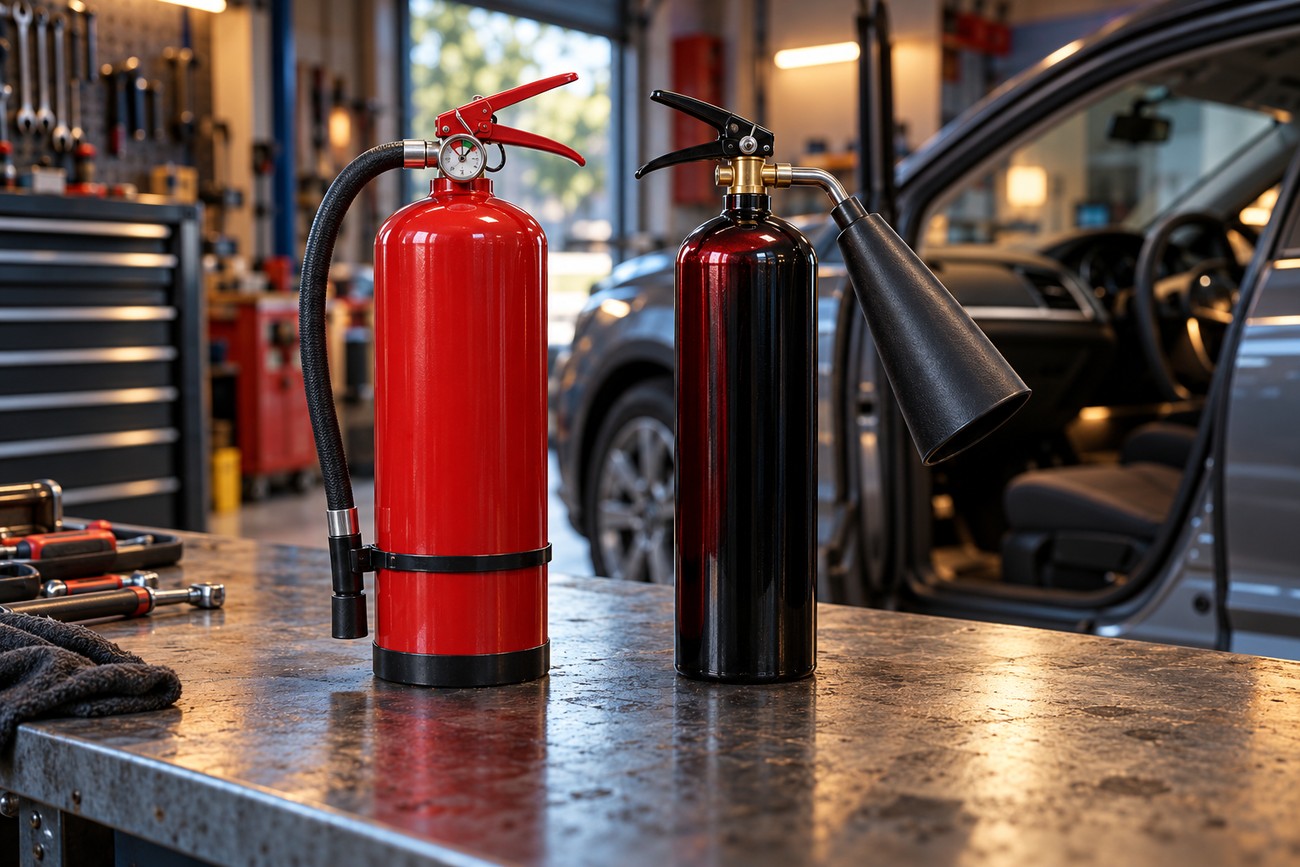
Dry chemical and carbon-dioxide (CO₂) extinguishers are common options for passenger cars. Vehicle fires can involve fuel, wiring, or other materials, so choose by the fire classes marked on the particular unit rather than by agent name alone. The rating tells you more about its intended use than a broad claim that it is “for cars.”
Multipurpose ABC dry chemical is widely used because it covers ordinary combustibles, flammable liquids, and electrical fires. Its drawback becomes clear after discharge: the powder residue can spread through the interior and contaminate electronics. That cleanup cost is real, although it should not deter you from using a suitable extinguisher against a small fire when it is safe to do so.
CO₂ leaves little residue, which may matter around interior fittings and electrical equipment. It is, however, typically rated only for B and C fires, it can be heavier or more expensive for a practical vehicle installation, and it still needs appropriate inspection and storage. Check the specific unit’s rating and instructions; a clean agent is not automatically the better match for every vehicle fire.
For a vehicle that runs on propane or compressed natural gas, pay particular attention to the flammable-gas and electrical hazards of its fuel and electrical systems, and do not assume every dry chemical or CO₂ model is rated for them. A hybrid or electric vehicle adds a high-voltage battery: a lithium-ion battery fire is beyond what a handheld extinguisher is designed to stop, so the response is to get everyone out and call 911. Fleet policies and state rules may also affect the choice and number of units.
Whichever agent you choose, learn how to release the bracket and operate the extinguisher before an emergency. Use it only if the fire is small, you have a clear escape route, and you can approach without putting yourself at risk. A fire spreading through a vehicle calls for getting people clear and calling 911.
Where to Keep It: Access Beats a Perfect Specification
An extinguisher stored only in the trunk may be difficult to retrieve when smoke is spreading or the rear of the vehicle is inaccessible. The FMCSA rule for commercial vehicles requires the extinguisher to be securely mounted and readily accessible, and the same principle makes sense in a private car: keep it in the cabin, near the driver. That makes location part of the safety decision, rather than an afterthought once you have selected a size.
Choose a secure in-cabin position that you can reach promptly and that does not interfere with driving controls or occupant movement. Check that the bracket fits the actual cylinder and holds it firmly during normal driving and hard braking. A loose extinguisher can become a hazard in a collision.
After installation, sit in the driving position and check the route to the handle. Passengers or luggage should not block it during an ordinary trip. If the intended cabin location cannot safely hold the size you selected, find a suitable mount rather than leaving the extinguisher unsecured.
Vehicle Type and Extinguisher Sizing: A Practical Reference
These are commonly cited US reference points, not a substitute for state rules, fleet policy, or the vehicle’s documentation.
| Vehicle type | Common US reference | What to verify |
|---|---|---|
| Private passenger car | No general federal requirement; a 2.5-lb ABC dry chemical unit rated around 1-A:10-B:C is a common practical recommendation, and 5-lb units are also popular. | Check the UL rating and agent charge on the label separately, and confirm a secure mount in the cabin. |
| Commercial truck or bus (FMCSA-regulated power unit) | 49 CFR 393.95 calls for one extinguisher rated at least 5 B:C, or two extinguishers each rated at least 4 B:C. | Confirm the vehicle is covered by the rule, check state and fleet requirements, and verify the mounting is secure and readily accessible. |
| Vehicle placarded for hazardous materials | 49 CFR 393.95 calls for an extinguisher rated at least 10 B:C. | Check the hazmat, state, and fleet requirements for the specific vehicle and load before selecting a unit. |
Pound figures and UL ratings are not interchangeable specifications. A 5-lb charge should not be treated as proof of a 5-B:C rating, or vice versa. Compare the rating on the product label with the measure used by the rule you need to meet.
Some fleet policies and state rules specify both the number and the rating of extinguishers for a particular vehicle. That becomes especially important for a bus, commercial vehicle, or special equipment, where a passenger-car shopping guide is a poor basis for a purchase.
Buying and Checking a Car Fire Extinguisher
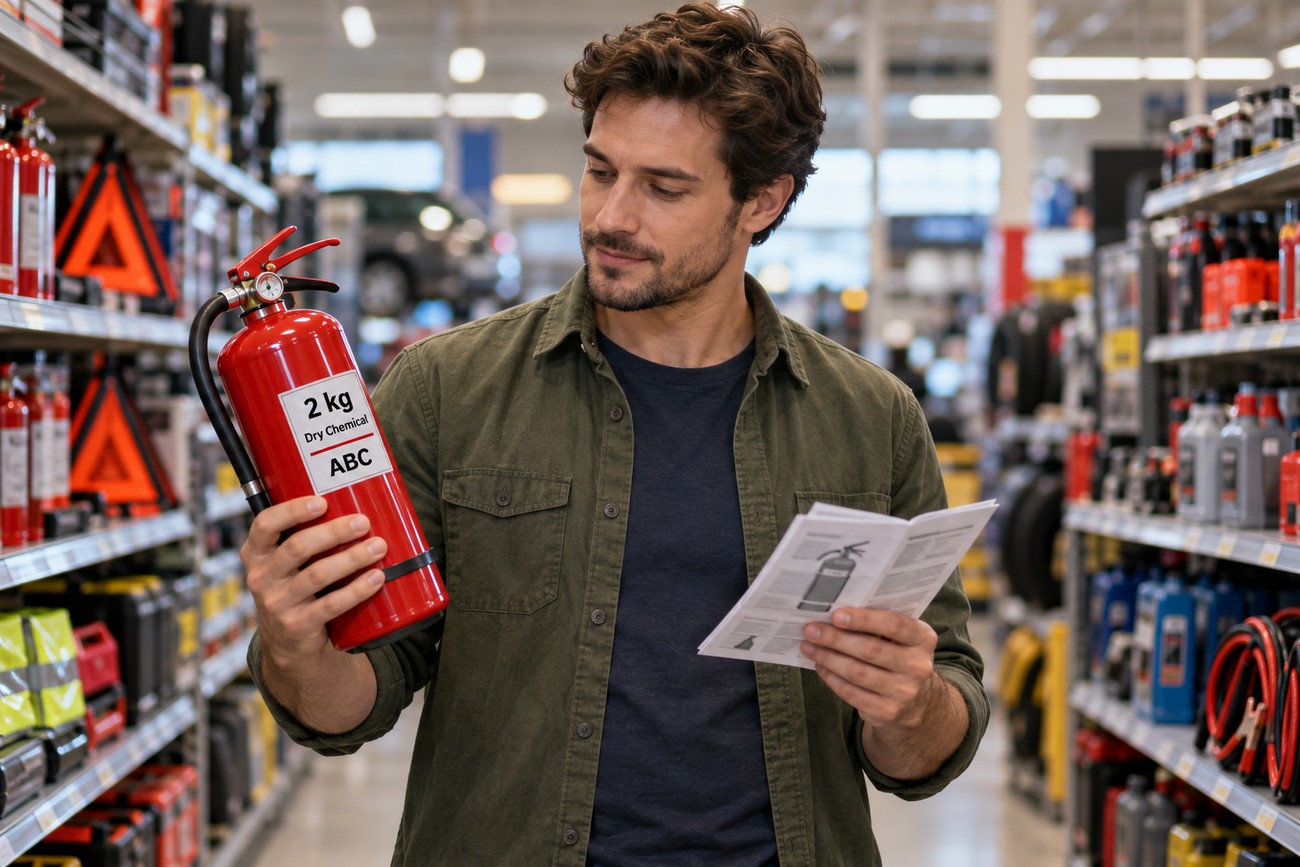
Start with the requirement that applies to the vehicle, if any, then compare the product label and documentation. Confirm its UL rating and charge, its extinguishing agent, and the fire classes marked for use. Price and advertising language cannot establish that it meets a specification or suits the hazards in your vehicle.
Check the listing mark and the rating printed on the extinguisher. UL 711 is the standard used to rate and fire-test portable extinguishers, and NFPA 10 is the standard for their selection, inspection, and maintenance; a reference to a standard in an advertisement does not by itself show that the unit meets a particular rule. If a seller’s description conflicts with the cylinder label, rely on verifiable product documentation or choose a clearer listing.
Before driving, inspect the manufacture or service date and the tamper seal and pin. Check that the pressure gauge, where the design has one, reads in the operable range, and look for damage, corrosion, leakage, or an unreadable label. NFPA 10 calls for monthly visual checks of extinguishers in buildings and limits disposable dry chemical units to 12 years from the date of manufacture; the same habits are sensible in a vehicle. Follow the unit’s instructions rather than assuming an unused extinguisher remains ready indefinitely.
Include the mounting hardware in the purchase decision. A cylinder that arrives without a suitable bracket can end up loose in the cabin or out of reach in the trunk. Confirm that the installed unit is secure, accessible, and removable without a complicated sequence of actions.
“New” is useful only if the extinguisher is correctly marked, within its service period, and ready where you can reach it. Recheck those points when you check the rest of the vehicle’s safety equipment. If a seal, gauge, or service marking gives you reason to doubt its condition, arrange appropriate service or replacement before relying on it.
Frequently asked questions
The right choice depends on the vehicle and the rules that apply to it. These answers give a decision point for common buying questions; where rules differ, verify the requirement before purchase.
What if my fleet or state rules specify a different extinguisher?
Follow the applicable rule or fleet policy rather than substituting a generic online recommendation. Compare its wording with the product label, including whether it specifies a UL rating, a charge in pounds, or more than one extinguisher. If a fleet policy and an inspection requirement appear to conflict, ask the fleet operator or the inspecting agency to clarify what they will accept.
How many fire extinguishers should I carry in a car?
For a private car, one properly rated, securely mounted unit is the usual practical choice, but do not assume one is sufficient for every vehicle. The required number may depend on vehicle category, state rules, or fleet policy; the FMCSA rule, for example, accepts either one 5 B:C unit or two 4 B:C units on a commercial power unit. Check quantity separately from size before buying, especially for commercial vehicles or special equipment.
What size fire extinguisher should I have in my car?
Choose a unit that meets any requirement that applies and can be mounted securely within reach. For most passenger cars, a 2.5-lb to 5-lb ABC dry chemical extinguisher rated at least 1-A:10-B:C is a common practical recommendation, not a legal minimum. Confirm which measurement your rule uses before ordering.
What is the best fire extinguisher to carry in a car?
The best choice is a serviceable extinguisher whose marked fire classes suit your vehicle’s risks and whose size meets the applicable requirement. Favor a unit you can secure near the driver and release quickly over one that looks better on paper but must stay in the trunk.
What type of fire extinguisher is recommended for a car?
ABC dry chemical and CO₂ are commonly recommended types. Dry chemical is versatile but leaves substantial residue; CO₂ leaves little residue but is typically rated only for B and C fires and can bring weight, cost, and inspection trade-offs. Check the individual unit’s UL rating, particularly if the vehicle runs on propane or natural gas.