A car can feel lazy even when its engine has adequate power. The usual culprit is a soft accelerator-pedal map: you press the pedal, but the vehicle requests throttle opening gradually. That can make ordinary launches and passing maneuvers feel less responsive, especially in a vehicle calibrated for smoothness, emissions, fuel economy, or drivetrain protection.
An electronic throttle response controller changes that pedal-to-throttle response curve. It can make the car react sooner to a small pedal movement, but it does not add horsepower or torque by itself. The useful decision is therefore about drivability: whether you want a sharper response, whether the vehicle already provides that function, and whether the change will remain controllable in traffic, on wet roads, and during low-speed maneuvers.
- What an Electronic Throttle Response Controller Actually Does
- How Drive-by-Wire Throttle Control Works
- What Changes Behind the Wheel—and What Does Not
- Throttle Controllers vs Factory Modes, Tuning, and Powerboxes
- Choosing Settings for City Driving, Wet Roads, and Daily Use
- Installation, Compatibility, and the Problems Marketing Leaves Out
- Common Myths: Is Sharper Throttle Response Really Faster?
- Frequently asked questions
- How do I fix an electronic throttle control warning?
- How much does it cost to fix an electronic throttle control system?
- What happens when electronic throttle control goes bad?
What an Electronic Throttle Response Controller Actually Does
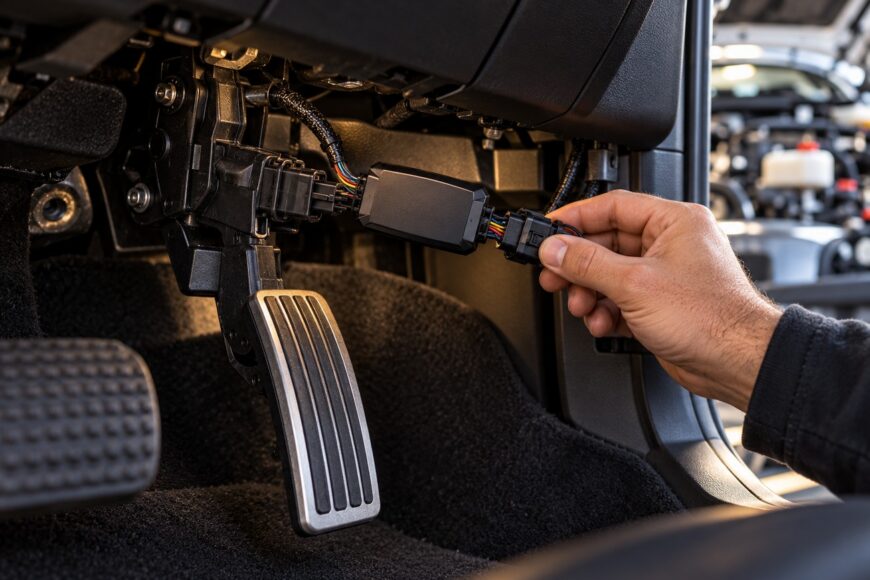
An electronic throttle response controller sits in the accelerator-pedal signal path and changes how pedal movement is interpreted. In simple terms, it can make a small pedal input request more throttle opening than the factory map would request. The result is a shorter-feeling pedal, especially during initial acceleration.
An electronic throttle response controller changes the pedal-to-throttle response curve. It does not increase maximum engine power or torque by itself. Most products also operate without changing fuel or ignition calibration, so they do not provide the type of engine-parameter changes associated with ECU tuning.
The distinction matters because a more immediate request is not the same as more available output. If the engine, transmission, tires, and ECU were already capable of producing the same acceleration, the controller may simply make that acceleration arrive earlier in the pedal travel. At full throttle, there may be little or no additional engine output available for the device to create.
Marketing figures such as “+30–50% throttle response” commonly describe a change in pedal sensitivity or response-map shape. They should not be read as a 30–50% increase in power, torque, or acceleration. A vehicle can feel substantially more alert in city driving while showing little change in measured acceleration.
How Drive-by-Wire Throttle Control Works
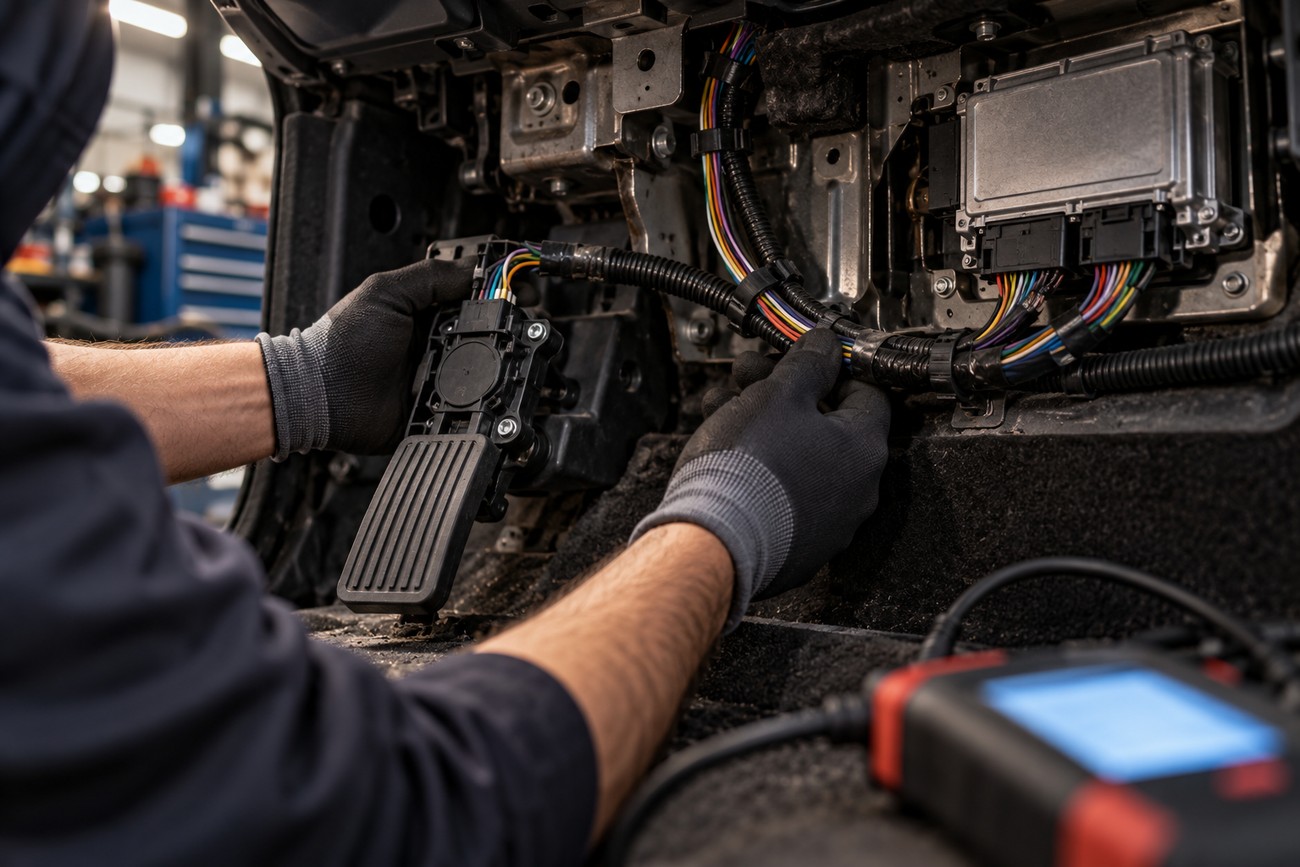
In a modern drive-by-wire vehicle, the accelerator pedal usually acts as a position sensor rather than a direct mechanical throttle connection. The pedal assembly sends one or more position signals to the ECU, which checks them for plausibility and interprets the driver’s request.
The ECU then uses a driver-demand or pedal map to decide how much throttle opening, torque, and transmission response to request. This map is often nonlinear. The first part of pedal travel may produce a deliberately modest response, while later movement requests substantially more output. That calibration helps with smooth starts, fuel economy, emissions, and protection of the drivetrain.
An external controller changes the signal or its interpretation before the ECU completes that process. It does not become the final authority over the engine. Traction control, stability control, transmission logic, and component-protection strategies can still limit the final throttle command whenever the vehicle detects wheelspin, instability, excessive temperature, or another risk.
This is why a controller cannot guarantee a stronger launch in every situation. The ECU may reduce the requested torque, the transmission may choose a different gear, or the tires may lack enough grip to use the sharper request. The device changes one input to a larger control system rather than replacing that system.
What Changes Behind the Wheel—and What Does Not
The strongest effect is usually found at small and medium pedal inputs. A vehicle that previously needed a noticeable pedal movement to leave smoothly may respond earlier, making urban traffic feel more active. The change is especially apparent during takeoff, rolling acceleration, and small throttle corrections.
Soft factory maps on turbocharged engines may make the controller feel more noticeable. Turbocharged vehicles are often calibrated with a progressive initial response, while an already sharp naturally aspirated setup may leave less subjective improvement to find. This is a difference in pedal calibration, not proof that one engine has gained more mechanical output.
Full-throttle acceleration is a different matter. Once the pedal requests the available engine output, making the early part of the curve more aggressive does not create additional airflow, fuel delivery, boost, or ignition authority. Overtaking may feel easier because the request arrives sooner, but measured acceleration can remain nearly unchanged.
Automatic transmissions can make the effect more noticeable because pedal position may influence shift timing, downshifts, and the transmission’s interpretation of driver demand. Manual-transmission drivers may still feel a sharper initial response, although clutch control and gear choice remain major factors. The result depends on the vehicle’s calibration and transmission logic, so reports from one model do not transfer reliably to another.
There is also a practical limit to subjective improvement. A driver may describe the car as faster because the “dead” part of the pedal has been reduced, while an instrument would show little difference in acceleration. That can still be useful for a vehicle that feels frustratingly lazy, provided the new response remains smooth and predictable.
Throttle Controllers vs Factory Modes, Tuning, and Powerboxes
These products are often grouped together because they all affect how a vehicle responds to the accelerator, but they do different work.
| Option | What it changes | Does engine output change? | Typical use | Principal limitation |
|---|---|---|---|---|
| External throttle response controller | Pedal-to-throttle response curve | No, by itself | Sharper or more progressive pedal feel | Can duplicate factory mapping and make low-speed control worse |
| OEM Eco, Normal, or Sport mode | Factory pedal mapping, transmission logic, and sometimes other vehicle systems | Usually no direct increase in maximum output | Selectable factory response and comfort settings | Available behavior depends on the vehicle’s original calibration |
| ECU tuning | Engine operating parameters and torque strategies | Potentially, depending on the calibration and hardware | Changing engine behavior and available output | Requires vehicle-specific calibration and can affect reliability, emissions, or warranty decisions |
| Powerbox or engine signal modifier | One or more engine sensor or control signals, depending on the product | May claim to influence output, but results depend on design and calibration | Alternative engine-performance modification | Quality, compatibility, and control strategy vary substantially |
OEM Eco, Normal, and Sport modes may already alter pedal mapping within the factory calibration. If Sport mode provides the response you want and Normal mode remains smooth, an external controller may add little beyond another set of labels and adjustment steps. It can be redundant rather than unique.
Choosing Settings for City Driving, Wet Roads, and Daily Use
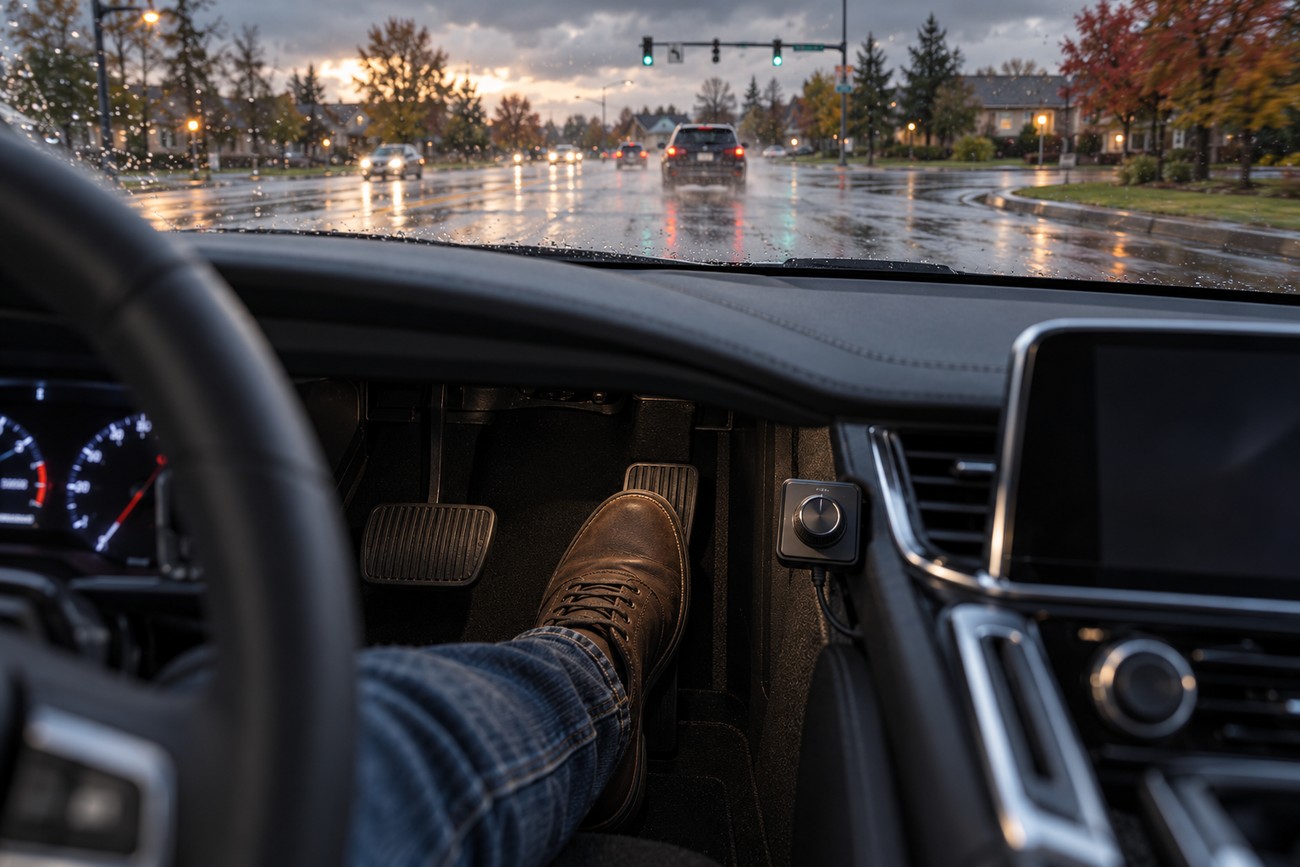
The most aggressive setting is rarely the best default for daily driving. It can make the first part of the pedal too sensitive, producing jerks when pulling away, parking, or moving through stop-and-go traffic. A moderate or more linear setting usually gives a clearer response without turning small ankle movements into abrupt torque requests.
Wet roads expose the limitation more clearly. A sharper pedal map cannot create tire grip, and it may cause earlier traction-control intervention or wheelspin on a low-grip surface. If the system intervenes repeatedly, the vehicle may accelerate less consistently than it would with a calmer request.
Towing, maneuvering on an incline, and reversing into a tight space also favor control over maximum sensitivity. A driver may need precise, small changes in torque rather than an immediate jump in throttle opening. Keeping a low or near-stock setting available is more useful than treating the most aggressive mode as the only meaningful setting.
Factory safety systems remain active, but they do not remove the need for a sensible calibration. ESP and traction control can reduce the final command after the pedal request has already become abrupt. For everyday use, test the lowest useful setting in a safe area, then check cold starts, parking, traffic gaps, and wet conditions before leaving it selected.
Installation, Compatibility, and the Problems Marketing Leaves Out
Compatibility must be verified for the exact vehicle model, model year, pedal assembly, and ECU configuration. Similar-looking vehicles can use different pedal sensors, connectors, software, or signal checks. A product that fits physically may still be unsuitable if its signal behavior does not match the vehicle’s diagnostic expectations.
Installation quality matters because the module becomes part of the pedal-signal path. Poorly seated connectors, damaged wiring, or an incompatible unit can create intermittent signal errors and inconsistent response. Some controllers may also interact poorly with factory drive modes, learned adaptations, or later software updates.
Return the vehicle to the stock pedal signal and reproduce the complaint before blaming the throttle body or ECU, especially after a software update or an intermittent connector fault.
That diagnostic order prevents a response setting from being mistaken for a hardware failure. Common complaints include jerky low-speed behavior, difficult throttle modulation in traffic, an overly nervous response, and little noticeable benefit at cruising or highway speed. A controller may improve the first few feet of acceleration while adding no value during steady high-speed driving.
Before buying, check the exact application list, confirm whether the device can be bypassed or returned to stock, and identify how the vehicle’s original drive modes behave with it installed. Keep the original connector arrangement and installation instructions. If a warning appears after installation, remove the added variable before drawing conclusions about the throttle body, pedal sensor, or ECU.
Common Myths: Is Sharper Throttle Response Really Faster?
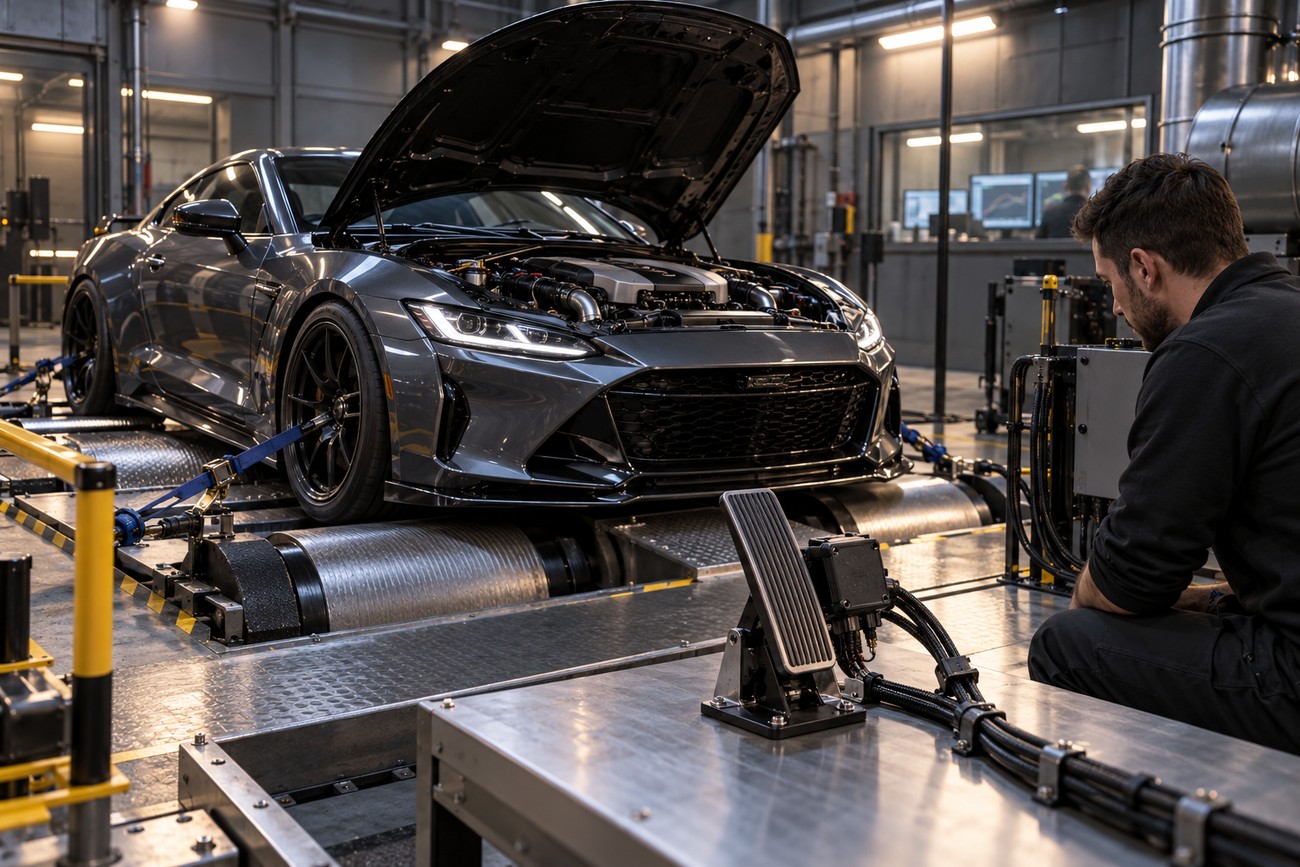
A throttle controller does not add power simply because the car feels more eager. It generally changes pedal mapping, while ECU tuning can change engine operating parameters such as torque strategies and other calibration values. These are different upgrades with different risks, objectives, and verification methods.
The claim that a more aggressive mode is always faster also fails in real conditions. On a slippery surface, a sudden torque request can cause wheelspin or earlier traction-control intervention. The driver may then lose time and smoothness compared with a less aggressive setting that keeps the tires closer to their available grip.
Drivers seeking horsepower, torque, or shorter verified acceleration times should not treat a pedal controller as an engine-performance upgrade. It may make the vehicle feel more responsive, which is a valid comfort or drivability goal, but that benefit should be judged through controllability and actual use rather than advertising percentages.
The device is least compelling when the vehicle already has a responsive factory map or useful Eco, Normal, and Sport calibration. It is more defensible when the specific complaint is a dull initial pedal response and the buyer accepts that the change will be most visible at small and medium inputs. Skip it if the real complaint is weak high-speed acceleration, lack of power, or a mechanical fault.
Frequently asked questions
Electronic throttle warnings can have several causes, including the added controller, wiring, the pedal sensor, the throttle assembly, or ECU-related diagnosis. Returning the vehicle to its stock signal and scanning for fault codes can help separate an installation issue from a vehicle fault. The symptoms and warning severity determine whether the vehicle should be driven or inspected immediately.
How do I fix an electronic throttle control warning?
Start by returning any added throttle controller to the stock pedal signal, then scan the vehicle for stored fault codes. Inspect the accelerator-pedal and throttle-body connectors, wiring, and signs of loose or damaged terminals. Do not assume that changing the response setting will repair an underlying electronic throttle control fault.
The warning may involve the pedal sensor, throttle assembly, wiring, ECU-related diagnosis, or the added module itself. If the vehicle has inconsistent response, enters a reduced-response protection mode, or shows multiple warning indicators, avoid repeated road testing until the fault is identified. A diagnostic scan and a controlled comparison with the stock configuration provide more useful evidence than trying different controller modes.
How much does it cost to fix an electronic throttle control system?
There is no universal repair price because the fault can range from diagnosis or a connector repair to replacement of the pedal sensor, throttle assembly, or an added controller. ECU-related diagnosis can also change the scope of the work. The correct estimate depends on which component is actually failing and whether the aftermarket module is involved.
Ask for the diagnostic result before approving parts replacement. Removing the controller and checking the original signal path can separate an installation problem from a vehicle fault. This approach may avoid replacing a throttle assembly when the cause is a connector, wiring issue, or incompatible module.
What happens when electronic throttle control goes bad?
A failing electronic throttle system can produce warning indicators, inconsistent pedal response, delayed or reduced response, and reduced-response protection behavior. The vehicle may still move, but its acceleration can become unpredictable or deliberately limited by the ECU.
Continued driving depends on the exact symptoms and warning severity. A brief warning with normal operation still requires diagnosis, while severe hesitation, unstable response, or a protection mode calls for stopping in a safe place and arranging professional inspection. Treating the symptom as a performance-setting issue can delay repair of the pedal sensor, throttle assembly, wiring, ECU, or an added controller.