Dyno tuning and street tuning solve different measurement problems. A dynamometer gives the tuner controlled load, repeatable test conditions, and direct torque feedback. That makes it possible to see whether a change in ignition, boost, fuel, or cam timing produced a real mechanical improvement rather than a subjective impression.
Street tuning exposes the car to real airflow, intake temperature, road load, gear behavior, and traffic-related transitions that a shop environment may miss. It also removes the dino’s direct torque signal, so small gains become harder to separate from measurement noise. The practical choice is therefore a trade-off between controlled measurement and real-world validation, with neither method reliable as the sole source of evidence.
- What Dyno Tuning and Street Tuning Actually Measure
- Where a Dyno Has the Clear Advantage
- Where Street Tuning Finds Problems a Dyno Can Miss
- Dyno Tuning vs Street Tuning: Practical Trade-Offs
- The Fuel and Ignition Question: Knock Limit Versus MBT
- Why Power Numbers Disagree Between Dynos
- Common Tuning Mistakes and the Hybrid Workflow That Avoids Them
- Frequently asked questions
- How much HP will a dyno tune add?
- What should I prepare before a dyno tuning session?
- What is the difference between dyno tuning and street tuning?
What Dyno Tuning and Street Tuning Actually Measure
A dynamometer measures the engine’s output through the drivetrain while controlling or recording the conditions under which that output is produced. A load-bearing dyno can hold the engine at specified rpm and load, allowing the tuner to examine steady-state cells, transitions, and repeatable full-load runs. This is especially useful when the calibration requires careful changes rather than a single wide-open-throttle sweep.
An inertia dyno works differently. Its fixed rotating mass is accelerated by the vehicle, so it is primarily focused on full-throttle acceleration sweeps and is limited for steady-state and partial-load work. It can produce useful power and torque curves, but it is less suitable for holding a specific rpm and load while the tuner evaluates a narrow calibration area.
Street tuning measures how the complete vehicle behaves under actual road conditions. The car experiences real airflow, intake temperature, road load, traction changes, gear selection, throttle control, and the thermal behavior of the cooling system. Data logs can reveal mixture, ignition correction, boost, temperatures, and sensor behavior, but street tuning does not directly measure torque.
That distinction changes how results should be interpreted. A dyno can show that a calibration change improved torque at a particular operating point, while the road can show whether the driver can access that improvement smoothly. A car may gain on a graph and still hesitate during a throttle transition, return poorly to idle, or respond differently once it is pulling a real gear against aerodynamic load.
Where a Dyno Has the Clear Advantage
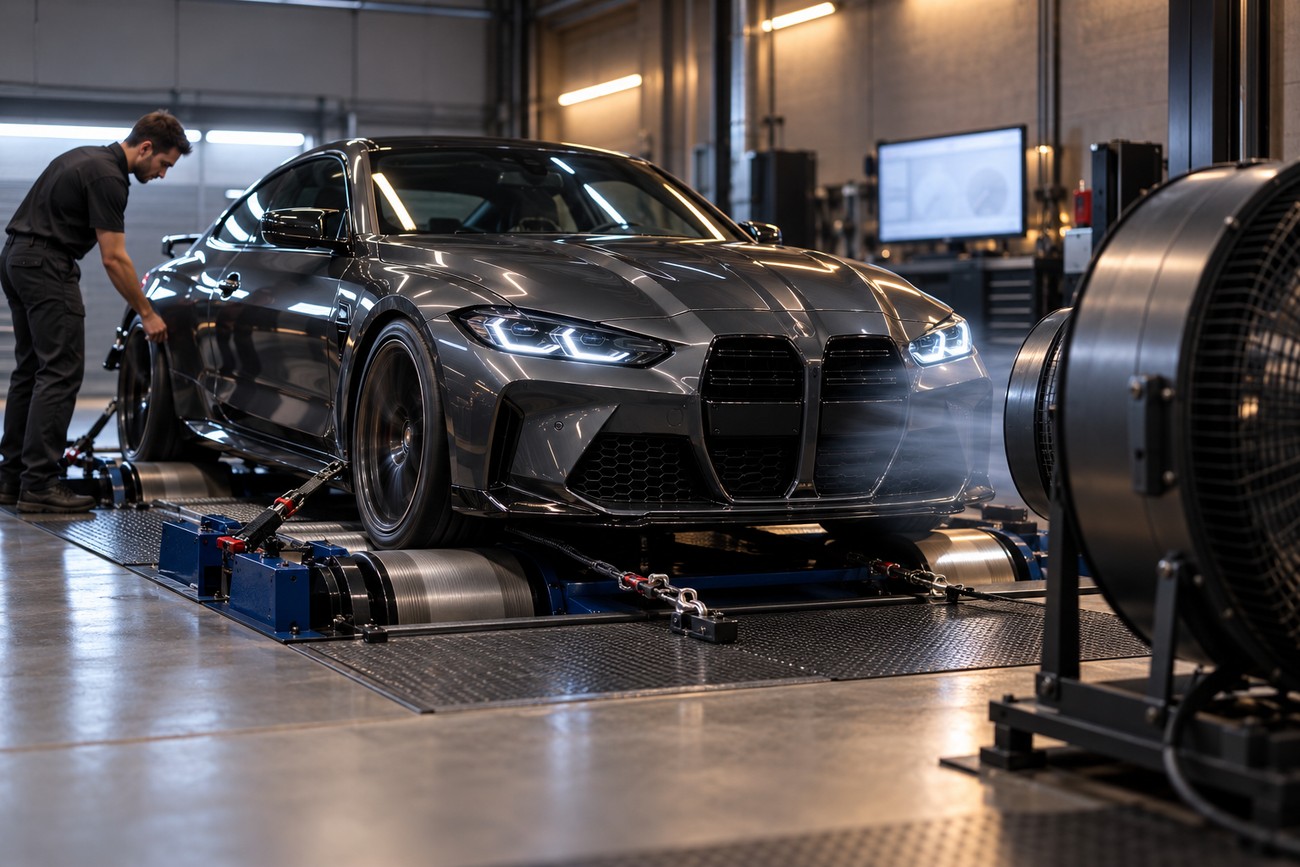
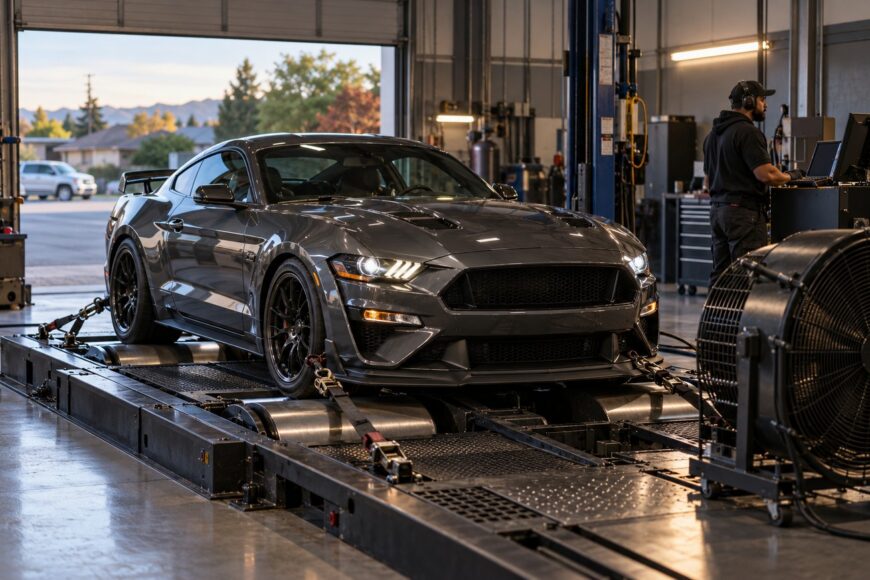
The dino’s clearest advantage is control. The tuner can repeat the same rpm and load points, make one change at a time, and compare the resulting torque response. This is more informative than judging acceleration by feel, because changes in traction, road gradient, wind, gear selection, and driver input can easily disguise a small improvement.
Direct torque feedback is particularly valuable for ignition, boost, and cam timing. Small cam-timing changes may alter the shape of the torque curve without creating a dramatic peak-power difference. On the road, those changes are difficult to evaluate objectively without rapid, repeatable torque measurement. A load-bearing dyno can test them in the operating areas where the engine actually responds.
For a detonation-limited engine, the safe ignition limit is generally set by the knock threshold, whether the work is done on a dyno or on the road with proper logging. The dyno does not remove the need for knock control, fuel monitoring, temperature checks, and conservative protection strategies. It simply makes the relationship between a calibration change and torque response easier to observe.
Torque measurement becomes more important with E85, methanol, race fuel, and other fuels where knock may not be the primary limiter. If detonation does not arrive first, the tuner needs another way to identify the useful ignition range. A dyno can also test load-dependent boost control and enrichment strategies more systematically, although its ventilation and load scenario determine how representative the result will be.
Dyno airflow must be treated as part of the test design. Fan position, ventilation capacity, vehicle speed simulation, and the duration of the load can change intake and coolant temperatures enough to alter the calibration decision.
A dyno does not automatically reproduce real aerodynamic load, high-speed ram air, or vehicle cooling behavior. A large fan pointed at the front of the car may provide useful airflow, yet it may not duplicate the pressure and temperature conditions seen at speed. The test remains valuable, provided its limits are understood and later validation includes the operating conditions the dyno could not recreate.
Where Street Tuning Finds Problems a Dyno Can Miss
Road validation is where drivability becomes measurable in practical terms. Cold starts, warm-up behavior, idle recovery, throttle transitions, deceleration, and partial-load operation may never appear in a full-throttle dyno session. A calibration that looks clean at high load can still produce a hesitation when the throttle opens slightly or an unstable return to idle after a gear change.
Real traffic also exposes the way the engine and transmission interact. Turbo response may differ by gear because the engine sees a different load trajectory than it did on the dyno. Electronic throttle control, boost targets, torque intervention, and gear-specific limits can create behavior that is absent in a simple acceleration sweep. In-gear acceleration may feel slower even when the peak power graph appears strong.
Temperatures are another important distinction. The road supplies changing airflow, heat soak, ambient conditions, and cooling demand that a dyno setup may only approximate. A vehicle can pass a short dyno pull and then show rising intake or coolant temperatures during repeated real-world use. Logs taken across the intended driving range help identify whether the calibration remains stable after the first clean run.
Street tuning has its own measurement cost. Each change may require a run, a safe stop, log review, and another run, while fuel is consumed and conditions change. High-load testing should take place on a closed course, track, or other controlled legal facility, rather than on an uncontrolled public road. Safety and legality are part of the test method, not obstacles to be ignored for convenience.
Dyno Tuning vs Street Tuning: Practical Trade-Offs
The comparison below shows why the two methods are complementary. The most suitable choice depends on whether the immediate task is measuring a small mechanical change or confirming how the complete vehicle behaves outside the shop.
| Area | Dyno tuning | Street tuning |
|---|---|---|
| Load control | Controlled and repeatable; a load-bearing dyno can hold specified rpm and load. | Real road load, but changing with speed, gear, gradient, wind, and traffic. |
| Torque measurement | Direct torque feedback supports objective comparison of small changes. | No direct torque feedback; logs and repeatable acceleration tests are indirect. |
| Repeatability | High when the same gear, fuel, tire pressure, temperature, and correction standard are maintained. | Lower because weather, surface, traffic, and vehicle temperature vary. |
| Drivability | Can test selected transitions, but may miss cold starts and everyday behavior. | Shows idle recovery, throttle response, deceleration, and partial-load behavior directly. |
| Thermal realism | Depends heavily on ventilation, fan control, and the chosen load scenario. | Reflects real airflow, heat soak, and cooling demand more directly. |
| Partial-load tuning | Strong on a load-bearing dyno; limited on an inertia-only installation. | Natural operating environment, though repeatable cell-by-cell testing is harder. |
| Safety | Vehicle remains secured in a controlled facility, with risks managed by the operator. | Requires a closed course, track, or other controlled legal facility for high-load work. |
| Best use case | Baseline calibration, torque evaluation, and controlled optimization. | Transient behavior, thermal validation, and confirmation of real vehicle response. |
A dyno is generally the efficient place to establish the baseline and optimize changes that need torque feedback. Street testing is more demanding because it involves repeated runs, stops, log review, and fuel, yet it answers questions the dyno cannot answer fully. The road can show whether the driver receives the expected benefit in the gear and conditions that matter.
The strongest general workflow is hybrid. Use the dyno for controlled load-based calibration, fuel and ignition work, boost control, and torque evaluation. Then use a closed course or track to validate transient response, cooling, intake temperatures, deceleration, and gear-specific behavior. This avoids treating a clean graph as proof that the vehicle is finished.
More power on a graph and faster real-world acceleration are not always the same outcome. A broad torque curve, predictable throttle response, stable temperatures, and effective traction can matter more than a higher isolated peak. The best result is the calibration that produces measurable output and makes that output usable.
The Fuel and Ignition Question: Knock Limit Versus MBT
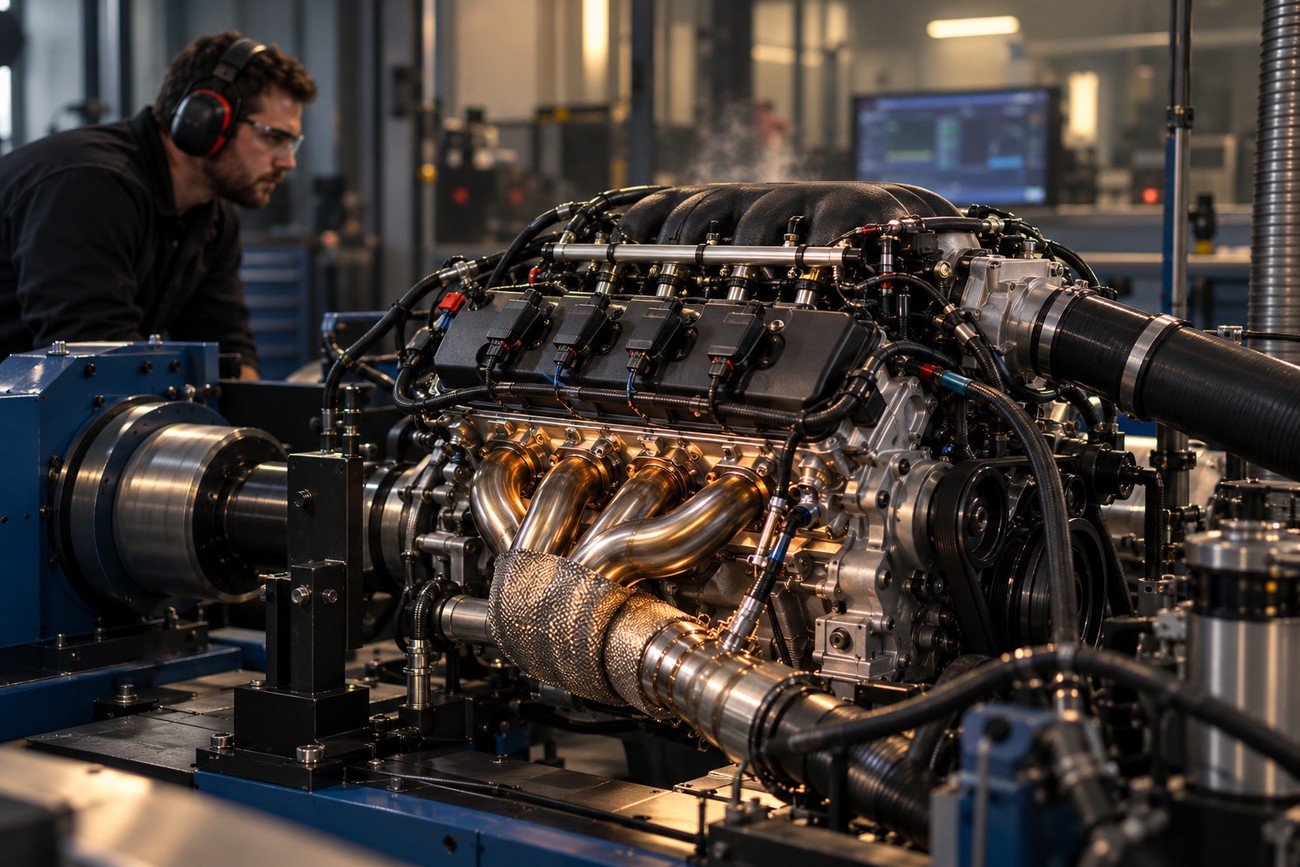
Ignition tuning depends on what limits the engine first. On a detonation-limited gasoline engine, the safe ignition limit is generally determined by the knock threshold. If advancing the timing brings knock, the calibration must stay on the safe side of that threshold, subject to the engine’s protection systems, fuel quality, and operating temperature.
MBT means the ignition point at which additional advance no longer produces a useful torque increase. Reaching the knock limit and reaching MBT are not always the same event. An engine may encounter knock before MBT, or it may tolerate more advance without knock while torque has already stopped increasing.
With a suitable gasoline calibration and good logging, a detonation-limited engine can often reach a similar safe ignition result on a dyno or on the road. The road can identify knock activity, mixture problems, temperatures, and ECU corrections, provided the logging is fast enough and the test conditions are controlled. It still cannot provide the same direct confirmation of small torque changes.
On high-octane or alcohol fuels, the absence of knock is not a reason to keep adding timing. Torque response is used to confirm whether the engine is still gaining useful output or has already reached MBT.
E85, methanol, race fuel, and other high-octane fuels can move the limiting factor away from knock. In that situation, the tuner may have no audible or logged detonation signal to identify the optimum angle. Without torque feedback, a timing change can feel promising, remain free of obvious knock, and still leave power on the table or move beyond the point of useful combustion phasing.
The common belief that more ignition advance automatically means more power is therefore unsafe. After MBT, additional advance does not guarantee more power and can increase risk. A dino’s torque trace is especially useful here because it distinguishes a real improvement from an advance value that merely looks aggressive in the calibration file.
Why Power Numbers Disagree Between Dynos
Different dynos can report different power figures without either test being mechanically wrong. The result depends on the dyno type, drivetrain attachment, tire pressure, strap arrangement, gear selection, fuel, temperature, correction settings, and the method used to process the run. A number is meaningful only with its test context.
Correction standards also matter. SAE J1349 generally reports approximately 4% less power than SAE J607, and the standards are not directly interchangeable. A before-and-after comparison that changes standards can create an apparent gain or loss even when the vehicle and calibration have not changed.
Correction factors account for air-density differences, which helps compare tests performed in different atmospheric conditions. They do not capture every fuel, knock-sensitivity, cooling, or calibration-quality difference. Corrected power is therefore a standardized estimate under defined assumptions, not a promise that the engine will produce the same number in every environment.
For a useful comparison, keep the same dyno, gear, tire pressure, fuel, temperature conditions, and correction standard. Tire pressure and vehicle attachment can affect repeatability, especially when the test relies on driven tires and straps. Comparing a graph from one facility with a graph from another is usually a comparison of procedures as much as a comparison of engines.
Common Tuning Mistakes and the Hybrid Workflow That Avoids Them
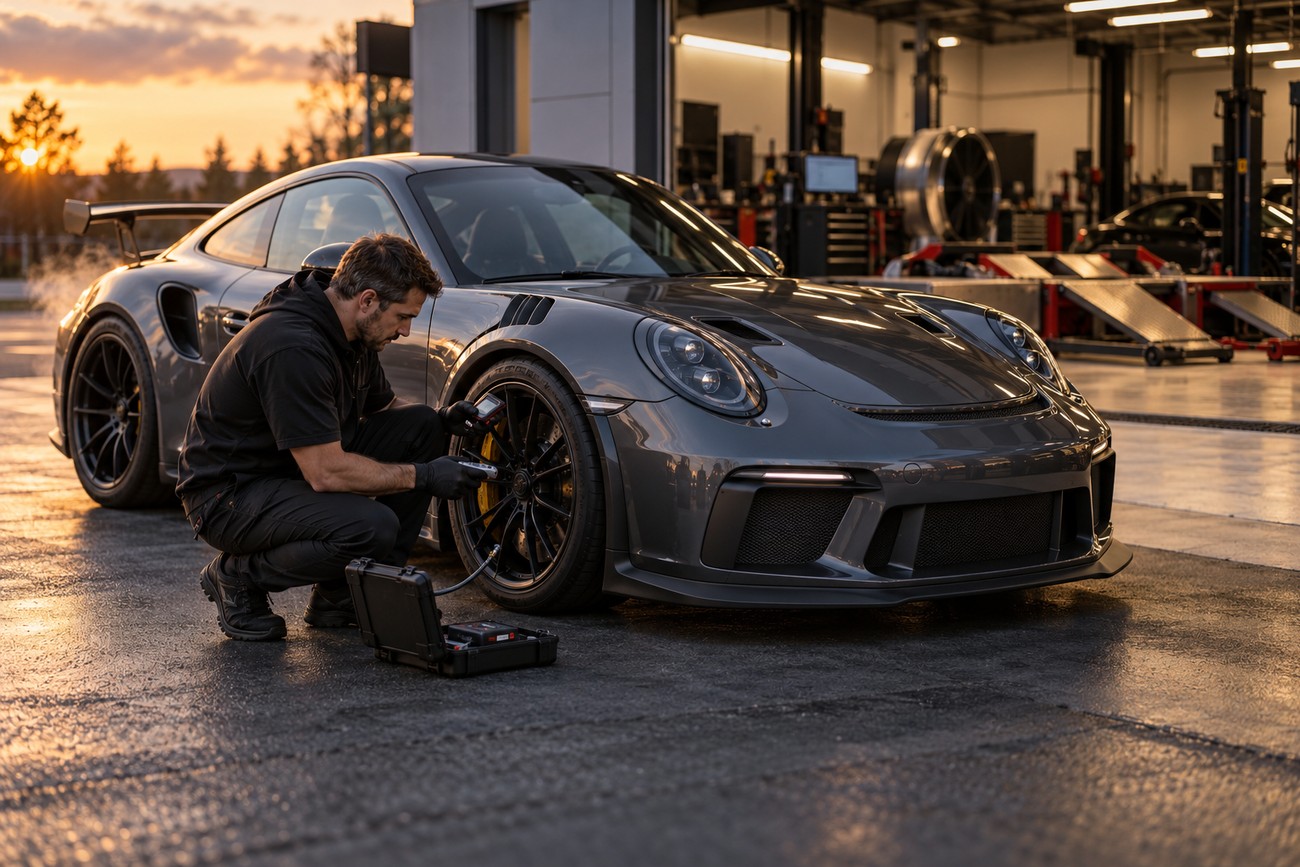
The first mistake is treating mismatched dyno runs as a precise before-and-after test. Record the dyno type, gear, tire pressure, fuel, ambient conditions, correction standard, and relevant vehicle settings. If those variables change, the result may still be informative, but the size and direction of the calibration effect become less certain.
A second mistake is optimizing only peak power. Peak output can rise while the car develops a hole in the midrange, poor throttle transitions, unstable idle recovery, or excessive temperature growth. Check cold start, warm-up, idle, deceleration, partial load, transient enrichment, boost control, and protection strategies alongside the full-load curve.
Subjective acceleration is useful for detecting a large problem, but it is a weak tool for finding a small optimum. Wind, road grade, traction, shift behavior, and driver expectation can all influence the impression. The absence of audible knock is also not proof of a safe calibration; knock control activity, mixture, temperatures, fuel pressure, and ECU safeguards should be logged and reviewed.
A practical process begins with a mechanically sound vehicle and a controlled baseline. Verify fault codes, sensors, fuel delivery, ignition components, cooling, and boost or vacuum integrity before changing the calibration. Use consistent fuel and tire pressure, then establish repeatable dyno runs where controlled load and torque feedback matter.
After the dyno work, use data logging to check protection behavior and validate the calibration on a closed course or track. Confirm real airflow, intake and coolant temperatures, transient throttle response, turbo behavior, deceleration, partial-load operation, and gear-specific acceleration. If the vehicle behaves poorly outside the dyno, revise the calibration rather than defending the graph.
- Inspect the vehicle and resolve mechanical faults before tuning.
- Use consistent fuel, tire pressure, test gear, and correction settings.
- Establish a documented baseline with logs and repeatable dyno runs.
- Optimize fuel, ignition, boost, and load-dependent areas where torque feedback is useful.
- Validate cold starts, transitions, partial load, thermal behavior, and real in-gear response in a controlled legal environment.
- Review the complete data set before accepting the calibration as finished.
Frequently asked questions
How much HP will a dyno tune add?
There is no universal horsepower gain from a dyno tune. The result depends on the baseline calibration, engine hardware, fuel, and available calibration headroom. A vehicle with a conservative or mismatched baseline may have meaningful room for improvement, while a well-calibrated engine with limited hardware changes may show little peak-power movement.
Peak horsepower also does not describe the entire result. A dyno session may improve the torque curve, throttle behavior, boost control, or temperature stability without producing a dramatic increase at the highest measured point. Compare the same dyno, gear, fuel, tire pressure, temperature conditions, and correction standard before judging the gain.
What should I prepare before a dyno tuning session?
Arrive with the vehicle mechanically ready. Check for fault codes, fluid leaks, worn ignition components, cooling problems, fuel-delivery issues, intake leaks, and loose driveline or exhaust hardware. Use the fuel intended for the final calibration, and keep the fuel type and tire pressure consistent if you need a reliable before-and-after comparison.
Tell the tuner how the vehicle will be used, including street driving, track work, towing, cold-weather operation, or a specific fuel. That information affects the priorities for cold starts, partial load, thermal protection, boost response, and peak output. Bring any relevant ECU logs or known symptoms, while recognizing that the completed calibration still needs closed-course validation for real-world behavior.
What is the difference between dyno tuning and street tuning?
Dyno tuning provides controlled load, repeatable conditions, and direct torque feedback, making it useful for measuring changes to fuel, ignition, boost, and cam timing. Street tuning evaluates the complete vehicle under real airflow, heat soak, gear behavior, throttle transitions, and everyday operating conditions.
The two methods are complementary. A dyno is best for controlled optimization, while a closed course or track helps validate drivability, temperatures, transient response, and real-world performance.