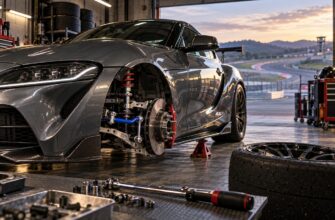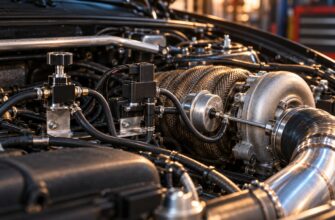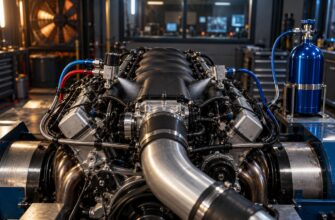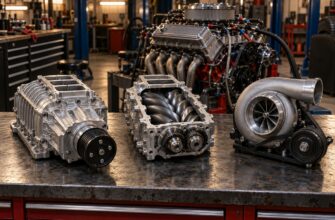
A freer-flowing downpipe can reduce restriction after the turbocharger, improve turbine-outlet flow, and change how quickly the exhaust system sheds heat. Those effects explain the appeal of a larger pipe or a less restrictive catalyst. They do not, by themselves, guarantee a useful power increase on every turbocharged car.
The result depends on the turbocharger, pipe diameter, ECU calibration, and catalyst configuration. A catless part may alter backpressure, exhaust temperature, and gas composition while also causing catalyst-monitoring faults, stronger odor, more noise, and inspection problems. For a road car, the sensible decision is to balance performance against emissions compliance rather than assume that removing the catalyst is automatically better.
- What Does Upgrading a Downpipe Actually Do?
- Emissions Laws: Why Catless Is Not a Legal Upgrade
- Catless, High-Flow or OEM-Style: Comparing the Real Trade-Offs
- Power, ECU Calibration and Check-Engine Faults
- Installation Problems and Hidden Costs
- How to Choose a Downpipe for a Road Car
- Frequently asked questions
- What does upgrading your downpipe do on a turbocharged car?
- Why can P0420 return after a new catalytic downpipe is installed?
What Does Upgrading a Downpipe Actually Do?
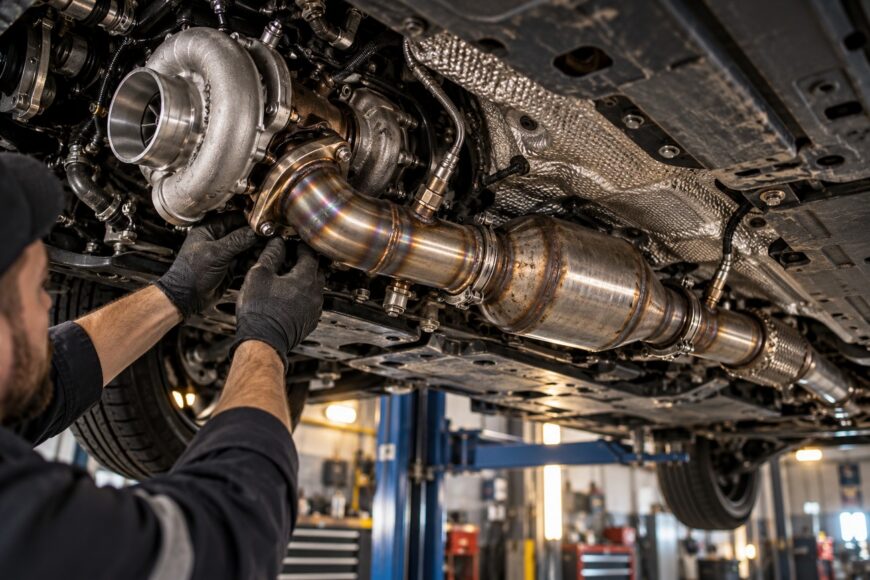
The downpipe carries exhaust gas away from the turbocharger and into the rest of the exhaust system. Its diameter, bends, oxygen-sensor positions, catalyst location, and internal restriction all affect the pressure and temperature seen at the turbine outlet. Reducing restriction can help the turbocharger move exhaust gas, but the value of that change depends on how restrictive the original system was.
Changing the pipe after the first oxygen sensor can alter backpressure, exhaust temperature, and gas composition. A larger diameter may support a high-output turbo, while an oversize pipe can reduce gas velocity and offer little benefit on a smaller setup. Catalyst placement also matters because a catalyst close to the turbo reaches operating temperature sooner.
ECU calibration is part of the hardware combination. The engine may need different boost control, fueling, ignition, or torque management after a substantial exhaust change, although calibration for drivability does not make an emissions-modified part legal. Advertised gains often assume a particular turbo, tune, and catalyst arrangement, so results on a stock ECU may be small or accompanied by faults.
A physical flow improvement is only one part of a complete performance package. The vehicle still has to control mixture, temperature, boost, noise, and emissions monitors. Removing restriction does not create a universal guaranteed power increase, and the best result for a road car may come from retaining a suitable catalyst while improving the rest of the system.
Emissions Laws: Why Catless Is Not a Legal Upgrade
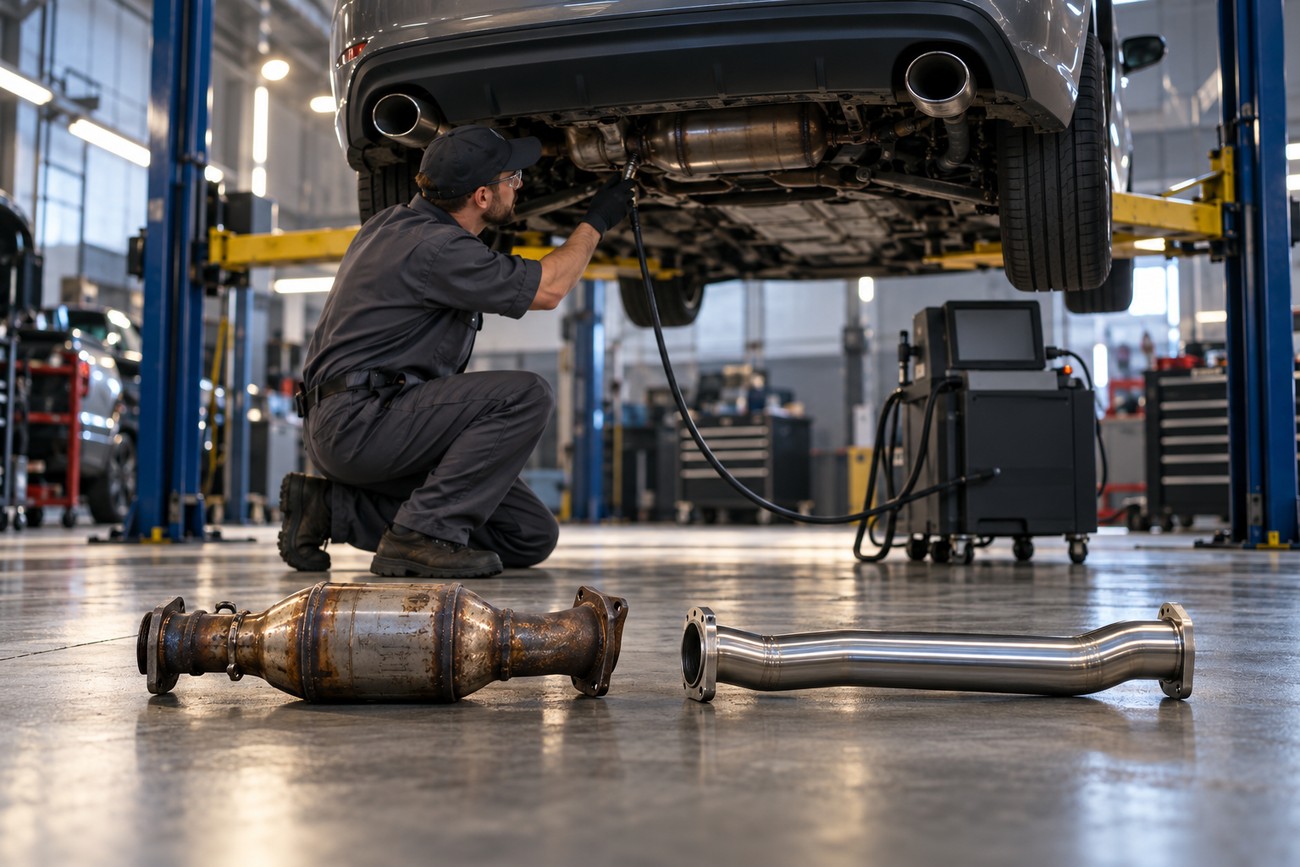
In the United States, the Clean Air Act prohibits removing, bypassing, or making less effective factory emissions-control devices for the vehicle’s service life. The rule does not end when the warranty expires. EPA treats disabling, damaging, or otherwise degrading emissions-control devices as tampering, and a replacement pipe whose primary effect is bypassing or removing a catalytic converter is federally prohibited.
A software change does not erase that restriction. Disabling emissions monitoring may itself constitute tampering rather than legalizing modified hardware. A car can run smoothly with the warning suppressed and still be outside its certified emissions configuration.
UK requirements create similar practical limits for road use. For vehicles first registered from 1 September 2002, a missing, obviously modified, or defective emissions-control component can cause MOT failure. For vehicles registered after 1 March 2001, a replacement catalytic converter must be type-approved.
A competition-only designation does not automatically make an emissions-modified part legal for road use. Legal status depends on the vehicle, jurisdiction, certification, and intended use. Warranty status is a separate issue: an out-of-warranty vehicle can still be subject to emissions rules for its entire service life.
Catless, High-Flow or OEM-Style: Comparing the Real Trade-Offs
These three configurations can feel similar in a product catalog while behaving differently on the road. “High-flow” is a marketing description, not proof of emissions compliance; legality depends on certification, efficiency, and vehicle application.
| Downpipe type | Flow potential | Emissions and smell | Noise and fault risk | Inspection prospects and road suitability |
|---|---|---|---|---|
| OEM-equivalent | Usually closest to the original system | Designed to preserve catalyst function and normal odor control | Lowest likelihood of new noise or catalyst-efficiency faults when correctly fitted | Best starting point for a road car, subject to correct approval and condition |
| Certified high-flow catalytic | May reduce restriction while retaining a catalyst | Can preserve emissions performance when properly certified and matched to the vehicle; “high-flow” alone proves nothing | Moderate risk of noise, heat, or faults if fitment or calibration is wrong | Potentially suitable where certification and local rules support the application |
| Catless | Usually offers the least catalyst restriction | Higher risk of fuel smell, noticeable exhaust odor in traffic or an enclosed garage, and emissions-test failure | High risk of Check Engine warnings and catalyst-efficiency faults; sound may become harsher | Poor choice for a road car where inspection and emissions compliance matter |
Keeping a catalyst does not guarantee legality if the component is uncertified or the ECU calibration has been altered. Conversely, a properly documented replacement may provide the desired fitment and flow without accepting the odor and inspection risk associated with a catless system.
The practical compromise is broader than maximum flow. It includes catalyst efficiency, cold-start behavior, exhaust temperature, noise, smell, and the chance of passing an emissions inspection. Removing the catalyst can make the car feel more aggressive while making daily use less pleasant in traffic or a closed garage.
Power, ECU Calibration and Check-Engine Faults
Catless installations often trigger Check Engine warnings and catalyst-efficiency codes such as P0420 or P0430 because the ECU compares oxygen-sensor behavior across the catalyst. A freer-flowing pipe can also expose an existing fueling, ignition, or sensor problem that was previously less obvious. The drivability effect after installation is model-dependent and should not be treated as universal.
P0420 or P0430 does not automatically prove that the replacement catalyst is defective. The same codes can result from an exhaust leak, a leak before a sensor, misfires, or inaccurate AFR/O2 readings. Sensor placement and wiring must also be checked because a change in pipe design can alter both the measured gas stream and the sensor’s exposure to heat.
Require a leak test and scan-data diagnosis before blaming the replacement catalyst for P0420 or P0430. Verify misfire history, sensor readings, and exhaust leaks first.
A tune may be needed to achieve stable boost control or acceptable drivability after a hardware change, but it is not an emissions-compliance solution. Software that disables emissions monitoring may itself constitute tampering. Clearing the code without finding its cause can also hide a real leak, misfire, or mixture problem that threatens the catalyst and engine.
Power claims should therefore be read as configuration-specific claims. A result obtained with a particular turbo, calibration, pipe diameter, and catalyst cannot be transferred automatically to a stock car. On some vehicles, the main change may be sound and response rather than a substantial repeatable increase in power.
Installation Problems and Hidden Costs
Downpipe work is often more difficult than the product listing suggests. Corroded fasteners, seized oxygen sensors, broken studs, and difficult-to-reach flanges can turn a straightforward replacement into additional labor. A leaking flange can create false sensor readings, unpleasant odor, and a louder exhaust, so sealing the system is part of the repair rather than a cosmetic detail.
Before buying, check the pipe diameter, flange type, oxygen-sensor position, turbo outlet, catalyst location, and clearance for the heat shield. Wiring must stay away from hot surfaces, and neighboring hoses, brackets, and underbody panels need adequate clearance. A different exhaust temperature can affect heat shielding, sensor wiring, and nearby components.
The final cost may include new gaskets, studs, nuts, clamps, hardware, heat-shield work, leak checks, and calibration. Removing and reinstalling the original part can also be useful if the car must later pass an inspection or be sold in an unmodified condition. The part price rarely represents the complete project cost.
Cheap catalytic converters carry their own risks. Under high temperature, a poor-quality unit may melt, break up, or rattle internally. A damaged substrate can create restriction later, so a component that initially appears to offer good flow may become a reliability problem as it ages.
How to Choose a Downpipe for a Road Car
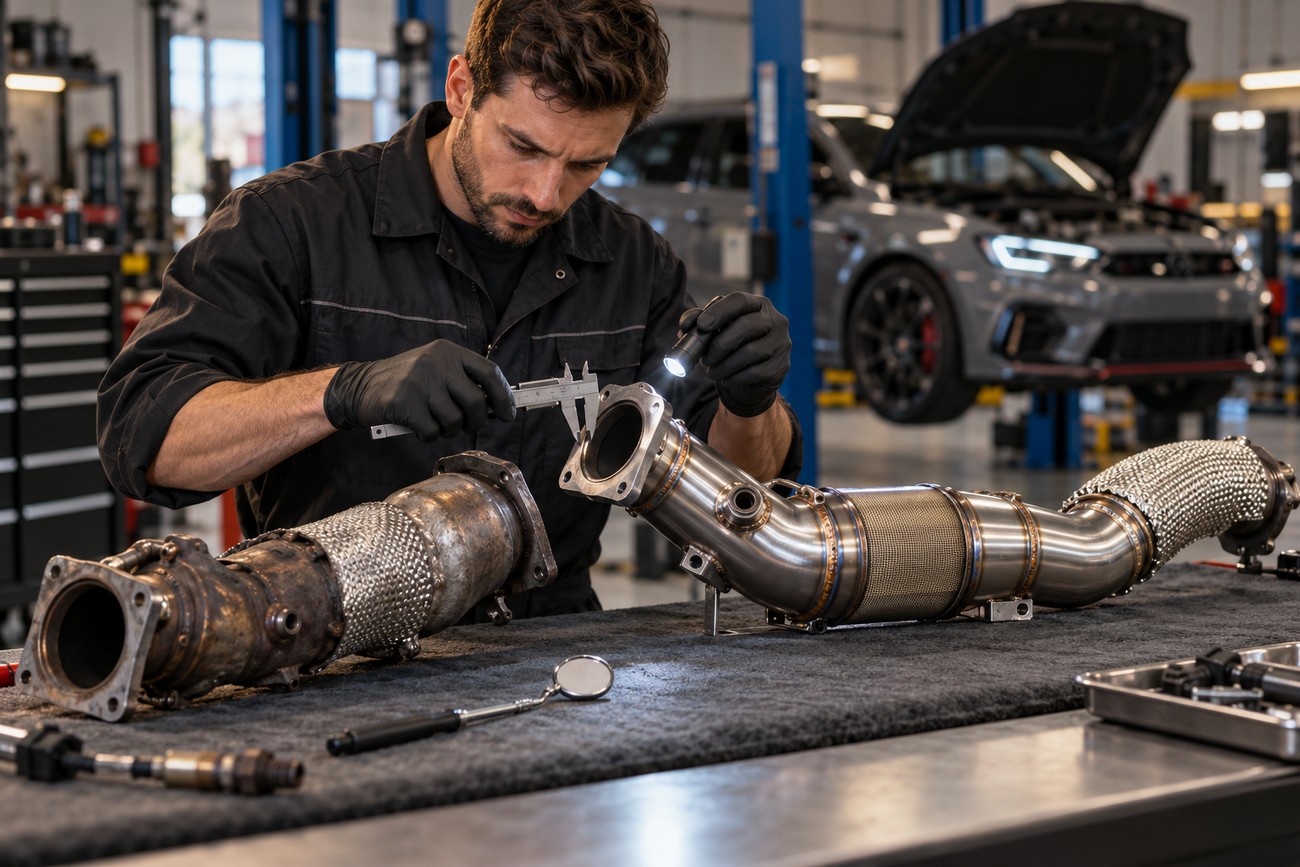
Start with local law, inspection rules, emissions-test requirements, insurance terms, and the exact certification of the part. Check the vehicle-specific application rather than relying on a universal “high-flow” label. A catalyst-retaining design is only a useful legal option when its approval and efficiency are documented for that vehicle and jurisdiction.
Then define the performance objective. A small turbocharged engine used for commuting may gain little from an aggressively enlarged pipe, while a substantially upgraded turbo may need more flow. Consider cold-start emissions, heat near the engine bay, exhaust noise, highway drone, fuel smell, and future resale alongside any expected power improvement.
Catalyst position deserves particular attention. A catalyst close to the turbo supports faster light-off; moving it farther away can worsen cold-start emissions even if the engine later runs cleanly. That trade-off is easy to miss because peak-power testing does not represent the first minutes of a cold drive.
Before changing hardware, scan the current system, check for leaks and misfires, and confirm that the existing catalyst and sensors are working. For a road car where legality matters, a documented, catalyst-retaining solution is usually the safer direction. The best compromise balances flow, catalyst efficiency, cold-start behavior, temperature, noise, and inspection risk.
Frequently asked questions
The answers below address the main performance, diagnostic, and road-use considerations discussed above. They also explain why downpipe changes should be assessed as part of the complete exhaust and engine system. Legal requirements and inspection rules remain jurisdiction-specific.
What does upgrading your downpipe do on a turbocharged car?
It changes the flow path immediately after the turbocharger, which can reduce turbine-outlet restriction and alter heat retention. The effects are separate: a less restrictive outlet may change turbo response, while pipe diameter and catalyst design influence gas velocity, temperature, and total flow.
The same hardware can also change oxygen-sensor readings and catalyst monitoring. A larger pipe therefore needs to be assessed with the turbocharger, ECU calibration, catalyst position, and exhaust temperature in mind. It is a system change, not a standalone horsepower guarantee.
Why can P0420 return after a new catalytic downpipe is installed?
Begin with a leak test, including the joints before the sensors, then confirm sensor position, wiring, and connector condition. Review scan data for front and rear oxygen-sensor behavior, and check the vehicle’s misfire history before condemning the new catalyst.
Incorrect AFR/O2 readings, an unresolved misfire, or a leak can repeatedly recreate the code. If the replacement catalyst is uncertified, incorrectly sized, or poorly positioned, it may also fail to deliver the expected efficiency even though the part is new.