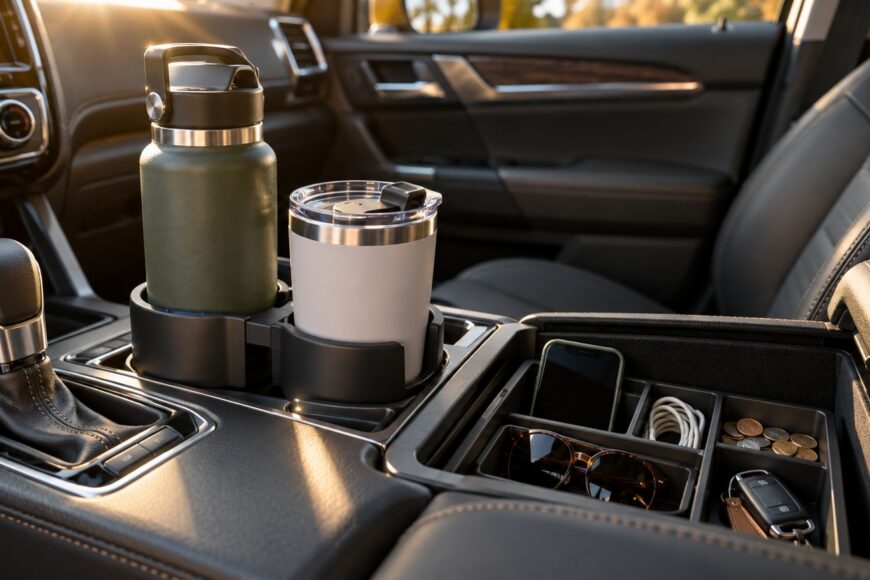
Oversized bottles expose the limits of many factory cup holders, while loose expanders and console organizers can introduce problems of their own. Consoles may differ by model year, trim, opening shape, and nearby controls, even within the same vehicle line. A bottle that fits the advertised diameter can still wobble, interfere with a lid, or place too much force on the factory holder.
Cup holder expanders add room for larger drinkware. Console organizers divide open storage into smaller compartments for phones, cables, keys, and other frequently used items. Both can improve access, yet added capacity may reduce stability, block useful factory space, or make cleaning harder.
Vehicle compatibility requires measurement and a real-world check. The vehicle make, the bottle volume, and a product claim such as “fits all vehicles” do not establish a secure fit. Shape, depth, taper, support height, clearance, and the bottle’s base all matter.
- What Cup Holder Expanders and Console Organizers Actually Solve
- Cup Holder Expanders vs. Console Organizers: Which Fits the Job?
- How to Measure Your Vehicle Before Buying
- Stability, Bottle Weight, and Interior Safety
- Common Fit Failures and Hidden Drawbacks
- Choosing the Right Design for Your Bottle and Console
- Installation and the Real-World Fit Test
- Frequently asked questions
- Why does my bottle fit the advertised diameter but still wobble?
- How can I keep a console organizer from becoming a spill trap?
- What should I do if an accessory fits my vehicle but blocks the console lid?
What Cup Holder Expanders and Console Organizers Actually Solve
A cup holder expander is mainly a clearance accessory. It enlarges the usable opening so a wide bottle or travel mug can sit where the factory holder is too narrow. Product descriptions commonly list bottles about 3.4–3.8 inches in diameter, but this is not an industry standard and says little about the strength or geometry of the installed base.
A console organizer addresses a different problem. It turns a deep or open compartment into separate spaces for small items, helping you reach a phone, charging cable, sunglasses, or coins without searching through a large cavity. Its value depends on preserving access to the storage space and controls around it.
SAE J1100 standardizes methods for measuring vehicle dimensions; it does not establish a universal cup-holder diameter or capacity. The standard generally measures the base vehicle and usually excludes accessories, so an installed organizer can change practical clearances around a lid, armrest, shifter, or passenger’s hand.
Extra storage also consumes space. An organizer can cover factory cup holders, open console areas, USB ports, ventilation, or the path of a console lid. An expander can crowd neighboring holders and reduce lateral support for a narrow can or small cup. Neither accessory is necessarily secure simply because it fits in the console.
Cup Holder Expanders vs. Console Organizers: Which Fits the Job?
Choose an expander when the main restriction is the opening around a large bottle. Choose an organizer when small items move around inside an existing compartment. The comparison below is a decision aid, not proof that either design fits a particular vehicle.
| Factor | Cup holder expander | Console organizer |
|---|---|---|
| Primary purpose | Creates a wider opening for large bottles, mugs, or tumblers. | Adds compartments for phones, cables, keys, and other small items. |
| Space used | Uses a factory cup holder and may crowd adjacent holders. | Uses console storage and may reduce open compartment capacity. |
| Compatibility risk | Round expanding bases may fail in non-round or partially open holders. | Fit depends on compartment dimensions, trim, lid movement, and nearby ports. |
| Stability concern | A wider opening may reduce support for narrow containers; a tall bottle can increase tipping force. | Loose items can move inside compartments, and the unit may shift or rattle. |
| Access | May obstruct another holder, shifter, armrest, or console controls. | May make the console lid, USB ports, or deeper storage harder to reach. |
| Cleaning burden | Spills can collect around the base and contact inserts. | Seams and small gaps can trap liquid, dust, and food debris. |
| Best-use scenario | A measured, sturdy holder for a bottle that does not fit the factory opening. | A removable compartment system that leaves essential controls and storage accessible. |
Soft contact inserts can reduce play, squeaks, and plastic damage in either accessory type. They do not correct an unsuitable shape or compensate for excessive bottle weight.
The practical choice depends on the item that causes the daily inconvenience. A large bottle needs stable support; a console organizer needs clear access and easy cleaning. Combining both may save space only if the accessories do not interfere with each other.
How to Measure Your Vehicle Before Buying
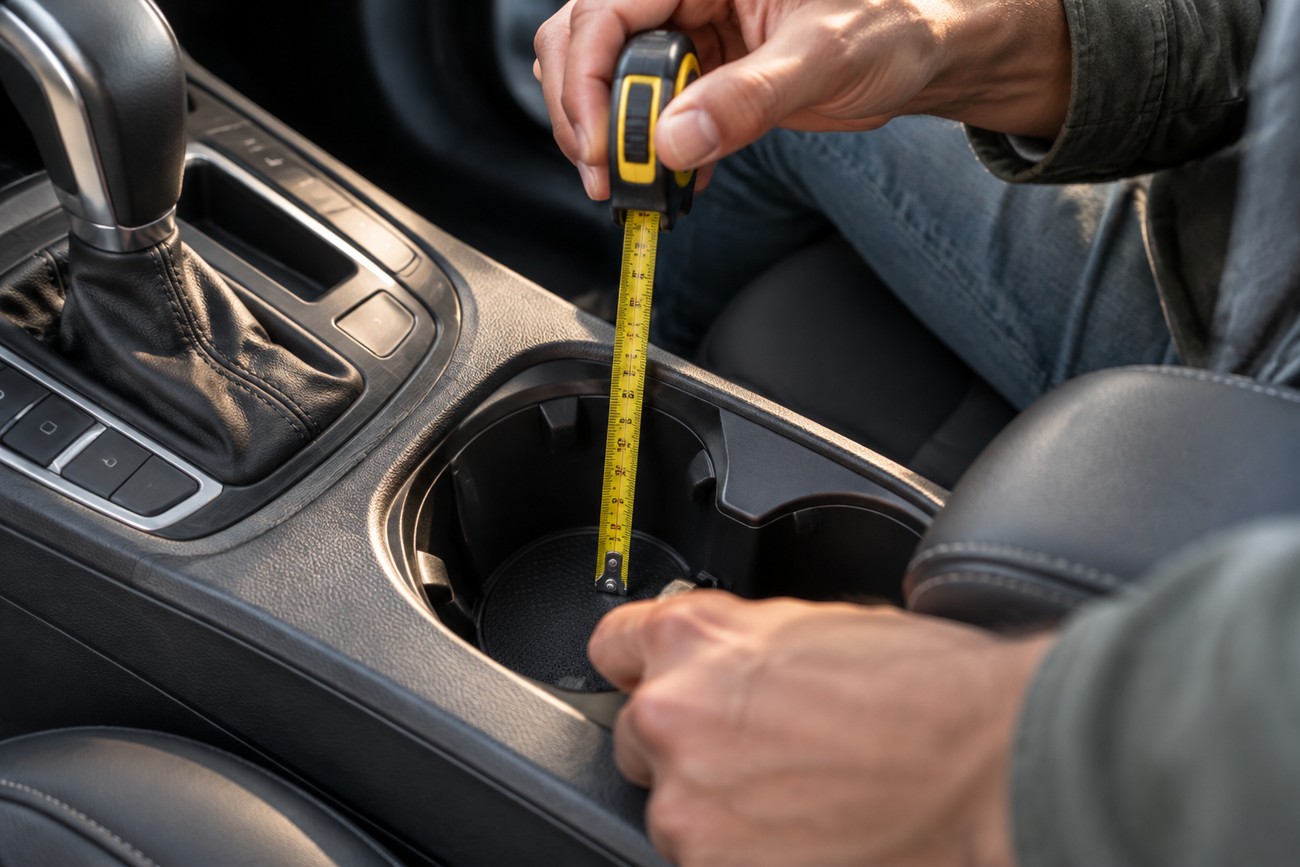
Start with the actual opening, not the vehicle badge. Measure the usable width at the top and lower part of the factory cup holder, then check whether the opening is round, tapered, oval, divided, or partially open. Compatibility depends on the specific console shape, depth, taper, opening geometry, trim, model year, and expansion mechanism.
Measure depth as well as diameter. A base that fits at the rim may bottom out early, fail to reach a support surface, or rest on a narrow edge. Check for internal ledges, drainage features, protrusions, and any section that prevents an expanding mechanism from contacting the walls evenly.
Map the surrounding clearance using the accessory’s expected footprint. Move the shifter through its full range, open and close the console lid, lower the armrest, and check access to USB ports and ventilation. Measuring only the top diameter misses taper, depth, protrusions, and the space required for moving parts.
Measure the bottle separately, including the widest section and the shape of its base. A rounded or protruding base may fail to sit on the accessory’s support surface even if the bottle’s main diameter is within the advertised range. Note whether a sleeve, handle, or lid adds width above the part that enters the holder.
For an organizer, measure the compartment floor, not only the opening. Record changes in width along the depth, hinge locations, removable trays, and the clearance needed for a hand to retrieve an item. SAE J1100 generally measures the base vehicle and usually excludes accessories, so judge an installed organizer by these practical clearances.
Stability, Bottle Weight, and Interior Safety
A larger opening does not guarantee stability. A tall, heavy bottle increases the tipping moment during braking and turns because its inertia acts higher above the support point. A design that feels solid with an empty container may lean, twist, or pull against the factory holder once the bottle is full.
The load also travels into the walls of the factory cup holder. Those walls may be designed for lighter containers, and a rigid expander can concentrate force at a small contact area. For a large bottle, a low support point and wide base matter more than the maximum advertised diameter.
Test the installed accessory first with no container, then with a light container and the intended bottle. In a safe setting, check the setup after firm braking and controlled turns. Watch for rocking at the base, slipping in the factory holder, contact with the shifter or armrest, and movement of the bottle relative to the expander.
NHTSA links more than 800 deaths per year to unsecured loads. All 50 U. S. states and the District of Columbia require prevention of movement, falling, or leakage from unsecured objects. These points do not certify any accessory’s performance, so a product that stays in place during installation should not be treated as secure under every driving condition.
Common Fit Failures and Hidden Drawbacks
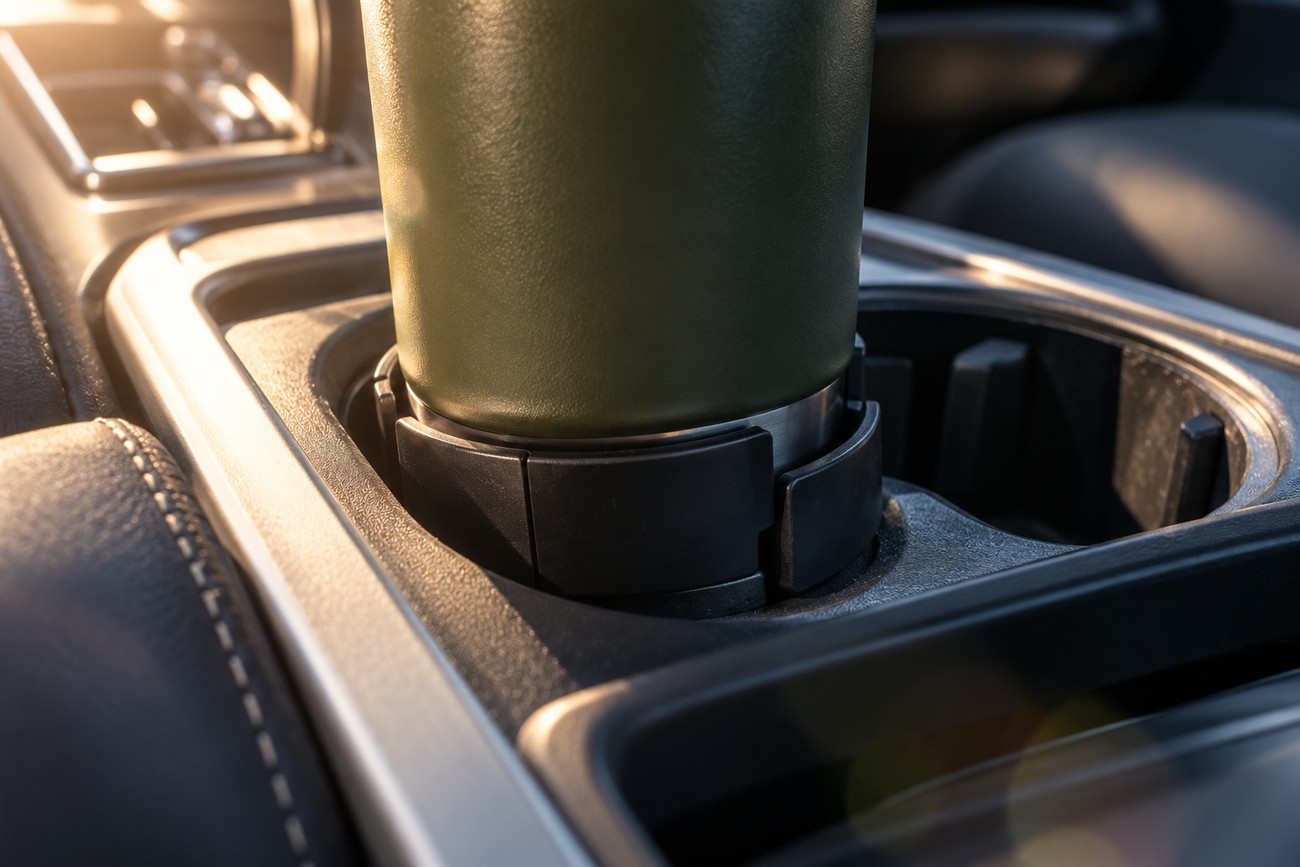
Round expanding bases often fail in non-round or partially open factory cup holders. A holder may have a curved front and an open rear, or two different internal widths, leaving the expander supported on only part of its circumference. The unit may appear secure but twist under a bottle’s weight.
An adjustable base does not compensate for differences in cup holder width equally in every direction. Some mechanisms expand along one axis, while the holder requires support across another. Uneven contact can create looseness, squeaks, and pressure marks on the plastic without producing reliable retention.
Phone compartments create another common mismatch. A slot may accept a bare phone while rejecting one in a protective case, or it may place the screen at an awkward angle. Flimsy lids, elastic retainers, and bulky edges can make the organizer harder to use than the original open compartment.
Cleaning is easy to overlook. Organizers add seams and narrow gaps where spilled drinks, dust, and crumbs collect, while an expander can trap liquid around its base. Removable parts help, yet some designs still require removing the entire accessory for normal console use.
Sharp or protruding edges deserve a hands-on inspection before regular driving. They can catch clothing, mark the console, or create a contact injury risk during sudden braking. Rattles that seem minor in a parked vehicle may become persistent once the accessory is loaded and the vehicle is moving.
Choosing the Right Design for Your Bottle and Console
For a large bottle, prioritize a low support point and wide base over the maximum advertised diameter. This geometry can reduce the bottle’s leverage and spread force into the factory holder. A tall thermos still requires caution because the accessory cannot remove the tipping moment created by its height and weight.
Mixed drinkware requires a compromise. One accessory rarely holds both a narrow can and a large thermos equally well: increasing the opening can reduce lateral support for the smaller container. A removable insert or separate support ring may be more useful than the largest possible opening.
Check the position of the phone pocket and how a passenger would reach for it. An organizer that places items under the armrest, against a shifter, or behind a bottle may add compartments while reducing practical access. Soft contact surfaces can reduce looseness, squeaks, and plastic damage.
Central placement is not always the best placement. An offset installation may clear a shifter, console lid, or armrest, provided the base remains fully supported and does not obstruct another control. Before buying, compare reviews for the exact vehicle model year and trim, since console shapes can differ within one model line.
Installation and the Real-World Fit Test
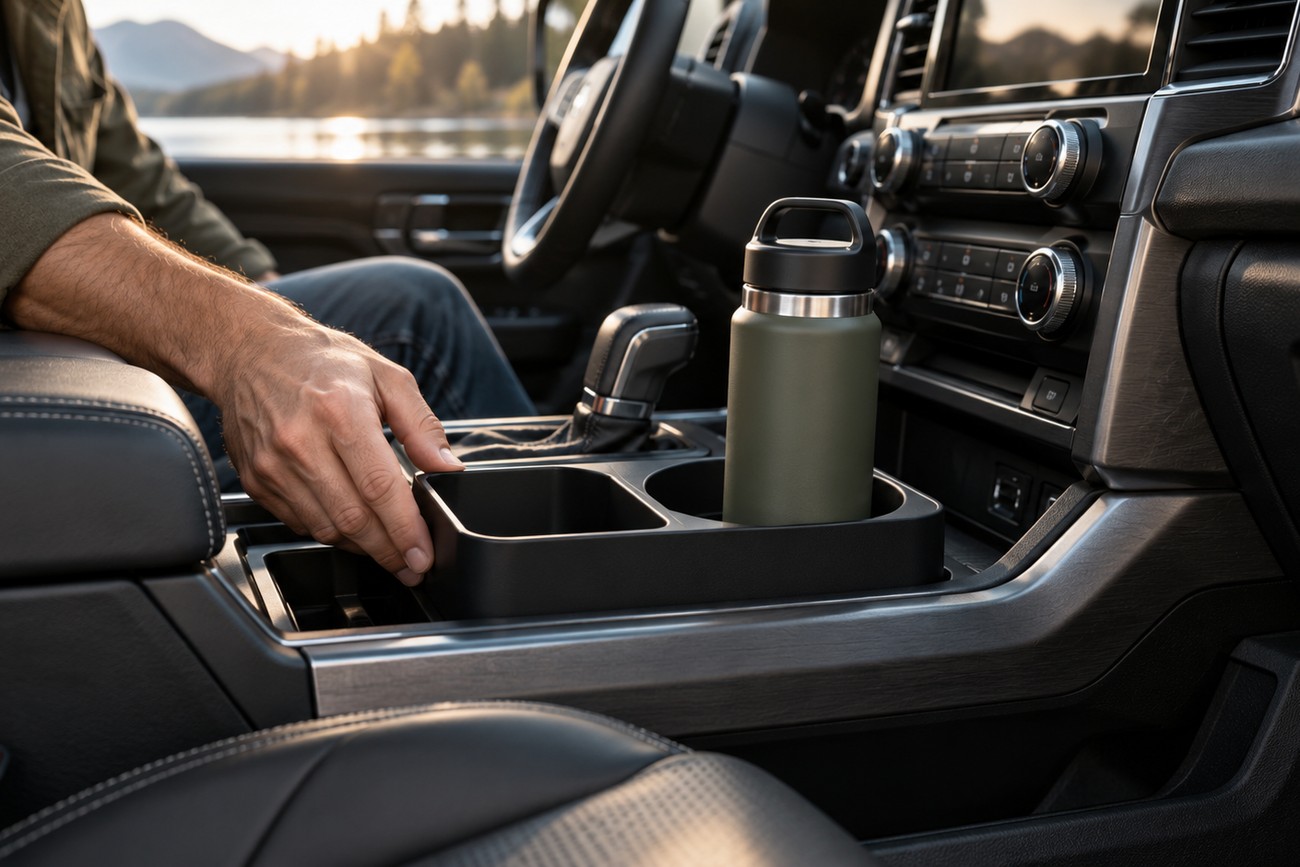
Begin with an empty installation and inspect every contact point. The accessory should sit level, engage the holder or compartment evenly, and remain clear of the shifter, console lid, armrest, USB ports, ventilation, and passenger access. Remove protective film or temporary packing material before judging the final fit.
- Check the base for rocking, uneven expansion, and contact with fragile trim.
- Operate the shifter, lid, armrest, and nearby controls through their full normal movement.
- Test a narrow container and a large container, checking for both side support and removal clearance.
- Repeat the test with the intended bottle empty and full during firm braking and controlled turns in a safe setting.
- Remove or reposition the accessory if it blocks practical access, shifts, rattles, or places excessive force on the factory holder.
A product that fits into an opening is not necessarily secure. The full setup must remain stable without forcing the console, trapping the bottle against a control, or allowing liquid to spill during ordinary vehicle movement. If the accessory needs constant removal to use the console normally, its fit may not justify the inconvenience.
Marketing claims such as “fits all vehicles” conflict with the lack of a universal cup-holder standard. One user report mentions compatibility with Hydro Flask 32/40 oz and Yeti 20/26/30 oz bottles; this is not independent evidence of universal compatibility. Treat isolated bottle claims as a starting point for checking dimensions, rather than as a substitute for testing your vehicle and bottle together.
Frequently asked questions
A listed fit is only a starting point. Bottle shape, spill-prone gaps, and access to the console lid can still affect everyday use. These questions address what to check when an accessory fits on paper but causes problems after installation.
Why does my bottle fit the advertised diameter but still wobble?
Nominal diameter does not describe the complete contact between the bottle and the accessory. A rounded or protruding bottle base may touch only a small part of the support surface, while a tapered bottle can leave side clearance even when its widest measurement matches the listing.
Support height also matters. A bottle perched high above the holder has more leverage on the expander, and a shallow or tapered factory holder may let the expander tilt. Check the base shape, the lower bottle diameter, the support platform, and the gap around the bottle rather than relying on one width measurement.
How can I keep a console organizer from becoming a spill trap?
Choose a design with a removable liner, accessible seams, and surfaces you can wipe without removing the entire console assembly. A liner should lift out easily enough to clean under it, and the organizer should not seal spilled liquid against the factory compartment.
After a spill, remove the liner and inspect the corners, hinge areas, and contact points before reinstalling it. Avoid designs with deep, closed pockets that cannot be reached by a cloth or rinsed safely. Regular removal also reveals whether dust and debris are collecting beneath the organizer.
What should I do if an accessory fits my vehicle but blocks the console lid?
First, check whether you can move the accessory to a supported offset position without contacting the shifter, armrest, or passenger’s reach path. A small relocation may solve the interference if the base remains evenly supported.
If repositioning fails, change the accessory type or return it. An organizer that prevents normal lid movement reduces the console’s function and can encourage repeated removal while driving. Compatibility should include full operation of the surrounding interior, not simply physical insertion.